Authentication and Transaction S ecurity in E-Business AXSionics - - PowerPoint PPT Presentation

authentication and transaction s ecurity in e business
SMART_READER_LITE
LIVE PREVIEW

Authentication and Transaction S ecurity in E-Business AXSionics - - PowerPoint PPT Presentation

next generation of access control Authentication and Transaction S ecurity in E-Business AXSionics AG, BFH S pin-off Park, S eevorstadt 103b, CH-2501 Biel-Bienne Lorenz Mller Mobile: + 41 79 341 03 26 Lorenz.mueller@axsionics.ch 1 next


slide-1
SLIDE 1

1

next generation of access control
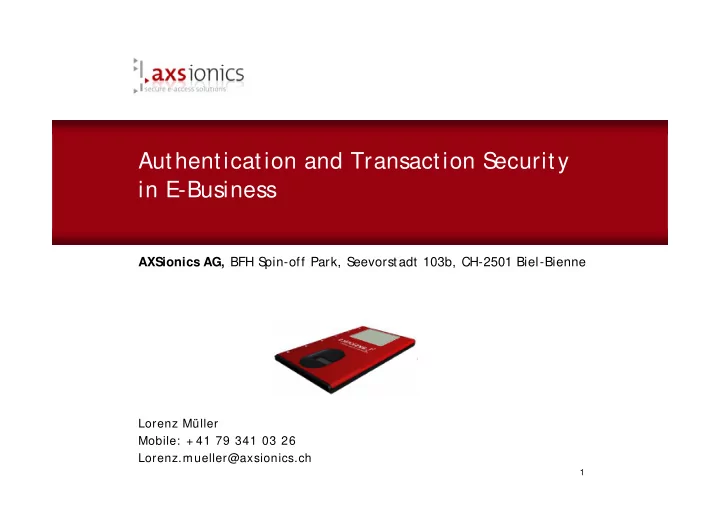
Authentication and Transaction S ecurity in E-Business

AXSionics AG, BFH S pin-off Park, S eevorstadt 103b, CH-2501 Biel-Bienne

Lorenz Müller Mobile: + 41 79 341 03 26 Lorenz.mueller@axsionics.ch

slide-2
SLIDE 2

2

next generation of access control

Overview

  • Phising – what it is, how it works…
  • Malware – a landscape
  • Role of authentication and transaction security
  • Authentication with biometrics
  • AXS Authentication SystemTM
slide-3
SLIDE 3

3

next generation of access control

Bank robbery – what is your style?

slide-4
SLIDE 4

4

next generation of access control

Old goals – new methods

Classical attack

  • Personal presence
  • Hard work
  • Single copy
  • Limited action range
  • High risk
  • High success rate is critical

Cyber attack

  • Remote attack
  • Available tools
  • Automated industrial copies
  • Worldwide action range
  • Low risk
  • Low success rate is sufficient

The goal of most crimes is to get money!

slide-5
SLIDE 5

5

next generation of access control

Security $ 45Bil 19% CAGR (2007)

Market perspectives and indicators

Physical Access Control

€ 2900 Mil 8-9 % CAGR

  • Building/facilities access
  • High-throughput access control

E-Business B2B (EU) € 1640 Bil 34 % CAGR (2007)

Logical Access Control

€ 420 Mil 20 % CAGR

  • Extranet Access Management
  • Identity and Access Management

Transaction Security

€ …. Mil … % CAGR

  • On-line contracts
  • Digital signatures
  • Secure payment

Logical & Physical Access Control

€ 500 Mil 15 % CAGR

  • Unified management & security

policies

Source: Gartner Group

slide-6
SLIDE 6

6

next generation of access control

Fraud Rate in the Cyber S pace

US credit card based transactions: 2004

slide-7
SLIDE 7

7

next generation of access control

Fraud Types in non-physical interactions

US Federal Trade Commission’s: Top Categories in 2004 for Consumer Fraud Complaints Source ISACA

slide-8
SLIDE 8

8

next generation of access control

Phising – what it is, how it works…

  • A few examples
  • How to set-up a phising attack
  • Facts and figures
  • The business case
slide-9
SLIDE 9

9

next generation of access control

Phising Mail PayPal

slide-10
SLIDE 10

10

next generation of access control

slide-11
SLIDE 11

11

next generation of access control

slide-12
SLIDE 12

12

next generation of access control

MITM phising – how to set up the attack

slide-13
SLIDE 13

13

next generation of access control

Troj an horse phishing – how to set up the attack

Attacker Client Bank Web Server

  • 2. Generate and

send Spam mails With Trojan horse Fraudulent Server

  • 1. Preparation
  • Fraudulent Server
  • Email addresses
  • Program Trojan horse
  • Hire money courier

Client logs to bank account

  • 4. Trojaner manipulates

transaction data Money courier

  • 5. Transfer to

Money courier

  • 6. Get money

from courier (Western Union)

  • 3. Trojaner retrieves online

instruction from fraudulent server

slide-14
SLIDE 14

14

next generation of access control

Troj an horse operates above TLS / S S L

  • [ID:1800 IP:200.165.211.68 12.10.2005 22:05:41]
  • check=1&PBLZ=32050000&KONTONUMMER=600000&kMH5

LW0ai9k=FS911&javascript=1&Anmelden.x=32&Anmelden .y=7

  • Ihr persönliches Finanzportal 32050000 - Microsoft

Internet Explorer

  • [-- bankingportal.sparkasse-

krefeld.de/browserbanking/GvLogin --]

slide-15
SLIDE 15

15

next generation of access control

Exchanging entry fields in XML data

  • [ID:1800 IP:200.16[06/02/06] 15:23:49: [SKIPPED TAN] :

552484 URL: https://bankingportal.ksk- fds.de/banking/gvueberweisungtransaction; logindata: https://bankingportal.ksk-fds.de/banking/: check:1;kontonumber:900000;sklx64ehwdx:82827;javasc ript:1;x:39;y:11nn5.211.68 12.10.2005 22:05:41]

slide-16
SLIDE 16

16

next generation of access control

Phising: S tatistical Highlights for May 2007

Number of unique phishing reports received in May: 23415 Number of unique phishing sites recorded in May: 37438 Number of brands hijacked by phishing campaigns in May: 149 Number of brands comprising the top 80%

  • f phishing campaigns in May:

11 Country hosting the most phishing websites in May: United States Contain some form of target name in URL: 15.5 % No hostname just IP address: 6 % Percentage of sites not using port 80: 1.1 % Average time online for site: 3.8 days Longest time online for site: 30 days

Source: http://www.antiphishing.org

slide-17
SLIDE 17

17

next generation of access control

Number of attacks

slide-18
SLIDE 18

18

next generation of access control

Innovation is guaranteed

slide-19
SLIDE 19

19

next generation of access control

S urprise – it‘ s not the Russian Mafia (alone)

slide-20
SLIDE 20

20

next generation of access control

Innovative methods – Troj an horses keyloggers

slide-21
SLIDE 21

21

next generation of access control

Attacks are well targeted

slide-22
SLIDE 22

22

next generation of access control

Why attackers do phising – the business case

Business Case: 50 k Mails 0.5-1 % sucess 50 k$ revenue

  • Approx. 40 k$ netto
slide-23
SLIDE 23

23

next generation of access control

Overall costs

  • 25‘000 attacks / per month
  • 10 %

successful

  • Approx. 50 k$ damage / successful attack
  • 125 Mio$ / month; approx. 1.5 Bill $ / year

Example: Nordea Bank, Sweden Thomas Claburn (01/ 24/ 2007 6:00 PM ES T) URL: http:/ / www.eetimes.eu/ scandinavia/ 197000422 Cyber crime apparently pays quite well. S wedish bank Nordea has acknowledged that about 250 of its online banking customers have been robbed of about 8 million S wedish kronor -- roughly $1.14 million dollars -- as a result of a targeted phishing campaign. Customers were duped by a phishing scam coupled with a version of the Haxdoor Troj an installed on their computers. The attack took place over the past 15 months, according to Boo Ehlin, a spokesman for the bank. S wedish trade publication Computer S weden reported that 121 people may have been involved in carrying out the attack, but Ehlin could not confirm that figure. The article identified Russian cyber thieves as being behind the attack.

slide-24
SLIDE 24

24

next generation of access control

Malware – a landscape

  • Taxonomy and definitions
  • Tools and methods
  • How attackers make money
  • Attacks on E-business and E-transactions
slide-25
SLIDE 25

25

next generation of access control

Malware and crimeware

Malware is unwanted software running on a user’ s computer that performs malicious actions. It encompasses among others

  • Adw are ( m alicious but legal)
  • Spyw are ( m alicious in a legal grey zone)
  • Viruses, W orm s ( destructive w ithout com m ercial purposes)
  • Crim ew are

Crimeware is software that performs illegal actions unanticipated by a user running the software, which are intended to yield financial benefits to the distributor of the software.

Source: The Crimeware Landscape: Malware, Phishing, Identity Theft and Beyond A Joint Report of the US Department of Homeland Security – SRI International Identity Theft Technology Council and the Anti-Phishing Working Group. October, 2006

slide-26
SLIDE 26

26

next generation of access control

Distribution of crimeware

Crimeware is distributed via many mechanisms, including:

  • Social engineering attacks convincing users to open a malicious

email attachment containing crimeware;

  • Injection of crimeware into legitimate web sites via content

injection attacks such as cross-site scripting;

  • Exploiting security vulnerabilities through w orm s and other

attacks on security flaws in operating systems, browsers, and

  • ther commonly installed software;
  • Insertion of crimeware into dow nloadable softw are that
  • therwise performs a desirable function.
slide-27
SLIDE 27

27

next generation of access control

Aim of crimeware

Crimeware can be used in many ways, including:

  • Theft of personal information for fraudulent use and/ or resale on a

secondary market (as in a “ phishing” attack);

  • Theft of trade secrets and/or intellectual property, by

commission, or for sale, blackmail or embarrassment;

  • Distributed denial-of-service attacks launched in furtherance of
  • nline extortion schemes;
  • Spam transmission;
  • “Click fraud” that generates revenues by simulating traffic to
  • nline advertisements;
  • “Ransomware” that encrypts data and extorts money from the

target to restore it;

  • Perform or support man-in-the-middle attack;
  • Manipulation of data in sensitive transactions;
slide-28
SLIDE 28

28

next generation of access control

Transaction triangle in E-business - attacks

0101010 0110111 1001001 0101010 0110111 1001001

Identity theft Transaction manipulation Denial of Service

slide-29
SLIDE 29

29

next generation of access control

The role of authentication and transaction security

  • The weak spots in E-business schemes
  • Defense in depth
  • Raising the threshold
  • The AXS-AS approach
slide-30
SLIDE 30

30

next generation of access control

Attacks on the E-business transaction

slide-31
SLIDE 31

31

next generation of access control

Defense in depth

slide-32
SLIDE 32

32

next generation of access control

Raising the threshold

Comfort

  • mobility,
  • convenience

Security

Strong Authentication, Transaction signing SSL / TLS (Credit Card) static PW One-time PW (TAN, iTAN) Short time PW (timer based) Short Time PW (challenge based) Certificate (soft token PKI) SSL / TLS Hard Token PKI Hard Token PKI on trusted platform Personal contact Spyware attacks (today) Offline phishing attacks (today)

  • nline channel breaking

attack boundary

  • ffline credential stealing

attack boundary Personal Token Cluster Transaction Signing Strong Authentication

slide-33
SLIDE 33

33

next generation of access control

Ergonomic and economic constraints

  • No local installtions on client IAD (Internet Access Device)
  • Price must be at least as low as SMC-Reader
  • User-Side Identity Management (individual federation)
  • Full mobility (must work everywhere)
  • Non disclosure of private data (biometrics)
  • Simple to operate, easy to roll out
slide-34
SLIDE 34

34

next generation of access control

Authentication with biometrics

  • Authentication factors
  • Biometrics
  • Errors in biometric application
  • Encapsulated biometrics
slide-35
SLIDE 35

35

next generation of access control

Three factors for authentication

slide-36
SLIDE 36

36

next generation of access control

Biometric S ystem

Definition: „Biometrics is a pattern recognition system that recognizes persons by some characteristic physiologic or behaviorist features.“

Attribute: mandatory Universal: All persons have the feature Distinctive: Each person has a distinct feature Long lived: Features are invariant over the time Measurable: Feature can be measured Attribute:

  • ptional

Quality: Feature is simple to measure, separates maximal Acceptance: Persons are willing to accept the measurement Fraud: It is difficult to fool the measurement system

slide-37
SLIDE 37

37

next generation of access control

Overview on common biometric features

Physiological features

  • Finger print
  • I ris
  • Retina
  • Veins
  • Palm
  • Face
  • Ear form
  • Finger geom etries
  • DNA, Protein
  • Odor
  • Tem perature im age ( hand,

face)

  • Lip print
  • Teeth bit
  • …….

Behaviorist features

  • Voice
  • Hand w riting
  • Hand m ovem ent dynam ics
  • Gait
  • Keyboard pressure

dynam ics

  • Grip
  • ………
slide-38
SLIDE 38

38

next generation of access control

Market S hare by Technology

slide-39
SLIDE 39

39

next generation of access control

Unique role of biometrics

Cooperative Authentication

  • The user has an interest that

his identity is verified

Typical applications are:

  • E-banking
  • E-voting
  • Remote access
  • E-business

Non-cooperative Authentication

  • Operator has to proof the identity
  • Users hides his true identity

Typical applications are:

  • Remote Database access
  • Online value services, e.g. e-University
  • Adult services / online lotteries
  • Identification card
  • access to social security / health services
  • forensics

2 or 3 factor Authentication with

biometrics

1 / 2 or 3 factor Authentication

slide-40
SLIDE 40

40

next generation of access control

Two modes of operation: identification, verification

slide-41
SLIDE 41

41

next generation of access control

Biometric comparison process

slide-42
SLIDE 42

42

next generation of access control

Exampel – Fingerprint Feature Extraction (processing)

Ridge direction field Binarization Scelet extraction Feature extraction Minutiae Fingerprint recording I mage quality enhancement

slide-43
SLIDE 43

43

next generation of access control

Matching (Minutia)

slide-44
SLIDE 44

44

next generation of access control

Matching: 2. geometrical

slide-45
SLIDE 45

45

next generation of access control

Match (1)

slide-46
SLIDE 46

46

next generation of access control

Matching score distributions, threshold, error rates

Frequency density

slide-47
SLIDE 47

47

next generation of access control

FRR, FAR, EER, ROC-curve

0.00001 0.0001 0.001 0.01 0.1 1 0.00001 0.0001 0.001 0.01 0.1 1 FMR FNMR ROC EER

slide-48
SLIDE 48

48

next generation of access control

Errors are not so well defined

  • 0.2
  • 0.1

0.1 0.2 dc'

  • 0.2
  • 0.1

0.1 0.2 dy'

B C A D

slide-49
SLIDE 49

49

next generation of access control

Central or distributed biometric systems are vulnerable

Verification / Identification Biometric Application System Match

Identity Data Identity Data

Extract Capture Template Database Biometric Character- istic Subject Identity claim Score threshold

Pre- Processing Feature Extraction Raw data

Comparison

Query Template

Template creation

Reference template Identity Data Identity Credential Verification Identification Physical signal presentation Measurement

Identity Database Verification mode

Enrollment Authentication

Imposter Collusion Social Engineering Fake biometrics Data Insertion Replay Enrolment collusion Template stealing Template Replacement Insider Manipulation Imposter fakes FTE Misidentification of user Imposter changes policy System tampering (SW/HW) Imposter takes session over

Comparison decision

slide-50
SLIDE 50

50

next generation of access control

Reduced attack points with ‚ encapsulated biometrics‘

Biometric system in one tamper resistant device

  • Delivered by operator that controls processing
  • Hold by user that controls his biometric data
slide-51
SLIDE 51

51

next generation of access control

AXS

  • Authentication S

ystemTM

  • Architecture
  • Key innovations – the advantages
  • Demo
slide-52
SLIDE 52

52

next generation of access control

AXS – Authentication S ystemTM approach

Replace client computer by a secure token

slide-53
SLIDE 53

53

next generation of access control

AXS

  • Authentication S

ystem – Positioning

Comfort

  • mobility,
  • convenience

Security

Strong Authentication, Transaction signing SSL / TLS (Credit Card) static PW One-time PW (TAN, iTAN) Short time PW (timer based) Short Time PW (challenge based) Certificate (soft token PKI) SSL / TLS Hard Token PKI Hard Token PKI on trusted platform Personal contact troyan horses attacks (today) phishing attacks (today)

  • nline channel breaking

attack boundary

  • ffline credential stealing

attack boundary Personal Token Cluster Transaction Signing Strong Authentication

slide-54
SLIDE 54

54

next generation of access control

The Internet Passport™ convenient security – for everyone, anywhere

Fingerprint Sweep Sensor Display 6 optical sensors Secure chip with multiple personal keys USB-Interface for recharging

slide-55
SLIDE 55

55

next generation of access control

User authenticates himself to his personal “ Internet Passport™ ” through the biometric sweep sensor

01001101 00110010 10101001 01010101 01011101 10101001 01010101 01011101 00101000 01100101

Trusted transition from the physical to the digital identity

1 1

Biometric verification occurs inside the IPP

Biometric data never leaves the token Link to digital identity highly secured

slide-56
SLIDE 56

56

next generation of access control

The service provider sends a code back through the optical interface

End-to-end connection security check

2

01001101 00110010 10101001 01010101 01011101 10101001 01010101 01011101 00101000 01100101

Optical interface - from any screen

Optical communication interface enables downwards

communication - anytime, everywhere

S

trong encryption used for the Flickercode

Flickercode

2 2

slide-57
SLIDE 57

57

next generation of access control

Convenient use of “ The Internet Passport” enables convergence of logical and physical access

Optical Interface NFC RFID USB-Interface Payment @ POS Building Access / e-ticketing e-transactions, strong authentication Specific Smart Card application Logical Access / Applicatoins Physical Access / Applications

slide-58
SLIDE 58

58

next generation of access control

Multiple personal keys enable to share the cost

  • f infrastructure amongst several providers

Bank A Insurance A Corporate A e-biz 1 Corporate B e-biz n AXSionics AuSP

  • ne card

multiple provider no passwords just convenience Issuer and/or Authentication Service Provider Card belongs to the Infrastructure of the Issuer

slide-59
SLIDE 59

59

next generation of access control

Demo and conclusion

Major concerns of the E-society

  • Endpoint authentication
  • Transaction security
  • Reliable and privacy respecting identity management
  • Credential proliferation for every user

Solutions

  • Strong 3-factor link between person and his digital credentials
  • Cryptographic secured channel between server and user
  • Encapsulated biometrics
  • User Side Identity Management assistant
  • Personal identity federation
slide-60
SLIDE 60

60

next generation of access control

Lorenz Müller +41 79 341 03 26 lorenz.mueller@axsionics.ch www.axsionics.com

Thank you