Authentication and technology Secure Communication people Jeff - - PDF document

authentication and
SMART_READER_LITE
LIVE PREVIEW

Authentication and technology Secure Communication people Jeff - - PDF document

Authentication and technology Secure Communication people Jeff Chase Duke University Where are the boundaries of the system that you would like to secure? Where is the weakest link? What happens when the weakest link fails? The First


slide-1
SLIDE 1

1

Authentication and Secure Communication

Jeff Chase Duke University technology people Where are the boundaries of the “system” that you would like to secure? Where is the weakest link? What happens when the weakest link fails?

The First Axiom of Security

  • “Security is at least as much a social problem as it is a

technical problem.” – Translation: humans are the weak link.

  • We will focus on the technical elements, but do not

lose sight of the social dimension. – Keys left in lock – Phishing – Executable attachments – Trojan software – Post-it passwords – Bribes, torture, etc. – Etc.

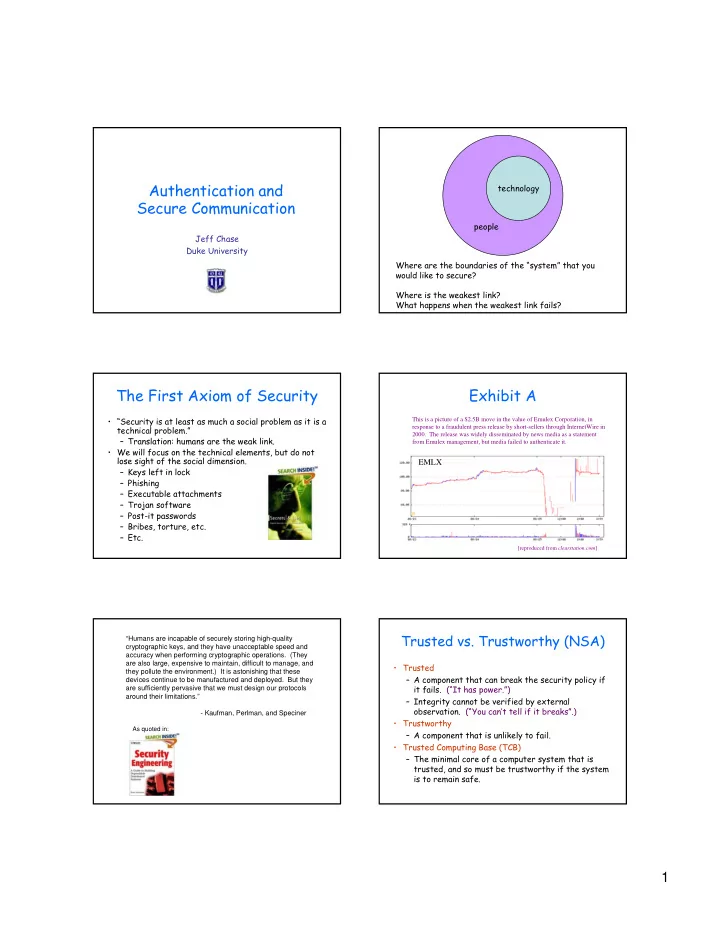
Exhibit A

EMLX

This is a picture of a $2.5B move in the value of Emulex Corporation, in response to a fraudulent press release by short-sellers through InternetWire in

  • 2000. The release was widely disseminated by news media as a statement

from Emulex management, but media failed to authenticate it.

[reproduced from clearstation.com]

“Humans are incapable of securely storing high-quality cryptographic keys, and they have unacceptable speed and accuracy when performing cryptographic operations. (They are also large, expensive to maintain, difficult to manage, and they pollute the environment.) It is astonishing that these devices continue to be manufactured and deployed. But they are sufficiently pervasive that we must design our protocols around their limitations.”

  • Kaufman, Perlman, and Speciner

As quoted in:

Trusted vs. Trustworthy (NSA)

  • Trusted

– A component that can break the security policy if it fails. (“It has power.”) – Integrity cannot be verified by external

  • bservation. (“You can’t tell if it breaks”.)
  • Trustworthy

– A component that is unlikely to fail.

  • Trusted Computing Base (TCB)

– The minimal core of a computer system that is trusted, and so must be trustworthy if the system is to remain safe.

slide-2
SLIDE 2

2

Questions and Answers #1

  • Who is the sender?

– Authentication

  • Is the sender allowed to do this?

– Authorization

  • Is this really what the sender said?

– Integrity

  • Could anyone else have intercepted it?

– Privacy

Questions and Answers #2

  • Authentication?

– Challenge/response: passwords, certificates – A subject bound to a strong identity is a principal.

  • Authorization?

– Access control lists or capabilities (ticket/token)

  • Integrity?

– Message digests and digital signatures

  • Privacy

– Encryption (provides integrity too) All of these require some form of a shared secret or shared trust in a third party, or both.

Security Cryptography algorithms Public key (e.g., RSA) Secret key (e.g., DES) Message digest (e.g., MD5) Security services Authentication Privacy Message integrity

Familiar names for the protagonists in security protocols

Alice First participant Bob Second participant Carol Participant in three- and four-party protocols Dave Participant in four-party protocols Eve Eavesdropper Mallory Malicious attacker Sara A server

Cryptography for Busy People

  • Encrypt and Decrypt functions

– M = Decrypt(Encrypt(M) – Standard and efficient enough to be practical.

  • Crypto functions are parameterized by keys.

– Fixed-width “random” value. – Everybody has their own key(s) or key pair(s). – “Computationally infeasible” to decrypt without the key. – Key length really matters.

  • Two fundamental variants:

– Public-key or asymmetric crypto (e.g., RSA) – Secret-key, private-key, symmetric crypto (e.g., DES)

  • Foundation of many/all security mechanisms.

Using Crypto: the Basics

  • Privacy

– Attacker cannot read encrypted data.

  • Integrity

– Encrypt a hash/checksum/digest of the message.

  • Authentication

– Challenge-response with a nonce

  • “number used once”

– Receiver encrypts the nonce and sends it back.

  • Proves it possesses the matching key.

– Nonces can be timestamps, serial numbers, etc. to prevent replay attacks.

slide-3
SLIDE 3

3

Symmetric Crypto

  • “Secret key” or “private key” cryptography.

– DES, 3DES, DESX, IDEA, AES

  • Sender and receiver must possess a shared secret

– Shared key K

  • Message M, Key K

{M}K = Encrypt(M, K) M = Decrypt({M}K , K)

Asymmetric Crypto

  • Sometimes called “public key” cryptography.
  • Each subject/principal possesses a keypair: K-1 and K

– Decrypt(K, Encrypt(K-1, M)) = M

  • Given Encrypt(K-1, M), cannot compute M without K.
  • Given M and Encrypt(K-1, M), cannot compute K or K-1
  • Given x, cannot compute y such that

Decrypt(K, y) = x, unless you know K-1.

  • Each principal keeps one key private.
  • The inverse key may be public.
  • Either key can be used to encrypt/decrypt.

Pros and Cons

Symmetric crypto (DES, AES, …) – Pro: cheap and easily supported by hardware – Con: need a shared secret.

  • Shared secrets are harder to keep secret.
  • key distribution problem

Asymmetric crypto (Diffie-Hellman, RSA) – Con: expensive – Pro: no need for a shared secret

  • The recipient just needs to know sender’s public key.
  • Multicast or broadcast? Message storage? No problem.
  • Solves the private-key distribution problem

– Con: introduces a new public-key distribution problem

Figure 7.3 Cryptography notations

KA Alice’s secret key KB Bob’s secret key KAB Secret key shared between Alice and Bob KApriv Alice’s private key (known only to Alice) KApub Alice’s public key (published by Alice for all to read) {M}

K

Message Mencrypted with key K [M]K Message Msigned with key K

Performance of encryption and secure digest algorithms

Key size/hash size (bits) Extrapolated speed (kbytes/sec.) PRB optimized (kbytes/s) TEA 128 700

  • DES

56 350 7746 Triple-DES 112 120 2842 IDEA 128 700 4469 RSA 512 7

  • RSA

2048 1

  • MD5

128 1740 62425 SHA 160 750 25162

Better Together, Part 1

  • Use asymmetric crypto just to “handshake” and establish a

secret session key.

  • Converse with the efficiency of symmetric crypto.
  • Example: Secure Sockets Layer (SSL) or Transport-Layer

Security (TLS), used in HTTPS.

  • End-to-end security above TCP.

“SYN, etc.” “My public key is K.”

Client Server

“Let’s establish a session key: {S}K .”

{M}S

slide-4
SLIDE 4

4

SSL is not so simple…

  • How do we know who we are talking to?

– Do we care? Somebody does…

  • How do we prevent replays of encrypted content?
  • SSL/TLS uses this basic handshake protocol, but

there are many other aspects: – Nonces, serial numbers, timestamps – Hashes and MACs – Certificates – More on this later…

Secure Hash / Message Digest

  • Well-known, standard, hash functions digest = h(M).

– MD5, SHA1 – Very efficient to compute. – Digest is a small, fixed-width quantity: i.e., it is a hash.

  • Often called a fingerprint or cryptographic checksum.

– Collision-resistant

  • There exist distinct M1 and M2 such that h(M1) == h(M2).
  • Such collisions are “hard” to find.

– One way

  • Given digest, cannot generate an M with h(M) == digest.

– Secure

  • The digest does not help to discover any part of M.

Messages with both Authenticity and Secrecy

  • How does A send a message x to B with:

– Authenticity (B knows that only A could have sent it) – Secrecy (A knows that only B can read the message)

1. A Transmits the following message x – {{x}KA

  • 1}KB
  • 2. What if x is large (performance concerns)?

– A transmits KA to B, B transmits KB to A – A picks JA, transmits {JA}KB to B – B picks JB, transmits {JB}KA to A – Each computes secret key, Ksk = Hash(JA, JB) – A transmits {x}Ksk to B [Vahdat]

Digital Signatures

  • How can the sender/writer A of M allow any receiver

to verify or prove that A sent/stored M? – authenticity

  • Digital signature using asymmetric crypto, e.g., RSA.

– A computes digest h(M)

– A computes signature {h(M)}K and appends to M.

  • Encrypted with A’s private key K.

– Receiver decrypts digest using A’s public key K-1 – Receiver computes h(M) and compares to digest.

  • Digital signatures are “unforgeable” and “non-repudiable”.

– Unlike physical signatures, they are bound to a particular message or document. – Legally binding in the US.

Digital signatures with public keys

{h}Kpri M Signing Verifying E(Kpri, h) 128 bits H(M) h M h H(doc) D(Kpub,{h}) {h}Kpri h' h = h'? M signed doc

Low-cost signatures with a shared secret key

M Signing Verifying H(M+K) h h' H(M+K) h h = h'? K M signed doc M K

Message authentication code (MAC)

  • Pro: fast
  • Con: repudiable
  • Con: shared secret
slide-5
SLIDE 5

5

Public Key Distribution

  • The “key” challenge today is public key distribution (and

revocation).

  • Approach #1: trust e-mail/web (i.e., assume DNS and IP really

go where you want, and authenticate the source.)

– Example: PGP, GPG, “pretty good”…or do it in person.

  • Approach #2 : use a Public Key Infrastructure (PKI)

– Requires everyone to agree on a central point of trust (Certifying Authority or CA). – Difficult to understand and deploy. – Hierarchy helps.

  • Approach #3: “web of trust” in which parties establish pairwise

trust and endorse public keys of third parties.

– Local example: SHARP. Involves transitive trust.

Certifying Public Keys

  • Digital signatures enable any entity to endorse the

(public key, identity) binding of another entity.

  • A certificate is a special type of digitally signed

document: – “I certify that the public key in this document belongs to the entity named in this document, signed X.”

  • Recipient must trust the issuer X, and must know

the public key of X.

  • E.g., X may be a widely trusted certifying authority

(CA) whose public key is widely available. – The public key of Verisign is wired into every browser.

Figure 7.13 X509 Certificate format

Subject Distinguished N ame, PublicKey Issuer Distinguished N ame, Signature Period of validity Not Before Date, Not After Date Administrativeinforma tion Version, Serial Number Extended Information

Certificate Hierarchy

  • r Web of Trust
  • Chain of Trust

– If X certifies that a certain public key belongs to Y, and Y certifies that another public key belongs to Z, then there exists a chain of certificates from X to Z – Someone that wants to verify Z’s public key has to know X’s public key and follow the chain – X forms the root of a tree (web?)

  • Certificate Revocation List

– What happens when a private key is compromised? [Vahdat]

PKI

  • Public Key Infrastructure
  • Everyone trusts some root CAs.

– Sure….

  • Institutions/organizations set up their own CAs, and

the root CAs endorse them to issue certificates for their members. – $$$

  • And so on, recursively, to form a hierarchy like DNS.
  • Network applications will have access to the keypairs

and certificates of their users, and will validate the certificates of servers. – Any day now…

What happens…

https://www.consumefest.com/shop.html

slide-6
SLIDE 6

6

Secure HTTP

  • Uses SSL/TLS over TCP.
  • Browser has some set of public keys for root CAs

wired into it.

  • Browser always authenticates the server.

– Server presents certificate signed by root CA. – Domain name must match the certificate, etc.

  • Server optionally requests to authenticate the

browser. – Browser presents certificate. – Passwords authentication is much more common.

  • Browser and server negotiate a bulk cipher and

secret session key.

A Short Quiz

1. What is the most important advantage of symmetric crypto (DES) relative to asymmetric crypto (RSA)?

  • 2. What is the most important advantage of

asymmetric crypto relative to symmetric crypto?

  • 3. What is the most important limitation/challenge for

asymmetric crypto with respect to security?

  • 4. Why does SSL “change ciphers” during the

handshake?

  • 5. How does SSL solve the key distribution problem for

symmetric crypto?

  • 6. Is key exchange vulnerable to man-in-the-middle

attacks?

Handshake Protocol Structure

C

ClientHello ServerHello, [Certificate], [ServerKeyExchange], [CertificateRequest], ServerHelloDone

S

[Certificate], ClientKeyExchange, [CertificateVerify] Finished switch to negotiated cipher Finished switch to negotiated cipher

Figure 7.18 SSL handshake protocol

Client Server ClientHello ServerHello Certificate Certificate Request ServerHelloDone Certificate Certificate Verify Change Cipher Spec Finished Change Cipher Spec Finished Establish protocol version, session ID, cipher suite, compression method, exchange random values

O

ptionally send server certificate and request client certificate

Send client certificate response if

requested Change cipher suite and finish handshake

Figure 7.17 SSL protocol stack

SSL Handshake protocol SSL Change Cipher Spec SSL Alert Protocol Transport layer (usually TCP) Network layer (usually IP) SSL Record Protocol HTTP Telnet SSL protocols: Other protocols:

Figure 7.19 SSL handshake configuration

  • ptions

Component Description Example Key exchange method the method to be used for exchange of a session key RSA with public-key certificates Cipher for data transfer the block or stream cipher to be used for data IDEA Message digest function for creating message authentication codes (MACs) SHA

slide-7
SLIDE 7

7

OpenSSH

  • Uses SSL

– User’s public key installed on host side – Host’s public key installed on client side

  • Or Kerberos

SSL Questions

  • How do SSL endpoints verify the integrity of

certificates (IDs)?

  • Does s-http guarantee non-repudiation for electronic

transactions? Why/how or why not?

  • Does SSL guarantee security of (say) credit numbers

in electronic commerce? "Using encryption on the Internet is the equivalent of arranging an armored car to deliver credit-card information from someone living in a cardboard box to someone living on a park bench"

  • Gene Spafford, CERIAS @ Purdue

More PKI

  • (Public key) infrastructures

– Many organizations now have set up their own – Many have not (e.g., Duke)

  • Public (key infrastructure)

– Still elusive – Failure of Secure Electronic Transactions (SET)

slide-8
SLIDE 8

8

PGP

  • Pretty Good Privacy
  • Each user has an asymmetric keypair
  • Secure e-mail, possibly with multiple receivers

– Digitally sign message with your private key. – Encrypt message and signature with random session key. – Append session key encrypted with public key of each intended recipient.

  • Users may sign/endorse each other’s public keys and

endorsements.

  • Should this be illegal?

– Zimmerman case, 1993

What happens…

https://www.library.duke.edu

Kerberos 101

  • Secure end-to-end communication (like SSL)

– But always authenticates both ends

  • Trusted authentication server (like SSL)

– But requires synchronous interaction with AS

  • Symmetric crypto only

– No RSA, no certificates, no PKI. – (Actually, webauth uses a certificate to authenticate the authentication server.)

  • A form of single sign-on

– Only have to type your password to the AS

  • Based on “Needham-Schroeder key distribution”

Simple shared-secret based cryptographic authentication

shuque@isc.upenn.edu

Add mutual authentication

shuque@isc.upenn.edu

Problems with this scheme

  • Generalizing the model for m users and n services,

requires a priori distribution of m x n shared keys

  • Possible improvement:

– Use trusted 3rd party, with which each user and service shares a secret key: m + n keys – Also has important security advantages

shuque@isc.upenn.edu

slide-9
SLIDE 9

9

Mediated Authentication

  • A trusted third party mediates authentication
  • Called the Key Distribution Center (KDC)

– aka Authentication Server

  • Each user and service shares a secret key with the KDC
  • KDC generates a session key, and securely distributes it

to communicating parties

  • Communicating parties prove to each other that they

know the session key

shuque@isc.upenn.edu shuque@isc.upenn.edu

Mediated Authentication

shuque@isc.upenn.edu

Mediated Authentication

shuque@isc.upenn.edu

Kerberos (almost)

shuque@isc.upenn.edu

Kerberos (roughly)

shuque@isc.upenn.edu

slide-10
SLIDE 10

10

Kerberos (detailed)

  • Each user and service registers a secret key with the KDC
  • Everyone trusts the KDC

– “Put all your eggs in one basket, and then watch that basket very carefully” - Anonymous Mark Twain

  • The user’s key is derived from a password, by applying a hash

function

  • The service key is a large random number, and stored on the

server

shuque@isc.upenn.edu

Needham-Schroeder Protocol

shuque@isc.upenn.edu [Provided for completeness]

Mediated Authentication

  • Nomenclature:

– Ka = Master key for “alice”, shared by alice and the KDC – Kab = Session key shared by “alice” and “bob” – Tb = Ticket to use “bob” – K{data} = “data” encrypted with key “K”

shuque@isc.upenn.edu

Don’t Forget

1. All of this relies on various fragile assumptions about people and communities. – Security technology only works if people use it. – Find the weakest link in the end-to-end chain. – Compromised key? All bets are off. – Beware false sense of security! (E.g., WEP)

  • 2. Design for easy, incremental, organic deployment.

– What layer? IPSEC or VPN vs. TLS

  • 3. Understand full range of potential attacks.

– Man-in-middle, replays and nonces, challenge/response – Useful model to guide analysis: logic of “belief” (BAN)

Figure 7.20 SSL record protocol

Application data

abcdefghi abc def ghi

Record protocol units Compressed units MAC Encrypted TCP packet Fragment/combine Compress Hash Encrypt Transmit [Provided for completeness]

PKI: The Concept

Verisign unc cs duke cs env mc

Etc. chase

cs washington Verisign (or Thawte, etc.) issues certificate signing keys to organizations.