Australias peanut industrys transformation to adapt to future - - PowerPoint PPT Presentation

australia s peanut industry s transformation to adapt to
SMART_READER_LITE
LIVE PREVIEW

Australias peanut industrys transformation to adapt to future - - PowerPoint PPT Presentation

Australias peanut industrys transformation to adapt to future climates Peter Thorburn a , Nadine Marshall a , Yash Chauhan b , Felix Bianchi a , Emma Jakku a , Emily Mendham a , Nancy Schellhorn a , Graeme Wright e a CSIRO Ecosystem Sciences


slide-1
SLIDE 1

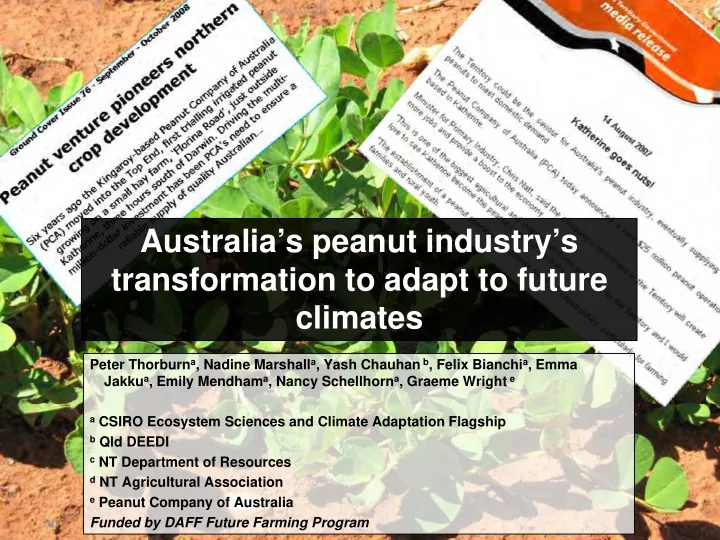
Peter Thorburna, Nadine Marshalla, Yash Chauhan b, Felix Bianchia, Emma Jakkua, Emily Mendhama, Nancy Schellhorna, Graeme Wright e

a CSIRO Ecosystem Sciences and Climate Adaptation Flagship b Qld DEEDI c NT Department of Resources d NT Agricultural Association e Peanut Company of Australia

Funded by DAFF Future Farming Program

Australia’s peanut industry’s transformation to adapt to future climates

slide-2
SLIDE 2

Why are peanuts on the move?

Climatic threat

Aflatoxin disease risk for peanuts in Kingaroy

(Chauhan et al 2010)

slide-3
SLIDE 3

Challenges of transformative adaption

  • What will be the impact of this cropping system on the

environment in the new region?

  • What are the pest, disease and biosecurity risks?
  • How will the cropping system, and its impact, change

with further climate change?

  • Within the social domain, what key characteristics of

the planning and reorganisation phases that are the ‘preconditions’ for a successful transformation?

slide-4
SLIDE 4

CSIRO DAFF Peanut Project Agronomy

Conceptual model of peanut/cereal/cover cropping system

Guiding field experiments and simulation activities

Irrigation Mulch N fertiliser Crop growth and yield Environmental N losses Soil C

Products (positive) Inputs Products (negative)

Soil mineral N Germination and Establishment Infiltration (v. runoff)

slide-5
SLIDE 5

Simulating different irrigation triggers and rates of N fertilizer

  • n the performance of maize and peanut crops in wet and dry

seasons at Katherine

Important aim: To understand the loss of N to the environment in the most efficient management system

slide-6
SLIDE 6

Early impacts of climate change on peanut rotations: Conclusion is for mixed effects on yield and nitrogen and water losses

  • Kingaroy and Atherton - boost yields of winter maize (as

temperatures get closer to optimum range for this tropical crop)

  • Katherine - cropping in the wet summer season adversely

affected.

  • Kingaroy should face least disadvantage provided water and

nitrogen are not limiting

Wet season maize and dry season peanut Dry season maize and wet season peanut

slide-7
SLIDE 7

Key social features of the transition process: Framework for resilience to climate change

Exposure Sensitivity Adaptive Capacity Potential Impact Ecological Vulnerability Sensitivity Potential Impact Adaptive Capacity Socioeconomic Vulnerability Ecological Socio- economic

after Marshall et al. (2010)

slide-8
SLIDE 8

Key social features of the transition process: Framework for resilience to climate change

Exposure Sensitivity Adaptive Capacity Potential Impact Ecological Vulnerability Sensitivity Potential Impact Adaptive Capacity Socioeconomic Vulnerability Ecological Socio- economic

after Marshall et al. (2010)

slide-9
SLIDE 9

Social attributes of sensitivity and adaptive capacity

Resource Dependency

  • Attachment to occupation
  • Employability
  • Place attachment
  • Family characteristics
  • Networks: internal and

external

  • Business approach and

skills

  • Business characteristics
  • Local knowledge
  • Environmental practices

Adaptive Capacity

  • Risk and uncertainty
  • Planning, learning and

reorganising

  • Flexibility
  • Interest in change
slide-10
SLIDE 10

Pests, disease and biosecurity impacts

  • Review
  • 74% of Australian peanut pests have been reported in the NT.
  • Major pests such as peanut scarabs and the white-fringed weevil have

not yet been reported.

  • 91% of the Aust peanut pathogens have been reported in NT.
  • Cylindrocladium black rot and net blotch not reported
  • Mosaic landscapes may reduce crop to crop transmission of

diseases and limit pest colonization

% Native vegetation in landscape

10 20 30 40 50

Foliage consumption

0.00 0.02 0.04 0.06 0.08

  • Modelling of parasitoid-host

interactions in landscape context

  • Early modelling - native

vegetation cover of 20% reuces crop injury from cotton boll worm

slide-11
SLIDE 11

Can Australia’s peanut value chains transform to adapt to future climates?

  • It is not yet clear...
  • Pests, diseases, biosecurity
  • Agronomy, enterprise profitability

?

  • Climate change resilience

?

  • Environmental impacts

??

  • Social adaptive capacity

???

  • Continuing work to better resolve the issues
  • Develop a blueprint for successful transformation

Our thanks to our organisations and people

CSIRO Ecosystem Sciences and Climate Adaptation Flagship Qld DEEDI NT Department of Resources NT Agricultural Association Peanut Company of Australia DAFF Future Farming Program