
SLIDE 1
CHI 2011 – NON-FLAT DISPLAYS | 10.05.2011
Gilbert Beyer, Florian Alt, Jörg Müller, Albrecht Schmidt, Karsten Isakovic, Stefan Klose, Manuel Schiewe, Ivo Haulsen.
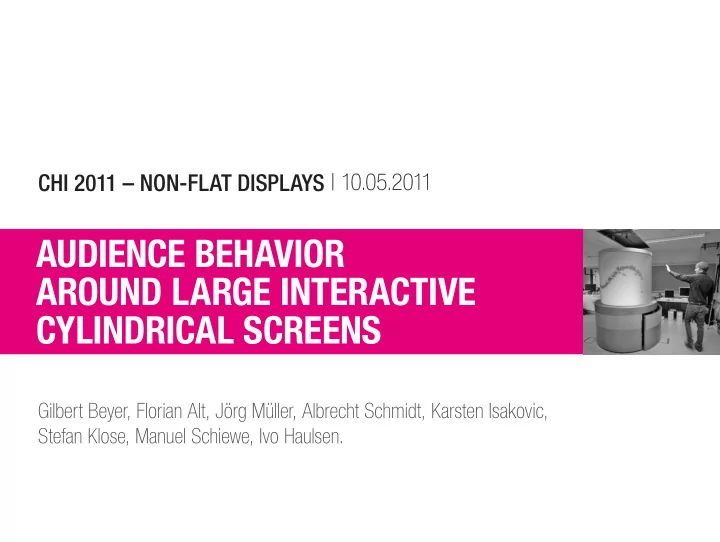
AUDIENCE BEHAVIOR AROUND LARGE INTERACTIVE CYLINDRICAL SCREENS - - PowerPoint PPT Presentation
CHI 2011 NON-FLAT DISPLAYS | 10.05.2011 AUDIENCE BEHAVIOR AROUND LARGE INTERACTIVE CYLINDRICAL SCREENS Gilbert Beyer, Florian Alt, Jrg Mller, Albrecht Schmidt, Karsten Isakovic, Stefan Klose, Manuel Schiewe, Ivo Haulsen. Flat Screen
CHI 2011 – NON-FLAT DISPLAYS | 10.05.2011
Gilbert Beyer, Florian Alt, Jörg Müller, Albrecht Schmidt, Karsten Isakovic, Stefan Klose, Manuel Schiewe, Ivo Haulsen.
Page 12 of 16
Page 12 of 16
Page 12 of 16
Page 12 of 16
Page 3 of 35
Classical columns
Page 5 of 35
Digital columns still bloody expensive
Page 6 of 35
Prototype interactive rear-projection column
Page 7 of 35
Prototype interactive rear-projection column
Page 12 of 16
Page 12 of 16
Reactive Typo
Page 12 of 16
Move to Paint
Page 12 of 16
Ambient Column
Page 12 of 16
Page 12 of 35
Lev Manovich > Imprisonment of the viewer‘s body in front of classical screens
Page 15 of 35
Sweet spot / Prison
Page 16 of 35
Sweet spot / Prison
Page 17 of 35
Hypotheses > H1: Users walk more when interacting with the column > more distance, more time, more positions
Page 18 of 35
Hypotheses > H2: Users position themselves frontally with flat screens – not with column screens
Page 12 of 16
Page 19 of 35
User study > Lab study, 2 days, 4 prototypes > within-subject design > Video observation, interviews and questionnaires
Page 20 of 35
Survey Prototypes
Page 21 of 35
Fake Prototypes Purpose: to distract from displays under investigation
Page 22 of 35
Room layout
Page 23 of 35
Participants > 15 participants, 10 male, 5 female, 32.7 years mean age, diverse demographic backgrounds > send them on „screen museum round tour“
Observation
Page 24 of 35
Page 12 of 16
Page 25 of 35
H1: Walking / H2: Frontal Position
Page 26 of 35
H1: Walking / H2: Frontal Position
H1a: Distance Walked H1b: Time spent standing H2: Parallel shoulder position Flat/Column Flat/Column Flat/Column
100 80 60 40 20 meter 100 80 60 40 20 percent 100 80 60 40 20 percent
mean std
Page 27 of 35
H1: Walking / H2: Frontal Position
Measure Distance walked Time spent standing Mean duration of stops Max duration of stops Total time spent Time spent with shoulders parallel Time spent with shoulders parallel while walking Time spent with shoulders parallel while standing Stops per minute Mean distance from display Variance in location Variance in location Scale meters percent seconds seconds seconds percent percent percent 1/min meters rows columns 47.3 44.9 3.5 12.9 97.7 41.5 22.1 70 8.3 1.5 5.6 3.7 21.2 62.8 9.9 38.7 172.8 69.5 46.3 82 6.8 1.7 2.3 0.93
All comparisons with Wilcoxon-signed-rank-test with paired samples.
0.01 0.05 0.01 0.05 0.01 0.001 0.001 0.001 0.001 0.001 Column mean Flat mean p-Value
Page 27 of 35
H1: Walking / H2: Frontal Position
Measure Distance walked Time spent standing Mean duration of stops Max duration of stops Total time spent Time spent with shoulders parallel Time spent with shoulders parallel while walking Time spent with shoulders parallel while standing Stops per minute Mean distance from display Variance in location Variance in location Scale meters percent seconds seconds seconds percent percent percent 1/min meters rows columns 47.3 44.9 3.5 12.9 97.7 41.5 22.1 70 8.3 1.5 5.6 3.7 21.2 62.8 9.9 38.7 172.8 69.5 46.3 82 6.8 1.7 2.3 0.93
All comparisons with Wilcoxon-signed-rank-test with paired samples.
0.01 0.05 0.01 0.05 0.01 0.001 0.001 0.001 0.001 0.001 Column mean Flat mean p-Value
Page 28 of 35
Results H1: walking, position variance >> supported H2: frontal positioning >> partially supported
Page 29 of 35
Sweet spot / Prison
Page 12 of 16
Page 12 of 16
Page 12 of 16
Page 32 of 35
Columns > are encountered laterally. Design for one-hand use. > are for passers-by. Design for walking. > are only semi-framed. Design for variable positions.
Page 33 of 35
Flat screens > are faced frontally. Design for both-hand use. > are for standing still at a fixed spot for longer times. More complexity is possible.
Page 12 of 16
Page 34 of 35
Next Step: Multiple users > Planned study on social interaction around columns > No sweet spot: are there less inhibitions to start performing?
Page 12 of 16
Page 20 of 35
Discussion & Questions