
SLIDE 1
Topic 14 Li k d Li t Linked Lists
"All the kids who did great in high school writing g g g pong games in BASIC for their Apple II would get to college, take CompSci 101, a data structures course and when they hit the pointers business their course, and when they hit the pointers business their brains would just totally explode, and the next thing you knew, they were majoring in Political Science because law school seemed like a better idea."
- Joel Spolsky
p y
Thanks to Don Slater of CMU for use of his slides.
CS 307 Fundamentals of Computer Science Linked Lists
1
Attendance Question 1
What is output by the following code?
ArrayList<Integer> a1 = new ArrayList<Integer>(); ArrayList<Integer> a2 = new ArrayList<Integer>(); ArrayList<Integer> a2 = new ArrayList<Integer>(); a1.add(12); a2.add(12); System.out.println( a1 == a2 );
- A. No output due to syntax error
- B. No output due to runtime error
- C. false
- D. true
CS 307 Fundamentals of Computer Science Linked Lists
2
Dynamic Data Structures
Dynamic data structures Dynamic data structures
– They grow and shrink one element at a time, normally without some of the inefficiencies of normally without some of the inefficiencies of arrays – as opposed to a static container like an array pp y
Big O of Array Manipulations
– Access the kth element – Add or delete an element in the middle of the array while maintaining relative order – adding element at the end of array? space avail? no space avail? add element at beginning of an array
CS 307 Fundamentals of Computer Science Linked Lists
3
– add element at beginning of an array
Object References
Recall that an object reference is a variable that stores the address of an object A reference can also be called a pointer They are often depicted graphically:
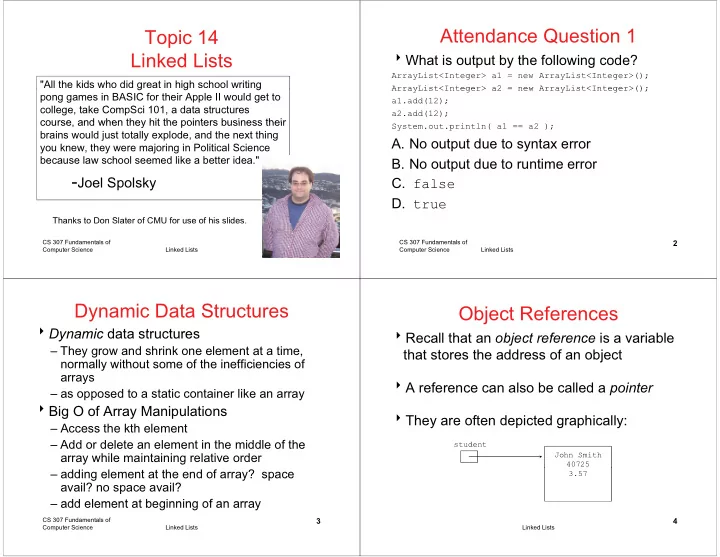
student John Smith 40725 3.57
Linked Lists
4