CSCI 136 Data Structures & Advanced Programming Doubly Linked - - PowerPoint PPT Presentation

csci 136 data structures advanced programming
SMART_READER_LITE
LIVE PREVIEW

CSCI 136 Data Structures & Advanced Programming Doubly Linked - - PowerPoint PPT Presentation

CSCI 136 Data Structures & Advanced Programming Doubly Linked Lists Fall 2020 Bill J Bill L null null This Video Continue discussing lists w/ linked structures Singly Linked Lists Circularly Linked Lists Doubly Linked


slide-1
SLIDE 1

CSCI 136 Data Structures & Advanced Programming

Doubly Linked Lists Fall 2020

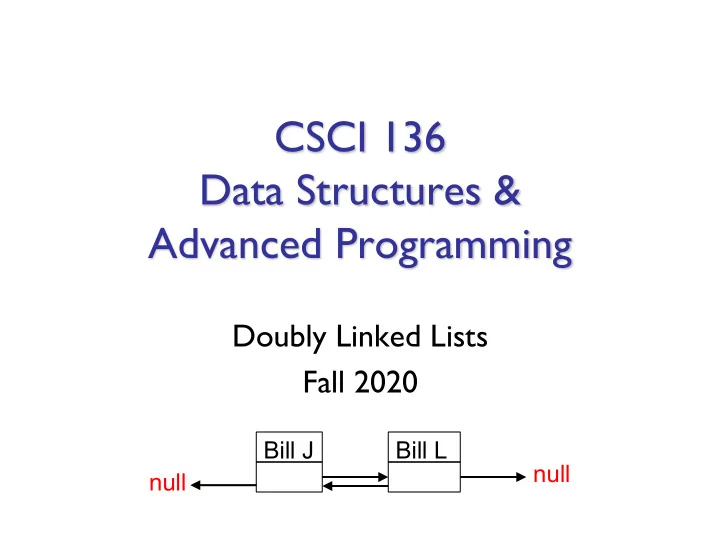
Bill J Bill L null null

slide-2
SLIDE 2

This Video

  • Continue discussing lists w/ linked structures
  • Singly Linked Lists
  • Circularly Linked Lists
  • Doubly Linked Lists

2

slide-3
SLIDE 3

Recall: Linked List Basics

  • There are two key aspects of Lists
  • The list elements
  • Store data, point to neighboring element(s)
  • The list itself
  • Manages/organizes the elements into a cohesive list
  • Visualizing lists:

head

List element List class

3

slide-4
SLIDE 4

Recall: SinglyLinkedList Basics

  • SinglyLinkedList class has:
  • Public methods that implement List interface
  • Internal state/details that are hidden from the user
  • Each “node” has:
  • A data value
  • A next variable that identifies the next element in

the list

  • The SinglyLinkedList class keeps a

reference only to the first list element (head)

4

slide-5
SLIDE 5

SinglyLinkedList Summary

  • More control over space usage than Vectors
  • Easy to access the front of list: O(1)
  • Direct access to head: yay!
  • Difficult to access later elements: O(n)
  • We must always start our traversals at head
  • We must always go forward

5

slide-6
SLIDE 6

DoublyLinkedLists

  • Keep reference/links in both directions
  • Can therefore traverse forwards and backwards!
  • DoublyLinkedListNode class’s instance variables:
  • E value;

DoublyLInkedListNode next; DoublyLinkedListNode prev;

  • This adds one more reference per node, but overall

space overhead still proportional to number of elements

6

slide-7
SLIDE 7

Linked List Visualization

7

head

Node SinglyLinkedList

head tail

DoublyLinkedListNode DoublyLinkedList

slide-8
SLIDE 8

DoublyLinkedList Tradeoffs

  • ALL tail operations (including removeLast) are fast!
  • Why? We have direct access to the tail node & its predecessor
  • But, additional code complexity in each list operation
  • Example: add(E d, int index) has four cases to consider

now:

  • empty list
  • add to front
  • add to tail
  • add in middle
  • Some additional space consumption (previous)
  • but space overhead is still O(n) like SLL and Vector

8

slide-9
SLIDE 9

public class DoublyLinkedNode<E> { protected E data; protected DoublyLinkedNode<E> nextElement; protected DoublyLinkedNode<E> previousElement; // Constructor “stitches“ new node btwn existing nodes public DoublyLinkedNode(E v, DoublyLinkedNode<E> next, DoublyLinkedNode<E> previous) { data = v; nextElement = next; if (nextElement != null) nextElement.previousElement = this; previousElement = previous; if (previousElement != null) previousElement.nextElement = this; } }

slide-10
SLIDE 10

public void add(int i, E value) { if (i == 0) addFirst(value); // head else if (i == size()) addLast(value); // tail else { // find items before and after insertion point DoublyLinkedNode<E> before = null; DoublyLinkedNode<E> after = head; while (i > 0) { before = after; after = after.next(); i--; } // create new value to ”splice” into list // note: constructor properly updates neighbors DoublyLinkedNode<E> insertedNode = new DoublyLinkedNode<E>(value,after, before); count++; } }

slide-11
SLIDE 11

Vectors vs. SLL vs. DLL

11

Operation Vector SLL DLL size O(1) O(1) O(1) addLast O(1) or O(n)(if resize) O(n) O(1) removeLast O(1) O(n) O(1) getLast O(1) O(n) O(1) addFirst O(n) O(1) O(1) removeFirst O(n) O(1) O(1) getFirst O(1) O(1) O(1) get(i) O(1) O(n) O(n) set(i) O(1) O(n) O(n) remove(i) O(n) O(n) O(n) contains O(n) O(n) O(n) remove(o) O(n) O(n) O(n)