Atlanta College & Career Academy Atlanta Board Update College - - PowerPoint PPT Presentation

atlanta college career academy atlanta
SMART_READER_LITE
LIVE PREVIEW

Atlanta College & Career Academy Atlanta Board Update College - - PowerPoint PPT Presentation

Atlanta College & Career Academy Atlanta Board Update College & Career December 2018 Academy Update 1 Agenda Purpose Articulate the need for expanding the Atlanta College & Career Academy (ACCA) Roadmap Current


slide-1
SLIDE 1

Atlanta College & Career Academy Update

1
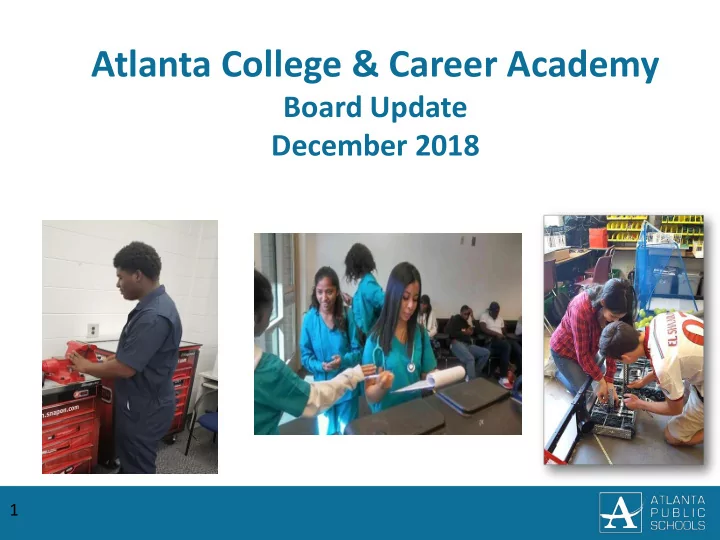
Atlanta College & Career Academy

Board Update December 2018

slide-2
SLIDE 2

Agenda

  • Purpose
  • Articulate the need for expanding the Atlanta

College & Career Academy (ACCA)

  • Roadmap
  • Current Program
  • Program Expansion – Phase II
  • Takeaway
  • To understand how the ACCA is a linchpin to

realizing our mission of preparing students for college and career and critical for meeting new state standards within CCRPI

2

slide-3
SLIDE 3

ACCA is a key strategy in service to the accomplishment of

  • ur mission.

3

slide-4
SLIDE 4

4

  • 2012-2013 – Former APS Superintendent Erroll Davis initiated idea of

creating a College & Career Academy

  • 2013-2014 – APS conducted research and consulted w/ various partners
  • August/September 2015 - The Atlanta College and Career Academy was

included in the district’s charter application to the state

  • Winter 2015 - APS submitted the TCSG GA College and Career Academy

Project Assistance Grant (GCCAP) and was awarded a $3.3M grant

  • 2016 – Planning with Atlanta Technical College began; advisory board

was established; doors opened in August 2016

  • 2017 – Planning for Phase 2 of academy began (included in January

2017 board presentation); conversations with potential partners began

  • 2018 – Parks MS facility was identified as location for Phase 2; Perkins

and Will identified as architectural firm for renovations

Planning for ACCA started in 2012, with the first phase of the academy launching in 2016

slide-5
SLIDE 5

5

Current Program

slide-6
SLIDE 6

6

The current ACCA dual-enrollment model, with Atlanta Technical College (ATC), allows students to earn both high school and college credits.

  • Students in Gr. 9-12 are eligible to participate
  • Students in Gr. 9-12 are eligible to participate, if they meet dual

enrollment admission criteria (test, g.p.a., etc.)

  • Program began in the 2016-17 school year
  • Students are transported from their home school for afternoon

classes at ATC

  • Enrollment: 120 – 140 students annually
  • Technical Certificates of Completion Earned
  • 2016-17: 26 students
  • 2017-18: 30 students
slide-7
SLIDE 7

Students are enrolled in the following pathways and content courses at ATC:

Pathways

  • Automotive Chassis Tech/Collision
  • Biotechnology
  • Cosmetology/Barbering
  • CIS (Networking)
  • Design Media Technology
  • Drafting
  • Early Childhood Care and

Education

  • Electronics (Technology)
  • Patient Care Assistant

Content Courses

  • English
  • Mathematics
  • Psychology
  • Sociology

7

slide-8
SLIDE 8

The current ACCA program is primarily funded by the Technical College of Ga (TCSG) with some support from APS General Fund.

  • TCSG incurs the cost of majority of the expenses associated with

attending the ACCA program through Atlanta Technical College Instructors

  • Books
  • Supplies
  • APS General Funds
  • Support Staff - $302,772
  • Transportation - $109,479
  • Supplies - $4,000
  • Perkins Funds
  • Additional Supplies, including career-counseling materials -

$4,000

8

slide-9
SLIDE 9

9

Program Expansion – Phase II II

slide-10
SLIDE 10

The rationale for the Phase-II Expansion is to address the needs

  • f our students and parents, as well as build a strong workforce.

10

  • Address limited CTAE options in existing high schools (see appendix)
  • Meet increased college & career readiness state expectations (CCRPI)
  • Provide greater access to students who are unable to meet the dual

enrollment criteria, students with special needs, and English learners

  • Respond to parents’ requests for greater career-readiness choices
  • Address workforce demands aligned to Metro Atlanta and the state of

Georgia’s workforce needs

  • Create a pipeline to ATC by providing ACCUPLACER/SAT support along

with career pathway exposure

  • Increase student enrollment from 120 students to approximately 1,000

(840 at Parks and 160 at ATC)

  • Focus on building a more robust career-readiness program
  • Utilize remaining funds from the GCCAP Grant for capitol and structural

improvement by June 30, 2021

slide-11
SLIDE 11

The Phase-II Expansion will provide students from across the district access to the following pathways with DOE courses that are not available at ATC or most APS high schools: Pathway Offerings

  • Automotive
  • Aviation Mechanics
  • Business
  • Construction
  • Culinary Arts
  • Cybersecurity
  • Dental Science
  • Digital Web Design
  • Distribution & Logistics
  • Fire & Emergency Services
  • Graphic Communication
  • Heating, Ventilation, Air

Conditioning Repair

  • Law and Legal Services
  • Nursing
  • Teaching as a Profession

11

slide-12
SLIDE 12

The Phase-II Expansion will also provide students access to the following course offerings as a means of addressing scheduling needs associated with them spending half-a-day on campus.

Course Offerings

  • Advanced Placement (AP)
  • Acceleration & Remediation

Courses via Atlanta Virtual Academy (AVA)

  • Specific courses will be

determined by student need/interest and availability of offerings at the local school site

12

slide-13
SLIDE 13

13

Students will spend half of their day participating in the ACCA program (Parks & ATC)

  • Sample Schedule

Note: Students will graduate from their home high schools.

7:45 a.m. – 8:15 am Students arrive at home school 8:30 a.m. Students depart for session 1 at the Career Academy (30 minutes travel time) 8:50 a.m. – 9:00 a.m. Session I students arrive at ACCA Second stop at ATC 9:00 a.m. – 11:00 a.m. Session I students complete pathway course and Tools for College Success, remediation or accelerated courses 1st and 2nd Periods 11:10 a.m. – 11:40 a.m. ACCA and ATC Students travel to their home school 11:45 a.m. – End of Day 3rd and 4th period at home school

slide-14
SLIDE 14

We have identified potential partners who are equipped o to support the implementation of the program.

Pathways: Sports Medicine Teaching as a Profession Cosmetology/Entrepreneurship Barbering/Entrepreneurship Fire and Emergency Services Emergency Medical Responder Culinary Arts/Hospitality, Recreation and Tourism Application of Law/Legal Administrative Services

Human Services Trade and Industrial Information Technology

Pathways: Construction: Masonry/Electrical Aviation Maintenance Transportation/Logistics HVAC Refrigeration and Electrical Agricultural Education: Landscaping Audio, Video, Technology and Film Pathways: Advanced Placement Computer Science Web and Digital Design Cybersecurity Programming Potential Sponsors: Potential Sponsors: Potential Sponsors:

Dual Enrollment

Potential Sponsors:

14

slide-15
SLIDE 15

With an additional $7 million in SPLOST, renovations at Parks would begin with minor work in January 2019 and would be completed by July 2020.

15 Capital Budget for Phase II Expansion Technical College System of Georgia (1.5 million was initially allocated for the upkeep of the Parks facility) $3 million Proposed SPLOST Investment (1.5 million was initially allocated for the upkeep of the Parks facility) $8.5 million Requested Partner Support (one-time Equipment Costs) $1.8 million Total $12.5 million Generated funds will support the following…

  • Infrastructure Improvement
  • Roofing
  • HVAC
  • Modification of spaces to better serve the program
  • Flooring
  • Restrooms
  • Furniture and Fixtures for CTAE programs
slide-16
SLIDE 16

Operatin ing Fundin ing Sc Scenari rio 1: : Co Comple lete costs ts with ith zero offse sets.

16

  • $2.6 million would need to be allocated within the General Fund budget to support ACCA

expansion.

  • Alternatively, APS could attempt to launch the 15 pathways at each individual high

school, but this would require extensive capital investments at all high schools at an estimated one-time cost of $134M in addition to an annual operating cost of $12.2M (see appendix)

Item Cost Notes 15 Teachers 1,319,700 $

1 teacher per pathway (15 total)

Support Staff 384,658 $

Principal, Nurse, 2 Non-Instructional Paraprofessionals, CTI Teacher

Transportation 94,316 $ Operational 665,358 $ Supplies 108,284 $ 2,572,316 $ Total Funding Gap Operating Funding Scenario 1

slide-17
SLIDE 17

Operating Funding Scenario 2: Complete costs with high schools contributing for each participating student with a 1.1 million dollar general-fund budget requirement.

17

  • $1.1 million would need to be allocated within the General Fund budget to support ACCA

expansion.

Item Cost Notes 15 Teachers 1,319,700 $

1 teacher per pathway (15 total)

Support Staff 384,658 $

Principal, Nurse, 2 Non-Instructional Paraprofessionals, CTI Teacher

Transportation 94,316 $ Operational 665,358 $ Supplies 108,284 $ 2,572,316 $ Total Cost (636,164) $

6 teaching positions and supplies funded by streamlining existing CTAE programs in high schools

(800,000) $

High schools to fund at $950 per participating student

1,136,152 $

Total Funding Gap

Operating Funding Scenario 2

slide-18
SLIDE 18

Operating Funding Scenario 3: Complete costs with high schools contributing for each participating student and 1.1 million gap closed through efficiencies gained with recommended school-model changes.*

18

  • If school model changes are approved, no additional general fund budget dollars are

required *Proposed school model changes to be discussed.

Item Cost Notes Teachers 1,319,700 $

1 teacher per pathway (15 total)

Support Staff 384,658 $

Principal, Nurse, 2 Non-Instructional Paraprofessionals, CTI Teacher

Transportation 94,316 $ Operational 665,358 $ Supplies 108,284 $ 2,572,316 $ Total Cost (636,164) $

6 teaching positions and supplies funded by streamlining existing CTAE programs in high schools

(800,000) $

High schools to fund at $950 per participating student

(1,136,152) $

$1.1M through identified inefficiencies w school model changes

0 Total Funding Gap Operating Funding Scenario 3

slide-19
SLIDE 19

19

slide-20
SLIDE 20

20

Appendix

slide-21
SLIDE 21

CTAE pathway offerings for each high school.

21

slide-22
SLIDE 22

Alt lternativ ive Sc Scenari rio: : Bu Build ild out t 139 programs at t ele leven hig igh sc school l campuses

22

  • The estimated construction cost of $116,380,000 is based on the current renovation costs

for the Parks facility and may vary by high school campus.

  • An accurate construction estimate cannot be provided without conducting a facility

assessment of each high school campus.

  • While the estimated $134M capital investment for both equipment and construction

would be a one-time cost, the $12.2M expense would be a recurring operating expense.