Athlete Achievement & Enjoyment Dr James Matthews, C. Psychol., - - PowerPoint PPT Presentation

athlete achievement enjoyment
SMART_READER_LITE
LIVE PREVIEW

Athlete Achievement & Enjoyment Dr James Matthews, C. Psychol., - - PowerPoint PPT Presentation

Creating an Optimal Climate for Athlete Achievement & Enjoyment Dr James Matthews, C. Psychol., Ps.S.I UCD School of Public Health, Physiotherapy and Sports Science IOC consensus statement on youth athletic development Develop


slide-1
SLIDE 1

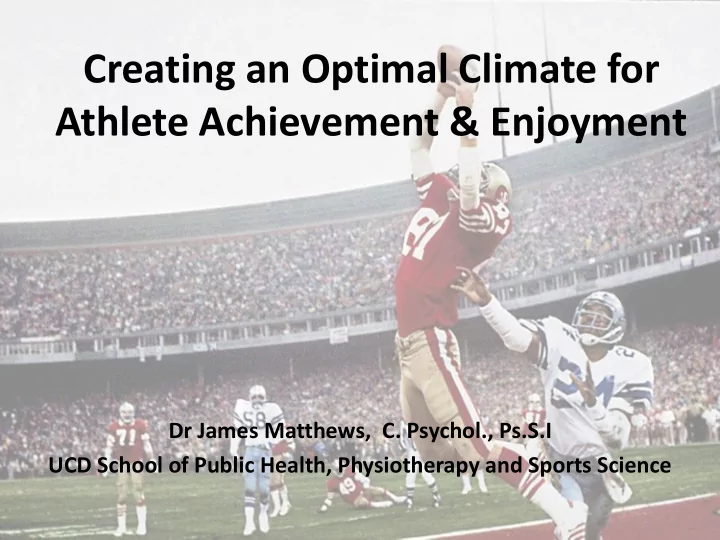
Creating an Optimal Climate for Athlete Achievement & Enjoyment

Dr James Matthews, C. Psychol., Ps.S.I UCD School of Public Health, Physiotherapy and Sports Science
slide-2
SLIDE 2

“Develop ¡healthy, ¡capable ¡and ¡resilient ¡young ¡ athletes, while attaining widespread, inclusive, sustainable and enjoyable participation and success for all levels of individual athletic achievement. “ ¡ ¡

IOC consensus statement on youth athletic development

slide-3
SLIDE 3

Two ¡questions ¡to ¡answer…

  • 1. What does success mean?
  • 2. How can you create the right climate

for achievement and enjoyment?

slide-4
SLIDE 4

An ¡athlete’s ¡behaviour ¡in ¡achievement ¡ situations is a consequence of their perception ¡of ¡“success” ¡in ¡different ¡ contexts.

Achievement Goal Theory (Nic (Nicholls, 1989; D holls, 1989; Duda & Hall, 2001; Duda, 2013 uda & Hall, 2001; Duda, 2013)

slide-5
SLIDE 5

Dispositional Factors Task-oriented Ego-oriented Situational Factors Task involving climate Ego involving climate Achievement Behaviour

Achievement Goal Theory

slide-6
SLIDE 6

Task Oriented Behaviour

  • 1. Persistence
  • 2. Optimal Effort
  • 3. Focus on developing

current skills and learning new ones

  • 4. Self referencing
  • 5. Choice of moderately

challenging activities

  • 6. Selection of

competitive settings that allow feedback

  • n performance
  • 7. Do not fear failure
slide-7
SLIDE 7

“For ¡myself, ¡losing ¡is ¡not ¡coming ¡second. ¡ It's getting out of the water knowing you could have done better. For myself, I have ¡won ¡every ¡race ¡I've ¡been ¡in.” ¡ Ian Thorpe, 5 Time Olympic Champion

slide-8
SLIDE 8

Ego Oriented Behaviour

  • Perception of high

ability

  • Selection of activities

where person feels he/she will demonstrate superior performance to others

  • When this cannot be

achieved – person will select goals that are either very easy or will avoid the task

  • Drop out
  • Don’t ¡persist
  • Blame others (Attribution

failure to external factors

  • utside of their control)
  • Super sensitive to

criticism in front of peers

  • Challenge coach authority
slide-9
SLIDE 9

“It’s ¡not ¡enough ¡to ¡succeed; others must fail!”

Quote attributed to Gore Vidal

slide-10
SLIDE 10

In pairs, consider which grouping is best and why

Desired Goal Orientation?

  • Hi task/low ego?
  • Low task/High ego?
  • Hi task/Hi ego?
  • Low task/Low ego?
slide-11
SLIDE 11

High Ego – Low Task High Ego – High Task

Anxiety Focus on winning Focus on winning or what it takes to win Uses feedback constructively

Low Ego – Low Task Low Ego – High Task

Disinterested Low perceived ability Low anxiety High enjoyment

EGO - HIGH EGO - LOW TASK - LOW TASK - HIGH

slide-12
SLIDE 12

“What ¡may ¡make ¡high ¡task ¡& ¡high ¡ego ¡ individuals motivated and confident ‘over ¡the ¡long ¡haul’ ¡… ¡is ¡the ¡fact ¡that ¡ they have their strong task orientation to fall back on when their sense of normative ¡competence ¡is ¡in ¡jeopardy” ¡

(Duda, 1997; Van Van Yperen et al., 2015)

slide-13
SLIDE 13

What is a Motivational Climate?

The way in which an individual in a position of authority shapes and structures an achievement setting establishes a motivational climate that conveys certain goals

slide-14
SLIDE 14

“People ¡say ¡you ¡need ¡to ¡be ¡hard ¡

  • n ¡people, ¡but ¡by ¡the ¡time ¡you’re ¡

at that elite level you are prepared to die and the last thing you need is someone whipping you into shape. No one could have questioned my commitment to the sport, so it would seem rather ridiculous that you would need to push and bully to get the best ¡out ¡of ¡me.” ¡

(Victoria Pendleton, Olympic Champion)

slide-15
SLIDE 15

“It’s ¡interesting ¡to ¡hear ¡so ¡many ¡ways ¡to ¡ explain it: laid-back, free willy, doing whatever,” “We ¡run ¡this ¡program ¡with ¡extraordinary ¡ standards in how we prepare every day, with ¡expectations ¡that ¡they’re ¡going ¡to ¡be ¡ working their tails off every single step of every ¡single ¡practice.” ¡And ¡they ¡do ¡that, ¡ they’re ¡in ¡an ¡environment ¡where ¡they ¡can ¡ feel ¡good ¡about ¡what ¡they’re ¡doing.” “This ¡is ¡the ¡result ¡of ¡a ¡journey ¡to ¡figure ¡out ¡ how you can create an environment where people can find their best, stay at their best, foster their best for the people around them so that everybody can join in.”

(Pete Carroll, Super Bowl winning Coach with the Seattle Sea Hawks)

slide-16
SLIDE 16

How ¡can ¡we ¡create ¡the ¡“right” ¡climate?

slide-17
SLIDE 17

Think TARGET…

Ask ¡yourself…

  • Task - Are activities task or outcome focused?
  • Authority - Do you insist or involve?
  • Recognition - What do you reward?
  • Grouping - How do you group players?
  • Evaluation – What do you assess?
  • Timing – Do you provide time for individuals?

Applicable in practice and competition

slide-18
SLIDE 18

If ¡you ¡build ¡it, ¡they ¡will…

  • Keep participating
  • Feel capable
  • Have positive affect
  • Be at decreased risk of

burn-out

  • Perform…

Duda et al, 2013; Harwood, 2015; Hodge el., 2014; Isoard-Gautheur et al., 2013

slide-19
SLIDE 19

Two ¡Questions ¡to ¡Answer…

  • 1. The meaning of success is crucial. Winning is

important, but the journey of striving to win through learning, effort and persistence is more important.

  • 2. The climate established by the coach plays a major

role in terms of producing an adaptive and resilient athlete that can functional effectively in their sport, so think TARGET.

slide-20
SLIDE 20

Selected References

  • Bergeron MF, Mountjoy M, Armstrong N, et al. (2015). International Olympic Committee

consensus statement on youth athletic development. British Journal of Sports Medicine, 49, 843-851.

  • Duda, ¡J. ¡L. ¡(2013). ¡The ¡conceptual ¡and ¡empirical ¡foundations ¡of ¡Empowering ¡Coaching™: ¡

Setting the stage for the PAPA project. International Journal of Sport and Exercise Psychology, 11(4), 311-318.

  • Duda, J.L. (2001). Achievement goal research in sport: pushing the boundaries and clarifying

some misunderstandings. G.C. Roberts (Ed.), Advances in motivation in sport and exercise, Human Kinetics, Champaign: IL.

  • Harwood, C. G., Keegan, R. J., Smith, J. M. J., & Raine, A. S. (2015). A systematic review of the

intrapersonal correlates of motivational climate perceptions in sport and physical activity. Psychology of Sport and Exercise, 18, 9-25.

  • Hodge, K., Henry, G., & Smith, W. (2014). A case study of excellence in elite sport:

Motivational climate in a world champion team. The Sport Psychologist, 28 (1), 60–74

  • Isoard-Gautheur, E. Guillet-Descas, & J.L. Duda (2013). How to achieve in elite training

centers without burning out. An achievement goals theory perspective. Psychology of Sport and Exercise, 14, 72–83.

  • Van Yperen, N. W., Blaga, M., & Postmes, T. (2014). A meta-analysis of self-reported

achievement goals and non-self-report performance across three achievement domains (work, sports, and education). PLoS ONE, 9(4): e93594