SLIDE 1
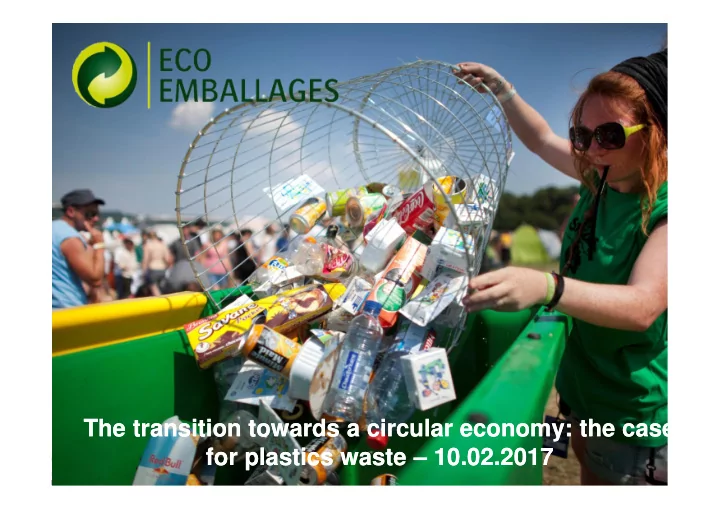
The transition towards a circular economy: the case for plastics waste – 10.02.2017 The transition towards a circular economy: the case for plastics waste – 10.02.2017
SLIDE 2 GENERAL OBJECTIVES
Give French consumers the opportunity to sort more and better (not only plastics packaging but all materials) Increase the recyclable part of plastic packaging while reaching an economic, social and environmental
Develop other recovery options for packaging that are
- and will remain - non recyclable (energy, RDF, …)
Define collection and sorting organizations allowing to control and reduce costs Guarantee recycling, develop markets and applications for recycled resins
SLIDE 3 5MT OF HOUSEHOLD PACK AGING IN FRANCE
0,3 MT METAL 0,3 MT METAL <0,1 MT ALUMINIUM <0,1 MT ALUMINIUM 1 MT PAPER/CARDBOAR D/BRICKS 1 MT PAPER/CARDBOAR D/BRICKS 1,2 MT PLASTICS 1,2 MT PLASTICS 2,4 MT GLASS 2,4 MT GLASS
6 billions units 9 billions units 15 billions units 50 billions units 100 billions units
GLOBAL RECYCLING RATE: 67% METAL: 108% GLASS: 85% PAPER/CARDBOARD: 67% BRICKS: 45% PLASTICS: 23,8% ALUMINIUM : 35%
National target of 75% of recycling by 2022
SLIDE 4
56% of plastics packaging are expected to be recycled in 2030 (+ 400,000 t)
4
Today’s situation Estimate for 2022 Estimate for 2030
Plastic packaging sold on French market (kt/year) 1 090 1 147 1 207
Of which Bottles 435 445 449 Trays, pots and other rigids 375 396 424 Films 280 305 334
Packaging waste recycled (kt/year) 256 445 675
Of which Bottles 250 311 368 Trays, pots and other rigids 4 100 232 Films 2 34 75
Plastic packaging recycling rate 23% 39% 56%
Of which Bottles
57% 70% 82%
Trays, pots and other rigids
1% 25% 55%
Films
1% 11% 23%
SLIDE 5
IMPLEMENTATION BY MUNICIPALITIES AND SORTING CENTRES TARGETS REACHED END OF 2016 5
36 modernised sorting centres 9 new pilot sorting centres 15M inhabitants sort all packaging
+2 kg/inhab/year of new plastics
+ same effect for other materials
SLIDE 6 PET bottles, & flasks PET trays & pots Already in place PEHD/PP , bottles, & flasks PEHD,/PP trays & pots Already in place Flexible films PEBD/PEHD Already in place, to be consolidated PS/XPS/PSE trays & pots Difficult to sort, limited outlets Complex /multilayer PET trays & pots; PP/complex or too tiny flexible films Design to improve recyclability or energy recovery PVC Non conclusive recycling tests : chlored plastics not fit for energy
- recovery. Elimination as a waste.
6
FOCUS ON THE NEW STREAMS & THEIR MARKET
SLIDE 7
Increasing plastics packaging recyclability w ith packers & fillers
7 Mono-material trays: KERMENÉ, ELIVIA, HERTA, BEL Guide of best practices: SYNDIFRAIS Reducing aluminium: ALBEA, ELVIR Packaging innovation: MERALLIANCE
SLIDE 8 CONCLUSIONS
8
- Need to involve all actors of the packaging value chain:
Packers & fillers (« design for recycling ») Consumers (in sorting their waste properly) Municipalities (optimised selective collection) Recycling industry (expertise sharing)
- Need to modernise sorting: fewer sorting centres (240 today, i.e. an
average of 1 for 250,000 inhabitants), automatisation, industrialisation
- Need for a stable and well-defined quality of recycled materials so
as to allow sound market developments, to ensure outlets, and to avoid dependency on exports