At-Risk Group: Partnering Across Campus - - PowerPoint PPT Presentation

at risk group partnering
SMART_READER_LITE
LIVE PREVIEW

At-Risk Group: Partnering Across Campus - - PowerPoint PPT Presentation

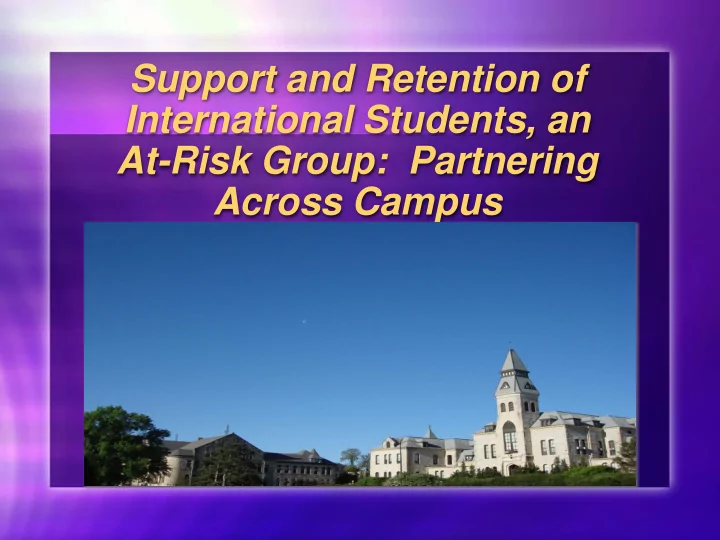
Support and Retention of International Students, an At-Risk Group: Partnering Across Campus http://www.epodunk.com/cgi-bin/genInfo.php?locIndex=4827 Kansas State University English Language Program Leena Chakrabarti, Assistant Director


slide-1
SLIDE 1

Support and Retention of International Students, an At-Risk Group: Partnering Across Campus

slide-2
SLIDE 2

http://www.epodunk.com/cgi-bin/genInfo.php?locIndex=4827

slide-3
SLIDE 3

Kansas State University English Language Program

Leena Chakrabarti, Assistant Director

Adrienne Hamann, Student Services Coordinator

slide-4
SLIDE 4

Presentation Outline

 Research of international students as an

at-risk group

 English Language Program Student

Services

  • In House Advising
  • Partnerships

 Audience sharing ideas in small groups  Q&A

slide-5
SLIDE 5

Research

Why should International Students be considered as At-Risk Students?

slide-6
SLIDE 6

What defines an at risk student?

 Socio-economic

status

 Unrealistic goals  Adult returners

after long hiatus

 Cultural barriers  Language barriers  Access to student

support services

 Travel time and

costs

 Weak self concept

http://www.schoolcraft.edu/pdfs/cce/12.2.23-32.pdf

slide-7
SLIDE 7
  • 1. Performance

 “[…] International students are not

achieving as well as their local counterparts, in fact are failing much more readily, seemingly because of lack of the requisite English language skills” (Paton, pg. 20).

slide-8
SLIDE 8
  • 2. Adaptation

 “International students come from a vast range

  • f cultural and linguistic backgrounds. While it

is easy to document the first language and country of origin of overseas students, what is not so obvious is the nature of their previous educational experience; in particular the culture of learning to which they were accustomed in their home countries” (Baird & Dooey, 2012, pg. 102, )

slide-9
SLIDE 9
  • 3. Stress Management

 “In addition to adjusting to a new educational

system and a new social environment, international students face unique sources of stress such as homesickness, culture shock, language barrier, financial difficulties, immigration requirements, racial discrimination, and strenuous academics (Xuesong Han, Xuemei Han, Luo, Jacobs, and

Jean-Baptiste, 2013, pg. 1).”

slide-10
SLIDE 10

ELP History

 Growth of program: Number of students  Faculty: 2 full time and 2 part time in 1986

47 full time in 2015

1986 2005 2009 2015 38 70 485 297

slide-11
SLIDE 11

Demographics

 Chinese and Saudi  Ecuadorian and Brazilian (special programs)  80% of our students come admitted to the

university

 10% come for English only, then get admission  10% are on exchange or are spouses, etc.

slide-12
SLIDE 12

Brandy Caulfield

Instructor/Advisor

ELP Student Services Team

Laura Phillips-Zee

Instructor/Advisor

Ellen Conroy

Instructor/Advisor

Leena Chakrabarti

Assistant Director

Adrienne Hamann

Student Services Coordinator

Simone Willert

Office Manager

Anne

Cannon

Instructor/Advisor

slide-13
SLIDE 13

In House Advising

Orientation Classes Advising Appointments TOWARD class Social Hangout Awards Ceremony

slide-14
SLIDE 14

Orientation Class Rationale

 Both orientation classes are semester long

courses

 Many programs provide a week-long

  • rientation

 We have developed these two orientation

classes to aide in the transition that students have to make when coming to the United States.

slide-15
SLIDE 15

Basic ELP Orientation

 High beginning through low intermediate

international students

 Basic information such as ELP grading

process and scheduling information

 ELP faculty present on

plagiarism, motivation, and organizational skills.

slide-16
SLIDE 16

Student Worker Contribution

 Take attendance  Assist students on an individual basis  Individual lessons with students for make-

up classes

 Presentations on sports in the USA and a

digital library tour

 They build relationships with the students

slide-17
SLIDE 17
slide-18
SLIDE 18

Student Workers (Contd)

Jia Li: Mandarin, Malay, Cantonese China, Singapore, Cambodia, and Japan Julie: Portuguese Traveled to and studied in Brazil Putnam Scholarship, Kansas Music Scholarship Mauricio: Spanish Vice President of International Buddies

slide-19
SLIDE 19

Student Workers (Contd)

Nick: Portuguese, Spanish Brazil, Philippines, study abroad in Australia Presidential award for study abroad Ronnie: Spanish Study abroad in Spain, Japan, and Taiwan, taught English in Mexico Truman Scholarship Nominee, Cargill Global Scholar, College of Agriculture Scholarships, McKelvie Public Service Scholarship

slide-20
SLIDE 20

ELP Student Services

slide-21
SLIDE 21

Orientation to Higher Education

 Emphasize cultural and academic

understanding

 Develop effective academic and life

skills

 Provide student-instructor and student-

student interaction in English

slide-22
SLIDE 22

Orientation to Higher Education

 Cover an array of topics that students will need to

understand while at KSU.

 Topics include:

  • GPA and grades
  • Academic Integrity
  • Legal Issues
  • Career Services
  • Stress Management
  • I-20s and Travel
slide-23
SLIDE 23

Travel Project for Orientation to Higher Education

 Students get into groups and sign up for a destination of their

choice.

 Each person in the group is responsible for one of the following:

  • Travel (airfare and/or car rental)
  • Research (historical importance, facts, etc)
  • Places to see and things to do (monuments, sights, etc)
  • Food and hotel (find local restaurants)

 The PowerPoint is worth 20 points.  The purpose of the project is to expose students to group work ,

money management, safety, and to practice citing sources.

slide-24
SLIDE 24

Advising Appointments

 Connected to Orientation classes  Every new student at all levels meets

with an advisor during their first semester

 They will meet with an advisor again

in higher levels when they take upper level orientation

slide-25
SLIDE 25

Advising Appointments (contd.)

 Gather information about student’s

well-being

 Early intervention  Check on grades  Offer support  Each student will have a face in the

ELP that they can relate to

slide-26
SLIDE 26

TOWARD Class for Reinstated Students

 Students who are reinstated have had three

semesters of nonperformance

 Training in organization, wellness,

academics, responsibility and discipline

 Twice a week, 2 credit hours, graded class  Students from all levels (beginning to

advanced)

 Taught at the ITC – individual computer

access and printing work

slide-27
SLIDE 27

TOWARD - Organization

 Calendar –input test dates and major

assignments

 Checking K-State Email  Help students stay on track

slide-28
SLIDE 28

TOWARD - Wellness

 Physical/mental wellness - includes exercise

classes and Social Hangout participation

 Visiting speaker from Lafene

Health Center to talk about wellness topics such as importance of sleeping, medicines and vaccinations.

slide-29
SLIDE 29

TOWARD - Academics

 24 study skills classes in a semester  They are not learning anything new, but reviewing

material

 Self-motivated students – general monitoring  Less-motivated students – more supervision

slide-30
SLIDE 30

TOWARD – Responsibility & Discipline

 ACIC - Academic and Career Information Center

– students do a StrengthsQuest assessment – matches your academics and interests to a career

 Group Challenge course at the Rec Center  Responsibility to the group/team

slide-31
SLIDE 31

Social Hangout

 Meet once every two weeks for two hours  Practice English in a social setting and opportunity

for social involvement

 Make new friends  Learn about American culture and the culture of

classmates

 Started in Fall of 2013  Student worker participation

slide-32
SLIDE 32

Social Hangout Activities

slide-33
SLIDE 33

Awards Ceremony

 Faculty nominate students who they think

show exceptional achievement in the ELP

 Winners are chosen from each level  Certificates and gift bags are presented to

the winners

slide-34
SLIDE 34

Awards Ceremony Contd.

 Associate Provost and directors of

International Programs, provosts and deans from different colleges, and ELP faculty are invited to ceremony.

 We rent a large theatre hall in student union

for this event.

slide-35
SLIDE 35

Partnerships

 University class audit – list of large lecture

classes for students to visit

 Housing and Dining, Counseling Services,

Office of Student Life and the Student Health Center

 Missing Student Protocol in tandem with

the Office of Student Life

 Pre-enrollment – deans and student advisors

to pre-enroll

slide-36
SLIDE 36

Group Activity

 Get into small groups  Discuss one creative and successful thing

that your program does for student support

 Share ideas with everyone

slide-37
SLIDE 37

Q & A

http://www.k-state.edu/elp/professional_presentations/

slide-38
SLIDE 38

Resources

Baird, Craig & Patricia Dooey. Journal of the Australian & New Zealand Student Services Association; Apr2012, Issue 39, p9-20, 12p.

Bulger, Stephanie & Debraha Watson. “Broadening the definition of at-risk students.” The Community College Enterprise. Fall 2006.

Chickering, Arthur. “Arthur Chickering’s Seven Vectors of Development.” Education and Identity, San Francisco: Jossey-Bass. 1969.

Gordon, Virginia N., Wesley R. Habley, & Thomas J. Grites and Associates. Academic Advising. Jossey-Bass A Wiley Imprint. 2008

Han, Xuemei, Xuesong Han, Selby Jacobs, Michael Jean-Baptiste, & Qianlai

  • Luo. Journal of American College Health; Jan2013, Vol. 61 Issue 1,

p1-8, 8p.

Paton, Michael John. “Why International Students are at Greater Risk of Failure: An Inconvenient Truth.” The International Journal of Diversity in Organizations, Communities, and Nations. 2007. Volume 6, Number 6.

Phinney, Jean S. “A Three State Model of Ethnic Identity Development.” State University of New York. 1993.