Astroparticle Physics in the LHC Era NGC 253 John Beacom John - - PowerPoint PPT Presentation

astroparticle physics in the lhc era
SMART_READER_LITE
LIVE PREVIEW

Astroparticle Physics in the LHC Era NGC 253 John Beacom John - - PowerPoint PPT Presentation

Astroparticle Physics in the LHC Era NGC 253 John Beacom John Beacom The Ohio State University The Ohio State University John Beacom, The Ohio State University Pheno Symposium, University of Wisconsin-Madison, April 2008 Plan of the Talk


slide-1
SLIDE 1

Pheno Symposium, University of Wisconsin-Madison, April 2008 John Beacom, The Ohio State University

Astroparticle Physics in the LHC Era

John Beacom John Beacom The Ohio State University The Ohio State University

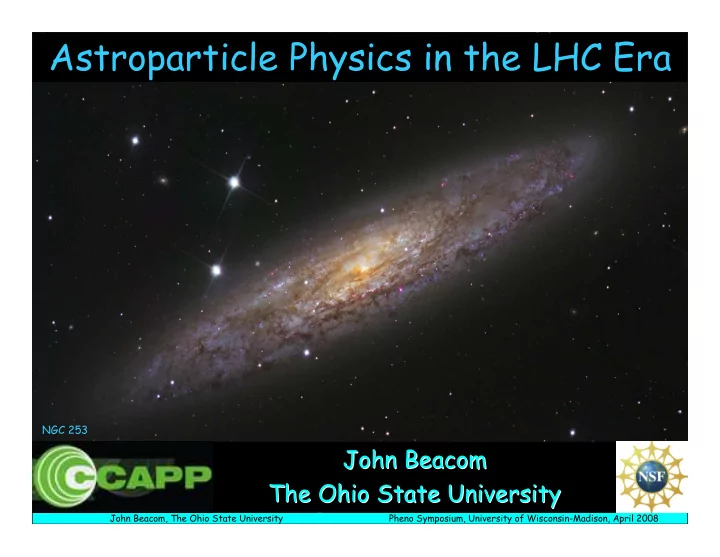
NGC 253
slide-2
SLIDE 2

Pheno Symposium, University of Wisconsin-Madison, April 2008 John Beacom, The Ohio State University

Plan of the Talk Plan of the Talk

Cosmic Rays, Gamma Rays, and Neutrinos Gamma Ray Detectors and Sources Neutrino Detectors and Sources Prospecting for New Physics Concluding Perspectives

slide-3
SLIDE 3

Pheno Symposium, University of Wisconsin-Madison, April 2008 John Beacom, The Ohio State University

Cosmic Rays, Gamma Rays, and Neutrinos

Are there high energy processes in nature? Do these produce gamma rays and neutrinos?

slide-4
SLIDE 4

Pheno Symposium, University of Wisconsin-Madison, April 2008 John Beacom, The Ohio State University

What What’ ’s So Special s So Special About a About a TeV TeV? ?

1 TeV = 1012 eV = 1.6 erg per particle Far above atomic (eV) and nuclear (MeV) scales

slide-5
SLIDE 5

Pheno Symposium, University of Wisconsin-Madison, April 2008 John Beacom, The Ohio State University

Cosmic Ray Cosmic Ray Protons, Electrons, and Protons, Electrons, and Nuclei Nuclei

slide-6
SLIDE 6

Pheno Symposium, University of Wisconsin-Madison, April 2008 John Beacom, The Ohio State University

Cosmic Rays Imply Gamma Rays and Neutrinos Cosmic Rays Imply Gamma Rays and Neutrinos

p + p p + p + 0, p + n + + 0 2 , ± e ± + 3

  • Hadronic mechanism
  • Leptonic mechanism

e + + e

  • Nuclear (A*) mechanism

A' + A* + X A* A +

Anchordoqui, Beacom, Goldberg, Palomares-Ruiz, Weiler, PRL 98, 121101 (2007)

slide-7
SLIDE 7

Pheno Symposium, University of Wisconsin-Madison, April 2008 John Beacom, The Ohio State University

neutrinos gamma rays cosmic rays revealing direct energetic untrustworthy? stoppable divertable

Astronomy with New Messengers Astronomy with New Messengers

slide-8
SLIDE 8

Pheno Symposium, University of Wisconsin-Madison, April 2008 John Beacom, The Ohio State University

Gamma Ray Detectors and Sources

Do luminous high energy gamma ray sources exist? Can we find them and measure them?

slide-9
SLIDE 9

Pheno Symposium, University of Wisconsin-Madison, April 2008 John Beacom, The Ohio State University

Gamma-Ray Detection Techniques Gamma-Ray Detection Techniques

below ~ 0.3 TeV primary gamma ray ~ 0.3-30 TeV air Cerenkov from shower above ~ 3 TeV shower at ground

slide-10
SLIDE 10

Pheno Symposium, University of Wisconsin-Madison, April 2008 John Beacom, The Ohio State University

EGRET Source Results EGRET Source Results

slide-11
SLIDE 11

Pheno Symposium, University of Wisconsin-Madison, April 2008 John Beacom, The Ohio State University

EGRET Diffuse Results EGRET Diffuse Results

slide-12
SLIDE 12

Pheno Symposium, University of Wisconsin-Madison, April 2008 John Beacom, The Ohio State University

HESS Observatory HESS Observatory

Four 13-m telescopes operated synchronously In full operation in Namibia since 2004

slide-13
SLIDE 13

Pheno Symposium, University of Wisconsin-Madison, April 2008 John Beacom, The Ohio State University

Resolved Extended Sources Resolved Extended Sources

supernova remnant RX J1713.7-3946

HESS Collaboration (2006)

slide-14
SLIDE 14

Pheno Symposium, University of Wisconsin-Madison, April 2008 John Beacom, The Ohio State University

HESS J1702-420 HESS J1713-381 HESS 1632-478 330° RX J1713.7-3946 HESS J1640-485 HESS J1616-508 HESS J1614-518 359° HESS J1708-410 HESS J1634-472 HESS J1745-303 LS 5039 HESS J1804-216

  • Gal. Center

HESS J1837-069 G0.9+0.1 HESS J1813-178 HESS J1825-137 HESS J1834-087 30° 0°

Sources > 6 sigma (9 new, 11 total) Sources > 4 sigma (7 new)

HESS Survey of the Inner Galaxy HESS Survey of the Inner Galaxy

slide-15
SLIDE 15

Pheno Symposium, University of Wisconsin-Madison, April 2008 John Beacom, The Ohio State University

Instrument:

  • Four 12-m telescopes
  • 500-pixel cameras (3.5° FoV)
  • FLWO, Mt. Hopkins, AZ (1268 m)
  • Completed Spring 2007

Specifications:

  • Energy threshold

~ 150 GeV

  • Source location

< 0.05°

  • Energy resolution

~ 10-20 %

VERITAS Observatory VERITAS Observatory

slide-16
SLIDE 16

Pheno Symposium, University of Wisconsin-Madison, April 2008 John Beacom, The Ohio State University

Skymap Skymap of

  • f

VHE Gamma-Ray Sources VHE Gamma-Ray Sources

slide-17
SLIDE 17

Pheno Symposium, University of Wisconsin-Madison, April 2008 John Beacom, The Ohio State University

Milagro Milagro Experiment Experiment

  • Water Cherenkov Detector
  • 2600m asl
  • 898 detectors

– 450(t)/273(b) in pond – 175 water tanks

  • 4000 m2 / 4.0x10⁴ m2
  • 2-20 TeV median energy
  • 1700 Hz trigger rate
  • 0.4o-1.0o resolution
  • 95% background rejection
slide-18
SLIDE 18

Pheno Symposium, University of Wisconsin-Madison, April 2008 John Beacom, The Ohio State University

Milagro Milagro 12 12 TeV TeV Diffuse Diffuse

First partial preview of the Northern neutrino sky

Milagro Collaboration (2007)

slide-19
SLIDE 19

Pheno Symposium, University of Wisconsin-Madison, April 2008 John Beacom, The Ohio State University

Cygnus Region Cygnus Region

Beacom, Kistler (2007)

slide-20
SLIDE 20

Pheno Symposium, University of Wisconsin-Madison, April 2008 John Beacom, The Ohio State University

Milagro Milagro J2019+37 Region J2019+37 Region

Milagro Collaboration (2007) Beacom, Kistler (2007)

MGRO J2019+37 in Cygnus

slide-21
SLIDE 21

Pheno Symposium, University of Wisconsin-Madison, April 2008 John Beacom, The Ohio State University

Gamma-Ray Scorecard Gamma-Ray Scorecard

  • Up to ~ 0.1 TeV

EGRET saw ~ 102 sources in the full sky EGRET saw full-sky diffuse emission

  • Around 1 TeV

Whipple, HESS, etc saw tens of sources No data on diffuse emission

  • Around 10 TeV

Milagro saw a few sources in survey mode Milagro saw diffuse emission in part of sky

slide-22
SLIDE 22

Pheno Symposium, University of Wisconsin-Madison, April 2008 John Beacom, The Ohio State University

Neutrino Detectors and Sources

Do luminous high energy neutrino sources exist? Can we find them and measure them?

slide-23
SLIDE 23

Pheno Symposium, University of Wisconsin-Madison, April 2008 John Beacom, The Ohio State University

Muon-Induced Muon-Induced Neutrinos Neutrinos

~

  • For hadronic sources,
  • Near 1 TeV,

P( µ) ~ nL ~ 106

  • Detection reaction is

µ + n µ + p

  • Muon range is ~ 1-10 km
slide-24
SLIDE 24

Pheno Symposium, University of Wisconsin-Madison, April 2008 John Beacom, The Ohio State University

IceCube IceCube

slide-25
SLIDE 25

Pheno Symposium, University of Wisconsin-Madison, April 2008 John Beacom, The Ohio State University

Neutrino Neutrino Skymap Skymap? ?

AMANDA Collaboration (2003)

slide-26
SLIDE 26

Pheno Symposium, University of Wisconsin-Madison, April 2008 John Beacom, The Ohio State University

AMANDA Results AMANDA Results

AMANDA Collaboration (2007)

slide-27
SLIDE 27

Pheno Symposium, University of Wisconsin-Madison, April 2008 John Beacom, The Ohio State University

Probing Sources Probing Sources With With Neutrinos Neutrinos

Definitive sign of hadronic mechanism km3 detectors are big enough Advantages at large energies Neutrino-only sources?

Kistler, Beacom (2006)

slide-28
SLIDE 28

Pheno Symposium, University of Wisconsin-Madison, April 2008 John Beacom, The Ohio State University

Galactic Neutrino Sources Galactic Neutrino Sources

Vela Jr. supernova remnant (and many more)

Kistler, Beacom (2006)

slide-29
SLIDE 29

Pheno Symposium, University of Wisconsin-Madison, April 2008 John Beacom, The Ohio State University

Neutrinos from the Neutrinos from the Milagro Milagro Source Source

MGRO J2019+37 in Cygnus

Beacom, Kistler (2007)

slide-30
SLIDE 30

Pheno Symposium, University of Wisconsin-Madison, April 2008 John Beacom, The Ohio State University

Neutrino Scorecard Neutrino Scorecard

  • Up to ~ 1 TeV

Super-Kamiokande, other experiments saw only atmospheric neutrinos

  • Above 1 TeV

AMANDA saw only atmospheric neutrinos Excellent prospects for IceCube

  • At much higher energies

From several experiments, only upper limits on fluxes

slide-31
SLIDE 31

Pheno Symposium, University of Wisconsin-Madison, April 2008 John Beacom, The Ohio State University

Prospecting for New Physics

Do neutrinos or dark matter have new properties? Are there dark matter annihilation signals? What surprises are out there?

slide-32
SLIDE 32

Pheno Symposium, University of Wisconsin-Madison, April 2008 John Beacom, The Ohio State University

Neutrino Flavor Ratios Neutrino Flavor Ratios

µ + µ e + e + 2µ

e : µ : ~ 1 : 2 : 0 e : µ : ~ 1 : 1 : 1

µ

Beacom, Bell, Hooper, Pakvasa, Weiler, PRL 90, 181301 (2003); Beacom, Bell, Hooper, Pakvasa, Weiler, PRD 69, 017303 (2004)

~ 5:1:1 ~ 0:1:1 Neutrino invisible decays are not ruled out, and would greatly alter the ratios Other new physics can lead to different ratios Mocioiu

slide-33
SLIDE 33

Pheno Symposium, University of Wisconsin-Madison, April 2008 John Beacom, The Ohio State University

Dark Matter Properties Dark Matter Properties

Albuquerque, Burdman, Chacko, PRL 92, 221802 (2004)

NLSP is charged and short-lived Astro neutrinos make NSLP pairs in Earth ~ 1% branch Energetic NLSP pairs make a new signal in IceCube Better if prompt atmospheric neutrino flux is large

Ando, Beacom, Profumo, Rainwater, JCAP04 (2008) 029

Profumo

slide-34
SLIDE 34

Pheno Symposium, University of Wisconsin-Madison, April 2008 John Beacom, The Ohio State University

Dark Matter Dark Matter Annihilation Annihilation

Mack, Jacques, Beacom, Bell, Yuksel (2008)

upper limit on

< Av > < Av >total

upper limit on Annihilation products: gamma rays and neutrinos Dent, Mack Profumo

slide-35
SLIDE 35

Pheno Symposium, University of Wisconsin-Madison, April 2008 John Beacom, The Ohio State University

Concluding Perspectives

slide-36
SLIDE 36

Pheno Symposium, University of Wisconsin-Madison, April 2008 John Beacom, The Ohio State University

Conclusions Conclusions

Luminous TeV gamma-ray sources exist: Most have uncertain astronomical associations Fundamental question of production mechanism Neutrino observations can be decisive: IceCube and other detectors coming online A novel probe of the cosmos and new particle physics Better gamma-ray observations are essential: Increase energy range to test spectra Refine angular resolution to make identifications Cover the full sky to study populations and diffuse Great future with lots of complementary data

slide-37
SLIDE 37

Pheno Symposium, University of Wisconsin-Madison, April 2008 John Beacom, The Ohio State University