Dark ma'er what is it and how well can one determine its - - PowerPoint PPT Presentation

dark ma er what is it and how well can one determine its
SMART_READER_LITE
LIVE PREVIEW

Dark ma'er what is it and how well can one determine its - - PowerPoint PPT Presentation

Dark ma'er what is it and how well can one determine its proper5es? Leszek Roszkowski BayesFITS Group Na5onal Centre for Nuclear Research (NCBJ), Warsaw, Poland and University of Sheffield, UK Dark ma'er is made up of WIMPs DM WIMP


slide-1
SLIDE 1
  • L. Roszkowski, PTF, Katowice, 14/05/2016

1

Dark ma'er – what is it and how well can one determine its proper5es?

Leszek Roszkowski

BayesFITS Group Na5onal Centre for Nuclear Research (NCBJ), Warsaw, Poland and University of Sheffield, UK

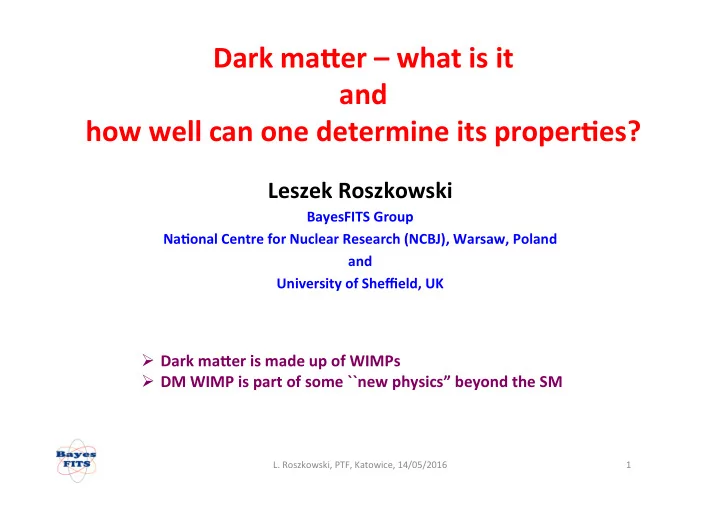
Ø Dark ma'er is made up of WIMPs Ø DM WIMP is part of some ``new physics” beyond the SM

slide-2
SLIDE 2
  • L. Roszkowski, PTF, Katowice, 14/05/2016

2

Where is ``new physics”?

Ø No convincing hint from the LHC but… Low energy SUSY remains the front-runner for ``new physics” Higgs boson: Ø Fundamental scalar --> SUSY Ø Light and SM-like --> SUSY

slide-3
SLIDE 3

Plan:

² Implica5ons of Higgs boson mh~125 GeV and direct limits on SUSY: ² Prospects for detec5on in unified and general SUSY models

² complementarity of LHC and DM searches (direct and CTA)

² Once WIMP detected: challenge of WIMP reconstruc5on ² Summary

3

  • L. Roszkowski, PTF, Katowice, 14/05/2016

Based mainly on:

  • K. Kowalska, L. Roszkowski, E. M. Sessolo, arXiv:1302.5956, JHEP 1306 (2013) 078
  • L. Roszkowski, E. M. Sessolo, A. J. Williams, arXiv:1405.4289 and arXiv:1411.5214 (JHEP)
  • K. Kowalska, L. Roszkowski, E. M. Sessolo, S. Trojanowski, 1402.1328 (JHEP)
  • K. Kowalska, L. Roszkowski, E. M. Sessolo, A. J. Williams, 1503.08219 (JHEP)
  • L. Roszkowski, E. M. Sessolo, S. Trojanowski, A. J. Williams, 1603.06519

DM WIMP: ~1 TeV (higgsino)

slide-4
SLIDE 4

The 125 GeV Higgs boson and SUSY

Higgs boson mass of 125 GeV came out to lie in a narrow window allowed by simplest SUSY models (114.4 to ~132 GeV)

MSSM SM (valid up to MP)

{

50 100 150 200 GeV

…LEP excl. …LE…LEP excl. P excl. …LEP excl.

Smoking gun of SUSY?

…close to the upper limit: this has strong implica5ons…

  • L. Roszkowski, PTF, Katowice, 14/05/2016

4

à ~750 GeV Higgs boson: Ø fundamental scalar --> SUSY Ø light and SM-like --> SUSY

slide-5
SLIDE 5

~125 GeV Higgs and unified SUSY

u Take only mh~125 GeV and lower limits from direct SUSY searches

  • L. Roszkowski, PTF, Katowice, 14/05/2016

5

L ∼ e

(mh−125.8 GeV)2 σ2+τ2

~125 GeV Higgs mass implies mul5-TeV scale for SUSY

1302.5956

u Add relic abundance

~1 TeV higgsino DM

(``new”)

bino DM

(previously favored)

Simple unified SUSY: NO other solu5ons

∆m2

h = 3m4 t

4π2v2 ⇤ ln M2

SUSY

m2

t

⇥ + X2

t

M2

SUSY

  • 1 −

X2

t

12M2

SUSY

⇥⌅

s, MSUSY ≡ √m˜

t1m˜ t2,

masses in agreement

d Xt = At µ cot β.

ΩDMh2 ' 0.12

CMSSM

A curse!

slide-6
SLIDE 6

CMSSM and direct DM searches

  • L. Roszkowski, PTF, Katowice, 14/05/2016

6

µ > 0

~1TeV higgsino DM: exci5ng prospects for 1 tonne detectors

Stau coan’n A-funnel ~1 TeV higgsino DM 1405.4289 (update of 1302.5956)

70%

slide-7
SLIDE 7

DM direct detec5on

  • L. Roszkowski, PTF, Katowice, 14/05/2016

7

10-50 10-48 10-46 10-44 10-42 10-40 10-38 100 101 102 103 104

SI cross section (cm2) per nucleon WIMP Mass [GeV/c2]

CRESST-II CRESST-II (2014) DAMA/LIBRA XENON100 XENON1T(proj.) LUX KIMS ZEPLIN III CDMS,EDELWEISS CDMSII-Si XENON10

  • LE

CMSSM

µ>0 Buchmueller et al (2013) Roszkowski et al (2014)

Neutrino Background 10-50 10-48 10-46 10-44 10-42 10-40 10-38 100 101 102 103 104

SI cross section (cm2) per nucleon WIMP Mass [GeV/c2]

CRESST-II CRESST-II (2014) DAMA/LIBRA XENON100 XENON1T(proj.) LUX KIMS ZEPLIN III CDMS,EDELWEISS CDMSII-Si XENON10

  • LE

CMSSM

µ>0 Buchmueller et al (2013) Roszkowski et al (2014)

Neutrino Background 10-50 10-48 10-46 10-44 10-42 10-40 10-38 100 101 102 103 104

SI cross section (cm2) per nucleon WIMP Mass [GeV/c2]

CRESST-II CRESST-II (2014) DAMA/LIBRA XENON100 XENON1T(proj.) LUX KIMS ZEPLIN III CDMS,EDELWEISS CDMSII-Si XENON10

  • LE

CMSSM

µ>0 Buchmueller et al (2013) Roszkowski et al (2014)

Neutrino Background 10-50 10-48 10-46 10-44 10-42 10-40 10-38 100 101 102 103 104

SI cross section (cm2) per nucleon WIMP Mass [GeV/c2]

CRESST-II CRESST-II (2014) DAMA/LIBRA XENON100 XENON1T(proj.) LUX KIMS ZEPLIN III CDMS,EDELWEISS CDMSII-Si XENON10

  • LE

CMSSM

µ>0 Buchmueller et al (2013) Roszkowski et al (2014)

Neutrino Background 10-50 10-48 10-46 10-44 10-42 10-40 10-38 100 101 102 103 104

SI cross section (cm2) per nucleon WIMP Mass [GeV/c2]

CRESST-II CRESST-II (2014) DAMA/LIBRA XENON100 XENON1T(proj.) LUX KIMS ZEPLIN III CDMS,EDELWEISS CDMSII-Si XENON10

  • LE

CMSSM

µ>0 Buchmueller et al (2013) Roszkowski et al (2014)

Neutrino Background 10-50 10-48 10-46 10-44 10-42 10-40 10-38 100 101 102 103 104

SI cross section (cm2) per nucleon WIMP Mass [GeV/c2]

CRESST-II CRESST-II (2014) DAMA/LIBRA XENON100 XENON1T(proj.) LUX KIMS ZEPLIN III CDMS,EDELWEISS CDMSII-Si XENON10

  • LE

CMSSM

µ>0 Buchmueller et al (2013) Roszkowski et al (2014)

Neutrino Background 10-50 10-48 10-46 10-44 10-42 10-40 10-38 100 101 102 103 104

SI cross section (cm2) per nucleon WIMP Mass [GeV/c2]

CRESST-II CRESST-II (2014) DAMA/LIBRA XENON100 XENON1T(proj.) LUX KIMS ZEPLIN III CDMS,EDELWEISS CDMSII-Si XENON10

  • LE

CMSSM

µ>0 Buchmueller et al (2013) Roszkowski et al (2014)

Neutrino Background 10-50 10-48 10-46 10-44 10-42 10-40 10-38 100 101 102 103 104

SI cross section (cm2) per nucleon WIMP Mass [GeV/c2]

CRESST-II CRESST-II (2014) DAMA/LIBRA XENON100 XENON1T(proj.) LUX KIMS ZEPLIN III CDMS,EDELWEISS CDMSII-Si XENON10

  • LE

CMSSM

µ>0 Buchmueller et al (2013) Roszkowski et al (2014)

Neutrino Background 10-50 10-48 10-46 10-44 10-42 10-40 10-38 100 101 102 103 104

SI cross section (cm2) per nucleon WIMP Mass [GeV/c2]

CRESST-II CRESST-II (2014) DAMA/LIBRA XENON100 XENON1T(proj.) LUX KIMS ZEPLIN III CDMS,EDELWEISS CDMSII-Si XENON10

  • LE

CMSSM

µ>0 Buchmueller et al (2013) Roszkowski et al (2014)

Neutrino Background 10-50 10-48 10-46 10-44 10-42 10-40 10-38 100 101 102 103 104

SI cross section (cm2) per nucleon WIMP Mass [GeV/c2]

CRESST-II CRESST-II (2014) DAMA/LIBRA XENON100 XENON1T(proj.) LUX KIMS ZEPLIN III CDMS,EDELWEISS CDMSII-Si XENON10

  • LE

CMSSM

µ>0 Buchmueller et al (2013) Roszkowski et al (2014)

Neutrino Background 10-50 10-48 10-46 10-44 10-42 10-40 10-38 100 101 102 103 104

SI cross section (cm2) per nucleon WIMP Mass [GeV/c2]

CRESST-II CRESST-II (2014) DAMA/LIBRA XENON100 XENON1T(proj.) LUX KIMS ZEPLIN III CDMS,EDELWEISS CDMSII-Si XENON10

  • LE

CMSSM

µ>0 Buchmueller et al (2013) Roszkowski et al (2014)

Neutrino Background 10-50 10-48 10-46 10-44 10-42 10-40 10-38 100 101 102 103 104

SI cross section (cm2) per nucleon WIMP Mass [GeV/c2]

CRESST-II CRESST-II (2014) DAMA/LIBRA XENON100 XENON1T(proj.) LUX KIMS ZEPLIN III CDMS,EDELWEISS CDMSII-Si XENON10

  • LE

CMSSM

µ>0 Buchmueller et al (2013) Roszkowski et al (2014)

Neutrino Background 10-50 10-48 10-46 10-44 10-42 10-40 10-38 100 101 102 103 104

SI cross section (cm2) per nucleon WIMP Mass [GeV/c2]

CRESST-II CRESST-II (2014) DAMA/LIBRA XENON100 XENON1T(proj.) LUX KIMS ZEPLIN III CDMS,EDELWEISS CDMSII-Si XENON10

  • LE

CMSSM

µ>0 Buchmueller et al (2013) Roszkowski et al (2014)

Neutrino Background 10-50 10-48 10-46 10-44 10-42 10-40 10-38 100 101 102 103 104

SI cross section (cm2) per nucleon WIMP Mass [GeV/c2]

CRESST-II CRESST-II (2014) DAMA/LIBRA XENON100 XENON1T(proj.) LUX KIMS ZEPLIN III CDMS,EDELWEISS CDMSII-Si XENON10

  • LE

CMSSM

µ>0 Buchmueller et al (2013) Roszkowski et al (2014)

Neutrino Background 10-50 10-48 10-46 10-44 10-42 10-40 10-38 100 101 102 103 104

SI cross section (cm2) per nucleon WIMP Mass [GeV/c2]

CRESST-II CRESST-II (2014) DAMA/LIBRA XENON100 XENON1T(proj.) LUX KIMS ZEPLIN III CDMS,EDELWEISS CDMSII-Si XENON10

  • LE

CMSSM

µ>0 Buchmueller et al (2013) Roszkowski et al (2014)

Neutrino Background 10-50 10-48 10-46 10-44 10-42 10-40 10-38 100 101 102 103 104

SI cross section (cm2) per nucleon WIMP Mass [GeV/c2]

CRESST-II CRESST-II (2014) DAMA/LIBRA XENON100 XENON1T(proj.) LUX KIMS ZEPLIN III CDMS,EDELWEISS CDMSII-Si XENON10

  • LE

CMSSM

µ>0 Buchmueller et al (2013) Roszkowski et al (2014)

Neutrino Background

Recent Phys. Rept. (1407.0017)

  • H. Baer, K.-Y. Choi, J.E Kim, LR

Xenon-1T reach

~1 TeV higgsino DM: Excellent prospects!

Reach of LUX (?)
slide-8
SLIDE 8

~1 TeV higgsino DM is robust

  • L. Roszkowski, PTF, Katowice, 14/05/2016

8

Watch prior dependence and chi2 vs Bayesian

MasterCode, 1508.01173

Present in both unified and pheno SUSY models

slide-9
SLIDE 9

Why ~1 TeV higgsino DM is so interes5ng

  • L. Roszkowski, PTF, Katowice, 14/05/2016

9

easiest to achieve Ωχh2 ' 0.1

when m ˜

H ' 1 TeV

When m ˜

B ∼

> 1 TeV:

² robust, generically present in many SUSY models (both GUT-based and not) ² implied by ~125 GeV Higgs mass and relic density ² most natural of SUSY DM ² smoking gun of SUSY!?

Condi5on: heavy enough gauginos

No need to employ special mechanisms (A-funnel or coannihila5on) to obtain correct relic density

0.1 0.2 0.3 0.4 0.5 0.6 0.7 0.8 0.9 500 1000 1500 2000 2500 3000 3500 1h2 m1 [GeV] 1 with higgsinoness > 99.9% p19MSSM (GUT scale) mg

~ - m1 < 100 GeV

Similarly with wino but mass less determined due to Sommerfeld effect

slide-10
SLIDE 10
  • L. Roszkowski, PTF, Katowice, 14/05/2016

10

Strategies for WIMP Detection

direct detection (DD): measure WIMPs scattering off a target

go underground to beat cosmic ray bgnd

indirect detection (ID): HE neutrinos from the Sun (or Earth)

WIMPs get trapped in Sun’s core, start pair annihilating, only ν’s escape

antimatter (e+, ¯ p, ¯ D) from WIMP pair-annihilation in the MW halo

from within a few kpc

gamma rays from WIMP pair-annihilation in the Galactic center

depending on DM distribution in the GC

  • ther ideas: traces of WIMP annihilation in dwarf galaxies,

in rich clusters, etc

more speculative

the LHC

slide-11
SLIDE 11

CTA – New guy in DM hunt race

  • L. Roszkowski, PTF, Katowice, 14/05/2016

11

Cherenkov Telescope Array Ø ground-based gamma-ray telescope Ø Arrays in southern and northern hemisphere for full-sky coverage Ø Energy range: tens of GeV to >100 TeV Ø Sensi5vity: more than an order of mag improvement in 100 GeV – 10 TeV

CTA ! (NFW, 500 hr)!

HESS (112 hr)!

Fermi dSph ! (4 yrs +10 dsphs)!

15 pc 150 pc 15 pc 150 pc! Search Region! 0.1° 1.0° 0.1° 1.0°!

Galac5c Center DM Halo

hPp://www.cta-observatory.org/

diffuse gamma radia5on from WIMP pair annihila5on

slide-12
SLIDE 12

What can one learn from WIMP signal?

  • L. Roszkowski, PTF, Katowice, 14/05/2016

12

Assuming one year (day?) a CDM signal is actually detected…

A'empt to reconstruct:

  • WIMP mass mX
  • WIMP DD cross-sec5on sigmap
  • WIMP annihila5on c.s. sigma*v
  • Dominant annihila5on channel(s)
  • Confirm (thermal?) WIMP

hypothesis?

  • Compa5ble with some theory

frameworks…

Likely to be a challenging task! How well? Will possibly need signal in both DD and ID

…and eventually colliders

slide-13
SLIDE 13

If signal in direct detec5on only

  • L. Roszkowski, PTF, Katowice, 14/05/2016

13

Schumann @COSMO-15

…(?) Drees and Shan, 0803.4477 Peter, 0910.4765, Pato, et al, 1006.1322 Bernal, et al., 0804.1976 (DD + ID + ILC) …

Reconstruc5on of mX and sigmap

SI:

  • Low mass (tens of GeV): good
  • <~100 GeV: s5ll reasonable
  • >~200 GeV: poor

When sigmap

SI low: prospects poorer

Newstead, 1306.3244

E.g., mX= 20, 100, 500 GeV

10 tonne*yr Xe + 20 tonne*yr Ar

Update of Newstead et al., PRD 8, 076011 (2013)

1 & 2 sigma CI marginalized over astro parameters

slide-14
SLIDE 14
  • L. Roszkowski, PTF, Katowice, 14/05/2016

14

How about diffuse gamma radia5on

Fermi LAT CTA - upcoming

Annihilatio

CTA GC Halo 500 h

Fermi

Morselli, DSU-15

10-3 10-2 10-1 1 10 102 10-2 10-1 1 10 102 103 104 10¢¢ 30¢¢1¢ 5¢ 10¢ 30¢ 1o 2o 5o10o20o45o r @kpcD rDM @GeVêcm3D Angle from the GC @degreesD NFW Moore Iso Einasto EinastoB Burkert rü rü

  • Low WIMP mass: Fermi LAT
  • Mid range: Fermi LAT and CTA
  • High mass: CTA
slide-15
SLIDE 15
  • L. Roszkowski, PTF, Katowice, 14/05/2016

15

  • L. Roszkowski, Milan, Jan '16

15

WIMP reconstruc5on with diffuse gamma radia5on

  • Shapes different when vary mX

but…

  • Similar for different final states (esp. qqbar, VV, hh, but not for ee, mu mu,tau tau)

Cirelli et al., 2010 …

Aeff × dΦ/dE (GeV-1 s-1) E (GeV)

95% CL CTA

Roszkowski, Sessolo, Trojanowski, Williams (2016)

mχ = 1000 GeV, bb

  • (bench. point)

mχ = 500 GeV, W+W- mχ = 300 GeV, bb

  • / τ+τ− / W+W- / hh (all 25%)

mχ = 300 GeV, τ+τ−

10-6 10-5 10-4 10-3 10-2 10 100 1000 dΝ/dE × 〈σv〉/mχ

2 (GeV-3 cm3 s-1)

E (GeV)

95% CL FermiLAT

Roszkowski, Sessolo, Trojanowski, Williams (2016)

mχ = 25 GeV, bb

  • (bench. point)

mχ = 13 GeV, τ+τ− mχ = 130 GeV, W+W- mχ = 75 GeV, τ+τ−

10-32 10-31 10-30 10-29 10-28 10-27 10-26 0.1 1 10 100

slide-16
SLIDE 16
  • L. Roszkowski, PTF, Katowice, 14/05/2016

16

Consider direct detec5on and/or gamma radia5on

Bernal, et al., 0804.1976 (DD + ID + ILC)

LR + Sessolo + Trojanowski + Williams (in prep)

Assume signal detected in DD and/or DGR

DGR: Diffuse Gamma Radia5on

  • Assume WIMP benchmark points:

mass, sigmap

SI, sigma*v, annihila5on BR

Symbol Parameter Range Prior distribution mχ WIMP mass 10 − 10000 GeV log σv Annihilation cross section 1 × 10⁻³⁰ − 1 × 10⁻²¹ cm3/s log σSI

p

Spin-independent cross section 1 × 10⁻¹² − 1 × 10⁻⁶ pb log Fraction of b¯ b final state fb¯

b

(benchmarks a,b,c,d) 0 − 1 See text Fraction of WW final state fW W (benchmarks a,b,c,d) 0 − 1 See text Fraction of hh final state fhh (benchmarks a,b,c,d) 0 − 1 See text fττ Fraction of ττ final state 0 − 1 See text Fraction of leptonic final state flep (benchmarks e,f) 0 − 1 See text Fraction of hadronic final state fhad (benchmarks e,f) 0 − 1 See text v0 Circular velocity 220 ± 20 km/s Gaussian vesc Escape velocity 544 ± 40 km/s Gaussian ρ0 Local DM density 0.3 ± 0.1 GeV/cm3 Gaussian γNFW NFW slope parameter 1.20 ± 0.15 Gaussian

  • Sta5s5cal approach
  • Construct likelihood func5on for DD, Fermi

LAT dSphs, CTA

  • Vary four WIMP proper5es + several

astrophysical parameters

  • Produce mock data
  • Compare with benchmark point

ρ(r) = ρ0 ⇣ 1 + R

rs

⌘3γNFW ⇣

r R

⌘γNFW ⇣ 1 + r

rs

⌘3γNFW

BP1 BP2 BP3 BP4(a, b, c, d) BP5 mχ 25 GeV 100 GeV 250 GeV 1000 GeV 1000 GeV σv 8 × 10⁻²⁷ cm3/s 2 × 10⁻²⁶ cm3/s 4 × 10⁻²⁶ cm3/s 2 × 10⁻²⁵ cm3/s 3 × 10⁻²⁶ cm3/s σSI

p

2 × 10−46 cm2 3 × 10−46 cm2 5 × 10−46 cm2 2 × 10−45 cm2 2 × 10−45 cm2 Final state (a) b¯ b (b) W +W − (hadronic scans) b¯ b b¯ b b¯ b (c) τ +τ − W +W − Final state (leptonic scan) (d) µ+µ−

slide-17
SLIDE 17
  • L. Roszkowski, PTF, Katowice, 14/05/2016

17

Diffuse Gamma Radia5on: Fermi LAT, CTA

LCTA =

NCTA

Y

i=1

8 < : Z dRCR

i

e

(1−RCR

i ) 2 2σ2 CR

Z dRGDE

i

e

(1−RGDE

i

)

2 2σ2 GDE

2 4

3

Y

j=1

µij

  • RCR

i

, RGDE

i

nij nij! eµij(RCR

i

,RGDE

i

) 3 5 9 = ; (11) LdSphs =

NdSphs

Y

j=1

(Z dJj log(10) ¯ Jj √ 2πσj exp " −(log10 Jj − log10 ¯ Jj)2 2σ2

j

# × NFermi Y

i=1

1 √ 2πσij exp " −(Φij − Φij)2 2σ2

ij

#!)

  • NFermi = 17 energy bins,

Fermi LAT

Assume 15 yrs and 45 dSphs

CTA

Assume 500 hrs

µij

  • RCR

i

, RGDE

i

  • = µDM

ij

+ RCR

i

µCR

ij

+ RGDE

i

µGDE

ij

Use modified Ring Method: ON, OFF 1, OFF 2

R - background normaliza5on CR: isotropic cosmic ray (from CTA) GDE: galac5c diffuse emission

s.

  • NCTA = 30 energy bins,, logarithmically spaced.

GDE: Extrapolated from Fermi LAT beyond 500 GeV (Silverwood, et al., Silk et al.)

DM: prompt and secondary (ICS from electrons on CMB, starlight and IR)

(Cirelli, et al., Silk et al.)

mu – number of counts

  • 3
  • 2
  • 1

1 2 3

  • 2
  • 1

1 2 3 4 5 l (°) b (°)

4 3 2 1
slide-18
SLIDE 18

WIMP reconstruc5on with Fermi LAT and CTA

  • L. Roszkowski, PTF, Katowice, 14/05/2016

18

Example: BP4a (``generic”) ``True” WIMP: mX= 1 TeV, BR(b-bbar)=1, sigma*v= 2x10-25 cm3s-1 But other values of mX and final states can give very similar spectra!

  • -> Heavy WIMP: Mass reconstruc5on doable but crude (CTA)

Fermi LAT helps narrow down sigma*v

slide-19
SLIDE 19

WIMP reconstruc5on with Fermi LAT and CTA

  • L. Roszkowski, PTF, Katowice, 14/05/2016

19

Example: BP4b (close to SUSY ~1 TeV higgsino case) ``True” WIMP: mX= 1 TeV, BR(WW)=1, sigma*v= 2x10-25 cm3s-1 WW final state: both mX and final states can be reconstructed rather well!

Addi5onal spectral feature: spike at Egamma=~ mX (caused by W à W+gamma)

Even more op5mis5c results for tau-tau and leptonic final states (mu-mu and e-e)

slide-20
SLIDE 20

Interplay of direct detec5on and gamma radia5on

  • L. Roszkowski, PTF, Katowice, 14/05/2016

20

Example BP1: mX= 25 GeV sigmap= 9.0 x 10-47cm2, sigma*v= 8.0 x 10⁻²⁶cm3s-1 BR(b bbar)=1 Direct detec5on signal can essen5al in pinpoin5ng WIMP mass but only at low mX.

Of help only for low mX This will in turn help reconstruc5ng final states.

slide-21
SLIDE 21

To take home:

Ø WIMP dark matter is still awaiting a discovery Ø SUSY Higgs of 125 GeV + DM abundance + unification: Ø Msusy ~ few TeV Ø DM WIMP is preferably ~1 TeV higgsino Ø DM ~1 TeV higgsino case will be sensitive to only DM searches (direct + CTA) Ø WIMP reconstruction: likely to be CHALLENGING Ø High mass (~1 TeV): CTA signal essential Ø Mid-range (~100 – few hundred GeV): most difficult

21

  • L. Roszkowski, PTF, Katowice, 14/05/2016

…unless WIMP << 100 GeV (DD) Far beyond the reach of LHC