Association of National Stakeholders in Traffic Safety Education - - PowerPoint PPT Presentation

association of national stakeholders in traffic safety
SMART_READER_LITE
LIVE PREVIEW

Association of National Stakeholders in Traffic Safety Education - - PowerPoint PPT Presentation

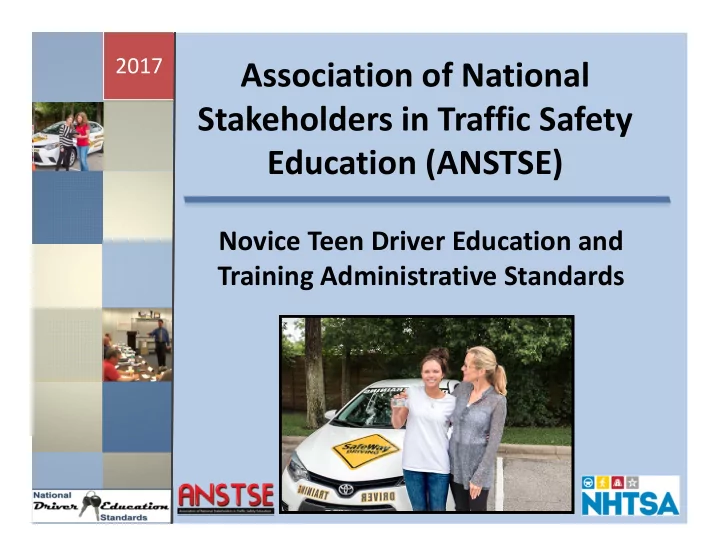
2017 Association of National Stakeholders in Traffic Safety Education (ANSTSE) Novice Teen Driver Education and Training Administrative Standards 2017 Presentation Topics The Stakeholder Association ANSTSE NHTSAs Support for Driver


slide-1
SLIDE 1

Association of National Stakeholders in Traffic Safety Education (ANSTSE)

Novice Teen Driver Education and Training Administrative Standards

2017

slide-2
SLIDE 2

2017 Slide 2

Presentation Topics

■ The Stakeholder Association‐ ANSTSE ■ NHTSA’s Support for Driver Education ■ The Novice Teen Driver Education and Training Administrative Standards (NTDETAS) ■ Instructor Training Curriculum/System ■ Technical Assistance ■ Taking Action

slide-3
SLIDE 3

2017 Slide 3

Motor Vehicle Crashes

  • Leading cause
  • f death

for teens

  • Teens crashes ↑
  • Teens deaths ↑
slide-4
SLIDE 4

2017 Slide 4

Addressing Vehicle Crash Fatalities

  • Teens continue to be over‐represented

in crashes.

  • Hope in addressing behaviors and skills
  • f teen drivers.
  • Organizations like ANSTSE working to

reduce fatalities.

slide-5
SLIDE 5

2017 Slide 5

Association of National Stakeholders in Traffic Safety Education

ANSTSE

  • Origin
  • Volunteer
  • rganization
  • Premise and goal
slide-6
SLIDE 6

2017 Slide 6

AAA AAA Foundation for Traffic Safety American Association of Motor Vehicle Administrators (AAMVA) American Driver and Traffic Safety Education Association (ADTSEA) Driver Education and Training Administrators (DETA) Governors Highway Safety Association (GHSA) Transportation Research Board (TRB)

ANSTSE Members

Driving School Association of the Americas (DSAA) The Association for Driver Rehabilitation Specialist (ADED)

slide-7
SLIDE 7

2017 Slide 7

ANSTSE Mission

  • Promote adoption of the Standards
  • Maintain and update the Standards
  • Support, encourage and strengthen

shared‐decision making

  • Identify and make recommendations
slide-8
SLIDE 8

2017 Slide 8

NHTSA’s Support for Driver Education

  • The NTDETAS
  • ANSTSE Activities
  • Strategic Plan
  • Technical Assistance for states
  • NHTSA State DE Assessments
  • Information Sharing System

Visit www.anstse.info and www.nhtsa.gov

slide-9
SLIDE 9

2017 Slide 9

NHTSA’s Support for Driver Education

DRIVER EDUCATION (ANSTSE) NTDETAS Standards & Strategic Plan ANSTSE State Technical Assistance NHTSA State Assessments Information Sharing System DRIVER EDUCATION (ANSTSE) NTDETAS Standards & Strategic Plan ANSTSE State Technical Assistance NHTSA State Assessments Information Sharing System

slide-10
SLIDE 10

2017 Slide 10

Novice Teen Driver Education and Training Administrative Standards

  • Revised and published in February 2017
  • Ultimate Goal: Ensure that driver

education and training is:

  • High quality
  • Consistent
  • Administering education standards and

policies are a State’s right

  • To serve as an anchor for State policies
  • n driver education and training
slide-11
SLIDE 11

2017 Slide 11

Novice Teen Driver Education and Training Administrative Standards

  • 1. Program Administration
  • 2. Education and Training

(including online delivery)

  • 3. Instructor Qualifications

(program & materials)

  • 4. Parental Involvement
  • 5. Coordination with Driver Licensing
slide-12
SLIDE 12

2017 Slide 12

Novice Teen Driver Education and Training Administrative Standards

A few highlights of the revisions include:

  • A. Content Standards

(ADTSEA & DSAA)

  • B. Delivery Standards
  • C. Online Delivery Standards
  • D. Instructor Training Standards
slide-13
SLIDE 13

2017 Slide 13

Novice Teen Driver Education and Training Administrative Standards

  • The NTDETAS are composed of both:

– “Normative” or mandatory and – “Informative” or optional components. – To be considered in compliance with the NTDETAS, a State

  • must meet all “Normative” components in full.
  • Should meet all “Informative” components in

full.

slide-14
SLIDE 14

2017 Slide 14

Novice Teen Driver Education and Training Administrative Standards

  • Standards that are “Normative,” or

mandatory utilize descriptors such as “shall,” “must” or “will.”

  • These standards are in bold font in this

document.

  • To be in compliance the State must meet

these Standards in full.

slide-15
SLIDE 15

2017 Slide 15

Novice Teen Driver Education and Training Administrative Standards

  • Standards that are “Informative” or
  • ptional utilize descriptors such as

“should” or “may.”

  • These standards are in regular font in

this document.

  • They generally support an overall larger

standard and assist the State in meeting the standard, and should be met if possible.

slide-16
SLIDE 16

2017 Slide 16

Novice Teen Driver Education and Training Administrative Standards

The two primary descriptors for standards in this document are:

  • “shall” (the State must meet to be

considered in compliance); and

  • “should” (the State should strive to meet

this standard or portion of a standard).

slide-17
SLIDE 17

2017 Slide 17

Novice Teen Driver Education and Training Administrative Standards

slide-18
SLIDE 18

2017 Slide 18

  • A. Content Standards

Two documents:

  • ADTSEA Curriculum Standards
  • DSAA Content Standards

Model standards for: ‐ Curricula, and ‐ Other teaching materials.

slide-19
SLIDE 19

2017 Slide 19

ADTSEA Content Standards

  • Revised in 2017 to include

new and emerging vehicle technology with the release of the NHTSA Federal Model State Policy

  • n Autonomous Vehicles.
slide-20
SLIDE 20

2017 Slide 20

ADTSEA Content Standards

  • Classroom Standard 11.0 Responding to

Vehicle Emergencies, Vehicle Malfunctions and Crashes and Understanding Vehicle Technology

– C 11.2 Student will recognize and understand the operation of current and emerging vehicle warning, assistance and convenience system technologies and address new automated vehicle safety technologies as they become available in the future.

slide-21
SLIDE 21

2017 Slide 21

DSSA Content Standards

  • 2017 revision includes

new and emerging vehicle technology with the release of the Federal Model State Policy.

slide-22
SLIDE 22

2017 Slide 22

DSSA Content Standards

Standard 11.0 Vehicle Technology Systems

  • To develop knowledge, appreciation, and

skills related to vehicle technology systems contributing to safe, responsible, and incident‐free driving. Standard 12.0 Automated Vehicle Systems

  • To develop knowledge, appreciation, and

skills related to automated vehicle systems, contributing to safe, responsible, and incident‐free driving.

slide-23
SLIDE 23

2017 Slide 23

  • B. Delivery Standards

Minimum guidelines on topics including:

– Concurrent and integrated instruction – Classroom & BTW time periods – Student‐instructor ratio – Requirements: Classrooms & training vehicles – Use of simulation, driving range, and computer‐based learning

slide-24
SLIDE 24

2017 Slide 24

  • C. Online Delivery Standards

To improve the quality of online driver education programs nationwide

slide-25
SLIDE 25

2017 Slide 25

  • C. Online Delivery Standards
  • Includes guidelines on:

– Instructional design – Structural design

slide-26
SLIDE 26

2017 Slide 26

  • C. Online Delivery Standards, con’t.

– Evaluation/testing/assessment – Technological design and capabilities – Legal requirements

slide-27
SLIDE 27

2017 Slide 27

  • D. Instructor Qualification

Standards

  • Proper instructor training is paramount
  • Teaching theory and practice‐ the focal point
  • Ample time for training
slide-28
SLIDE 28

2017 Slide 28

  • D. Instructor Qualification

Standards

  • Prerequisites and entry‐level

assessments

  • Training of instructors:

– course detailing information from State approved driver education curricula – course in teaching and learning theories – deliver practice teaching assignments

slide-29
SLIDE 29

2017 Slide 29

  • D. Instructor Qualification

Standards

– Having candidates teach with an experienced mentor or complete a student teaching practicum – Pass exit assessments – Require ongoing training and recertification

slide-30
SLIDE 30

2017 Slide 30

Model curriculum consists of:

  • Part I: Fundamental Concepts of

Teaching and Learning

  • Part II: Classroom Teaching and

Learning Theories

  • Part III: BTW Teaching and Learning

Theories

Stage 3: The Teaching Task

slide-31
SLIDE 31

2017 Slide 31

  • Includes Instructor’s Guide and

Participant Workbook:

– Lesson Plans with classroom and BTW activities – Slides – Videos for BTW part – Quizzes/Answer Sheets – Knowledge Tests/Answer Sheets

Stage 3: The Teaching Task

slide-32
SLIDE 32

2017 Slide 32

Stage 3: The Teaching Task

slide-33
SLIDE 33

2017 Slide 33

ANSTSE Website

www.anstse.info

  • Revised NTDETAS.
  • Model teaching task

instructor curriculum.

  • ANSTSE Strategic Plan.
  • NHTSA State assessment / ANSTSE

technical assistance reports.

  • Driver education reports and research.
slide-34
SLIDE 34

2017 Slide 34

ANSTSE Website

slide-35
SLIDE 35

2017 Slide 35

ANSTSE/NTDETAS Technical Assistance

Goal: Assist with adopting and implementing the standards and to make improvements in driver education

  • State driver education

programs can request technical assistance from ANSTSE

  • No cost to the state
  • For more information visit

www.anstse.info.

slide-36
SLIDE 36

2017 Slide 36

The Importance of Standards

  • Can improve your driver education

program.

  • All programs should utilize the standards

even for if the State doesn’t implement

  • r require them.
  • Can help reduce the number of motor

vehicle crashes and fatalities.

slide-37
SLIDE 37

2017 Slide 37

How to Take Action

  • Monitor progress in Driver Education
  • Encourage the adoption and

implementation of the revised standards, including standards for:

– Administration – Program delivery – Instructor training

slide-38
SLIDE 38

2017 Slide 38

How to Take Action , cont.

  • Encourage your state to:

– Schedule a NHTSA State Driver Education Assessment – Request Technical Assistance.

  • Work cooperatively within your driver

education community.

  • Follow the efforts of the ANSTSE.

www.anstse.info

slide-39
SLIDE 39

2017 Slide 39

Thanks to NHTSA!!!

slide-40
SLIDE 40

2017 Slide 40

ANSTSE Contact

Brett Robinson ANSTSE Secretariat American Driver and Traffic Safety Education Association (ADTSEA) (724) 801‐8246 brett@adtsea.org

slide-41
SLIDE 41

2017 Slide 41

NHTSA State Assessment Contact

Michelle Atwell Highway Safety Specialist, Enforcement & Justice Services National Highway Traffic Safety Administration (202) 366‐2084 Michelle.Atwell@dot.gov

slide-42
SLIDE 42

2017 Slide 42

Questions

Thank you for your support and interest in Driver Education and Training!