Association Landscape in 2016 Technology Expectations Changing - - PDF document

association landscape in 2016
SMART_READER_LITE
LIVE PREVIEW

Association Landscape in 2016 Technology Expectations Changing - - PDF document

Membership Model Research and Options Overview 1 Association Landscape in 2016 Technology Expectations Changing Information Member Overload Demographics Calls for Explicit ROI Regulatory Employer Climate Policies 2 www.mckinley


slide-1
SLIDE 1

www.mckinley‐advisors.com 1

1

Membership Model Research and Options Overview

2

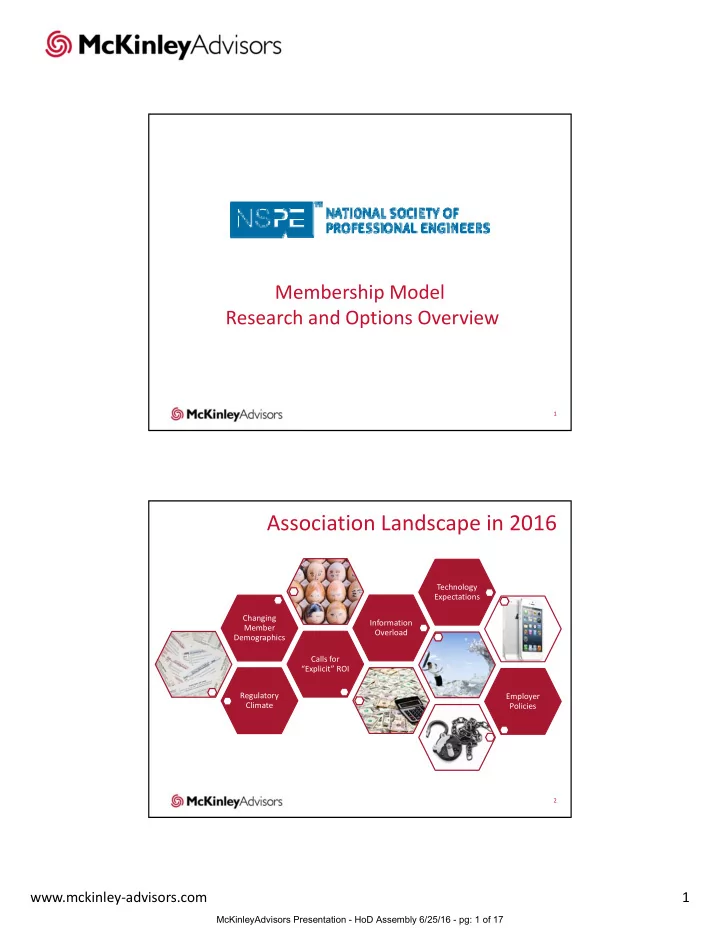
Association Landscape in 2016

Regulatory Climate Calls for “Explicit” ROI Changing Member Demographics Information Overload Technology Expectations Employer Policies McKinleyAdvisors Presentation - HoD Assembly 6/25/16 - pg: 1 of 17

slide-2
SLIDE 2

www.mckinley‐advisors.com 2

3

Membership Structures are Changing

Reported in McKinley’s 2013 Economic Impact of Association, 7of10 associations made

  • r considered making some type of change to their membership structure. A range of
  • ptions are being pursued:

4% 5% 5% 5% 5% 6% 7% 12% 17% 21% 25% Increase in dues Structural changes Consideration of structural changes Bundling options Streamlined categories Reduced cost of membership Group membership A la carte/online membership offering Dues restructure Addition of new member benefits Creation of new membership categories

In the past year, have you made or have you considered making significant changes to your membership structure and benefits packages? Please describe those changes.

N=172 4

Research Review

McKinleyAdvisors Presentation - HoD Assembly 6/25/16 - pg: 2 of 17

slide-3
SLIDE 3

www.mckinley‐advisors.com 3

5

Membership Structure: Project Overview

Project Immersion Membership Committee Call

  • Dec. 2

Data Review “Phase 1” Interviews Electronic Survey Membership Committee Call

  • Jan. 27

NSPE Board Meeting

  • Feb. 27‐28

Benchmarking Research NSPE Board Call April 27 SSEC Conf. Call May 25 Market Testing SSEC and HOD Meetings June 24‐25

6

Research Elements

“Phase 1” Interviews

  • 10 in‐depth

interviews

  • Purpose: gather

feedback to understand the range of perspectives on the current state

  • f NSPE

membership E‐Survey

  • Distributed to

24K current and former members

  • ~2,000 responses
  • Purpose:

measure member sentiment across a range of indicators Concept Testing

  • 22 in‐depth

interviews complete; 3 pending

  • Purpose: Gauge

initial reactions to a working draft of a unified membership concept

McKinleyAdvisors Presentation - HoD Assembly 6/25/16 - pg: 3 of 17

slide-4
SLIDE 4

www.mckinley‐advisors.com 4

7

“Phase 1” Interview Findings

Overall Sentiment Broad agreement that the current approach is not

  • ptimal; several spoke of momentum over the past

few years in rebuilding trust advancing progress. Current Challenges NSPE needs to continue to attack its central challenge: developing and communicating its value propositions and relevance. Future Focus NSPE should proactively work to increase “tangible” member value in addition to its role as an advocate for professional engineering and licensure.

8

Survey Results

McKinleyAdvisors Presentation - HoD Assembly 6/25/16 - pg: 4 of 17

slide-5
SLIDE 5

www.mckinley‐advisors.com 5

9

Demographics

3% 4% 7% 7% 9% 14% 17% 40% Chemical Interdisciplinary Environmental Structural Other, please specify: Electrical Mechanical Civil

Which of the following best represents your specialty area within engineering? (N = 1,404)

5% 20% 17% 12% 10% 35% 2% Less than a year 1‐5 years 6‐10 years 11‐15 years 16‐20 years More than 20 years Don't know

How long have you been a member of NSPE? (N = 1,105)

10

Satisfaction

19% 48% 28% 4% 0% 25% 45% 25% 5% 1% 33% 40% 19% 6% 3% Extremely satisfied Somewhat satisfied Neither satisfied nor dissatisfied Somewhat dissatisfied Extremely dissatisfied

How satisfied are you with your NSPE membership at the following levels?

National (N = 1,506) State (N = 699) Local (N = 684)

McKinleyAdvisors Presentation - HoD Assembly 6/25/16 - pg: 5 of 17

slide-6
SLIDE 6

www.mckinley‐advisors.com 6

11

Cost vs. Value

6% 18% 42% 27% 7% Far greater than the cost

  • f membership

Somewhat greater than the cost of membership Equal to the cost of membership Somewhat less than the cost of membership Far less than the cost of membership

Based on the amount you pay in dues, would you say the value you receive from NSPE membership is greater than the cost of membership, equal to the cost of membership, or less than the cost of membership? (N = 1,507) 24% value is greater than the cost

  • f membership

34% value is less than the cost of membership

12

NPS Benchmarked

‐24% ‐18% ‐16% ‐14% 9% 10% 11% 11% 16% 16% 16% 17% 21% 23% 25% 45%

Net Promoter Score Benchmarked Scientific/Engineering Professional Societies Average: 9%

Note: When asked generally, NSPE’s net promoter score differed from when respondents were asked to individually recommend national NSPE (‐18), state NSPE (‐4) and local NSPE (‐1).

McKinleyAdvisors Presentation - HoD Assembly 6/25/16 - pg: 6 of 17

slide-7
SLIDE 7

www.mckinley‐advisors.com 7

13

Value

27% 31% 26% 16% National State Local Unsure

Which level of NSPE delivers the most value to you? (N = 1,184)

14

Benefits and Services

4% 7% 7% 11% 12% 17% 19% 21% 26% 33% Blogs (e.g., NSPE Blog, PE Licensing Blog, etc.) NSPE Annual Meeting Interest groups NSPE‐PAC NSPE Job Board NSPE Update Daily Designs: Business News for PEs Legislative Action Center PE Magazine Fifteen free online seminars

How would you rate the importance of the following NSPE national products and services to you and your organization? (N = 1,349)

Sum of 9 and 10 (extremely important)

McKinleyAdvisors Presentation - HoD Assembly 6/25/16 - pg: 7 of 17

slide-8
SLIDE 8

www.mckinley‐advisors.com 8

15

Benefits and Services

4% 6% 24% 41% 46% 46% 49% 50% 60% 82% 25% 31% 58% 46% 41% 49% 35% 38% 30% 14% 71% 64% 18% 13% 13% 5% 17% 12% 10% 4% Volunteer opportunities In‐person networking events Conferences and meetings Online networking opportunities Online job board Government advocacy and policy efforts Professional education Career path and job search guidance Ethics resources Research and publications

At which level would you like NSPE to focus on providing the following products and services in the future? Please select the level at which you think it is most important for NSPE to provide each product or service. (N = 1,002)

National State Local

16

Models and Options Evaluated

McKinleyAdvisors Presentation - HoD Assembly 6/25/16 - pg: 8 of 17

slide-9
SLIDE 9

www.mckinley‐advisors.com 9

17

Model Optimization

Current Advantages Current Disadvantages Inefficiency Pricing Complexity Inconsistent Experience Administrative Support “Flexibility” “Partially” Unified Voice

18

Options Overview

Structure Examples

Federation (Services to States) Integrated Affiliate Model Consolidated Independent / Loosely Aligned

McKinleyAdvisors Presentation - HoD Assembly 6/25/16 - pg: 9 of 17

slide-10
SLIDE 10

www.mckinley‐advisors.com 10

19

Models and Options

Model Concept

Federation (Services to States) Ex: AHCA, NCEES, NCARB An association of associations; the primary role of the national

  • rganization shifts to coordinating federal advocacy efforts and

advancing the ability of the states to best serve individual members Potential Advantages:

  • Fulfills NSPE’s mission to promote licensure

by bolstering states’ ability to serve professional engineers

  • National can provide value to states by

providing billing and administrative support, advocacy services and other functions to expand their bandwidth to deliver quality programs/services to individual members

  • Allows states to continue direct member

service without “competition” from National

  • Similar to some current National/State

relationships Potential Disadvantages:

  • “Back‐office” functions not currently

viewed by some states as a significant benefit

  • Possible that some states would decide to

not join the Federation, therefore reducing the overall impact of the

  • rganization
  • No ability or mandate for National to

provide programming that could add value to individual membership

  • Would likely complicate National

governance model

  • Will likely require a new revenue driver at

the National level to be sustainable

20

Models and Options

Model Concept

Integrated Affiliate Model Reciprocity policies vary: Mandatory: Ex. AIA, NAR, ADA Voluntary: Ex. ASCE, IEEE Components are aligned in purpose, but retain some level of autonomy including the ability to set dues, create programs, etc. Membership reciprocity policies vary widely in the association industry

Potential Advantages:

  • Promotes consistency in

message and unity in mission

  • Streamlines administration

(e.g., one method of billing and collection)

  • Emphasizes collaboration and

shared accountability Potential Disadvantages:

  • Potential difficulty in

transitioning state‐only groups back to three‐tiered membership

  • Limits consumer choice

McKinleyAdvisors Presentation - HoD Assembly 6/25/16 - pg: 10 of 17
slide-11
SLIDE 11

www.mckinley‐advisors.com 11

21

Models and Options

Model Concept

Consolidated Ex: American Red Cross, American Diabetes Association, Alzheimer’s Association One “parent” corporation is established to administer and drive the mission and programs of work for itself and its geographic units, which are often not separately incorporated; most effective in

  • rganizations that share a singular purpose

Potential Advantages:

  • Allows NSPE National to establish a

standardized pricing model

  • Reduces redundancy and

inefficiency in programming, administrative costs and other

  • perational elements

Potential Disadvantages:

  • Seen most often in cause‐related

and “cure” organizations, where the “parent” and all components share a singular purpose

  • Requires group exemption and

dissolution of separate corporations, which leads to increased risk for “parent”

22

Models and Options

Model Concept

Independent Ex: AICPA, ABA, AMA Organizations who share a common mission but are not materially related in structural, operational or financial matters; no membership reciprocity or coordination Potential Advantages:

  • Frees each component from attempting to

coordinate services with others and creates bandwidth to provide programming and tangible member benefits based on their

  • wn market knowledge
  • Opportunity to differentiate member

content and value between NSPE National and states

  • Could provide more flexibility for NSPE to

become an umbrella organization for technician certifications and other paraprofessional pathways Potential Disadvantages:

  • Limited incentive for members to join

both state and national organizations

  • No consistency/standardization achieved

across states

  • Value of National‐only membership may

not be robust enough at present to drive membership

  • Increased competition between NSPE

National and states for recruiting members

  • Potential to alienate/disenfranchise NSPE

volunteers currently engaged through the three‐tiered system McKinleyAdvisors Presentation - HoD Assembly 6/25/16 - pg: 11 of 17

slide-12
SLIDE 12

www.mckinley‐advisors.com 12

23

Narrowing the Options

  • Federation (Services to States): Removed from consideration

because there is too much variability in state services to provide a suitable baseline for this model; National lacks the capacity at present to become an effective “service center” to all states.

  • Consolidated: Removed from consideration due to the desire

to allow states to maintain necessary autonomy in their

  • perations; similar capacity concerns for National.

Integrated or Independent?

24

Exploring an Integrated Approach: A Working Model

McKinleyAdvisors Presentation - HoD Assembly 6/25/16 - pg: 12 of 17

slide-13
SLIDE 13

www.mckinley‐advisors.com 13

25

Integrated Affiliate Model Goals

Simplify Unite Align

26

Overview of Working Model

  • Consistent, “total dues pricing” would be established

for all members across the country

  • Variable dues splits and service levels would be defined

for national and state associations.

  • State associations would opt‐in to a revenue / service

tier of that corresponds to their capacity to deliver services; this would require National to provide enhanced value to members in those states

  • An enhanced emphasis on recruitment and retention

activities would be central to the integrated approach

McKinleyAdvisors Presentation - HoD Assembly 6/25/16 - pg: 13 of 17

slide-14
SLIDE 14

www.mckinley‐advisors.com 14

27

Unified Price Point

  • National dues would remain consistent and state organizations would share in

the total dues revenue based on a manageable number of “tiers” that are commensurate with the level of service provided to members in the state, as determined by an evaluation of standard criteria

  • This method would account for the variability that does (and will continue to)

exist in staffing, resources and service levels across states. The table below provides a hypothetical scenario, for discussion purposes only.

Category National Share State Share Total Dues Higher capacity states $50 $250 $300 Moderate ‐ high capacity states $150 $150 $300 Moderate capacity states $200 $100 $300 Lower capacity states $250 $50 $300

28

Guiding Assumptions

  • This model will maintain flexibility by allowing states to opt into

an agreed upon member service “tier.”

  • National would take responsibility for providing a best‐in‐class

join / renew process and for delivering dues allocations to each

  • state. In an integrated model, there would be no state billing
  • ption.
  • The national organization’s responsibility for membership billing

will occur in tandem with a transition to a unified dues price point to coordinate efforts and ensure a manageable transition.

  • A transition window of several years will be provided to

eliminate the “state only” membership option and migrate current “state only” members to the unified price point.

McKinleyAdvisors Presentation - HoD Assembly 6/25/16 - pg: 14 of 17

slide-15
SLIDE 15

www.mckinley‐advisors.com 15

29

Potential Advantages and Challenges

‐Integrated structure ‐Consistent member price point ‐Streamlined administration ‐Transitioning “state

  • nly” members

‐Defining state dues allocation “tiers” ‐Need to increase national capacity

30

Proposed Categories for Consideration:

  • Staffing levels
  • Education offered
  • Membership figures/trends
  • Member communications
  • Advocacy efforts
  • Finance and operations

Developing Capacity Tiers

McKinleyAdvisors Presentation - HoD Assembly 6/25/16 - pg: 15 of 17

slide-16
SLIDE 16

www.mckinley‐advisors.com 16

31

Developing Capacity Tiers

Activities Low Moderate Moderate‐High High Staffing level (FTE Equivalents via part time, full time, AMC staffing) None .1‐*.5 .6‐1.5 1.6+ Sends chapter leaders to NSPE events annually Never Occasionally Frequently Always Number of CE credit hours offered annually 0‐5 6‐10 11‐20 21+ Number of face‐to‐face conferences or events per year 0‐2 3‐5 6‐10 11+ Total number of members <250 250‐499 500‐999 1,000+ Dues price range $0‐65 $66‐115 $116‐200 $201‐250 Membership retention rate <65% 65‐74% 75‐84% 85%+ Conduct annual member retention and recruitment efforts No Occasionally Regularly Frequently Uses NSPE database or other system to maintain member records No Occasionally Regularly Frequently Adheres to NSPE brand, website, and communication standards None Limited Moderate High Provides regular member communications and updates None Limited Moderate High Contributes content to NSPE National website and blogs No Occasionally Regularly Frequently Maintains a state legislative agenda aligned with NSPE's priorities Yes Yes Yes Yes Advocates to state legislatures on behalf of PEs No Occasionally Regularly Frequently Files IRS 990 or 990N tax returns annually Yes Yes Yes Yes Files appropriate dues remittance forms to NSPE National Yes Yes Yes Yes Conducts regular strategic and business planning No Occasionally Regularly Frequently Finance and Operations Member Communications Education Potential Capacity Rubric Criteria Membership Staffing Advocacy

32

Possible Next Steps

Continue to refine and advance the model:

  • Document the impact perpetuating the current approach
  • Convene a working group to address open questions
  • Fine‐tune pricing, tiers and financial forecasts
  • Model approaches to National / State service delivery
  • Continue work to expand and enhance value proposition
  • Pilot test the concept in select geographies

Or, pursue an alternative scenario:

  • Disaggregated model
  • Other ideas?

McKinleyAdvisors Presentation - HoD Assembly 6/25/16 - pg: 16 of 17

slide-17
SLIDE 17

www.mckinley‐advisors.com 17

33

Thank you! Jay Younger, FASAE jyounger@mckinley‐advisors.com Liz Williamson lwilliamson@mckinley‐advisors.com

McKinleyAdvisors Presentation - HoD Assembly 6/25/16 - pg: 17 of 17