
SLIDE 1
Assignment 2
Clumpfinding and Synergy Between Datasets
- Dr. Steve Mairs (ASTR351L Spring 2019)
Assignment 2 Clumpfinding and Synergy Between Datasets Dr. Steve - - PowerPoint PPT Presentation
Assignment 2 Clumpfinding and Synergy Between Datasets Dr. Steve Mairs (ASTR351L Spring 2019) Overview Unstable? 1. Star Formation 2. YSOs 3. Clumpfinding 4. Catalogues Fragmentation 5. Mass Equations
Clumpfinding and Synergy Between Datasets
1. Star Formation 2. YSOs 3. Clumpfinding 4. Catalogues 5. Mass Equations
Fragmentation Unstable?
We have a picture, what we need is a movie
We have a picture, what we need is a movie
Submm - The James Clerk Maxwell Telescope, Herschel Space Observatory CARMA ALMA Instruments to measure gas and dust Ring-like Structures Dense Gas/Dust Conglomerates
We use infrared telescopes to identify and classify YSOs The class is proportional to age! We expect to see Class 0/I associated with SCUBA-2 clumps (early SF!) These data have a lot of synergy With the JCMT’s!
The FellWalker algorithm is tuned to identify compact, localised emission Each pixel is considered in an image and the steepest gradients up to an emission peak are identified Checks are performed to ensure the peak is not a noise spike
The local maximum is assigned an identifying integer and all the pixels above a user-defined threshold that were included in the path to the peak are assigned the same integer. Clumps are split up based on the depth of the dips between peaks
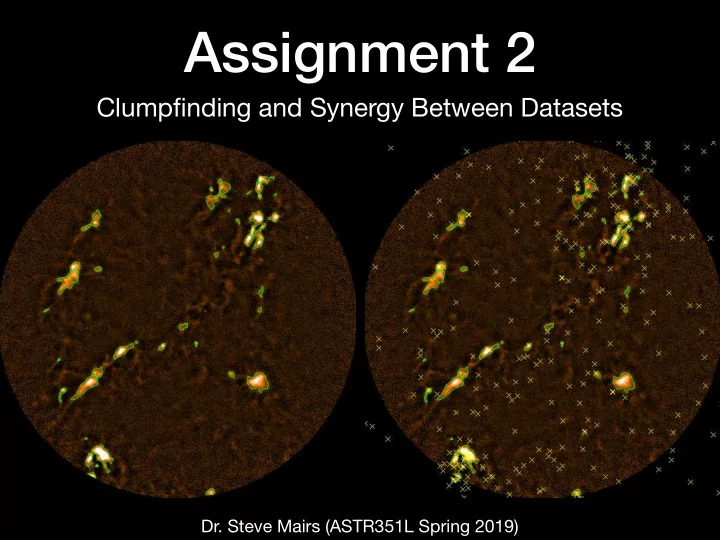
FellWalker Results Overplotted The FellWalker “Outmap”
4 9 28
Along with a map of all the clumps, you get all their properties! Peak1, Peak2 = Location of the peak Cen1, Cen2 = Location of the centre of the clump Size1, Size2 = Weighted average size along each axis Sum = Flux from all pixels in the clump simply added up together Volume = Area in 2D Peak = Flux of the peak pixel contained within clump
Note that a proper total flux is in units of mJy or Jy **** PAY ATTENTION TO UNITS **** In the example above, the units are mJy/arcsec2
So you need to multiply by the area of a pixel! (In arcsec2)
Iν = B(Td) x [1 - e-𝞄ν]
Begin with a modified blackbody equation to describe the flux:
Planck Equation Flux at frequency ν Dust Temperature Optical Depth
We are on the Rayleigh Jeans tail of the blackbody (𝞄ν << 1): So, Taylor Expand e-𝞄ν
Iν = B(Td) x [1 - (1 - 𝞄ν)] Iν = B(Td) x 𝞄ν
Rayleigh Jeans Tail
* JCMT
Sν = ∫IνdΩ
Let’s take a look at the total flux, Sν:
Sν = ∫ B(Td) x 𝞄ν dΩ Sν = B(Td) x 𝞄ν x Ω
Add flux Over solid angle Of source Column Density Mass density
Opacity of core Number density
Sν = B(Td) x NμmH𝜆ν x Ω
Sν = B(Td) x NμmH𝜆ν x Ω
Mean Molecular Weight x Mass of Hydrogen
Sν = B(Td) x (M/r2)μmH𝜆ν x (r2/D2)
2D Area of core Distance to core
Sν = (2hv3/c2) x {1/[exp(hv/kBTd) - 1]} x MμmH𝜆 x (1/D2)
Mass of core
M345GHz = 0.074 x (S345GHz/1 Jy) x (D/100 pc)2 x (𝜆345GHz/0.01 cm2 g-1) x [exp(17 K / Td) - 1] M☉ Good 𝜆345GHz = 0.01 cm2 g-1 Good Td = 15 K S345GHz comes from FellWalker Catalogue (“Sum”) - but check the units!! Find the distance, D, to the Orion Nebula
More Heat = Expansion = No star formation More Stuff = Collapse = Star Formation Stronger Pressure = Expansion = No star formation Stronger Gravity = Collapse = Star Formation Gravity Thermal Pressure A constant struggle!
Jeans Mass: The maximum mass a core can have before collapsing under its own gravity if there is only thermal pressure trying to prevent
It can be beautifully derived from first principles just using the continuity equation and Euler’s equation (but I’ll spare you the horror) Mass of core < Jeans Mass: Oscillating Wave Solution Mass of core >/= Jeans Mass: Runaway Collapse!
The Jeans mass, MJ, in a nice, approximate form:
MJ = 2.9 x (15 K / Td) x (R / 0.07 pc) M☉
Radius of the core assuming it has a spherical configuration **THE UNITS ARE IN PARSECS**
M / MJ < 1 —————> STABLE TO COLLAPSE M / MJ >/= 1 —————> UNSTABLE