Assigning Resources of Work Breakdown Plan Matrix Structure - - PDF document

assigning resources
SMART_READER_LITE
LIVE PREVIEW

Assigning Resources of Work Breakdown Plan Matrix Structure - - PDF document

Work Statement Responsibility Resource Network Gantt Budget Assigning Resources of Work Breakdown Plan Matrix Structure


slide-1
SLIDE 1

1

  • Share

Lessons Learned Evaluate Success Conduct Close-Out Meeting

  • Form

Project Team Statement

  • f Work

Purpose Project Background Project Deliverables

Work Breakdown Structure Responsibility Matrix

R A A S S R

Network Gantt Resource Plan Update Plan Resolve Issues Manage Change Track Progress Perform Tasks Budget

TIME

  • P

R O J E C T N O T E B O O K M E E TI N G S R E P O R T S L E S S O N S L E A R N E D

  • Resource

Plan

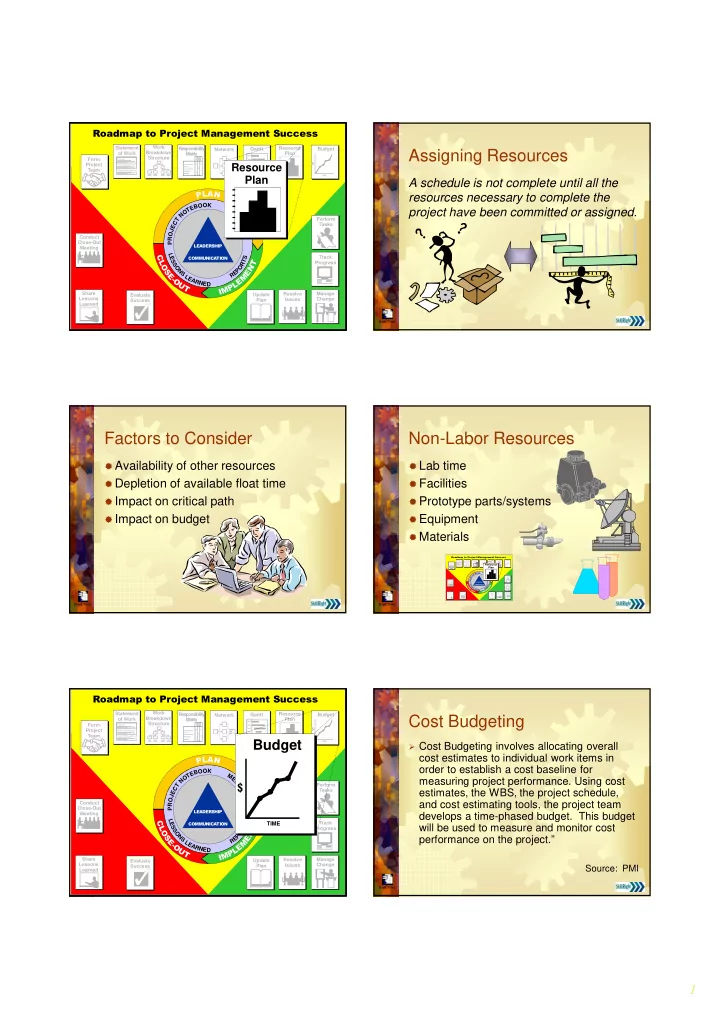
  • Assigning Resources

A schedule is not complete until all the resources necessary to complete the project have been committed or assigned.

  • Factors to Consider

Availability of other resources Depletion of available float time Impact on critical path Impact on budget

  • Non-Labor Resources

Lab time Facilities Prototype parts/systems Equipment Materials

Share Lessons Learned Evaluate Success Conduct Close-Out Meeting
  • Form
Project Team Statement
  • f Work
Purpos e Proje ct Bac kgroun d Proje ct D eli verabl es Work Breakdown Structure Res ponsi bil i ty Mat ri x R A A S S R Network Gantt Resource Plan Update Plan Resolve Issues Manage Change Track Progress Perform Tasks Budget TIME
  • P
R O J E C T N O T E B O O K M E E T I N G S R E P O R T S L E S S O N S L E A R N E D
  • Resource

Plan

  • Share

Lessons Learned Evaluate Success Conduct Close-Out Meeting

  • Form

Project Team Statement

  • f Work

Purpose Project Background Project Deliverables

Work Breakdown Structure Responsibility Matrix

R A A S S R

Network Gantt Resource Plan Update Plan Resolve Issues Manage Change Track Progress Perform Tasks

  • Budget

TIME

P R O J E C T N O T E B O O K M E E TI N G S R E P O R T S L E S S O N S L E A R N E D

  • Budget

TIME

  • Cost Budgeting

Cost Budgeting involves allocating overall

cost estimates to individual work items in

  • rder to establish a cost baseline for

measuring project performance. Using cost estimates, the WBS, the project schedule, and cost estimating tools, the project team develops a time-phased budget. This budget will be used to measure and monitor cost performance on the project.”

Source: PMI

slide-2
SLIDE 2

2

  • Budgeting Relationship

Level

  • f

Detail Planning Time plus Experience

Definitive Estimate : -5% to +10% Budget Estimate : -10% to +25% Order of Magnitude Estimate : -25% to +75%

  • Types of Budget Estimates

Order of Magnitude (Preliminary)

Supports decisions on project viability Includes historical cost data Actual cost within -25% to +75%

Budget Estimate

Supports project planning decisions Includes parametric modeling cost data Actual cost within -10% to +25%

Definitive

Supports project implementation Includes cost data for each WBS activity Actual cost within -5% to +10%

  • Obtaining Cost Data

Experience from past projects Functional subject matter experts Lessons learned Vendor quotes or bids Catalogs Cost estimating guides Buyers

  • Major Cost Categories

Capital Costs

Equipment Facility Modifications

Expenses

Labor costs Material costs Vendor/consultant costs

  • Facilities Modification

Line reconfiguration Alterations to existing building/structure New process flow Relocation of utility hook-ups

  • Other Cost Components

Overhead Management or contingency reserve

slide-3
SLIDE 3

3

  • Project Overhead

Equipment rental Travel Consultants Contract labor Facility support

  • Contingency Reserve

Weather delays Changes in design Unforeseen price increases Estimating errors Other project risks

  • Share

Lessons Learned Evaluate Success Conduct Close-Out Meeting

  • Form

Project Team Statement

  • f Work

Purpose Project Background Project Deliverables

Work Breakdown Structure Responsibility Matrix

R A A S S R

Network Gantt Resource Plan Update Plan Resolve Issues Manage Change Track Progress Perform Tasks Budget

TIME

  • P

R O J E C T N O T E B O O K M E E TI N G S R E P O R T S L E S S O N S L E A R N E D

  • What Is Risk?

Risk can be defined as:

“Any threat to project success.”

  • Schedule

Schedule

Within Available Resources

  • Risk Management

“Risk Management is the art and science of identifying, analyzing and responding to risk factors throughout the life of the project and in the best interests of its objectives.”

Source: PMI

slide-4
SLIDE 4

4

  • Risk Plan Development

Risk Identification Risk Quantification Response Development Risk Monitoring

  • Risk Identification Methods

Brainstorming Subject matter experts Historical data Lessons learned

  • Common Sources of Risk

Quality requirements Schedule constraints Cost limitations New technology Project complexity Third-party performance Contract terms (legal)

  • Prioritizing & Planning

PRIORITY 2 RISKS (High Probability) (Low Impact) Reactive Measures PRIORITY 1 RISKS (High Probability) (High Impact) Proactive and Reactive Measures PRIORITY 3 RISKS (Low Probability) (Low Impact) Monitor Only PRIORITY 2 RISKS (Low Probability) (High Impact) Reactive Measures Negative Impact on Scope/Quality/Cost/Schedule (Risk Event Value) Low High Medium 100% 50% 0% Probability of Occurrence

  • Risk Worksheet

Risk Worksheet

Date of Last Review: Project Manager: Date: Project Title: Risk Description: Risk Priority: 1 2 3 (Circle the Priority) Probability %: Risk Event Value (REV): Expected Monetary Value (EMV): Impacts: Quality Schedule Cost Scope Preventative Plan (Proactive Plan): (For Priority 1 Risks) Contingency Plan (Reactive Plan): (For Priority 1 and 2 Risks) Date of Last Review:

  • Team Activity — Risk

Management

  • Time:

Time: 15 Minutes

  • Instruction:

Instruction:

1) Identify at least one priority 1 or 2 risk for your team project. 2) Complete a risk worksheet for the risk identified. 3) Use the blank template following this page.

slide-5
SLIDE 5

5

  • Section 3.0

End of Planning Phase