Assessment Update 2014-2015 & Next Steps Every Student Succeeds - - PowerPoint PPT Presentation

assessment update 2014 2015 next steps
SMART_READER_LITE
LIVE PREVIEW

Assessment Update 2014-2015 & Next Steps Every Student Succeeds - - PowerPoint PPT Presentation

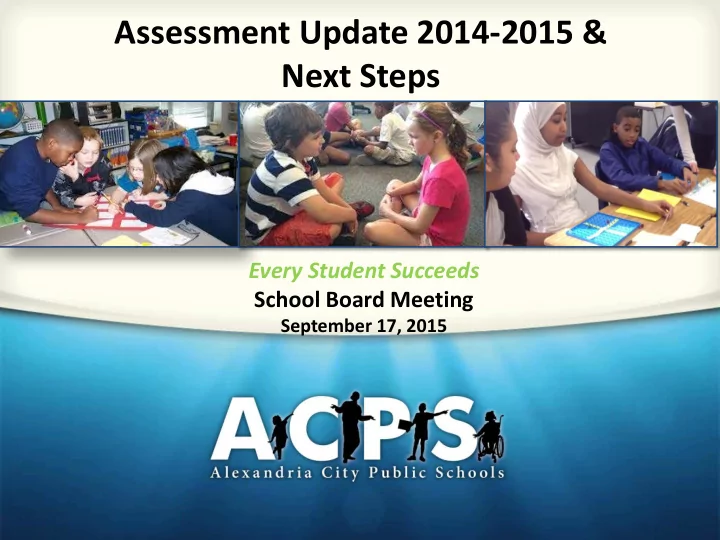
Assessment Update 2014-2015 & Next Steps Every Student Succeeds School Board Meeting September 17, 2015 www.acps.k12.va.us Assessment Update: 2014-2015 Preliminary Results Presented by: Clinton Page Chief Accountability Officer

slide-1
SLIDE 1

www.acps.k12.va.us

Assessment Update 2014-2015 & Next Steps

Every Student Succeeds School Board Meeting

September 17, 2015

slide-2
SLIDE 2

www.acps.k12.va.us www.acps.k12.va.us

2

Assessment Update: 2014-2015 Preliminary Results

Presented by: Clinton Page Chief Accountability Officer

slide-3
SLIDE 3

www.acps.k12.va.us www.acps.k12.va.us

3

Read All About It

slide-4
SLIDE 4

www.acps.k12.va.us www.acps.k12.va.us

4

Essential Questions

  • What are the two accountability systems?
  • How did ACPS perform in 2014-2015 according to each of

these systems?

  • Given the results, what are next steps for 2015-2016?
slide-5
SLIDE 5

www.acps.k12.va.us www.acps.k12.va.us

5

State Accreditation System

  • Measures achievement levels in English (Reading and

Writing), mathematics, science and history/social science.

  • New this year, schools not meeting the benchmark in the

current year or three-year average had the opportunity to meet the benchmark based on a four-year average.

slide-6
SLIDE 6

www.acps.k12.va.us www.acps.k12.va.us

6

State Accreditation Results

  • Fifteen of sixteen schools within ACPS earned state accreditation.
  • Twelve ACPS schools are Fully Accredited for the 2015-2016 school

year:

  • Two ACPS schools came out of warning from last year’s accreditation

status. – Patrick Henry earned full accreditation status after being warned for two consecutive years. – T.C. Williams earned full accreditation after previously having been warned in mathematics.

– Charles Barrett – Patrick Henry – Cora Kelly – Lyles-Crouch – Douglas MacArthur – George Mason – Matthew Maury – Mount Vernon – James K. Polk – Samuel Tucker – George Washington – T.C. Williams

slide-7
SLIDE 7

www.acps.k12.va.us www.acps.k12.va.us

7

State Accreditation Results

  • Schools not receiving Full Accreditation may have their current preliminary

Accreditation statuses changed based on potential Virginia Department of Education action scheduled for October 22, 2015.

  • Three ACPS schools are Accredited with Warning for 2015-2016: John

Adams, William Ramsay, and Francis C. Hammond, which is one less than last year. – John Adams is warned in one area, science, as is William Ramsay, which was warned in three areas last year. – Francis C. Hammond is warned in English and mathematics and is no longer warned in science, compared to 2014-2015.

  • Despite large gains, it is anticipated that Jefferson-Houston will remain in

Accreditation Denied status.

slide-8
SLIDE 8

www.acps.k12.va.us www.acps.k12.va.us

8

State Accreditation Highlights

  • 10 ACPS schools saw increases across all four content

areas

  • ACPS increased pass rates in all previously warned areas

by an average of 11 percentage points.

  • Patrick Henry, after having been warned in all four

content areas two years ago, increased performance by an average of 20 percentage points across all four content areas in the last two years to reach full accreditation this year.

slide-9
SLIDE 9

www.acps.k12.va.us www.acps.k12.va.us

9

State Accreditation Highlights: Jefferson-Houston

2014-2015 2015-2016 English 47% 61%

+14%

Math 46% 64%

+18%

History 51% 55%

+4%

Science 36% 60%

+24% Content Area Year Change

COMPARISON OF JEFFERSON-HOUSTON'S 2014-2015a AND 2015-2016b ACCREDITATION RESULTS

aData based on 2013-2014 school year bData based on 2014-2015 school year

slide-10
SLIDE 10

www.acps.k12.va.us www.acps.k12.va.us

10

Federal Annual Measurable Objectives (AMO)

  • Replaced Annual Yearly Progress (AYP)
  • Measures participation and achievement levels in reading

and mathematics

  • Reports the percent of students passing across nine

subgroups at the state, division, and school levels

slide-11
SLIDE 11

www.acps.k12.va.us www.acps.k12.va.us

11

Federal Annual Measurable Objectives (AMO)

slide-12
SLIDE 12

www.acps.k12.va.us www.acps.k12.va.us

12

Federal AMO’s can be met by:

  • Exceeding the AMO based on current year’s performance
  • Exceeding the AMO based on a 3 year average
  • Reducing the previous year’s failure rate by 10%
  • Having less than 30 students in a subgroup

“Higher Expectations” AMOs can be met by:

  • Having or maintaining progress within 5% of the previous

year

  • A subgroup that already exceeds the 6-year AMO and

showed year-to-year improvement

Federal Annual Measurable Objectives (AMO)

slide-13
SLIDE 13

www.acps.k12.va.us www.acps.k12.va.us

13

FAMO Highlights

  • ACPS saw performance increases across the division in

2014-2015 with five percentage point increases to passing rates across all students in the areas of English and mathematics when compared to the previous year.

66% 64% 71% 69%

0% 10% 20% 30% 40% 50% 60% 70% 80% 90% 100%

English Performance - All Students Math Performance - All Students 2013-14 Performance 2014-15 Performance

slide-14
SLIDE 14

www.acps.k12.va.us www.acps.k12.va.us

14

FAMO Highlights

  • As a division, ACPS met 16 out of 18 Federal English AMOs

and 16 out of 18 Federal Mathematics AMOs.

  • Four ACPS schools (Charles Barrett, Patrick Henry, Cora

Kelly, and Lyles-Crouch) met all 36 Federal AMOs with “higher expectations” in both English and mathematics.

17 10 16 16

2 4 6 8 10 12 14 16 18

English Math

AMOs Met in 2013-14 AMOs Met in 2014-15

slide-15
SLIDE 15

www.acps.k12.va.us www.acps.k12.va.us

15

Preliminary AMO Division Reading Performance

2013-14 2014-15 All Students 66% 71%

Yes - R10

Gap Group 1 53% 59%

Yes - R10

Gap Group 2 57% 65%

Yes

Gap Group 3 54% 57%

No

Asian 82% 82%

Yes - CI

Economically Disadvantaged 53% 59%

Yes - R10

Limited English Proficient 45% 51%

Yes - R10

Students with Disabilities 36% 37%

No

White 89% 91%

Yes - MP

School Year Data Collected Federal Subgroups Met Federal AMO?

71% 59% 65% 57% 82% 59% 51% 37% 91% 65% 64% 66% 80% 65% 61% 54% 76%

0% 10% 20% 30% 40% 50% 60% 70% 80% 90% 100% All Students Gap Gr 1 Gap Gr 2 Gap Gr 3 Asian FRL LEP SPED White

2014-2015 English Performance 2014-2015 English Benchmark

72% 66% 53% 57% 54% 82% 53% 45% 36% 89% 59% 57% 60% 80% 59% 52% 42% 75%

0% 10% 20% 30% 40% 50% 60% 70% 80% 90% 100% All Students Gap Gr 1 Gap Gr 2 Gap Gr 3 Asian FRL LEP SPED White

2013-14 English Performance 2013-14 English Benchmark

69%

slide-16
SLIDE 16

www.acps.k12.va.us www.acps.k12.va.us

16

  • ACPS met seven out of nine Federal English

performance AMOs by either the current year score being above the benchmark or a 10% reduction in the previous year’s failure rate.

  • In comparison to 2013-2014 performance, division

English scores increased or remained constant across all AMO subgroups.

  • The greatest increase in performance among subgroups

was that of gap group 2 (black students), which rose from 57% last year to 65% this year.

FAMO Results Summary - English

slide-17
SLIDE 17

www.acps.k12.va.us www.acps.k12.va.us

17

FAMO Results Summary - English

  • Students with Disabilities and gap group 3 (Hispanic

students) did not meet AMO targets at the division level based on their 2014-2015 performance levels.

  • Performance within the Students with Disabilities

subgroup increased one percentage point while the benchmark increased 12 percentage points when compared to last year.

  • English performance for gap group 3 (Hispanic students)

also fell below the benchmark (-9%) yet increased from the previous year (+3%).

slide-18
SLIDE 18

www.acps.k12.va.us www.acps.k12.va.us

18

Preliminary AMO Division Mathematics Performance

2013-14 2014-15 All Students 64% 69%

Yes

Gap Group 1 53% 58%

Yes - R10

Gap Group 2 55% 62%

Yes

Gap Group 3 53% 57%

Yes - R10

Asian 78% 82%

Yes - CI

Economically Disadvantaged 52% 58%

Yes - R10

Limited English Proficient 51% 55%

No

Students with Disabilities 30% 35%

No

White 87% 89%

Yes - MP

Met Federal AMO? Federal Subgroups School Year Data Collected

69% 58% 62% 57% 82% 58% 55% 35% 89% 63% 62% 65% 82% 63% 59% 57% 71%

0% 10% 20% 30% 40% 50% 60% 70% 80% 90% 100% All Students Gap Gr 1 Gap Gr 2 Gap Gr 3 Asian FRL LEP SPED White

2014-15 Math Performance 2014-15 Math Benchmark

68% 64% 53% 55% 53% 78% 52% 51% 30% 87% 57% 56% 60% 82% 57% 53% 49% 70%

0% 10% 20% 30% 40% 50% 60% 70% 80% 90% 100% All Students Gap Gr 1 Gap Gr 2 Gap Gr 3 Asian FRL LEP SPED White

2013-14 Math Performance 2013-14 Math Benchmark

66%

slide-19
SLIDE 19

www.acps.k12.va.us www.acps.k12.va.us

19

  • ACPS met seven out of nine Federal Mathematics

performance AMOs, which is in stark contrast to the 2013-2014 school year in which only one was met.

  • As with English scores, mathematics scores across the

division also exceeded those of last year. In comparison to 2013-2014 performance, mathematics scores increased across all AMO subgroups (ranging from +2 to +7 percentage points).

  • Again, the greatest increase in performance was for gap

group 2 (black students), which rose from 55% last year to 62% this year.

FAMO Results Summary - Mathematics

slide-20
SLIDE 20

www.acps.k12.va.us www.acps.k12.va.us

20

FAMO Results Summary - Mathematics

  • Students with Disabilities and Limited English

Proficient (LEP) students did not meet AMO targets at the division level based on their 2014-2015 performance levels.

  • Performance within the Students with Disabilities

subgroup increased five percentage points while the benchmark increased eight percentage points when compared to last year.

  • Math performance for LEP students also fell below the

benchmark (-4%) yet increased from the previous year (+4%).

slide-21
SLIDE 21

www.acps.k12.va.us www.acps.k12.va.us

21

Expedited Retake Pass Rate by Content Area Gr 3-8

  • Expedited retakes were made available by the Virginia Department of

Education for the first time in spring 2015 for grades 3-8.

  • Students scoring close to passing (375-399) on their first attempt were

considered for an expedited retake opportunity.

Content Area # Tests Taken % Pass on Expedited Retake English 568 46% Math 478 47% Science 195 41% History 166 37%

slide-22
SLIDE 22

www.acps.k12.va.us www.acps.k12.va.us

22

Expedited Retake Pass Rate by Test Gr 3-8

Content Area # Tests Taken % Pass on Expedited Retake Gr 3 Reading 108 47% Gr 3 Mathematics 106 58% Gr 4 Reading 128 56% Gr 4 Mathematics 87 37% Virginia Studies 85 48% Gr 5 Reading 77 48% Gr 5 Mathematics 75 55% Gr 5 Science 111 53% Gr 6 Reading 94 40% Gr 6 Math 101 44% Gr 7 Mathematics 102 44% Gr 7 Reading 72 40% Gr 8 Reading 89 40% Gr 8 Math 7 Too Small Gr 8 Science 84 25% Civics & Economics 81 26% All Tests 1407 45%

slide-23
SLIDE 23

www.acps.k12.va.us www.acps.k12.va.us

23

Next Steps

Presented by:

  • Dr. Terri Mozingo

Chief Academic Officer

slide-24
SLIDE 24

www.acps.k12.va.us www.acps.k12.va.us

24

Essential Questions

  • 1. What worked well in 2014-15?
  • 2. What lessons have we learned?
  • 3. What approaches will be used to

address gap group performance of SWD and ELL?

  • 4. How will we accelerate student

achievement going forward?

  • 5. How will we implement an aligned

planning approach to support all learners?

slide-25
SLIDE 25

www.acps.k12.va.us www.acps.k12.va.us

25

  • Set expectations for excellence using characteristics of high performing

schools

  • Used data to improve teaching and learning through job-embedded

professional development

  • Customized services and on-site support to schools based upon

disaggregated data analysis and formative assessments, especially for gap groups

  • Created and modeled lessons demonstrating instructional practices

aligned to Virginia state standards

  • Developed a Multi-Tiered System of Support to reinforce progress

monitoring and early intervention

  • Collaborated to achieve common outcomes and eliminate “silos” (e.g., ELL,

SWD, FARM, TAG/Honors, Student Services)

What Worked Well?

slide-26
SLIDE 26

www.acps.k12.va.us www.acps.k12.va.us

26

  • Working in cross-functional teams and collaboration at the division level is

critical for sustainable progress.

  • Creating a climate using data for planning and progress monitoring is essential

for informing decisions and improving student learning.

  • Supporting lesson planning aligned to the curriculum and standards is essential

for improving student outcomes.

What Lessons Were Learned?

  • Developing the MTSS framework to reinforce teaching the core

curriculum and using research-based interventions matched to the instructional needs of students.

  • Aligning instructional practices to VA state standards is a key

priority, including extending enrichment opportunities throughout the year.

  • Ongoing family and community involvement is essential for

improving student achievement.

slide-27
SLIDE 27

www.acps.k12.va.us www.acps.k12.va.us

27

Students with Disabilities

1. Customized professional learning with specific training standards/competencies for administrators, teachers, and support staff 2. Creation of cross-functional teams focusing upon achievement gap areas through reorganization of Department of Curriculum and Instruction 3. Ensuring standards-based teaching and learning that is rigorous and engaging using instructional walk-throughs with teacher feedback 4. Developing quality standards-based IEPs and related student progress monitoring (review of IEPs using a defined rubric) 5. Increasing parent engagement by expanding resources and staffing at the Parent Resource Center 6. Full implementation of the Multi-Tiered System of Support and using research based interventions in the targeted areas of reading and math based on individual student needs

  • 7. Division-level monitoring of SWD academic progress on formative assessments with

recommendations for improvement where needed

  • 8. Identify and share instructional practices in schools that have made significant progress with

schools that have not shown requisite gains in the performance of SWD

How Are We Addressing Priority Areas?

slide-28
SLIDE 28

www.acps.k12.va.us www.acps.k12.va.us

28

English Language Learners

  • 1. Customizing professional learning with specific training for administrators, teachers, and support

staff 2. Ensuring standards-based teaching and learning that is rigorous and engaging using instructional walk-throughs with teacher feedback 3. Implementing curricula that support the teaching of explicit vocabulary, language acquisition, and writing instruction to ELLs 4. Creation of cross-functional teams focusing upon achievement gap areas through reorganization of the Department of Curriculum and Instruction 5. Reinforcing research-based collaborative practices, including co-planning and co-teaching to maximize student engagement and student learning 6. Expanding the Adult Education Newcomers English Language Learner Program (NELL) 7. Division-level monitoring of ELL academic progress on formative assessments with recommendations for improvement where needed

  • 8. Identify and share instructional practices in schools that have shown significant progress with

schools than have not shown requisite gains in the performance of ELL

How Are We Addressing Priority Areas?

slide-29
SLIDE 29

www.acps.k12.va.us www.acps.k12.va.us

29

  • Implement a Multi-Tiered System of Support (MTSS)
  • Expand professional learning opportunities for teachers, principals, assistant

principals, and other staff

  • Customize professional development in lesson design, curriculum content, and

research-based best instructional practices

  • Emphasize collaboration and continuous feedback, including a new Academic

Advisory Committee

  • Stress reading, writing, and reasoning in the content areas, including

leadership cohorts in literacy, math, social studies and science

  • Increasing data-driven feedback to educators, including STAT and

walkthroughs

  • Provide targeted weekly support to schools, including feedback and

adjustment based upon continuous progress monitoring

How Will We Accelerate Student Achievement Going Forward ?

slide-30
SLIDE 30

www.acps.k12.va.us www.acps.k12.va.us

30

Levels of the System: Accelerating Student Achievement

Division Department School Student

slide-31
SLIDE 31

www.acps.k12.va.us

Superintendent School Board Karen A. Graf, Chair Kelly C. Booz Ronnie Campbell William E. Campbell Patricia Ann Hennig Stephanie A. Kapsis Justin Keating Marc Williams Christopher J. Lewis, Vice Chair

  • Dr. Alvin L. Crawley

31

Questions and Discussion

A Dream Realized …Every Student Succeeds