
SLIDE 1
BORN TO ENGINEER RESOURCES | BIONIC BOY
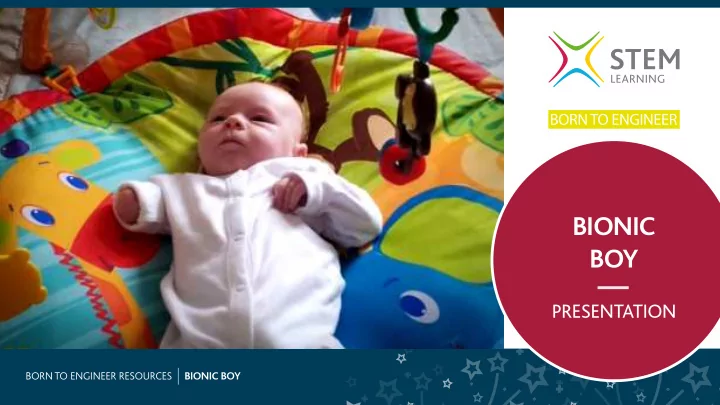
BIONIC BOY PRESENTATION BORN TO ENGINEER RESOURCES | BIONIC BOY - - PowerPoint PPT Presentation
BIONIC BOY PRESENTATION BORN TO ENGINEER RESOURCES | BIONIC BOY PRESENTATION Although Ben had not trained to be an Bionic Boy engineer, he was determined to help his son and this inspired him to design prototype arms that could be worn
BORN TO ENGINEER RESOURCES | BIONIC BOY
BORN TO ENGINEER RESOURCES | BIONIC BOY
2
Ben has founded the company Ambionics in order to develop this technology for the benefit of families across the world. Although Ben had not trained to be an engineer, he was determined to help his son and this inspired him to design prototype arms that could be worn from a much earlier age. His aim was to create a light, attractive and personalised limb, all produced with a 3D printer.
“My aim through Ambionics is to help children everywhere adopt and continue to use prosthetics into adulthood. Offering safe function with no small parts or batteries at the earliest possible age is key to achieving this.” Ben Ryan
Baby Sol was born in March 2015 and had his arm amputated when he was ten days
in his arm. Ben Ryan, Sol’s father, started to research
a prosthetic arm wouldn’t be available for Sol until he was at least 12 months old – and even when Sol is a year old, the artificial arm would be cosmetic with no grabbing or holding action.
BORN TO ENGINEER RESOURCES | BIONIC BOY
3
A prosthesis is a device that replaces a missing part of the human body (from Ancient Greek ‘prosthesis’: addition, application, attachment). What other prosthetics are you aware of?
BORN TO ENGINEER RESOURCES | BIONIC BOY
4
BORN TO ENGINEER RESOURCES | BIONIC BOY
5
References to prosthetic limbs in stories and poems, date back thousands
earliest historical accounts
were recorded in Greek and Roman times.
Prosthetic hand made from iron, dating around the 1500s.
In the year 2000, researchers in Cairo, Egypt, found what they believe to be the oldest artificial body part – a prosthetic toe made of wood and leather found attached to the nearly 3,000-year-old mummified remains
This provides a good guide to how little prosthetic limbs have changed throughout history.
BORN TO ENGINEER RESOURCES | BIONIC BOY
6
Artificial limbs started to be mass-produced in response to the enormous number
Technology continued to develop after the war with Queen Mary’s Hospital in Roehampton, England, becoming an important centre for manufacturing limbs.
Queen Mary’s Hospital, 1941
BORN TO ENGINEER RESOURCES | BIONIC BOY
7
Take a look at Ben Ryan’s video again, record your answers to the questions below What was Ben’s engineering challenge? What engineering materials does Ben talk about during the video? What technology does he use to create the working arm for Sol? How did he develop Sol’s arm? What stages of development did he go through? Before his son was born, Ben wasn’t an engineer. What engineering skills do you think he needed to learn? What challenges has he encountered in trying to create a prosthetic arm for his son, Sol?
BORN TO ENGINEER RESOURCES | BIONIC BOY
8 Spiders’ legs naturally want to contract, moving them inwards. Hydraulic power is the control of fluid to create movement
The outward movement of the spiders’ legs is controlled by the larger part of their body, which circulates fluid inside the body, flexing the legs hydraulically. The moving hand that Ben developed is inspired by the way that spiders move their legs.
BORN TO ENGINEER RESOURCES | BIONIC BOY
9
The prosthetic can have ‘superhuman’ functions, as long as they are safe for Sol to use. The designs that you create must be suitable for a child and must fit Sol comfortably.
Sol is growing up – he is already 3 years old and is getting ready to start school soon. Ben would like you to design a prosthetic arm that Sol can use when he is at school.
BORN TO ENGINEER RESOURCES | BIONIC BOY
10
BORN TO ENGINEER RESOURCES | BIONIC BOY
11
Can you create a prototype to develop your ideas?
How will the prosthetic arm look? (aesthetic prototype) What size will it be? (scale prototype) How will the prosthetic arm work? (functional prototype)
BORN TO ENGINEER RESOURCES | BIONIC BOY
12
Can you design a test that will help Ben to work out:
The maximum weight that Sol could carry Where the hook and loop should be located Hooks Loops
Hook and loop works by having two strips of material,
with lots of thinner loops that the hooks can cling to when the two elements are pressed together... The hooks and loops in Velcro are commonly made from nylon and polyester with the hooks being more rigid and thicker than the loops.
Peel strength Tensions strength Shear strength Cycle life
BORN TO ENGINEER RESOURCES | BIONIC BOY
13
How can you adapt the toy so that it could be used by someone with an additional need? The Christopher & Dana Reeve Foundation, who are dedicated to improving quality of life for people living with paralysis, created ‘Adaptoys’. Think of a toy that you played with when you were younger. Adaptoys are adapted versions of popular toys that allow people with physical disabilities to experience the happiness of playing with their families.
BORN TO ENGINEER RESOURCES | BIONIC BOY
14
When someone picks up an object, they can judge how much force to use, because the brain gets feedback from the touch receptors in their hand. Artificial hands (eg for robots or for prosthetic limbs) also need a sensing system if they are to use the correct force.
QTC is a rubber-like material containing tiny metal particles. It contains the metal nickel embedded in a polymer material. QTC stands for quantum tunnelling composite. When you squeeze it, its electrical resistance drops. QTC can act as a force sensor because it’s a material whose resistance increases when it is squeezed.
Explore the behaviour
Can you make a tactile sensor using QTC? Could QTC be used to give touch sensitivity in an artificial hand?