Assessing the Proposed 2014 Statistics Curriculum 9/22/2013 V0A V0A - - PDF document

assessing the proposed 2014 statistics curriculum 9 22
SMART_READER_LITE
LIVE PREVIEW

Assessing the Proposed 2014 Statistics Curriculum 9/22/2013 V0A V0A - - PDF document

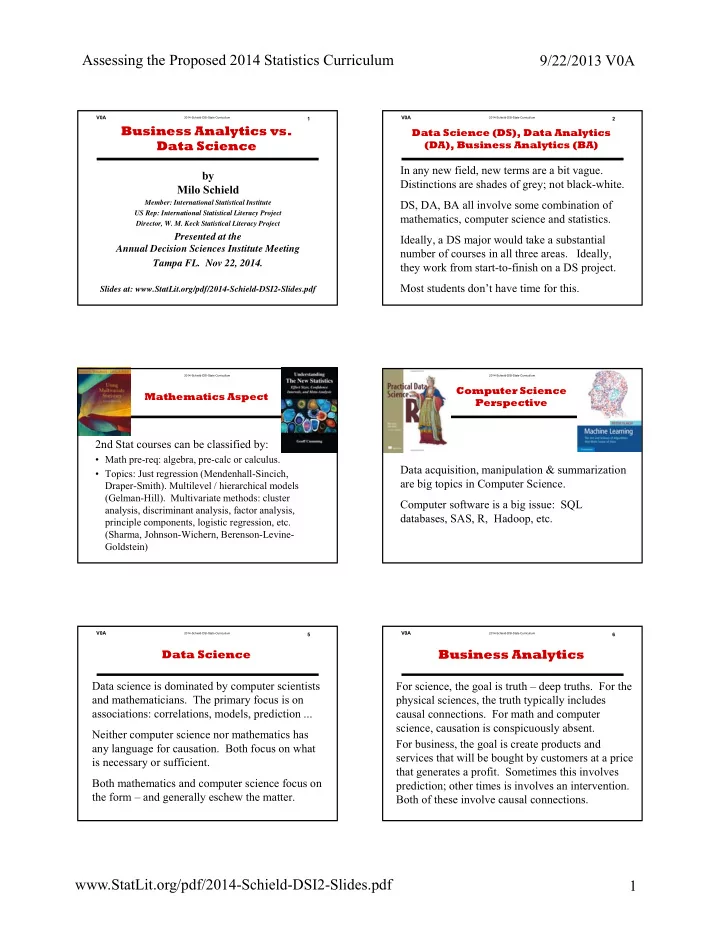
Assessing the Proposed 2014 Statistics Curriculum 9/22/2013 V0A V0A V0A 2014-Schield-DSI-Stats-Curricullum 1 2014-Schield-DSI-Stats-Curricullum 2 Business Analytics vs. Data Science (DS), Data Analytics Data Science (DA), Business


slide-1
SLIDE 1

Assessing the Proposed 2014 Statistics Curriculum 9/22/2013 V0A www.StatLit.org/pdf/2014-Schield-DSI2-Slides.pdf 1

2014-Schield-DSI-Stats-Curricullum

V0A 1

by Milo Schield

Member: International Statistical Institute US Rep: International Statistical Literacy Project Director, W. M. Keck Statistical Literacy Project

Presented at the Annual Decision Sciences Institute Meeting Tampa FL. Nov 22, 2014.

Slides at: www.StatLit.org/pdf/2014-Schield-DSI2-Slides.pdf

Business Analytics vs. Data Science

2014-Schield-DSI-Stats-Curricullum

V0A 2

Data Science (DS), Data Analytics (DA), Business Analytics (BA)

In any new field, new terms are a bit vague. Distinctions are shades of grey; not black-white. DS, DA, BA all involve some combination of mathematics, computer science and statistics. Ideally, a DS major would take a substantial number of courses in all three areas. Ideally, they work from start-to-finish on a DS project. Most students don’t have time for this.

2014-Schield-DSI-Stats-Curricullum

V0A 3

Mathematics Aspect

2nd Stat courses can be classified by:

  • Math pre-req: algebra, pre-calc or calculus.
  • Topics: Just regression (Mendenhall-Sincich,

Draper-Smith). Multilevel / hierarchical models (Gelman-Hill). Multivariate methods: cluster analysis, discriminant analysis, factor analysis, principle components, logistic regression, etc. (Sharma, Johnson-Wichern, Berenson-Levine- Goldstein)

2014-Schield-DSI-Stats-Curricullum

V0A 4

Computer Science Perspective

Data acquisition, manipulation & summarization are big topics in Computer Science. Computer software is a big issue: SQL databases, SAS, R, Hadoop, etc.

2014-Schield-DSI-Stats-Curricullum

V0A 5

Data Science Data science is dominated by computer scientists and mathematicians. The primary focus is on associations: correlations, models, prediction ... Neither computer science nor mathematics has any language for causation. Both focus on what is necessary or sufficient. Both mathematics and computer science focus on the form – and generally eschew the matter.

2014-Schield-DSI-Stats-Curricullum

V0A 6

Business Analytics

For science, the goal is truth – deep truths. For the physical sciences, the truth typically includes causal connections. For math and computer science, causation is conspicuously absent. For business, the goal is create products and services that will be bought by customers at a price that generates a profit. Sometimes this involves prediction; other times is involves an intervention. Both of these involve causal connections.

slide-2
SLIDE 2

Assessing the Proposed 2014 Statistics Curriculum 9/22/2013 V0A www.StatLit.org/pdf/2014-Schield-DSI2-Slides.pdf 2

2014-Schield-DSI-Stats-Curricullum

V0A 7

Four Big Ideas in Teaching Big-Data

  • 1. Association is not causation, but is often a sign
  • f causation somewhere.
  • 2. Confounding. Why getting more data may not

reduce confounding.

  • 3. Coincidence: Why coincidence increases as

the amount of data (# of rows) increases.

  • 4. Error: Why errors (false positives) increase as

the object of interest gets smaller (rarer).

2014-Schield-DSI-Stats-Curricullum

V0A 8

Statistical Literacy: Big Idea #1: Association

Just saying “Association is not Causation” exemplifies the “abstinence approach” to statistics. Abstinence may be fine in a math class. It is not acceptable in a Business program where associations are typically a sign of causation somewhere. Students should learn which statistical associations give stronger support for a causal connection.

2014-Schield-DSI-Stats-Curricullum

V0A 9

Statistical Literacy: Big Idea #2: Confounding

Confounders are related factors not taken into account in a study. The influence of confounders [confounding] is

  • mni-present in observational studies.

Simpson’s paradox (sign reversal or confounding)

  • is incidental when modelling or forecasting,
  • dominates when searching for causes.
2014-Schield-DSI-Stats-Curricullum

V0A 10

Statistical Literacy: Big Idea #3: Coincidence

Margin of error decreases as sample size increases. The Law of Very Large Numbers: the unlikely becomes almost certain given enough tries. Coincidence may be totally spurious or a sign

  • f causation.
2014-Schield-DSI-Stats-Curricullum

V0A 11

Statistical Literacy: Big Idea #4: Tests

False positive are a constant problem in tests. Qualitatively, the lower the prevalence of the group, the higher the chance of a false positive. Quantitatively, if the prevalence of the group of interest is the same as the error rate in the test, then the prediction accuracy is always 50%. The quantitative relationship is simple, memorable and helps in evaluating tests using Big Data.

2014-Schield-DSI-Stats-Curricullum

V0A 12

Conclusion

Business Analytics should focus on teaching the big ideas underlying the statistics produced by any analysis of observational data: big or small. Business Analytics should help students see which associations give stronger support for a causal

  • connection. They should be able to see the

influence of confounders, of coincidence and Type-1 errors in big data.

slide-3
SLIDE 3

Assessing the Proposed 2014 Statistics Curriculum 9/22/2013 V0A www.StatLit.org/pdf/2014-Schield-DSI2-Slides.pdf 3

2014-Schield-DSI-Stats-Curricullum

V0A 13

References

Berenson, (2013). Statistics Course for Big Data & Analytics. Slides at www.statlit.org/pdf/2013-Berenson-DSI-MSMESB-Slides.pdf Berenson, (2013). Big Data Implications for Stat Analysis & Instruction. www.statlit.org/pdf/2013-Berenson2-DSI-MSMESB-Slides.pdf Levine, Szabat & Stephan (2013). Data Discovery www.statlit.org/ pdf/2013-Levine-Szabat-Stephan-DSI-MSMESB-Slides.pdf Schield, M. (2014). Two Big Ideas for Teaching Big Data: ECOTS Paper at www.statlit.org/pdf/2014-Schield-ECOTS.pdf Schield, M. (2014). Big Data: Coincidence. National Numeracy Network. www.statlit.org/pdf/2014-Schield-NNN1-Slides.pdf Stine, D. (2013): Big Data Implications for intro stats. www.statlit.org/pdf/2013-Stine-DSI-MSMESB-Slides.pdf

slide-4
SLIDE 4

2014-Schield-DSI-Stats-Curricullum

V0A 1

by Milo Schield

Member: International Statistical Institute US Rep: International Statistical Literacy Project Director, W. M. Keck Statistical Literacy Project

Presented at the Annual Decision Sciences Institute Meeting Tampa FL. Nov 22, 2014.

Slides at: www.StatLit.org/pdf/2014-Schield-DSI2-Slides.pdf

Business Analytics vs. Data Science

slide-5
SLIDE 5

2014-Schield-DSI-Stats-Curricullum

V0A 2

Data Science (DS), Data Analytics (DA), Business Analytics (BA)

In any new field, new terms are a bit vague. Distinctions are shades of grey; not black-white. DS, DA, BA all involve some combination of mathematics, computer science and statistics. Ideally, a DS major would take a substantial number of courses in all three areas. Ideally, they work from start-to-finish on a DS project. Most students don’t have time for this.

slide-6
SLIDE 6

2014-Schield-DSI-Stats-Curricullum

V0A 3

Mathematics Aspect

2nd Stat courses can be classified by:

  • Math pre-req: algebra, pre-calc or calculus.
  • Topics: Just regression (Mendenhall-Sincich,

Draper-Smith). Multilevel / hierarchical models (Gelman-Hill). Multivariate methods: cluster analysis, discriminant analysis, factor analysis, principle components, logistic regression, etc. (Sharma, Johnson-Wichern, Berenson-Levine- Goldstein)

slide-7
SLIDE 7

2014-Schield-DSI-Stats-Curricullum

V0A 4

Computer Science Perspective

Data acquisition, manipulation & summarization are big topics in Computer Science. Computer software is a big issue: SQL databases, SAS, R, Hadoop, etc.

slide-8
SLIDE 8

2014-Schield-DSI-Stats-Curricullum

V0A 5

Data Science Data science is dominated by computer scientists and mathematicians. The primary focus is on associations: correlations, models, prediction ... Neither computer science nor mathematics has any language for causation. Both focus on what is necessary or sufficient. Both mathematics and computer science focus on the form – and generally eschew the matter.

slide-9
SLIDE 9

2014-Schield-DSI-Stats-Curricullum

V0A 6

Business Analytics

For science, the goal is truth – deep truths. For the physical sciences, the truth typically includes causal connections. For math and computer science, causation is conspicuously absent. For business, the goal is create products and services that will be bought by customers at a price that generates a profit. Sometimes this involves prediction; other times is involves an intervention. Both of these involve causal connections.

slide-10
SLIDE 10

2014-Schield-DSI-Stats-Curricullum

V0A 7

Four Big Ideas in Teaching Big-Data

  • 1. Association is not causation, but is often a sign
  • f causation somewhere.
  • 2. Confounding. Why getting more data may not

reduce confounding.

  • 3. Coincidence: Why coincidence increases as

the amount of data (# of rows) increases.

  • 4. Error: Why errors (false positives) increase as

the object of interest gets smaller (rarer).

slide-11
SLIDE 11

2014-Schield-DSI-Stats-Curricullum

V0A 8

Statistical Literacy: Big Idea #1: Association

Just saying “Association is not Causation” exemplifies the “abstinence approach” to statistics. Abstinence may be fine in a math class. It is not acceptable in a Business program where associations are typically a sign of causation somewhere. Students should learn which statistical associations give stronger support for a causal connection.

slide-12
SLIDE 12

2014-Schield-DSI-Stats-Curricullum

V0A 9

Statistical Literacy: Big Idea #2: Confounding

Confounders are related factors not taken into account in a study. The influence of confounders [confounding] is

  • mni-present in observational studies.

Simpson’s paradox (sign reversal or confounding)

  • is incidental when modelling or forecasting,
  • dominates when searching for causes.
slide-13
SLIDE 13

2014-Schield-DSI-Stats-Curricullum

V0A 10

Statistical Literacy: Big Idea #3: Coincidence

Margin of error decreases as sample size increases. The Law of Very Large Numbers: the unlikely becomes almost certain given enough tries. Coincidence may be totally spurious or a sign

  • f causation.
slide-14
SLIDE 14

2014-Schield-DSI-Stats-Curricullum

V0A 11

Statistical Literacy: Big Idea #4: Tests

False positive are a constant problem in tests. Qualitatively, the lower the prevalence of the group, the higher the chance of a false positive. Quantitatively, if the prevalence of the group of interest is the same as the error rate in the test, then the prediction accuracy is always 50%. The quantitative relationship is simple, memorable and helps in evaluating tests using Big Data.

slide-15
SLIDE 15

2014-Schield-DSI-Stats-Curricullum

V0A 12

Conclusion

Business Analytics should focus on teaching the big ideas underlying the statistics produced by any analysis of observational data: big or small. Business Analytics should help students see which associations give stronger support for a causal

  • connection. They should be able to see the

influence of confounders, of coincidence and Type-1 errors in big data.

slide-16
SLIDE 16

2014-Schield-DSI-Stats-Curricullum

V0A 13

References

Berenson, (2013). Statistics Course for Big Data & Analytics. Slides at www.statlit.org/pdf/2013-Berenson-DSI-MSMESB-Slides.pdf Berenson, (2013). Big Data Implications for Stat Analysis & Instruction. www.statlit.org/pdf/2013-Berenson2-DSI-MSMESB-Slides.pdf Levine, Szabat & Stephan (2013). Data Discovery www.statlit.org/ pdf/2013-Levine-Szabat-Stephan-DSI-MSMESB-Slides.pdf Schield, M. (2014). Two Big Ideas for Teaching Big Data: ECOTS Paper at www.statlit.org/pdf/2014-Schield-ECOTS.pdf Schield, M. (2014). Big Data: Coincidence. National Numeracy Network. www.statlit.org/pdf/2014-Schield-NNN1-Slides.pdf Stine, D. (2013): Big Data Implications for intro stats. www.statlit.org/pdf/2013-Stine-DSI-MSMESB-Slides.pdf