assembly / ISAs strategy write with gotos fjrst leaq (%rax, %rax, - - PowerPoint PPT Presentation

assembly isas
SMART_READER_LITE
LIVE PREVIEW

assembly / ISAs strategy write with gotos fjrst leaq (%rax, %rax, - - PowerPoint PPT Presentation

assembly / ISAs strategy write with gotos fjrst leaq (%rax, %rax, 2), %rax subq %rsp, %rax # memory[%rsp] = %rax pushq %rax movq %rsp, %rax the quiz: ASM 2 more detail today result = 0: equal; result positive: greater; result negative:


slide-1
SLIDE 1

assembly / ISAs

1

Changelog

Changes made in this version not seen in fjrst lecture:

5 September 2017: slide 3: lea destination should have been rax, not rsp 5 September 2017: slide 10: signed result w/o truncation is −264 + 1, not −264 − 1 5 September 2017: slide 12: changed version B and C to use jge 5 September 2017: slide 14: fjx bugs in third version: compare to 10 (not 9), end with %rbx set 8 September 2017: slide 11: use %rax, not %rbx

1

last time

AT&T syntax

movq (%rax,%rcx,4), %rbx = mov RBX, QWORD PTR [RAX + RCX * 4]

C to assembly

strategy — write with gotos fjrst

condition codes

set by arithmetic instructions + cmp or test used by conditional jump names based on subtraction (cmp) result = 0: equal; result positive: greater; result negative: less than …more detail today

2

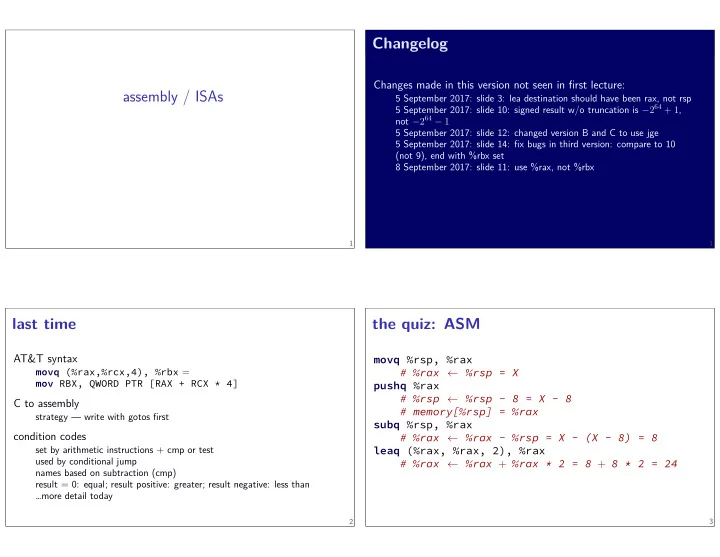
the quiz: ASM

movq %rsp, %rax # %rax ← %rsp = X pushq %rax # %rsp ← %rsp - 8 = X - 8 # memory[%rsp] = %rax subq %rsp, %rax # %rax ← %rax - %rsp = X - (X - 8) = 8 leaq (%rax, %rax, 2), %rax # %rax ← %rax + %rax * 2 = 8 + 8 * 2 = 24

3

slide-2
SLIDE 2

upcoming labs

this week: pointer-heavy code in C use tool to fjnd malloc/free-related mistakes fjx broken circular doubly-linked list implementation next week: in-lab quiz implement library functions strlen/strsep no notes

4

last time

AT&T syntax

movq (%rax,%rcx,4), %rbx = mov RBX, QWORD PTR [RAX + RCX * 4]

C to assembly

strategy — write with gotos fjrst

condition codes

set by arithmetic instructions + cmp or test used by conditional jump names based on subtraction (cmp) result = 0: equal; result positive: greater; result negative: less than …more detail today

5

condition codes and jumps

jg, jle, etc named based on interpreting result of subtraction zero: equal negative: less than positive: greater than

6

condition codes: closer look

x86 condition codes:

ZF (“zero fmag”) — was result zero? (sub/cmp: equal) SF (“sign fmag”) — was result negative? (sub/cmp: less) CF (“carry fmag”) — did computation overfmow (as unsigned)? OF (“overfmow fmag”) — did computation overfmow (as signed)? (and one more we won’t talk about)

GDB: part of “efmags” register set by cmp, test, arithmetic

7

slide-3
SLIDE 3

closer look: condition codes (1)

movq $−10, %rax movq $20, %rbx cmpq %rax, %rbx // result = %rbx - %rax = 30

as signed: 20 − (−10) = 30 as unsigned: 20 − (264 − 10) = ✘✘✘✘✘✘

✘ ❳❳❳❳❳❳ ❳

−264 − 30 30 (overfmow!)

ZF = 0 (false) not zero rax and rbx not equal

8

closer look: condition codes (1)

movq $−10, %rax movq $20, %rbx cmpq %rax, %rbx // result = %rbx - %rax = 30

as signed: 20 − (−10) = 30 as unsigned: 20 − (264 − 10) = ✘✘✘✘✘✘

✘ ❳❳❳❳❳❳ ❳

−264 − 30 30 (overfmow!)

ZF = 0 (false) not zero rax and rbx not equal

8

closer look: condition codes (1)

movq $−10, %rax movq $20, %rbx cmpq %rax, %rbx // result = %rbx - %rax = 30

as signed: 20 − (−10) = 30 as unsigned: 20 − (264 − 10) = ✘✘✘✘✘✘

✘ ❳❳❳❳❳❳ ❳

−264 − 30 30 (overfmow!)

ZF = 0 (false) not zero rax and rbx not equal SF = 0 (false) not negative rax <= rbx

8

closer look: condition codes (1)

movq $−10, %rax movq $20, %rbx cmpq %rax, %rbx // result = %rbx - %rax = 30

as signed: 20 − (−10) = 30 as unsigned: 20 − (264 − 10) = ✘✘✘✘✘✘

✘ ❳❳❳❳❳❳ ❳

−264 − 30 30 (overfmow!)

ZF = 0 (false) not zero rax and rbx not equal SF = 0 (false) not negative rax <= rbx OF = 0 (false) no overfmow as signed correct for signed

8

slide-4
SLIDE 4

closer look: condition codes (1)

movq $−10, %rax movq $20, %rbx cmpq %rax, %rbx // result = %rbx - %rax = 30

as signed: 20 − (−10) = 30 as unsigned: 20 − (264 − 10) = ✘✘✘✘✘✘

✘ ❳❳❳❳❳❳ ❳

−264 − 30 30 (overfmow!)

ZF = 0 (false) not zero rax and rbx not equal SF = 0 (false) not negative rax <= rbx OF = 0 (false) no overfmow as signed correct for signed CF = 1 (true)

  • verfmow as unsigned

incorrect for unsigned

8

exercise: condition codes (2)

// 2^63 - 1 movq $0x7FFFFFFFFFFFFFFF, %rax // 2^63 (unsigned); -2**63 (signed) movq $0x8000000000000000, %rbx cmpq %rax, %rbx // result = %rbx - %rax

ZF = ? SF = ? OF = ? CF = ?

9

closer look: condition codes (2)

// 2**63 - 1 movq $0x7FFFFFFFFFFFFFFF, %rax // 2**63 (unsigned); -2**63 (signed) movq $0x8000000000000000, %rbx cmpq %rax, %rbx // result = %rbx - %rax

as signed: −263 −

  • 263 − 1
  • = ✘✘✘✘✘

✘ ❳❳❳❳❳ ❳

−264 + 1 1 (overfmow) as unsigned: 263 −

  • 263 − 1
  • = 1

ZF = 0 (false) not zero rax and rbx not equal

10

closer look: condition codes (2)

// 2**63 - 1 movq $0x7FFFFFFFFFFFFFFF, %rax // 2**63 (unsigned); -2**63 (signed) movq $0x8000000000000000, %rbx cmpq %rax, %rbx // result = %rbx - %rax

as signed: −263 −

  • 263 − 1
  • = ✘✘✘✘✘

✘ ❳❳❳❳❳ ❳

−264 + 1 1 (overfmow) as unsigned: 263 −

  • 263 − 1
  • = 1

ZF = 0 (false) not zero rax and rbx not equal

10

slide-5
SLIDE 5

closer look: condition codes (2)

// 2**63 - 1 movq $0x7FFFFFFFFFFFFFFF, %rax // 2**63 (unsigned); -2**63 (signed) movq $0x8000000000000000, %rbx cmpq %rax, %rbx // result = %rbx - %rax

as signed: −263 −

  • 263 − 1
  • = ✘✘✘✘✘

✘ ❳❳❳❳❳ ❳

−264 + 1 1 (overfmow) as unsigned: 263 −

  • 263 − 1
  • = 1

ZF = 0 (false) not zero rax and rbx not equal SF = 0 (false) not negative rax <= rbx (if correct)

10

closer look: condition codes (2)

// 2**63 - 1 movq $0x7FFFFFFFFFFFFFFF, %rax // 2**63 (unsigned); -2**63 (signed) movq $0x8000000000000000, %rbx cmpq %rax, %rbx // result = %rbx - %rax

as signed: −263 −

  • 263 − 1
  • = ✘✘✘✘✘

✘ ❳❳❳❳❳ ❳

−264 + 1 1 (overfmow) as unsigned: 263 −

  • 263 − 1
  • = 1

ZF = 0 (false) not zero rax and rbx not equal SF = 0 (false) not negative rax <= rbx (if correct) OF = 1 (true)

  • verfmow as signed

incorrect for signed

10

closer look: condition codes (2)

// 2**63 - 1 movq $0x7FFFFFFFFFFFFFFF, %rax // 2**63 (unsigned); -2**63 (signed) movq $0x8000000000000000, %rbx cmpq %rax, %rbx // result = %rbx - %rax

as signed: −263 −

  • 263 − 1
  • = ✘✘✘✘✘

✘ ❳❳❳❳❳ ❳

−264 + 1 1 (overfmow) as unsigned: 263 −

  • 263 − 1
  • = 1

ZF = 0 (false) not zero rax and rbx not equal SF = 0 (false) not negative rax <= rbx (if correct) OF = 1 (true)

  • verfmow as signed

incorrect for signed CF = 0 (false) no overfmow as unsigned correct for unsigned

10

closer look: condition codes (3)

movq $−1, %rax addq $−2, %rax // result = -3

as signed: −1 + (−2) = −3 as unsigned: (264 − 1) + (264 − 2) = ✘✘✘✘

✘ ❳❳❳❳ ❳

265 − 3 264 − 3 (overfmow)

ZF = 0 (false) not zero result not zero

11

slide-6
SLIDE 6

closer look: condition codes (3)

movq $−1, %rax addq $−2, %rax // result = -3

as signed: −1 + (−2) = −3 as unsigned: (264 − 1) + (264 − 2) = ✘✘✘✘

✘ ❳❳❳❳ ❳

265 − 3 264 − 3 (overfmow)

ZF = 0 (false) not zero result not zero SF = 1 (true) negative result is negative OF = 0 (false) no overfmow as signed correct for signed CF = 1 (true)

  • verfmow as unsigned

incorrect for unsigned

11

while exercise

while (b < 10) { foo(); b += 1; } Assume b is in callee-saved register %rbx. Which are correct assembly translations?

// version A start_loop: call foo addq $1, %rbx cmpq $10, %rbx jl start_loop // version B start_loop: cmpq $10, %rbx jge end_loop call foo addq $1, %rbx jmp start_loop end_loop: // version C start_loop: movq $10, %rax subq %rbx, %rax jge end_loop call foo addq $1, %rbx jmp start_loop end_loop:

12

while to assembly (1)

while (b < 10) { foo(); b += 1; } start_loop: if (b < 10) goto end_loop; foo(); b += 1; goto start_loop; end_loop:

13

while to assembly (1)

while (b < 10) { foo(); b += 1; } start_loop: if (b < 10) goto end_loop; foo(); b += 1; goto start_loop; end_loop:

13

slide-7
SLIDE 7

while — levels of optimization

while (b < 10) { foo(); b += 1; }

start_loop: cmpq $10, %rbx jge end_loop call foo addq $1, %rbx jmp start_loop end_loop: ... ... ... ... cmpq $10, %rbx jge end_loop start_loop: call foo addq $1, %rbx cmpq $10, %rbx jne start_loop end_loop: ... ... ... cmpq $10, %rbx jge end_loop movq $10, %rax subq %rbx, %rax movq %rax, %rbx start_loop: call foo decq %rbx jne start_loop movq $10, %rbx end_loop:

14

while — levels of optimization

while (b < 10) { foo(); b += 1; }

start_loop: cmpq $10, %rbx jge end_loop call foo addq $1, %rbx jmp start_loop end_loop: ... ... ... ... cmpq $10, %rbx jge end_loop start_loop: call foo addq $1, %rbx cmpq $10, %rbx jne start_loop end_loop: ... ... ... cmpq $10, %rbx jge end_loop movq $10, %rax subq %rbx, %rax movq %rax, %rbx start_loop: call foo decq %rbx jne start_loop movq $10, %rbx end_loop:

14

while — levels of optimization

while (b < 10) { foo(); b += 1; }

start_loop: cmpq $10, %rbx jge end_loop call foo addq $1, %rbx jmp start_loop end_loop: ... ... ... ... cmpq $10, %rbx jge end_loop start_loop: call foo addq $1, %rbx cmpq $10, %rbx jne start_loop end_loop: ... ... ... cmpq $10, %rbx jge end_loop movq $10, %rax subq %rbx, %rax movq %rax, %rbx start_loop: call foo decq %rbx jne start_loop movq $10, %rbx end_loop:

14

compiling switches (1)

switch (a) { case 1: ...; break; case 2: ...; break; ... default: ... }

// same as if statement? cmpq $1, %rax je code_for_1 cmpq $2, %rax je code_for_2 cmpq $3, %rax je code_for_3 ... jmp code_for_default

15

slide-8
SLIDE 8

compiling switches (2)

switch (a) { case 1: ...; break; case 2: ...; break; ... case 100: ...; break; default: ... }

// binary search cmpq $50, %rax jl code_for_less_than_50 cmpq $75, %rax jl code_for_50_to_75 ... code_for_less_than_50: cmpq $25, %rax jl less_than_25_cases ...

16

compiling switches (3)

switch (a) { case 1: ...; break; case 2: ...; break; ... case 100: ...; break; default: ... }

// jump table cmpq $100, %rax jg code_for_default cmpq $1, %rax jl code_for_default jmp *table(,%rax,8) table: // not instructions // .quad = 64-bit (4 x 16) constant .quad code_for_1 .quad code_for_2 .quad code_for_3 .quad code_for_4 ...

17

computed jumps

cmpq $100, %rax jg code_for_default cmpq $1, %rax jl code_for_default // jump to memory[table + rax * 8] // table of pointers to instructions jmp *table(,%rax,8) // intel: jmp QWORD PTR[rax*8 + table] ... table: .quad code_for_1 .quad code_for_2 .quad code_for_3 ...

18

preview: our Y86 condition codes

ZF (zero fmag), SF (sign fmag) just won’t handle overfmow/underfmow

19

slide-9
SLIDE 9

microarchitecture v. instruction set

microarchitecture — design of the hardware

“generations” of Intel’s x86 chips difgerent microarchitectures for very low-power versus laptop/desktop changes in performance/effjciency

instruction set — interface visible by software

what matters for software compatibility many ways to implement (but some might be easier)

20

selected instruction set design concerns

ease of creating effjcient assembly/machine code ease of designing effjcient/cheap/low power/…hardware fmexibility for the future

21

ISAs being manufactured today

x86 — dominant in desktops, servers ARM — dominant in mobile devices POWER — Wii U, IBM supercomputers and some servers MIPS — common in consumer wifj access points SPARC — some Oracle servers, Fujitsu supercomputers z/Architecture — IBM mainframes Z80 — TI calculators SHARC — some digital signal processors Itanium — some HP servers (being retired) RISC V — some embedded …

22

ISA variation

instruction set instr. length # normal registers approx. # instrs. x86-64 1–15 byte 16 1500 Y86-64 1–10 byte 15 18 ARMv7 4 byte* 16 400 POWER8 4 byte 32 1400 MIPS32 4 byte 31 200 Itanium 41 bits* 128 300 Z80 1–4 byte 7 40 VAX 1–14 byte 8 150 z/Architecture 2–6 byte 16 1000 RISC V 4 byte* 31 500*

23

slide-10
SLIDE 10
  • ther choices: condition codes?

instead of: cmpq %r11, %r12 je somewhere could do: /* _B_ranch if _EQ_ual */ beq %r11, %r12, somewhere

24

  • ther choices: addressing modes

ways of specifying operands. examples: x86-64: 10(%r11,%r12,4) ARM: %r11 << 3 (shift register value by constant) VAX: ((%r11)) (register value is pointer to pointer)

25

  • ther choices: number of operands

add src1, src2, dest

ARM, POWER, MIPS, SPARC, …

add src2, src1=dest

x86, AVR, Z80, …

VAX: both

26

  • ther choices: instruction complexity

instructions that write multiple values?

x86-64: push, pop, movsb, …

more?

27

slide-11
SLIDE 11

CISC and RISC

RISC — Reduced Instruction Set Computer reduced from what? CISC — Complex Instruction Set Computer

28

CISC and RISC

RISC — Reduced Instruction Set Computer reduced from what? CISC — Complex Instruction Set Computer

28

some VAX instructions

MATCHC haystackPtr, haystackLen, needlePtr, needleLen Find the position of the string in needle within haystack. POLY x, coeffjcientsLen, coeffjcientsPtr Evaluate the polynomial whose coeffjcients are pointed to by coeffjcientPtr at the value x. EDITPC sourceLen, sourcePtr, patternLen, patternPtr Edit the string pointed to by sourcePtr using the pattern string specifjed by patternPtr.

29

microcode

MATCHC haystackPtr, haystackLen, needlePtr, needleLen Find the position of the string in needle within haystack.

loop in hardware??? typically: lookup sequence of microinstructions (“microcode”) secret simpler instruction set

30

slide-12
SLIDE 12

Why RISC?

complex instructions were usually not faster complex instructions were harder to implement compilers, not hand-written assembly

31

typical RISC ISA properties

fewer, simpler instructions seperate instructions to access memory fjxed-length instructions more registers no “loops” within single instructions no instructions with two memory operands few addressing modes

32

Y86-64 instruction set

based on x86

  • mits most of the 1000+ instructions

leaves addq jmp pushq subq jCC popq andq cmovCC movq (renamed) xorq call hlt (renamed) nop ret much, much simpler encoding

33

Y86-64 instruction set

based on x86

  • mits most of the 1000+ instructions

leaves addq jmp pushq subq jCC popq andq cmovCC movq (renamed) xorq call hlt (renamed) nop ret much, much simpler encoding

33

slide-13
SLIDE 13

Y86-64: movq

SDmovq

source destination

i — immediate r — register m — memory irmovq

✘✘✘✘✘ ✘ ❳❳❳❳❳ ❳

immovq

✘✘✘✘✘ ✘ ❳❳❳❳❳ ❳

iimovq rrmovq rmmovq

✘✘✘✘✘ ✘ ❳❳❳❳❳ ❳

rimovq mrmovq

✭✭✭✭✭ ✭ ❤❤❤❤❤ ❤

mmmovq

✘✘✘✘✘ ✘ ❳❳❳❳❳ ❳

mimovq

34

Y86-64: movq

SDmovq

source destination

i — immediate r — register m — memory irmovq

✘✘✘✘✘ ✘ ❳❳❳❳❳ ❳

immovq

✘✘✘✘✘ ✘ ❳❳❳❳❳ ❳

iimovq rrmovq rmmovq

✘✘✘✘✘ ✘ ❳❳❳❳❳ ❳

rimovq mrmovq

✭✭✭✭✭ ✭ ❤❤❤❤❤ ❤

mmmovq

✘✘✘✘✘ ✘ ❳❳❳❳❳ ❳

mimovq

34

Y86-64: movq

SDmovq

source destination

i — immediate r — register m — memory irmovq

✘✘✘✘✘ ✘ ❳❳❳❳❳ ❳

immovq

✘✘✘✘✘ ✘ ❳❳❳❳❳ ❳

iimovq rrmovq rmmovq

✘✘✘✘✘ ✘ ❳❳❳❳❳ ❳

rimovq mrmovq

✭✭✭✭✭ ✭ ❤❤❤❤❤ ❤

mmmovq

✘✘✘✘✘ ✘ ❳❳❳❳❳ ❳

mimovq

34

Y86-64 instruction set

based on x86

  • mits most of the 1000+ instructions

leaves addq jmp pushq subq jCC popq andq cmovCC movq (renamed) xorq call hlt (renamed) nop ret much, much simpler encoding

35

slide-14
SLIDE 14

cmovCC

conditional move exist on x86-64 (but you probably didn’t see them) Y86-64: register-to-register only instead of: jle skip_move rrmovq %rax, %rbx skip_move: // ... can do: cmovg %rax, %rbx

36

Y86-64 instruction set

based on x86

  • mits most of the 1000+ instructions

leaves addq jmp pushq subq jCC popq andq cmovCC movq (renamed) xorq call hlt (renamed) nop ret much, much simpler encoding

37

halt

(x86-64 instruction called hlt) Y86-64 instruction halt stops the processor

  • therwise — something’s in memory “after” program!

real processors: reserved for OS

38

Y86-64: specifying addresses

Valid: rmmovq %r11, 10(%r12) Invalid: rmmovq %r11, 10(%r12,%r13) Invalid: rmmovq %r11, 10(,%r12,4) Invalid: rmmovq %r11, 10(%r12,%r13,4)

39

slide-15
SLIDE 15

Y86-64: specifying addresses

Valid: rmmovq %r11, 10(%r12) Invalid:

✭✭✭✭✭✭✭✭✭✭✭✭✭✭✭✭✭✭✭✭✭✭✭ ✭ ❤❤❤❤❤❤❤❤❤❤❤❤❤❤❤❤❤❤❤❤❤❤❤ ❤

rmmovq %r11, 10(%r12,%r13) Invalid:

✭✭✭✭✭✭✭✭✭✭✭✭✭✭✭✭✭✭✭✭✭ ✭ ❤❤❤❤❤❤❤❤❤❤❤❤❤❤❤❤❤❤❤❤❤ ❤

rmmovq %r11, 10(,%r12,4) Invalid:

✭✭✭✭✭✭✭✭✭✭✭✭✭✭✭✭✭✭✭✭✭✭✭✭✭ ✭ ❤❤❤❤❤❤❤❤❤❤❤❤❤❤❤❤❤❤❤❤❤❤❤❤❤ ❤

rmmovq %r11, 10(%r12,%r13,4)

39

Y86-64: accessing memory (1)

r12 ← memory[10 + r11] + r12 Invalid:

✭✭✭✭✭✭✭✭✭✭✭✭✭✭✭✭✭ ✭ ❤❤❤❤❤❤❤❤❤❤❤❤❤❤❤❤❤ ❤

addq 10(%r11), %r12 Instead: mrmovq 10(%r11), %r11 /* overwrites %r11 */ addq %r11, %r12

40

Y86-64: accessing memory (1)

r12 ← memory[10 + r11] + r12 Invalid:

✭✭✭✭✭✭✭✭✭✭✭✭✭✭✭✭✭ ✭ ❤❤❤❤❤❤❤❤❤❤❤❤❤❤❤❤❤ ❤

addq 10(%r11), %r12 Instead: mrmovq 10(%r11), %r11 /* overwrites %r11 */ addq %r11, %r12

40

Y86-64: accessing memory (2)

r12 ← memory[10 + 8 * r11] + r12 Invalid:

✭✭✭✭✭✭✭✭✭✭✭✭✭✭✭✭✭✭✭✭ ❤❤❤❤❤❤❤❤❤❤❤❤❤❤❤❤❤❤❤❤

addq 10(,%r11,8), %r12 Instead: /* replace %r11 with 8*%r11 */ addq %r11, %r11 addq %r11, %r11 addq %r11, %r11 mrmovq 10(%r11), %r11 addq %r11, %r12

41

slide-16
SLIDE 16

Y86-64: accessing memory (2)

r12 ← memory[10 + 8 * r11] + r12 Invalid:

✭✭✭✭✭✭✭✭✭✭✭✭✭✭✭✭✭✭✭✭ ❤❤❤❤❤❤❤❤❤❤❤❤❤❤❤❤❤❤❤❤

addq 10(,%r11,8), %r12 Instead: /* replace %r11 with 8*%r11 */ addq %r11, %r11 addq %r11, %r11 addq %r11, %r11 mrmovq 10(%r11), %r11 addq %r11, %r12

41

Y86-64 constants (1)

irmovq $100, %r11

  • nly instruction with non-address constant operand

42

Y86-64 constants (2)

r12 ← r12 + 1 Invalid: ✭✭✭✭✭✭✭✭✭✭✭✭

❤❤❤❤❤❤❤❤❤❤❤❤

addq $1, %r12 Instead, need an extra register: irmovq $1, %r11 addq %r11, %r12

43

Y86-64 constants (2)

r12 ← r12 + 1 Invalid: ✭✭✭✭✭✭✭✭✭✭✭✭

❤❤❤❤❤❤❤❤❤❤❤❤

addq $1, %r12 Instead, need an extra register: irmovq $1, %r11 addq %r11, %r12

43

slide-17
SLIDE 17

Y86-64: operand uniqueness

  • nly one kind of value for each operand

instruction name tells you the kind (why movq was ‘split’ into four names)

44

Y86-64: condition codes

ZF — value was zero? SF — sign bit was set? i.e. value was negative? this course: no OF, CF (to simplify assignments) set by addq, subq, andq, xorq not set by anything else

45

Y86-64: using condition codes

subq SECOND, FIRST (value = FIRST - SECOND)

j__

  • r

cmov__ condition code bit test value test le SF = 1 or ZF = 1 value ≤ 0 l SF = 1 value < 0 e ZF = 1 value = 0 ne ZF = 0 value = 0 ge SF = 0 value ≥ 0 g SF = 0 and ZF = 0 value > 0

missing OF (overfmow fmag); CF (carry fmag)

46

Y86-64: conditionals (1)

✘✘✘ ❳❳❳

cmp, ✘✘✘

✘ ❳❳❳ ❳

test instead: use side efgect of normal arithmetic instead of cmpq %r11, %r12 jle somewhere maybe: subq %r11, %r12 jle (but changes %r12)

47

slide-18
SLIDE 18

Y86-64: conditionals (1)

✘✘✘ ❳❳❳

cmp, ✘✘✘

✘ ❳❳❳ ❳

test instead: use side efgect of normal arithmetic instead of cmpq %r11, %r12 jle somewhere maybe: subq %r11, %r12 jle (but changes %r12)

47

Y86-64: conditionals (1)

✘✘✘ ❳❳❳

cmp, ✘✘✘

✘ ❳❳❳ ❳

test instead: use side efgect of normal arithmetic instead of cmpq %r11, %r12 jle somewhere maybe: subq %r11, %r12 jle (but changes %r12)

47

push/pop

pushq %rbx

%rsp ← %rsp − 8 memory[%rsp] ← %rbx

popq %rbx

%rbx ← memory[%rsp] %rsp ← %rsp + 8

. . . memory[%rsp + 16] memory[%rsp + 8] memory[%rsp] memory[%rsp - 8] memory[%rsp - 16]

value to pop where to push

stack growth

48

call/ret

call LABEL

push PC (next instruction address) on stack jmp to LABEL address

ret

pop address from stack jmp to that address

. . . memory[%rsp + 16] memory[%rsp + 8] memory[%rsp] memory[%rsp - 8] memory[%rsp - 16]

address ret jumps to where call stores return address

stack growth

49

slide-19
SLIDE 19

Y86-64 state

%rXX — 15 registers

%r15 missing smaller parts of registers missing

ZF (zero), SF (sign), OF (overfmow)

book has OF, we’ll not use it CF (carry) missing

Stat — processor status — halted? PC — program counter (AKA instruction pointer) main memory

50

typical RISC ISA properties

fewer, simpler instructions seperate instructions to access memory fjxed-length instructions more registers no “loops” within single instructions no instructions with two memory operands few addressing modes

51

Y86-64 instruction formats

byte: 1 2 3 4 5 6 7 8 9 halt nop 1 rrmovq/cmovCC rA, rB 2 cc rA rB irmovq V, rB 3 F rB rmmovq rA, D(rB) 4 0 rA rB mrmovq D(rB), rA 5 0 rA rB OPq rA, rB 6 fn rA rB jCC Dest 7 cc call Dest 8 ret 9 pushq rA A 0 rA F popq rA B 0 rA F V D D Dest Dest

52

Secondary opcodes: cmovcc/jcc

byte: 1 2 3 4 5 6 7 8 9 halt nop 1 rrmovq/cmovCC rA, rB 2 cc rA rB irmovq V, rB 3 F rB rmmovq rA, D(rB) 4 0 rA rB mrmovq D(rB), rA 5 0 rA rB OPq rA, rB 6 fn rA rB jCC Dest 7 cc call Dest 8 ret 9 pushq rA A 0 rA F popq rA B 0 rA F V D D Dest Dest 0 always (jmp/rrmovq) 1 le 2 l 3 e 4 ne 5 ge 6 g

53

slide-20
SLIDE 20

Secondary opcodes: OPq

byte: 1 2 3 4 5 6 7 8 9 halt nop 1 rrmovq/cmovCC rA, rB 2 cc rA rB irmovq V, rB 3 F rB rmmovq rA, D(rB) 4 0 rA rB mrmovq D(rB), rA 5 0 rA rB OPq rA, rB 6 fn rA rB jCC Dest 7 cc call Dest 8 ret 9 pushq rA A 0 rA F popq rA B 0 rA F V D D Dest Dest

add

1

sub

2

and

3

xor

54

Registers: rA, rB

byte: 1 2 3 4 5 6 7 8 9 halt nop 1 rrmovq/cmovCC rA, rB 2 cc rA rB irmovq V, rB 3 F rB rmmovq rA, D(rB) 4 0 rA rB mrmovq D(rB), rA 5 0 rA rB OPq rA, rB 6 fn rA rB jCC Dest 7 cc call Dest 8 ret 9 pushq rA A 0 rA F popq rA B 0 rA F V D D Dest Dest

%rax

8

%r8

1

%rcx

9

%r9

2

%rdx

A

%r10

3

%rbx

B

%r11

4

%rsp

C

%r12

5

%rbp

D

%r13

6

%rsi

E

%r14

7

%rdi

F

none

55

Immediates: V, D, Dest

byte: 1 2 3 4 5 6 7 8 9 halt nop 1 rrmovq/cmovCC rA, rB 2 cc rA rB irmovq V, rB 3 F rB rmmovq rA, D(rB) 4 0 rA rB mrmovq D(rB), rA 5 0 rA rB OPq rA, rB 6 fn rA rB jCC Dest 7 cc call Dest 8 ret 9 pushq rA A 0 rA F popq rA B 0 rA F V D D Dest Dest

56

Immediates: V, D, Dest

byte: 1 2 3 4 5 6 7 8 9 halt nop 1 rrmovq/cmovCC rA, rB 2 cc rA rB irmovq V, rB 3 F rB rmmovq rA, D(rB) 4 0 rA rB mrmovq D(rB), rA 5 0 rA rB OPq rA, rB 6 fn rA rB jCC Dest 7 cc call Dest 8 ret 9 pushq rA A 0 rA F popq rA B 0 rA F V D D Dest Dest

56

slide-21
SLIDE 21

Y86-64 encoding (1)

long addOne(long x) { return x + 1; } x86-64: movq %rdi, %rax addq $1, %rax ret Y86-64: irmovq $1, %rax addq %rdi, %rax ret

57

Y86-64 encoding (1)

long addOne(long x) { return x + 1; } x86-64: movq %rdi, %rax addq $1, %rax ret Y86-64: irmovq $1, %rax addq %rdi, %rax ret

57

Y86-64 encoding (2)

addOne: irmovq $1, %rax addq %rdi, %rax ret ⋆

3 F %rax 01 00 00 00 00 00 00 00

30 F0 01 00 00 00 00 00 00 00 60 70 90

58

Y86-64 encoding (2)

addOne: irmovq $1, %rax addq %rdi, %rax ret ⋆

3 F 01 00 00 00 00 00 00 00

30 F0 01 00 00 00 00 00 00 00 60 70 90

58

slide-22
SLIDE 22

Y86-64 encoding (2)

addOne: irmovq $1, %rax addq %rdi, %rax ret

3 F 01 00 00 00 00 00 00 00

6 add %rdi %rax

30 F0 01 00 00 00 00 00 00 00 60 70 90

58

Y86-64 encoding (2)

addOne: irmovq $1, %rax addq %rdi, %rax ret

3 F 01 00 00 00 00 00 00 00

6 7

30 F0 01 00 00 00 00 00 00 00 60 70 90

58

Y86-64 encoding (2)

addOne: irmovq $1, %rax addq %rdi, %rax ret

3 F 01 00 00 00 00 00 00 00 6 7

9

30 F0 01 00 00 00 00 00 00 00 60 70 90

58

Y86-64 encoding (2)

addOne: irmovq $1, %rax addq %rdi, %rax ret

3 F 01 00 00 00 00 00 00 00 6 7 9

30 F0 01 00 00 00 00 00 00 00 60 70 90

58

slide-23
SLIDE 23

Y86-64 encoding (3)

doubleTillNegative: /* suppose at address 0x123 */ addq %rax, %rax jge doubleTillNegative

6 add %rax %rax

59

Y86-64 encoding (3)

doubleTillNegative: /* suppose at address 0x123 */ addq %rax, %rax jge doubleTillNegative ⋆

6 add %rax %rax

59

Y86-64 encoding (3)

doubleTillNegative: /* suppose at address 0x123 */ addq %rax, %rax jge doubleTillNegative ⋆

6

59

Y86-64 encoding (3)

doubleTillNegative: /* suppose at address 0x123 */ addq %rax, %rax jge doubleTillNegative

6 7 5 23 01 00 00 00 00 00 00

59

slide-24
SLIDE 24

Y86-64 encoding (3)

doubleTillNegative: /* suppose at address 0x123 */ addq %rax, %rax jge doubleTillNegative

6

7 5 23 01 00 00 00 00 00 00

59

Y86-64 encoding (3)

doubleTillNegative: /* suppose at address 0x123 */ addq %rax, %rax jge doubleTillNegative

6 7 5 23 01 00 00 00 00 00 00

59

Y86-64 decoding

20 10 60 20 61 37 72 84 00 00 00 00 00 00 00 20 12 20 01 70 68 00 00 00 00 00 00 00 rrmovq %rcx, %rax addq %rdx, %rax subq %rbx, %rdi jl 0x84 rrmovq %rax, %rcx jmp 0x68

byte: 1 2 3 4 5 6 7 8 9 halt nop 1 rrmovq/cmovCC rA, rB 2 cc rA rB irmovq V, rB 3 F rB rmmovq rA, D(rB) 4 0 rA rB mrmovq D(rB), rA 5 0 rA rB OPq rA, rB 6 fn rA rB jCC Dest 7 cc call Dest 8 ret 9 pushq rA A 0 rA F popq rA B 0 rA F V D D Dest Dest

60

Y86-64 decoding

20 10 60 20 61 37 72 84 00 00 00 00 00 00 00 20 12 20 01 70 68 00 00 00 00 00 00 00 rrmovq %rcx, %rax addq %rdx, %rax subq %rbx, %rdi jl 0x84 rrmovq %rax, %rcx jmp 0x68

byte: 1 2 3 4 5 6 7 8 9 halt nop 1 rrmovq/cmovCC rA, rB 2 cc rA rB irmovq V, rB 3 F rB rmmovq rA, D(rB) 4 0 rA rB mrmovq D(rB), rA 5 0 rA rB OPq rA, rB 6 fn rA rB jCC Dest 7 cc call Dest 8 ret 9 pushq rA A 0 rA F popq rA B 0 rA F V D D Dest Dest

60

slide-25
SLIDE 25

Y86-64 decoding

20 10 60 20 61 37 72 84 00 00 00 00 00 00 00 20 12 20 01 70 68 00 00 00 00 00 00 00 rrmovq %rcx, %rax

◮ 0 as cc: always ◮ 1 as reg: %rcx ◮ 0 as reg: %rax

addq %rdx, %rax subq %rbx, %rdi jl 0x84 rrmovq %rax, %rcx jmp 0x68

byte: 1 2 3 4 5 6 7 8 9 halt nop 1 rrmovq/cmovCC rA, rB 2 cc rA rB irmovq V, rB 3 F rB rmmovq rA, D(rB) 4 0 rA rB mrmovq D(rB), rA 5 0 rA rB OPq rA, rB 6 fn rA rB jCC Dest 7 cc call Dest 8 ret 9 pushq rA A 0 rA F popq rA B 0 rA F V D D Dest Dest

60

Y86-64 decoding

20 10 60 20 61 37 72 84 00 00 00 00 00 00 00 20 12 20 01 70 68 00 00 00 00 00 00 00 rrmovq %rcx, %rax addq %rdx, %rax subq %rbx, %rdi

◮ 0 as fn: add ◮ 1 as fn: sub

jl 0x84 rrmovq %rax, %rcx jmp 0x68

byte: 1 2 3 4 5 6 7 8 9 halt nop 1 rrmovq/cmovCC rA, rB 2 cc rA rB irmovq V, rB 3 F rB rmmovq rA, D(rB) 4 0 rA rB mrmovq D(rB), rA 5 0 rA rB OPq rA, rB 6 fn rA rB jCC Dest 7 cc call Dest 8 ret 9 pushq rA A 0 rA F popq rA B 0 rA F V D D Dest Dest

60

Y86-64 decoding

20 10 60 20 61 37 72 84 00 00 00 00 00 00 00 20 12 20 01 70 68 00 00 00 00 00 00 00 rrmovq %rcx, %rax addq %rdx, %rax subq %rbx, %rdi jl 0x84

◮ 2 as cc: l (less than) ◮ hex 84 00… as little endian Dest:

0x84

rrmovq %rax, %rcx jmp 0x68

byte: 1 2 3 4 5 6 7 8 9 halt nop 1 rrmovq/cmovCC rA, rB 2 cc rA rB irmovq V, rB 3 F rB rmmovq rA, D(rB) 4 0 rA rB mrmovq D(rB), rA 5 0 rA rB OPq rA, rB 6 fn rA rB jCC Dest 7 cc call Dest 8 ret 9 pushq rA A 0 rA F popq rA B 0 rA F V D D Dest Dest

60

Y86-64 decoding

20 10 60 20 61 37 72 84 00 00 00 00 00 00 00 20 12 20 01 70 68 00 00 00 00 00 00 00 rrmovq %rcx, %rax addq %rdx, %rax subq %rbx, %rdi jl 0x84 rrmovq %rax, %rcx jmp 0x68

byte: 1 2 3 4 5 6 7 8 9 halt nop 1 rrmovq/cmovCC rA, rB 2 cc rA rB irmovq V, rB 3 F rB rmmovq rA, D(rB) 4 0 rA rB mrmovq D(rB), rA 5 0 rA rB OPq rA, rB 6 fn rA rB jCC Dest 7 cc call Dest 8 ret 9 pushq rA A 0 rA F popq rA B 0 rA F V D D Dest Dest

60

slide-26
SLIDE 26

Y86-64: convenience for hardware

4 bits to decode instruction size/layout (mostly) uniform placement of

  • perands

jumping to zeroes (uninitialized?) by accident halts no attempt to fjt (parts of) multiple instructions in a byte

byte: 1 2 3 4 5 6 7 8 9 halt nop 1 rrmovq/cmovCC rA, rB 2 cc rA rB irmovq V, rB 3 F rB rmmovq rA, D(rB) 4 0 rA rB mrmovq D(rB), rA 5 0 rA rB OPq rA, rB 6 fn rA rB jCC Dest 7 cc call Dest 8 ret 9 pushq rA A 0 rA F popq rA B 0 rA F V D D Dest Dest

61

Y86-64

Y86-64: simplifjed, more RISC-y version of X86-64 minimal set of arithmetic

  • nly movs touch memory
  • nly jumps, calls, and movs take immediates

simple variable-length encoding next time: implementing with circuits

62

backup slides

63

closer look: condition codes (3)

movq $−1, %rax testq %rax, %rax // result = -1 ZF = 0 (false) not zero rax not zero SF = 1 (true) negative rax is negative OF = 0 (false) no overfmow as signed

  • peration can’t overfmow

CF = 0 (false) no ovefmow as unsigned

  • peration can’t overfmow

64

slide-27
SLIDE 27

exercise: condition codes and jXX

ZF = 0 (false) SF = 1 (true) OF = 0 (false) CF = 1 (true)

jle (signed less than equal) should do what? ja (unsigned greater than) should do what?

65

logical operators

return 1 for true or 0 for false

( 1 && 1 ) == 1 ( 1 || 1 ) == 1 ( 2 && 4 ) == 1 ( 2 || 4 ) == 1 ( 1 && 0 ) == 0 ( 1 || 0 ) == 1 ( 0 && 0 ) == 0 ( 0 || 0 ) == 0 (-1 && -2) == 1 (-1 || -2) == 1 ("" && "") == 1 ("" || "") == 1 ! 1 == 0 ! 4 == 0 !-1 == 0 ! 0 == 1

67

recall: short-circuit (&&)

1 #include <stdio.h> 2 int zero() { printf("zero()\n"); return 0; } 3 int one() { printf("one()\n"); return 1; } 4 int main() { 5 printf("> ␣ %d\n", zero() && one()); 6 printf("> ␣ %d\n", one() && zero()); 7 return 0; 8 }

zero() > 0

  • ne()

zero() > 0 AND false true false false false true false true

68

recall: short-circuit (&&)

1 #include <stdio.h> 2 int zero() { printf("zero()\n"); return 0; } 3 int one() { printf("one()\n"); return 1; } 4 int main() { 5 printf("> ␣ %d\n", zero() && one()); 6 printf("> ␣ %d\n", one() && zero()); 7 return 0; 8 }

zero() > 0

  • ne()

zero() > 0 AND false true false false false true false true

68

slide-28
SLIDE 28

recall: short-circuit (&&)

1 #include <stdio.h> 2 int zero() { printf("zero()\n"); return 0; } 3 int one() { printf("one()\n"); return 1; } 4 int main() { 5 printf("> ␣ %d\n", zero() && one()); 6 printf("> ␣ %d\n", one() && zero()); 7 return 0; 8 }

zero() > 0

  • ne()

zero() > 0 AND false true false false false true false true

68

recall: short-circuit (&&)

1 #include <stdio.h> 2 int zero() { printf("zero()\n"); return 0; } 3 int one() { printf("one()\n"); return 1; } 4 int main() { 5 printf("> ␣ %d\n", zero() && one()); 6 printf("> ␣ %d\n", one() && zero()); 7 return 0; 8 }

zero() > 0

  • ne()

zero() > 0 AND false true false false false true false true

68

recall: short-circuit (&&)

1 #include <stdio.h> 2 int zero() { printf("zero()\n"); return 0; } 3 int one() { printf("one()\n"); return 1; } 4 int main() { 5 printf("> ␣ %d\n", zero() && one()); 6 printf("> ␣ %d\n", one() && zero()); 7 return 0; 8 }

zero() > 0

  • ne()

zero() > 0 AND false true false false false true false true

68

&& to assembly

return foo() && bar(); result = foo(); if (result == 0) goto skip_bar; result = bar(); skip_bar: result = (result != 0);

69

slide-29
SLIDE 29

&& to assembly

return foo() && bar(); result = foo(); if (result == 0) goto skip_bar; result = bar(); skip_bar: result = (result != 0);

69

&& to assembly

return foo() && bar();

call foo testl %eax, %eax // result is %eax (return val) je skip_bar // if result == 0 (equal for cmp)... call bar testl %eax, %eax // result is %eax (return val) skip_bar: setne %al // set %al (low 8 bits of %eax) // to 1 if result != 0, to 0 otherwise movzbl %al, %eax // add zeroes to rest of %eax

70

recall: short-circuit (||)

1 #include <stdio.h> 2 int zero() { printf("zero()\n"); return 0; } 3 int one() { printf("one()\n"); return 1; } 4 int main() { 5 printf("> ␣ %d\n", zero() || one()); 6 printf("> ␣ %d\n", one() || zero()); 7 return 0; 8 }

zero()

  • ne()

> 1

  • ne()

> 1 OR false true false false true true true true

71

recall: short-circuit (||)

1 #include <stdio.h> 2 int zero() { printf("zero()\n"); return 0; } 3 int one() { printf("one()\n"); return 1; } 4 int main() { 5 printf("> ␣ %d\n", zero() || one()); 6 printf("> ␣ %d\n", one() || zero()); 7 return 0; 8 }

zero()

  • ne()

> 1

  • ne()

> 1 OR false true false false true true true true

71

slide-30
SLIDE 30

recall: short-circuit (||)

1 #include <stdio.h> 2 int zero() { printf("zero()\n"); return 0; } 3 int one() { printf("one()\n"); return 1; } 4 int main() { 5 printf("> ␣ %d\n", zero() || one()); 6 printf("> ␣ %d\n", one() || zero()); 7 return 0; 8 }

zero()

  • ne()

> 1

  • ne()

> 1 OR false true false false true true true true

71

recall: short-circuit (||)

1 #include <stdio.h> 2 int zero() { printf("zero()\n"); return 0; } 3 int one() { printf("one()\n"); return 1; } 4 int main() { 5 printf("> ␣ %d\n", zero() || one()); 6 printf("> ␣ %d\n", one() || zero()); 7 return 0; 8 }

zero()

  • ne()

> 1

  • ne()

> 1 OR false true false false true true true true

71

recall: short-circuit (||)

1 #include <stdio.h> 2 int zero() { printf("zero()\n"); return 0; } 3 int one() { printf("one()\n"); return 1; } 4 int main() { 5 printf("> ␣ %d\n", zero() || one()); 6 printf("> ␣ %d\n", one() || zero()); 7 return 0; 8 }

zero()

  • ne()

> 1

  • ne()

> 1 OR false true false false true true true true

71

exercise

movq $3, %rax movq $2, %rbx start_loop: addq %rbx, %rbx cmpq $3, %rbx subq $1, %rax jg start_loop What is the value of %rbx after this runs?

  • A. 2
  • D. 16
  • B. 4
  • E. 32
  • C. 8
  • F. something else

72

slide-31
SLIDE 31

Y86-64: simple condition codes (1)

If %r9 is -1 and %r10 is 1:

subq %r10, %r9 r9 becomes −1 − (1) = −2.

SF = 1 (negative) ZF = 0 (not zero)

andq %r10, %r10 r10 becomes 1

SF = 0 (non-negative) ZF = 0 (not zero)

73

the quiz: C (1)

int array[3]; int *ptr; sizeof(ptr) == sizeof(int *) (pointer size; lab: 8) sizeof(array) = 3 * sizeof(int) (lab: 3 × 4 = 12)

74

the quiz: C (2)

typedef struct foo { ... } bar;

struct foo a_variable_of_this_type;

common for, e.g., linked list

bar a_variable_of_this_type; wrong type:

✭✭✭✭✭✭✭✭✭✭✭✭✭✭✭✭ ✭ ❤❤❤❤❤❤❤❤❤❤❤❤❤❤❤❤ ❤

struct bar a_variable wrong type: ✭✭✭✭✭✭✭✭✭✭✭

✭ ❤❤❤❤❤❤❤❤❤❤❤ ❤

foo a_variable

typedef FIRST SECOND;

‘FIRST a_variable;’ same as ‘SECOND a_variable;’

75

exericse: || to assembly

if (foo() || bar()) quux(); call foo cmpl $0, %eax ____ skip_bar // (1) call bar cmpl $0, %eax skip_bar: ____ skip_quux // (2) call quux skip_quux:

What belongs in the blanks?

  • A. jg/jle
  • D. je/jne
  • B. jne/jne
  • E. something else
  • C. jne/je
  • F. there’s no instructions that make this work

76

slide-32
SLIDE 32

77