As the convention is about traffic signs and signals, we recommend - - PowerPoint PPT Presentation

as the convention is about traffic signs and signals we
SMART_READER_LITE
LIVE PREVIEW

As the convention is about traffic signs and signals, we recommend - - PowerPoint PPT Presentation

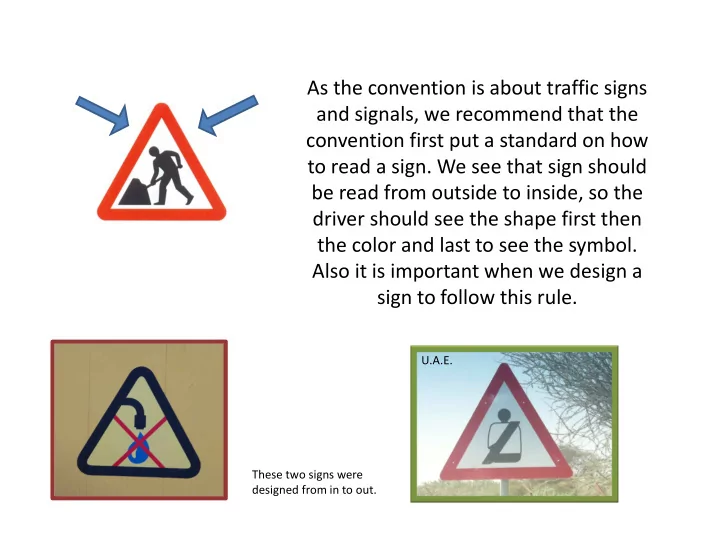
As the convention is about traffic signs and signals, we recommend that the convention first put a standard on how to read a sign. We see that sign should be read from outside to inside, so the driver should see the shape first then the color


slide-1
SLIDE 1

As the convention is about traffic signs and signals, we recommend that the convention first put a standard on how to read a sign. We see that sign should be read from outside to inside, so the driver should see the shape first then the color and last to see the symbol. Also it is important when we design a sign to follow this rule.

U.A.E. These two signs were designed from in to out.

slide-2
SLIDE 2

2= the convention should mention that the order of a police person on a section of road

  • ver ride any order
  • f any sign in that

section.

slide-3
SLIDE 3

3= the convention lack the right standardization as it mention sizes for the signs as small, normal, large and very large with out mentioning the sizes in numbers ( article 6, 4C) , in later stage it mention the sizes 60cm and 90cm for the small and normal size signs only , and also does not explain which method to use to arrive to these numbers, as UK measures the sign from bottom to top and

  • ther places they take the size of the horizontal line in the triangle,

and the sizes in these different methods are different. Also talks about traffic moving slowly, wide road, normal and high speed without putting a definition to what is slow,normal,high and wide road means. 2= The convention did not follow-up with the CP regarding the adapting the convention rules and to give one example: the prohibition of affixing any sign to any control device which is not related with it (article 4, a and b ) as we see a lot of violation to this in our road. Also it was required from CP to choose one system for the warning sign Aa or Ab (article 5, 2a ) but we see many CP are using the two system together in their territories. Some of the reasons as we see it for the improper use of road signs by contracting parties ( CP ) as it was mentioned in the invitation letter is: 1= the convention gave the right to the CP to introduce new signs without going back to convention (page 6, article 3, a(ii)).

slide-4
SLIDE 4

4= the convention gives the right to CP to choose one of the two STOP signs B2a and B2b to be used in their territories ( article 10, 3 ), this weaken the strength of the convention and confuses the road users . The 1968 convention asked CP to remove the sign B2b by 1978, and now the convention brought it back and we really can not understand why? Looking at the number of countries who chose B,2b over B,2a we see only 5 out 43 countries chose it. We recommend of removal of sign (B,2b). 5= we strongly recommend changing the numbering system in the convention, as it is complicated and not computer friendly. And to give one example sign A,1a and A,1b for warning of a bend in the road should be A-1L and A-1R. B2b 44= Article 9 (2) state that “danger warning signs shall be sited to give warning of possible road hazards” , we think the convention should rewrite this to say “definite and possible road hazards” as there are definite road hazards like bends or narrowness in the road , and in other hand, there are possible hazard as animals or pedestrians crossing the road.

slide-5
SLIDE 5

8= The convention did not put any standard for the colors of curb marking, and we strongly recommend it. As the colors on curb are very important traffic control devices. 9= Article 29bis (1) state that temporary markings because of road work shall be applied in colors different from the colors used for permanent marking, we suggest this practice should be for all sings except the STOP sign and GIVE WAY sign and not

  • nly road marking.

7= As we are on the subject of symbols numbering In the convention, then it is important to say that the numbering in the convention for some symbols are wrong. For example symbols A,18c, A,18d, A,18g, A,19b and A,19c are wrong, because one number represent two different symbols for two different situations. Also, what if someone mentioned symbol A,19c, then how can we know if he or she was talking about the situation where the merging is from right or is it from the left side of the road?. We recommend that each symbol should have its own number.
slide-6
SLIDE 6

10= One of the shortage in the convention is lack of all the symbols needed in our road, which make CP do their own designs with

  • ut consulting with the convention

and in time we see all the deviation in signs standard around the world. For example A1a,A1b,A1c and A1d are not enough to give warning to all the bends in the roads. So we think we should add more symbols and here are some symbols we think should be added to the convention.

30

slide-7
SLIDE 7

12= Annex 1, section II (7) It says : “ Warning of dips, hump bridges or ridges, or of section where the carriageway is in bad condition shall be given by symbol A,7a “, we can not understand how one symbol could give three meaning of three different situations. Then the convention continues by saying “to give warning of a hump bridge symbol A,7a may be replaced by symbol A,7b” and then the same for warning of a dip, A,7a may be replaced ( may be and not must!) by A,7c. We recommend to rewrite this section and just say for warning of bad condition on a road , symbol A,7a should be used and for hump symbol A,7b should be used and a dip symbol A,7c should be used. 11= In our study of traffic signs comprehension we asked 6000 participants from 6 countries for the meaning of symbol A,2a without the percentage of gradient and the result was 32.9% knew the right answer, then we showed them sign A,3a with the percentage of gradient and the result got better as it became 70.02%, and when we added an arrow to the symbol to show if the sign meant ascent or descent the percentage of right answer rose to 90.4% . So , we recommend strongly to add the arrow to all the ascent and descent signs.

slide-8
SLIDE 8

Also symbol A,7a is one of symbols that many drivers and also CP misunderstand its meaning as it looks similar to the hump symbol ( A,7b ) as we can see from the pictures and the chart in next page. We do recommend to change the symbol A,7a to be replaced by fig.2, as it was most chosen by drivers in

  • ur study as it shows in page 9.
  • Fig. 2

Kuwait U.A.E.

slide-9
SLIDE 9

9

  • 685

995 949 854 979 95 4557 75.95%

  • 3

8 4 5 4 24 0.4%

  • 48

13 2 63 1.05%

  • 1

41 42 0.7%

  • 301

2 43 788 1134 18.9%

  • 14

40 54 0.9% ! ! ! ! 111 111 1.85% " " " " 2 10 3 15 0.25%

  • 1000

1000 1000 1000 1000 1000 6000 100.0% 100.0% 100.0% 100.0% 100.0% 100.0% 100.0%

#$%$& ! #$%$& ! #$%$& ! #$%$& !

slide-10
SLIDE 10

10

$ $ $ $& & & &

  • !

! ! !

  • %$

%$ %$ %$ ' ' ' '

240 23 35 133 120 33 584 9.73%

%$ %$ %$ %$ ( ( ( (

265 20 24 177 64 941 1491 24.85%

%$ %$ %$ %$ ) ) ) )

326 775 793 433 543 26 2896 48.27%

%$ %$ %$ %$ * * * *

169 182 148 257 273 1029 17.15%

  • 1000

1000 1000 1000 1000 1000 6000 100.0%

(1) (2) (4) (3)

slide-11
SLIDE 11

13= The convention says for warning of road narrower shall be given by the symbol A,1a or by a symbol showing the outline of the road more clearly, such as A,4b. We just can’t see how two symbols could mean the same thing but one is more clearer that other. In our study we found both symbols are confusing to drivers, for example A,4b could mean and used in our roads in four different situations a) End of a lane. b) Temporary closure of a line because of road work. c) End of emergency lane. d) Narrowness in a lane. The problem in this, is drivers need to change lane in a) and b) situation , but in c) and d) situation they only need to continue in their lane with

  • caution. This is why we recommend to use symbol A,4b only in c) and

d) situations and for a) and b) situation we should use a new symbol as Fig. 1. 1995 convention has added a symbol G,12a which is similar to the recommended new symbol. What has been said about symbol A,4b is also true for symbol A,4a.

a) b) c) d)

  • Fig. 1
slide-12
SLIDE 12

12

Ukraine Kuwait Iran Bahrain France UK % Sign 1 33 124 87 84 202 38 9.47 Sign 2 207 101 433 226 254 367 26.47 Sign 3 526 253 254 383 151 595 36.03 Sign 4 234 522 226 307 393 28.03 100 200 300 400 500 600

%$&+!&, %$&+!&, %$&+!&, %$&+!&,

(1) (4) (3) (2)

slide-13
SLIDE 13

15= We recommend adding a graphic symbol of a car with falling rock symbol to make it more powerful warning sign . 14= The symbol A,8 of a dangerous shoulders could be misunderstood, especially the symbol looks like one of the symbols which were added in the convention in 2009 as one of the parking methods , so symbol A,8 in a warning sign could be understood as not to park on the shoulder. We recommend to add a flying stones to symbol A,8 as in symbol A,10a to give it a feeling of a moving car instead of a stationary.

slide-14
SLIDE 14

17= The convention recommend in case of a horizontal traffic light that the red light shall be placed on the side

  • pposite to that appropriate to the direction of traffic, we

disagree with this and recommend to place the red light always to the right, so drivers how are color blind could always recognize the red light as its always to the right. 18= the convention stated “warning of pedestrian crossing indicated either by road marking, or by sign E,12 shall be given by symbol A,12

  • f which there are two models : A,12a and a,12b” . Our comment on

this is first the convention did not explain nor showed the type of the road marking that could be used for a warning of pedestrian crossing, and if they meant to use the same symbol of A,12 on the ground then we are strongly apposed to this as we think it will undermine the value of human life when the cars drive on the symbol of a human (photo no. 1&2), lately this practice also has been used with the warning of children crossing A,13 (photo 4&5). Second we can not understand why there are two symbols for one subject, we recommend using only one and if there is a reason to have two symbols then the convention should explain why and where to use each one of them.

slide-15
SLIDE 15

Egypt Photo 1 Photo 2

slide-16
SLIDE 16

Photo 3 Photo 4 UK Switzerland Internet

slide-17
SLIDE 17

16= The convention has only one symbol to warn drivers from the possibility of children being in the road, which is symbol A,13. this symbol is used mostly near schools to warn drivers of children going or coming out from school. As there is one symbol for children, many time CP uses this symbol also at places where children are presence as near play gardens. The problem with this practice is most drivers associate this symbol to schools, so at afternoon or in holidays when children are most likely in play gardens or playing near their homes and a driver sees this sign he or she will not take precaution thinking this sign for schools and children are out of schools so there is no need to take precaution. We strongly recommend to add new signs to warn drivers the possibility of children presence at playing grounds and children playing near their homes as in fig.3 and fig.4, and use symbol A,13 only near schools.

  • Fig. 3
  • Fig. 4
slide-18
SLIDE 18

18= the convention assigned two different symbols of intersection, A,18a to be used with warning shape Aa and A,18b to be used with shape Ab. First we can not understand why two symbols ? Why not use one symbol for the two shapes of warning signs, and in this case we strongly recommend symbol A,18b because we should always draw the intersection diagram showing the road which the driver is driving on. Second; the convention states that CP could replace symbols A,18a and A,18b by symbols which show the nature of the intersection more clearly, such as A,18c,d,e,f and g, but we can clearly see that these symbols are not replacement for A,18a and b as they are for completely different situations. What has been said for symbols A,18a and b is the same for the symbol A,19a as symbols A,19b and c are not replacement for A,19a as the convention stated because they are for different situations.

slide-19
SLIDE 19

19= symbol A,23 for warning of a section of road temporary or permanently carrying two-way traffic on the same carriageway should be improved by adding a continuous line or a broken line between the two arrow as in fig.5.

  • Fig. 5

20= The symbol for warning of a section of road likely to be flown over at low altitude by aircraft taking off or landing on an airfield is A,30, this symbol could be improved by adding a graphic symbol of a car to it to differentiate it from the symbol of an airport as in fig. 9 but the symbol should be in 21= The convention states that warning of danger on a section of road that have no symbol in the convention, may be given by symbol A,32. then it continue to state that it is open to CP to adopt a graphic symbol in conformity to the convention. Warning sign with A,32 symbol alone is uncompleted sign and should not be used, the convention should strongly recommend that if CP could not indicate the type of danger by creating a new graphic symbol then it must put a separate panel with the sign explaining the type of danger by writing.

  • Fig. 9
slide-20
SLIDE 20

22= Give way Sign: Studies has shown that the less abstract the sign is the more drivers understood and comprehended the meaning of signs. Give Way sign B.1 is an abstract sign that is why we recommend putting the wording “Give Way” in side the sign as many countries has done, this will improve the comprehension

  • f the meaning of the sign , and in return we think it will

increase drivers compliance to the order of the sign. Also as the convention has allowed CP to use yellow or white ground for the sign, we recommend that the convention explain why and where should color be used.

GIVE

WAY Ireland Taiwan 23= we think giving priority of way to drivers in form of sign B,3 is not recommended with the speed of cars and the state of drivers mind and with all the distractions around them, we recommend giving the priority should be in form

  • f a warning sign as in symbol A,19a and b.

A,19a B,4 B,3 A,19b

slide-21
SLIDE 21

24= In section C, the convention gives the right for CP to choose yellow or white ground for the prohibitory and restrictive signs, here also we recommend that the convention explain why and where each color to be used. 25= C,1a sign is an abstract sign and what we have said about the “Give Way” sign is true with C,1a sign. Also here we recommend to add the wording “No Entry” in side the sign as many countries have done. 26= we notice that from sign C,1b to C,4b, the red bar comes under the symbols, but from symbol C,11 to C,20 and also some

  • ther symbols in the convention the red bar

is over the symbols. We recommend to standardize the way we draw the red bar in all the prohibition signs. We prefer that the red bar should be over the symbols.

slide-22
SLIDE 22

27= Signs C,13ab and C,13bb, we recommend that the red bar comes

  • ver the vehicle which is prohibited to

pass and not in the middle of the signs, as in fig. 87

  • Fig. 87

28= in our study we found that signs C,20a and C,20b are the least understood signs in the convention (table 3). We are sure that not many countries are using these signs, and if the convention thinks its important to have these two sign in the convention then we recommend to redesign the symbols to arrive to better comprehension of the meaning of them.

slide-23
SLIDE 23

23

  • "$

"$ "$ "$

405 6 13 35 11 99 569 9.49%

  • %$

%$ %$ %$

  • $
  • $
  • $
  • $

150 41 266 561 13 1031 17.19

$ $ $ $

103 7 268 132 8 518 8.64%

  • 203

603 895 84 245 96 2126 35.43%

$ $ $ $

  • &

& & &

23 16 22 1 62 1.03%

%$ %$ %$ %$

25 1 14 40 0.67%

" " " ". . . .# # # # && && && &&

9 41 50 0.83%

+!& +!& +!& +!& ! ! ! !

43 15 46 104 1.73%

+!& +!& +!& +!&

  • /
  • /
  • /
  • /

8 7 15 0.25%

  • /&
  • /&
  • /&
  • /&

" " " "$ $ $ $

6 15 65 2 88 1.47%

! ! ! ! $ $ $ $

246 747 993 16.55%

"01 "01 "01 "012 2 2 2

97 81 5 179 15 27 404 6.72%

01 01 01 012 2 2 2

1000 1000 1000 1000 1000 1000 6000 100.0%

What does this sign means?

Table 3

slide-24
SLIDE 24

29= D,1a sign is a wrong sign, it is a compulsory sign but gives two choices

  • f action . Compulsory or mandatory signs should give only one order and
  • ne action to follow, and because we allowed this to happened, we see that

some countries has compulsory signs with not two or three choices of actions but five as we see in photo. 43. Any sign that carry more than one

  • rder then becomes a regulatory sign, and must be a square or rectangular

shape sign but not circular. We think the symbol of sign D,1a was a ground marking ( photo 34) and then it was lifted to become a standing sign. Another dangerous reason with sign D,1a is in a carriageway with two or more lanes, the sign gives the impression that all drivers on all lanes could go straight or turn right, were in fact only the driver on the right lane has this choice. We strongly recommend changing the shape of sign D,1a from circular to rectangular as in fig. 32.

Fig.20 Photo 43 Photo34

slide-25
SLIDE 25

25

slide-26
SLIDE 26