arXiv:1312.3889v1 [math.NT] 13 Dec 2013 YVES AUBRY, DANIEL J. - - PDF document

arxiv 1312 3889v1 math nt 13 dec 2013
SMART_READER_LITE
LIVE PREVIEW

arXiv:1312.3889v1 [math.NT] 13 Dec 2013 YVES AUBRY, DANIEL J. - - PDF document

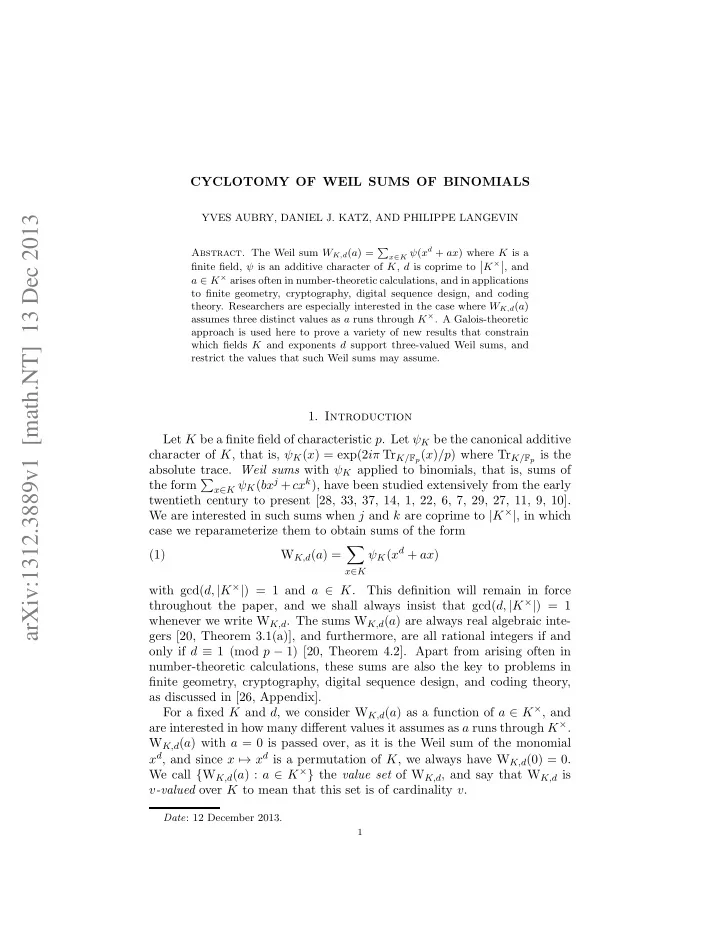
CYCLOTOMY OF WEIL SUMS OF BINOMIALS arXiv:1312.3889v1 [math.NT] 13 Dec 2013 YVES AUBRY, DANIEL J. KATZ, AND PHILIPPE LANGEVIN x K ( x d + ax ) where K is a Abstract. The Weil sum W K,d ( a ) = K finite field, is an


slide-1
SLIDE 1

arXiv:1312.3889v1 [math.NT] 13 Dec 2013

CYCLOTOMY OF WEIL SUMS OF BINOMIALS

YVES AUBRY, DANIEL J. KATZ, AND PHILIPPE LANGEVIN

  • Abstract. The Weil sum WK,d(a) =

x∈K ψ(xd + ax) where K is a

finite field, ψ is an additive character of K, d is coprime to

, and a ∈ K× arises often in number-theoretic calculations, and in applications to finite geometry, cryptography, digital sequence design, and coding

  • theory. Researchers are especially interested in the case where WK,d(a)

assumes three distinct values as a runs through K×. A Galois-theoretic approach is used here to prove a variety of new results that constrain which fields K and exponents d support three-valued Weil sums, and restrict the values that such Weil sums may assume.

  • 1. Introduction

Let K be a finite field of characteristic p. Let ψK be the canonical additive character of K, that is, ψK(x) = exp(2iπ TrK/Fp(x)/p) where TrK/Fp is the absolute trace. Weil sums with ψK applied to binomials, that is, sums of the form

x∈K ψK(bxj +cxk), have been studied extensively from the early

twentieth century to present [28, 33, 37, 14, 1, 22, 6, 7, 29, 27, 11, 9, 10]. We are interested in such sums when j and k are coprime to |K×|, in which case we reparameterize them to obtain sums of the form (1) WK,d(a) =

  • x∈K

ψK(xd + ax) with gcd(d, |K×|) = 1 and a ∈ K. This definition will remain in force throughout the paper, and we shall always insist that gcd(d, |K×|) = 1 whenever we write WK,d. The sums WK,d(a) are always real algebraic inte- gers [20, Theorem 3.1(a)], and furthermore, are all rational integers if and

  • nly if d ≡ 1 (mod p − 1) [20, Theorem 4.2]. Apart from arising often in

number-theoretic calculations, these sums are also the key to problems in finite geometry, cryptography, digital sequence design, and coding theory, as discussed in [26, Appendix]. For a fixed K and d, we consider WK,d(a) as a function of a ∈ K×, and are interested in how many different values it assumes as a runs through K×. WK,d(a) with a = 0 is passed over, as it is the Weil sum of the monomial xd, and since x → xd is a permutation of K, we always have WK,d(0) = 0. We call {WK,d(a) : a ∈ K×} the value set of WK,d, and say that WK,d is v-valued over K to mean that this set is of cardinality v.

Date: 12 December 2013.

1

slide-2
SLIDE 2

2 YVES AUBRY, DANIEL J. KATZ, AND PHILIPPE LANGEVIN

If d ≡ pj (mod |K×|) for some j, we say that d is degenerate over K, because TrK/Fp(xd +ax) = TrK/Fp((1+a)x), and so the binomial effectively becomes zero (if a = −1) or a nonvanishing linear form (if a = −1). Thus if d is degenerate over K, then readily obtains for a ∈ K that (2) WK,d(a) =

  • |K|

if a = −1,

  • therwise.

Helleseth [20, Theorem 4.1] shows that one always obtains a richer value set in the nondegenerate case. Theorem 1.1 (Helleseth, 1976). If d is nondegenerate over K, then WK,d(a) takes at least three values as a runs through K×. Here we want to know when Weil sums of this form can be three-valued, and if so, what are the three values they may take. We indicate all known infinite families of three-valued examples, arranged according to analogy, in the following table. In several entries, we make use of the p-adic valuation

  • f an integer a, denoted valp(a), which is the maximum k such that pk | a

(or ∞ if a = 0). We tacitly impose the condition that d be nondegenerate

  • ver K throughout the table, so that, for example, we cannot have i = 0 in

the first four rows. If K has characteristic p and 1/d is interpreted modulo |K×|, then WK,pd and WK,1/d take the same values as WK,d [20, Theorem 3.1], so the table records representative d modulo these equivalences. Table 1. Three-Valued Weil Sums

  • rder of K

d (nondegenerate) values of WK,d reference q = 2e d = 2i + 1 0, ±

  • 2gcd(e,i)q

[23, 25, 18] val2(i) ≥ val2(e) q = pe d = (p2i + 1)/2 0, ±

  • pgcd(e,i)q

[36] (i odd) p odd val2(i) ≥ val2(e) [19, 20] (i even) q = 2e d = 22i − 2i + 1, 0, ±

  • 2gcd(e,i)q

[38, 24] val2(i) ≥ val2(e) q = pe d = p2i − pi + 1 0, ±

  • pgcd(e,i)q

[36] (i odd) p odd val2(i) ≥ val2(e) [19, 20] (i even) q = 2e d = 2(e−1)/2 + 3 0, ±√2q [4, 5, 21] e odd q = 3e d = 2 · 3(e−1)/2 + 3 0, ±√3q [15] e odd q = 2e d = 2e/2 + 2(e+2)/4 + 1 0, ±2√q [12] val2(e) = 1 q = 2e d = 2(e+2)/4 + 3 0, ±2√q [12] val2(e) = 1 q = 2e d = 22i + 2i − 1 0, ±√2q [21] e odd 4i ≡ −1 (mod e)

slide-3
SLIDE 3

CYCLOTOMY OF WEIL SUMS OF BINOMIALS 3

First of all, note that all these value sets consist of three rational integers,

  • ne of which is 0, with the other two being opposites of each other. The

first two properties are inevitable facts, as shown in [26, Theorems 1.7, 1.9]. Theorem 1.2 (Katz, 2012). Let K be a finite field of characteristic p. If WK,d is three-valued for some exponent d, then d ≡ 1 (mod p − 1), and the values must be rational integers, one of which is zero. Concerning the two nonzero values of a three-valued Weil sum, one must be positive and the other negative, since it is known that

a∈K× WK,d(a)2 =

  • a∈K× WK,d(a)
  • 2. (See Lemma 2.1 and Corollary 2.3 below for details.)

However, it has not been proved that these values must have the same magnitude, although this is always what has been observed. We say that a three-valued Weil WK,d sum is symmetric when the two nonzero values are opposites of each other. If we assume that a three-valued Weil sum is symmetric, we can make further conclusions about the possible values. Proposition 1.3. If K is the finite field of characteristic p and order q, and if WK,d(a) is three-valued with values 0 and ±A, then |A| = pk for some positive integer k with √q < pk < q. This follows easily from well-known facts, which are arranged in Section 2, where the above proposition is proved as Proposition 2.4. Our first main result shows that in many cases, WK,d cannot be symmetric three-valued. Theorem 1.4. Let K be a finite field, and suppose that I and J are subfields

  • f K with [J : I] = 2, with d degenerate over I but not over J. Then the

set of values assumed by WK,d(a) as a runs through K× is not of the form {−A, 0, +A} for any A. We prove this in Section 6. This means that a field obtained by a tower

  • f quadratic extensions over a prime field can never support a three-valued

sum. Corollary 1.5. Let K be a finite field of characteristic p, and suppose that [K : Fp] is a power of 2. Then the set of values assumed by WK,d(a) as a runs through K× is not of the form {−A, 0, +A} for any A. For if WK,d were three-valued, Theorem 1.2 and eq. (2) would make d degenerate over Fp but not over K, and then as we proceed from Fp toward K up the tower of quadratic extensions, we must find a step where d passes from degenerate to nondegenerate. This corollary generalizes a result of Calderbank-McGuire-Poonen-Rubinstein [3, Theorem 3]. Our proof is quite different from that of Calderbank et al., who used McEliece’s Theorem from coding theory (a relative of Stickelberger’s Theorem on the p-divisibility of Gauss sums) and a delicate calculation in additive number theory to obtain Corollary 1.5 in the case where p = 2. The proof for Theorem 1.4 in full

slide-4
SLIDE 4

4 YVES AUBRY, DANIEL J. KATZ, AND PHILIPPE LANGEVIN

generality given here is much more straightforward, and is the consequence

  • f some useful observations about the p-adic valuation of Weil sums.

Helleseth conjectured [20, Conjecture 5.2] that the hypotheses of Corollary 1.5 make it impossible for the Weil sum to be three-valued at all. Conjecture 1.6 (Helleseth, 1976). Let K be a finite field of characteristic

  • p. If [K : Fp] is a power of 2, then WK,d is not three-valued.

If it were proved that three-valued Weil sums must be symmetric, this would follow from Corollary 1.5. The p = 2 case of Conjecture 1.6 has been proved. First, Feng [16, Theorem 2] showed that if p = 2, one could strengthen the conclusion of Corollary 1.5 to say that the value set is not

  • nly non-symmetric, but entirely lacks the value 0. Then when Katz [26,

Theorem 1.9] proved that a three-valued Weil sum must take the value 0, Conjecture 1.6 was established for p = 2. A symmetric three-valued Weil sum is called preferred if the magnitude

  • f the nonzero values is as small as possible in view of Proposition 1.3, that

is, if the nonzero values are ±√pq when q is an odd power of p, or if the nonzero values are ±p√q when q is an even power of p. This terminology

  • riginates from digital sequence design, wherein smaller magnitude Weil

sums of binomials correspond to smaller cross-correlation between a pair of maximal linear recursive sequences, which is desirable. The known infinite families of preferred three-valued Weil sums can be deduced from Table 1 above: the last five rows furnish preferred Weil sums, and in the first four rows, one must have gcd(e, i) = 1 if e is odd, or gcd(e, i) = 2 if e is even. Our second main result is a lower bound on the magnitude of the nonzero values of a symmetric three-valued Weil sum WK,d. This bound grows as the 2-divisibility of the degree of K over its prime field increases. Theorem 1.7. Let K be the finite field of characteristic p and order q. If val2([K : Fp]) = s and WK,d is symmetric three-valued with values 0, ±A, then |A| ≥ p2s−1√q. We prove this in Section 7. One consequence is that if the degree of K

  • ver its prime field is a multiple of 4, then WK,d cannot be preferred.

Corollary 1.8. Let K be the finite field of characteristic p and order q. If [K : Fp] ≡ 0 (mod 4), then the set of values assumed by WK,d as a runs through K× is not of the form {0, ±p√q}. This generalizes the result of Calderbank-McGuire [2], who proved a con- jecture of Sarwate and Pursley [35, p. 603], which is the special case of Corollary 1.8 where p = 2. Our proof technique for Theorem 1.7 in full generality is much simpler than the original proof of Calderbank-McGuire, as it obviates the need for McEliece’s Theorem or Stickelberger’s Theorem. Our first two results give restrictions on the types of fields that support symmetric and preferred Weil sums. Our third result shows that certain exponents d of the polynomial in the Weil sum prevent the Weil sum from being three-valued at all.

slide-5
SLIDE 5

CYCLOTOMY OF WEIL SUMS OF BINOMIALS 5

Theorem 1.9. Let K be a finite field of characteristic p with [K : Fp] even. If d is a power of p modulo

  • |K| − 1, then WK,d is not three-valued.

In other words, it is impossible for WK,d to be three-valued if K is the quadratic extension of a field F in which d is degenerate. We prove this in Section 8. Such an exponent d is called a Niho exponent, since they were first studied by Niho in [34]. Theorem 1.9 generalizes the result of Charpin [8, Theorem 2], who proved the p = 2 case. Some steps of Charpin’s proof for characteristic two do not hold in odd characteristic, so new arguments are devised. Finally, the techniques developed here can be used to simplify the proof that the values of a three-valued Weil sum must be rational integers, a result that appears above in Theorem 1.2, and which originally appeared in [26, Theorem 1.7]. Our proofs of all the above results make extensive use of Galois theory. Since Weil sums connect calculations in finite fields to calculations in cyclo- tomic extensions of Q, there are two realms, both cyclotomic, where Galois groups come into play. On the one hand, there are Galois groups for finite fields, which act on the terms of the polynomial arguments of the characters in the Weil sums; this is explored in Section 3. On the other hand, there are Galois groups for cyclotomic fields, which are applied to the values of the Weil sums; this is explored in Section 5. This dual Galois-theoretic approach has proved to be both powerful for obtaining new results, and at the same time, simplifies the proofs of previous results that we recapitulate. The organization of this paper is as follows: in Section 2, we prove some preliminary results using the well-known methodology of power moments. In Section 3, we explore the action of the Galois groups of finite fields on the terms inside the Weil sums. In Section 4, we look at the Fourier transform of the value set of our Weil sums, which is expressible in terms of Gauss sums, from which we deduce results about the p-adic valuation of Weil sum values. In Section 5, we explore the action of the Galois groups of cyclotomic fields

  • n the values of the Weil sums. In Sections 6, 7, and 8, we prove Theorems

1.4, 1.7, and 1.9, respectively. In the Appendix, we finish with our new simpler proof of the rationality of the values of three-valued Weil sums.

  • 2. Power Moments of Weil Sums

In this section we state some of the basic results about Weil sums that will be useful later on. These facts are proved using character sums known as power moments. Recall the definition (1) of WK,d, and our tacit insistence that gcd(d, |K×|) = 1 whenever we write WK,d. The mth power moment of the Weil sum WK,d is the sum

  • a∈K×

WK,d(a)m.

slide-6
SLIDE 6

6 YVES AUBRY, DANIEL J. KATZ, AND PHILIPPE LANGEVIN

The first few power moments can be calculated as straightforward character sums. Lemma 2.1. Let K be a finite field. Then (i).

a∈K× WK,d(a) = |K|,

(ii).

a∈K× WK,d(a)2 = |K|2, and

(iii).

a∈K× WK,d(a)3 = |K|2 · |R|,

where R is the set of roots of the polynomial (x + 1)d − xd − 1 in K.

  • Proof. See [26, Proposition 3.1].
  • Corollary 2.2. If K is a finite field, and d is nondegenerate over K, then

|WK,d(a)| < |K| for all a ∈ K×.

  • Proof. From Lemma 2.1(ii), the only way to escape this conclusion would be

to have |WK,d(b)| = |K| for some b ∈ K×, and WK,d(a) = 0 for all other a, which would make the Weil sum two-valued, contrary to Theorem 1.1.

  • Corollary 2.3. If d is nondegenerate over K, then WK,d assumes at least
  • ne positive value and at least one negative value.
  • Proof. Recall that the Weil sum values are real algebraic integers [20, Theo-

rem 3.1(a)]. By Theorem 1.1, we know that WK,d must assume at least two nonzero values. If all the nonzero values it assumes were of the same sign, then

  • a∈K× WK,d(a)

2 >

a∈K× WK,d(a)2, contradicting Lemma 2.1(i)

and (ii).

  • The following is an easy consequence of this power moment analysis, and

provides the proof of Proposition 1.3 in the Introduction. Proposition 2.4. If K is the finite field of characteristic p and order q, and if WK,d(a) is three-valued with values 0 and ±A, then d ≡ 1 (mod p − 1) and |A| = pk for some positive integer k. If R denotes the set of roots of (x + 1)d − xd − 1 in K, then √q <

  • |R| q = |A| < q.
  • Proof. By Theorem 1.2, we must have A ∈ Z and d ≡ 1 (mod p − 1). Let

NA be the number of a ∈ K× with WK,d(a) = A. Since the other two values WK,d(a) assumes are 0 and −A, we have

a∈K× WK,d(a)(WK,d(a) + A) =

2A2NA, and by Lemma 2.1(i),(ii), this sum also equals q2 + qA, so that NA = (q2 + qA)/(2A2), and so A can not be divisible by any prime other than p. We know |A| < q by Corollary 2.2. Similarly,

a∈K× WK,d(a)(WK,d(a)2−A2) = 0, and by Lemma 2.1(i),(iii)

equals q2 |R| − qA2, so |A| =

  • |R| q. Then note that 0, −1 ∈ R. (This is

clear for p = 2, and for p odd, note that gcd(d, q − 1) = 1 forces d to be

  • dd.) Thus A ≥ √2q.
  • It will also be useful to consider a version of the first power moment of a

Weil sum, but where we restrict the summation to a smaller subfield.

slide-7
SLIDE 7

CYCLOTOMY OF WEIL SUMS OF BINOMIALS 7

Lemma 2.5. Let K be a finite field and let L be the quadratic extension of

  • K. Then
  • a∈K×

WL,d(a) = |L| .

  • Proof. Let q = |K|. Since WL,d(0) = 0, we have
  • a∈K×

WL,d(a) =

  • x∈L

ψL(xd)

  • a∈K

ψK(a TrL/K(x)) = q

  • x∈L

TrL/K(x)=0

ψL(xd). If x ∈ L with TrL/K(x) = 0, then xq = −x, so that TrL/K(xd) = xqd + xd = (−x)d + xd = 0. (In odd characteristic, gcd(d, q − 1) = 1 makes d odd.) Thus

a∈K× WL,d(a) = q ·

  • {x ∈ L : TrL/K(x) = 0}
  • = q2 = |L|.
  • 3. Action of Galois Groups of Finite Fields

We begin this section by seeing that the automorphisms of a finite field K act trivially with respect to the Weil sum WK,d(a). As always WK,d(a) is as defined in (1), and gcd(d, |K×|) = 1 whenever we write WK,d. Lemma 3.1. Let K be a finite field of characteristic p. If σ ∈ Gal(K/Fp), then WK,d(σ(a)) = WK,d(a).

  • Proof. Since Galois conjugates have the same trace, they have the same

character value. Thus WK,d(a) =

x∈K ψK(σ(xd + ax)), and by repa-

rameterizing with y = σ(x), we have WK,d(a) =

y∈K ψK(yd + σ(a)y) =

WK,d(σ(a)).

  • The action of the Galois group also shows that some exponents give equiv-

alent Weil sums. Lemma 3.2. Let K be a finite field of characteristic p. Then WK,d(a) = WK,pjd(a) for any a ∈ K and j ∈ Z.

  • Proof. This follows immediately from the fact that xpjd is a Galois conjugate
  • f xd, and so ψK(xpjd) = ψK(xd).
  • Now we use finite field automorphisms to prove a congruence between the

Weil sum over a field and the Weil sum over its extensions. Lemma 3.3. Let K be a finite field of characteristic p, and let L be an extension of K with [L : K] a power of a prime ℓ distinct from p. Then for any a ∈ K, we have WL,d(a) ≡ WK,d([L : K]1−1/da) (mod ℓ), where 1/d indicates the multiplicative inverse of d modulo p − 1.

slide-8
SLIDE 8

8 YVES AUBRY, DANIEL J. KATZ, AND PHILIPPE LANGEVIN

  • Proof. For a ∈ K, we have

WL,d(a) =

  • x∈K

ψK(TrL/K(xd + ax)) +

  • x∈LK

ψL(xd + ax). The first sum equals

x∈K ψK([L : K](xd + ax)), and if we reparameterize

with w = [L : K]1/dx, then we see that this sum is WK,d([L : K]1−1/da). For the second sum, the action of Gal(L/K) partitions LK into orbits of Galois conjugates whose sizes are positive powers of ℓ. For any σ ∈ Gal(K/L), we have ψL(xd + ax) = ψL(σ(xd + ax)) = ψL(σ(x)d + aσ(x)), so that the value

  • f ψL(xd +ax) is constant on orbits, and thus the sum over LK is ℓ times

a sum of algebraic integers.

  • We then explore what this tells us in the case where d is degenerate in

the smaller field. Corollary 3.4. Let K be a finite field of characteristic p, and let L be an extension of L with [L : K] a power of a prime ℓ distinct from p. Let d be degenerate over K. Then WK,d(−1) ≡ |K| (mod ℓ) and WK,d(a) ≡ 0 (mod ℓ) for every a ∈ K {−1}.

  • Proof. Combine Lemma 3.3 with (2), and note that since d is degenerate
  • ver K, we have d ≡ 1 (mod p − 1), so the factor of [K : L]1−1/d mentioned

in Lemma 3.3 is equal to 1.

  • 4. Gauss Sum and Valuation

In this section, we explore the Fourier transform of the value set of the Weil sum, which is expressible in terms of Gauss sums. This will enable us to prove some criteria about the p-divisibility of Weil sum values. Throughout this section K is a finite field of characteristic p and order q and, as always, we assume that gcd(d, q − 1) = 1. For any multiplicative character χ ∈ K×, we consider the Gauss sum τK(χ) =

  • a∈K×

χ(a)ψK(a). By Fourier inversion, if a ∈ K×, we find that ψK(a) = 1 q − 1

  • χ∈

τK(χ)¯ χ(a).

slide-9
SLIDE 9

CYCLOTOMY OF WEIL SUMS OF BINOMIALS 9

Thus for a ∈ K×, WK,d(a) = 1 + 1 (q − 1)2

  • b∈K×
  • χ,ϕ∈

τK(χ)τK(ϕ)¯ χd(b) ¯ ϕ(ab) (3) = 1 + 1 q − 1

  • χ,ϕ∈

K× ϕ=¯ χd

τK(χ)τK(ϕ) ¯ ϕ(a) = q q − 1 + 1 q − 1

  • χ=1

τK(χ)τK(¯ χd)χd(a). If we denote by t the inverse of −d modulo q − 1, the above formula shows that q and the τK(χ)τK(¯ χd) are the Fourier coefficients of the mapping a → WK,d(at) from K× to C, whence by Fourier inversion (4)

  • a∈K×

WK,d(at)χ(a) =

  • q

if χ = 1, τK(χ)τK(¯ χd)

  • therwise.

Recall from the Introduction that for any nonzero integer n, the p-adic valuation of n, written valp(n), is the largest k such that pk divides n, and we set valp(0) = ∞. Then valp(ab) = valp(a) + valp(b) and valp(a + b) ≥ min{valp(a), valp(b)}, which becomes an equality whenever valp(a) = valp(b). We can extend the definition to Q, wherein valp(a/b) = valp(a) − valp(b). If ζp and ζq−1 are, respectively, primitive pth and (q − 1)th roots

  • f unity over Q, we can further extend valp to the field Q(ζp, ζq−1) where

the Gauss sums reside, while still retaining the relations given above con- cerning products and sums of elements. In this last field, elements can have fractional valuations: for instance valp(1 − ζp) = 1/(p − 1). We introduce the useful notation VK,d = min

a∈K× valp(WK,d(a)).

It is well known [31], [32, Section 6] that Stickelberger’s congruence on Gauss sums can be used to obtain the value of VK,d but we do not need it to reach

  • ur goal.

Lemma 4.1. For K a finite field of order q, and d an integer coprime to q − 1, we have VK,d = min

χ∈ K× χ=1

valp(τK(χ)τK(¯ χd)).

  • Proof. This is immediate once we note that valp(χ(a)) = 0 for any χ ∈

K× and any a ∈ K×, because (q − 1)valp(χ(a)) = valp(χ(a)q−1) = valp(1) = 0. Using the relation (3), one has VK,d ≥ minχ=1 valp(τK(χ)τK(¯ χd)), and the reverse inequality is obtained by using the relation (4), once we establish that minχ=1 valp(τK(χ)τK(¯ χd)) ≤ valp(q). This last fact follows because

slide-10
SLIDE 10

10 YVES AUBRY, DANIEL J. KATZ, AND PHILIPPE LANGEVIN

τK(¯ χ) = χ(−1)τK(χ) and |τK(χ)|2 = q for any nontrivial multiplicative character χ, and so

χ=1 τK(χ)τK(¯

χd) = ±qq−2.

  • Corollary 4.2. Let L be a finite extension of K. For a positive integer d,

VL,d ≤ [L : K] × VK,d

  • Proof. Denoting by NL/K the norm from L over K, we know by the Hasse-

Davenport relation (see [13]) that −τL(χ ◦ NL/K) = (−τK(χ))[L:K], and the set of lifted characters χ ◦ NL/K as χ runs through the nontrivial elements of K× is a subset of the nontrivial elements of L×.

  • The remaining results in this section are specific to quadratic extensions
  • f finite fields, which are involved in our three main results (Theorems 1.4,

1.7, and 1.9). Lemma 4.3. Let K be a finite field, and let L be the quadratic extension

  • f K.

Let d be degenerate over K, but not over L. Let Y be a set of representatives of cosets of K× in L×. Then for a ∈ L, we have WL,d(a) = |K| (Z(a) − 1), where Z(a) is the number of y ∈ Y such that TrL/K(yd + ay) = 0.

  • Proof. If K has characteristic p, then Lemma 3.2 allows us to replace d with

pjd for any j, so we may take d ≡ 1 (mod |K×|) without loss of generality. Then WL,d(a) = 1 +

  • y∈Y
  • x∈K×

ψL((yd + ay)x) = − |K| +

  • y∈Y
  • x∈K

ψK(x TrL/K(yd + ay)), since |Y | = (|L| − 1)/(|K| − 1) = |K| + 1. The sum over x is |K| when TrL/K(yd + ay) = 0; otherwise the sum is 0.

  • This calculation has immediate consequences for the p-adic valuation of

Weil sum values. Corollary 4.4. Let K be a finite field of characteristic p, and let L be the quadratic extension of K. Let d be degenerate over K, but not over L. Then VL,d = [K : Fp], and furthermore, WL,d(a) = −|K| for some a ∈ L×.

  • Proof. Let Y and Z(a) be as defined in Lemma 4.3, which tells us that

WL,d(a) = |K| (Z(a) − 1), for each a ∈ L. All these numbers have a valuation greater or equal to [K : Fp]. Since d is not degenerate over L, WL,d(a) must be negative for

slide-11
SLIDE 11

CYCLOTOMY OF WEIL SUMS OF BINOMIALS 11

some a ∈ L× by Corollary 2.3. The only way to make WL,d(a) negative is to have Z(a) = 0, which makes WL,d(a) = − |K|, and then the valuation of WL,d(a) is precisely [K : Fp].

  • The calculation of Lemma 4.3 also gives a nonnegativity condition that

will be useful in our proof of Theorem 1.9. Corollary 4.5. Let K be a finite field, and let L be the quadratic extension

  • f K. Let d be degenerate over K. Then WL,d(a) ≥ 0 for all a ∈ K.
  • Proof. We may take d nondegenerate over L, since (2) settles the degenerate
  • case. Let a ∈ K. By Lemma 4.3, it suffices to find some y ∈ L× such that

TrL/K(yd + ay) = 1. In characteristic 2, take y ∈ K×, so that TrL/K(yd + ay) = 2(yd + ay) = 0. In odd characteristic, take y ∈ L with y2 ∈ K but y ∈ K. Then y and −y are conjugates under the action of Gal(L/K), and so TrL/K(yd + ay) = (−y)d + a(−y) + yd + ay = 0.

  • 5. Action of Galois Groups of Cyclotomic Fields

Throughout this section, ζp denotes a primitive pth root of unity over Q. If K is a field of characteristic p, then the Weil sum values WK,d(a) reside in Q(ζp) by definition (1). First we see how Galois automorphisms permute the Weil sum values. Recall that we always have d invertible modulo |K×| whenever we write the sum WK,d. Lemma 5.1. Let K be a finite field of characteristic p. If σ is the element of Gal(Q(ζp)/Q) with σ(ζp) = ζj

p, then σ(WK,d(a)) = WK,d(j1−(1/d)a), where

1/d indicates the multiplicative inverse of d modulo p − 1.

  • Proof. This is [26, Theorem 2.1(b)].
  • This shows that if two Weil sum values are Galois conjugates over Q, then

they occur equally often. Corollary 5.2. Let K be a finite field, and let A and B be values assumed by WK,d. If A and B are Galois conjugates over Q, then the number of a ∈ K× such that WK,d(a) = A is equal to the number of a ∈ K× such that WK,d(a) = B.

  • Proof. Let σ ∈ Gal(Q(ζp)/Q) with σ(A) = B, and let j ∈ F×

p such that

σ(ζp) = ζj

  • p. By Lemma 5.1, WK,d(a) = A precisely when WK,d(j1−1/da) =

B.

  • Often the Weil sums lie in a proper subfield of Q(ζp). We give a criterion

for determining when this happens. Lemma 5.3. Let K be a finite field of characteristic p. Let E be the exten- sion of Q generated by all the values of WK,d(a) for a ∈ K×. Let m be the smallest divisor of p − 1 such that d ≡ 1 (mod (p − 1)/m). Then E is the unique subfield of Q(ζp) with [E : Q] = m.

slide-12
SLIDE 12

12 YVES AUBRY, DANIEL J. KATZ, AND PHILIPPE LANGEVIN

  • Proof. An arbitrary σ ∈ Gal(Q(ζp)/Q) takes ζp to ζj

p for some j ∈ F× p . So

by Lemma 5.1, we have (5) σn(WK,d(a)) = WK,d(jn(1−1/d)a) for any a ∈ K× and n ∈ Z. Since d ≡ 1 (mod (p − 1)/m), we see that jm(1−1/d) = 1 for any j ∈ F×

p .

Thus if σ ∈ Gal(Q(ζp)/Q), then σm fixes all the values of WK,d. So the subgroup of index m in Gal(Q(ζp)/Q) fixes all values in E, and so [E : Q] is a divisor of m. Conversely, if we set n = [E : Q] and Fourier transform both sides of (5) with a multiplicative character χ ∈ K×, we obtain

  • a∈K×

WK,d(a)χ(a) =

  • a∈K×

WK,d(jn(1−1/d)a)χ(a). The left hand side is nonzero, since it is either q (if χ is principal, cf. Lemma 2.1(i)), or a product of Gauss sums involving nontrivial characters (use (4) with χ1/d in place of χ). The right hand side is ¯ χ(jn(1−1/d)) times the left hand side. Thus we must have χ(jn(1−1/d)) = 1 for all j ∈ F×

p and all

χ ∈ K×, which forces d ≡ 1 (mod (p − 1)/n). By the minimality of m, this means that [E : Q] = n ≥ m.

  • Remark 5.4. Values of WK,d are always algebraic integers, so that if these

lie in a field E, they actually lie in the ring of algebraic integers in E. Remark 5.5. In view of the previous remark, the special case of Lemma 5.3 when m = 1 states that the values of WK,d(a) for a ∈ K× all lie in Z if and only if d ≡ 1 (mod p − 1). This was proved in [20, Theorem 4.2]. The next result is reminiscent of the power moments of Section 2. We shall combine it with Lemma 5.1 in Corollary 5.7 below. Lemma 5.6. Let K be a finite field. For any b ∈ K with b = 1, we have

  • a∈K×

WK,d(a)WK,d(ba) = 0.

  • Proof. Since WK,d(0) = 0, we may include the a = 0 term in
  • a∈K×

WK,d(a)WK,d(ba) =

  • x,y∈K

ψK(xd + yd)

  • a∈K

ψK(a(x + by)) = |K|

  • x,y∈K

x+by=0

ψK(xd + yd) = |K|

  • y∈K

ψK(yd(1 + (−b)d)), which vanishes because y → yd is a permutation of K, and 1 + (−b)d = 0 since b = 1.

slide-13
SLIDE 13

CYCLOTOMY OF WEIL SUMS OF BINOMIALS 13

Now we combine Lemmas 5.1 and 5.6. Corollary 5.7. If K is a finite field and σ ∈ Gal(Q(ζp)/Q) permutes the values of WK,d nontrivially, then

  • a∈K×

WK,d(a)σ(WK,d(a)) = 0.

  • Proof. Lemma 5.1 furnishes an element b such that σ(WK,d(a)) = WK,d(ba)

for all a ∈ K×, and clearly b = 1, for otherwise σ would fix each value taken by WK,d. Lemma 5.6 finishes the proof.

  • 6. Proof of Theorem 1.4

We have three fields I ⊆ J ⊆ K with [J : I] = 2. Let p be the charac- teristic of our fields. As always, gcd(d, |K×|) = 1. We are given that d is degenerate in I, but not in J. We want to show that the value set of WK,d is not of the form {0, ±A}. Suppose the contrary. By Proposition 2.4, |A| must be an integral power of p with

  • |K| < |A| < |K|, so then

VK,d = valp(A) > valp(

  • |K|)

= 1 2[K : Fp]. On the other hand, by Corollary 4.2 and Corollary 4.4, we get a contradiction because VK,d ≤ [K : J] × VJ,d = [K : J] × [I : Fp] = 1 2[K : Fp].

  • 7. Proof of Theorem 1.7

We have K a finite field of characteristic p and order q with [K : Fp] divisible by 2s. As always, gcd(d, q − 1) = 1. We suppose that WK,d is symmetric three-valued with values 0 and ±A, and our goal is to show that |A| ≥ p2s−1√q. Note that Fp2s ⊆ K. Since WK,d is three-valued, d is degenerate over Fp by Theorem 1.2. If d were nondegenerate over Fp2s, then there must be subfields I and J of Fp2s with [J : I] = 2 and d degenerate over I but not

  • ver J. Then Theorem 1.4 tells us that WK,d is not symmetric three-valued,

contrary to our hypothesis. So d is degenerate over Fp2s, and thus every point of Fp2s is an element

  • f the set R of roots of (x + 1)d − xd − 1. Thus |R| ≥ p2s, so Proposition 2.4

tells us that |A| =

  • |R| q ≥ p2s−1√q.
slide-14
SLIDE 14

14 YVES AUBRY, DANIEL J. KATZ, AND PHILIPPE LANGEVIN

  • 8. Proof of Theorem 1.9

We have L a finite field with [L : Fp] even, and d is a power of p modulo

  • |L| − 1. We want to show that WL,d is not three-valued.

Since we are considering WL,d, the exponent d is an invertible element modulo |L|. If d is degenerate over L, then WL,d is at most two-valued by (2), so we assume that d is nondegenerate over L henceforth. The proof that WL,d is not three-valued when L is of characteristic 2 is given as [8, Theorem 2], so we assume that we are in odd characteristic henceforth. Assume WL,d is three-valued to show a contradiction. By Theorem 1.2 and Corollary 2.3, these three values are all in Z, one of them is 0, one is positive, and one is negative. Let K be the subfield of L with [L : K] = 2. Then by Corollary 4.5, we know that WL,d(a) ≥ 0 for all a ∈ K. Corollary 3.4 shows that WL,d(−1) is odd, and that WL,d(a) is even for all other a ∈ K. Since these are nonnegative, the positive value of WL,d must be WL,d(−1), and WL,d(a) = 0 for all other a ∈ K. But Lemma 2.5 tells us that

a∈K× WL,d(a) = |L|, which forces WL,d(−1) = |L|. This contradicts

Corollary 2.2, since WL,d was assumed to be nondegenerate over L.

  • Appendix. New Proof of the Rationality of Three-Valued

Weil Sums We suppose that WK,d is three-valued, and we want to show that those three values lie in Z. As for the rest of Theorem 1.2, the conclusion that d ≡ 1 (mod p − 1) will then follow immediately from Remark 5.5, and the proof that one of the three values is 0 is given in [26, Theorem 5.2], which is not very difficult to follow. The proof of rationality given here, while complex, is considerably easier than the original, given as [26, Theorem 4.1]. Let p and q be respectively the characteristic and order of K, and so gcd(d, q−1) = 1. Let ζp be a primitive pth root of unity over Q. Let WK,d(a) take the three distinct values A, B, and C, respectively, for NA, NB, and NC values of a ∈ K×. By Lemma 5.1, the Galois group Gal(Q(ζp)/Q) permutes A, B, and C. The field Q(A, B, C) is a cyclic Galois extension of Q since it is contained in the cyclic extension Q(ζp) of Q. Let σ be a generator of Gal(Q(A, B, C)/Q). There are three possible actions of σ upon {A, B, C}: (i) σ is the identity permutation, (ii) σ acts transitively, or (iii) σ permutes a pair of these elements, and fixes the third. As A, B, and C are algebraic integers, they lie in Z if and only if they lie in Q, and this occurs precisely in Case (i), it suffices to show that Cases (ii) and (iii) are impossible. In Case (ii), Corollary 5.2 tells us that NA = NB = NC, so they all equal (q − 1)/3. Then Lemma 2.1(i) shows that NAA + NBB + NCC = q, so that A + B + C = 3 +

3 q−1. As A + B + C is fixed by σ, it lies in Q, and is at the

same time an algebraic integer, so it lies in Z. This means that q − 1 | 3, which forces p = 2, in which case ζp = −1, and so the values of WK,d lie

slide-15
SLIDE 15

CYCLOTOMY OF WEIL SUMS OF BINOMIALS 15

in Z, contradicting our supposition that σ permutes them nontrivially. So Case (ii) is impossible. Henceforth, we suppose that we are in Case (iii). Without loss of gener- ality, we suppose that the generator σ of Gal(Q(A, B, C)/Q) has σ(A) = B, σ(B) = A, and σ(C) = C. Then σ is of order 2, and so Q(A, B, C) is a quadratic extension of Q lying in Q(ζp). There is no such thing if p = 2 (since ζp = −1, so Q(ζp) = Q). Otherwise, since Q(ζp) is cyclic of degree p − 1 over Q, this means that Q(A, B, C) is the unique quadratic extension

  • f Q contained in Q(ζp). In view of the values of the quadratic Gauss sums

[17], we know that this unique quadratic extension must be Q(√p) if p ≡ 1 (mod 4), or Q(√−p) if p ≡ 3 (mod 4). But since A, B, and C are real (see [20, Theorem 3.1(a)] or [26, Theorem 2.1(c)]), the latter case is impossible, so we must have p ≡ 1 (mod 4) and Q(A, B, C) = Q(√p). Then C ∈ Z, since it is an algebraic integer fixed by σ, and A = a+b√p and B = a−b√p, for some a, b with 2a, 2b, and a + b ∈ Z, since this is the form of algebraic integers in Q(√p), as shown in [30, Chapter IV, Theorem 2.3]. Then Lemma 2.1(i),(ii) tells us that NAA + NBB + NCC = q, (6) NAA2 + NBB2 + NCC2 = q2. (7) Also

a∈K× WK,d(a)σ(WK,d(a)) = 0 by Corollary 5.7, so

(8) NAAB + NBBA + NCC2 = 0. By Corollary 5.2, we have NA = NB, and since A = a+b√p and B = a−b√p,

  • ur three equations (6), (7), and (8) become

2NAa + NCC = q, 2NA(a2 + pb2) + NCC2 = q2, 2NA(a2 − pb2) + NCC2 = 0, and this system is equivalent to the system 2NAa + NCC = q, (9) 4NAa2 + 2NCC2 = q2, (10) 4NApb2 = q2. (11) From (11) we see that p | NA. Note that C = 0, since otherwise (9) and (10) imply that NA = 1, contradicting p | NA. If we subtract (10) from 2(a + C) times equation (9), we obtain 2(2NA + NC)aC = q(2a + 2C − q), and since NA + NB + NC = q − 1, with NA = NB, this gives 2(q − 1)aC = q(2a + 2C − q). Examine the p-adic valuation of each side to see that max{valp(a), valp(C)} ≥ valp(q). Then by Corollary 2.2, we see that |C| < q, and since C = 0, we

slide-16
SLIDE 16

16 YVES AUBRY, DANIEL J. KATZ, AND PHILIPPE LANGEVIN

must have valp(C) < valp(q) ≤ valp(a), so that q | 2a. If we reduce (9) modulo q, we see that q | NCC, but since q ∤ C, we have p | NC. Thus p | NA and p | NC, and so p | (2NA + NC) = q − 1, which is absurd. Thus Case (iii) is impossible, and the proof is complete. Acknowledgement The second author thanks Tor Helleseth for help with the history of these researches. References

[1] N. M. Akuliniˇ

  • cev. Bounds for rational trigonometric sums of a special type. Dokl.
  • Akad. Nauk SSSR, 161:743–745, 1965. trans. in Soviet Math. Dokl. 6 (1965), 480–

482. [2] A. R. Calderbank and G. McGuire. Proof of a conjecture of Sarwate and Pursley regarding pairs of binary m-sequences. IEEE Trans. Inform. Theory, 41(4):1153– 1155, 1995. [3] A. R. Calderbank, G. McGuire, B. Poonen, and M. Rubinstein. On a conjecture

  • f Helleseth regarding pairs of binary m-sequences. IEEE Trans. Inform. Theory,

42(3):988–990, 1996. [4] A. Canteaut, P. Charpin, and H. Dobbertin. Couples de suites binaires de longueur maximale ayant une corr´ elation crois´ ee ` a trois valeurs: conjecture de Welch. C. R.

  • Acad. Sci. Paris S´
  • er. I Math., 328(2):173–178, 1999.

[5] A. Canteaut, P. Charpin, and H. Dobbertin. Binary m-sequences with three-valued crosscorrelation: a proof of Welch’s conjecture. IEEE Trans. Inform. Theory, 46(1):4– 8, 2000. [6] L. Carlitz. A note on exponential sums. Math. Scand., 42(1):39–48, 1978. [7] L. Carlitz. Explicit evaluation of certain exponential sums. Math. Scand., 44(1):5–16, 1979. [8] P. Charpin. Cyclic codes with few weights and Niho exponents. J. Combin. Theory

  • Ser. A, 108(2):247–259, 2004.

[9] T. Cochrane and C. Pinner. Stepanov’s method applied to binomial exponential sums.

  • Q. J. Math., 54(3):243–255, 2003.

[10] T. Cochrane and C. Pinner. Explicit bounds on monomial and binomial exponential

  • sums. Q. J. Math., 62(3):323–349, 2011.

[11] R. S. Coulter. Further evaluations of Weil sums. Acta Arith., 86(3):217–226, 1998. [12] T. W. Cusick and H. Dobbertin. Some new three-valued crosscorrelation functions for binary m-sequences. IEEE Trans. Inform. Theory, 42(4):1238–1240, 1996. [13] H. Davenport and H. Hasse. Die Nullstellen der Kongruenzzetafunktionen in gewissen zyklischen F¨

  • allen. J. Reine Angew. Math., 172:151–182, 1935.

[14] H. Davenport and H. Heilbronn. On an exponential sum. Proc. London Math. Soc. (2), 41:449–453, 1936. [15] H. Dobbertin, T. Helleseth, P. V. Kumar, and H. Martinsen. Ternary m-sequences with three-valued cross-correlation function: new decimations of Welch and Niho

  • type. IEEE Trans. Inform. Theory, 47(4):1473–1481, 2001.

[16] T. Feng. On cyclic codes of length 22r with two zeros whose dual codes have three

  • weights. Des. Codes Cryptogr., 62(3):253–258, 2012.

[17] C. F. Gauss. Summatio quarumdam serierum singularium. Comment. Soc. Reg. Sci. Gottingensis, page 1, 1811. [18] R. Gold. Maximal recursive sequences with 3-valued recursive cross-correlation func-

  • tions. IEEE Trans. Inform. Theory, 14(1):154–156, 1968.
slide-17
SLIDE 17

CYCLOTOMY OF WEIL SUMS OF BINOMIALS 17

[19] T. Helleseth. Krysskorrelasjonsfunksjonen mellom maksimale sekvenser over GF(q). Master’s thesis, Matematisk Institutt, Universitetet i Bergen, 1971. [20] T. Helleseth. Some results about the cross-correlation function between two maximal linear sequences. Discrete Math., 16(3):209–232, 1976. [21] H. D. L. Hollmann and Q. Xiang. On binary cyclic codes with few weights. In Finite fields and applications (Augsburg, 1999), pages 251–275. Springer, Berlin, 2001. [22] A. A. Karatsuba. On estimates of complete trigonometric sums. Mat. Zametki, 1:199– 208, 1967. trans. in Math. Notes 1 (1967), no. 2, 133–139. [23] T. Kasami. Weight distribution formula for some class of cyclic codes. Technical report, Univ. Illinois, Urbana, 1966. [24] T. Kasami. The weight enumerators for several classes of subcodes of the 2nd order binary Reed-Muller codes. Information and Control, 18:369–394, 1971. [25] T. Kasami, S. Lin, and W. W. Peterson. Some results on cyclic codes which are invariant under the affine group and their applications. Information and Control, 11:475–496, 1967. [26] D. J. Katz. Weil sums of binomials, three-level cross-correlation, and a conjecture of

  • Helleseth. J. Combin. Theory Ser. A, 119(8):1644–1659, 2012.

[27] N. Katz and R. Livn´

  • e. Sommes de Kloosterman et courbes elliptiques universelles en

caract´ eristiques 2 et 3. C. R. Acad. Sci. Paris S´

  • er. I Math., 309(11):723–726, 1989.

[28] H. D. Kloosterman. On the representation of numbers in the form ax2+by2+cz2+dt2. Acta Math., 49(3-4):407–464, 1927. [29] G. Lachaud and J. Wolfmann. Sommes de Kloosterman, courbes elliptiques et codes cycliques en caract´ eristique 2. C. R. Acad. Sci. Paris S´

  • er. I Math., 305(20):881–883,

1987. [30] S. Lang. Algebraic number theory, volume 110 of Graduate Texts in Mathematics. Springer-Verlag, New York, second edition, 1994. [31] P. Langevin. Les sommes de caract` eres et la formule de Poisson dans la th´ eorie des codes, des s´ equences et des fonctions bool´

  • ennes. PhD thesis, Universit´

e de Toulon, 1999. [32] P. Langevin and P. V´

  • eron. On the non-linearity of power functions. Des. Codes Cryp-

togr., 37(1):31–43, 2005. [33] L. J. Mordell. On a sum analogous to a Gauss sum. Quart. J. Math., 3:161–167, 1932. [34] Y. Niho. Multi-valued cross-correlation function between two maximal linear recursive

  • sequences. PhD thesis, University of Southern California, Los Angeles, 1972.

[35] D. V. Sarwate and M. B. Pursley. Crosscorrelation properties of pseudorandom and related sequences. IEEE Trans. Inform. Theory, 68(5):593–619, 1980. correction in IEEE Trans. Inform. Theory 68 (1980), no. 12, 1554. [36] H. M. Trachtenberg. On the cross-correlation functions of maximal linear sequences. PhD thesis, University of Southern California, Los Angeles, 1970. [37] I. M. Vinogradov. Some trigonometrical polynomials and their applications. C. R.

  • Acad. Sci. URSS, (1):10–14, 1933.

[38] L. R. Welch. Trace mappings in finite fields and shift register cross-correlation proper-

  • ties. Technical report, Dept. Electrical Engineering, University of Southern California,

Los Angeles, 1969. Institut de Math´ ematiques de Toulon, Universit´ e de Toulon, France and Insitut de Math´ ematiques de Luminy, Marseille, France Department of Mathematics, California State University, Northridge, United States Institut de Math´ ematiques de Toulon, Universit´ e de Toulon, France