Arthritis and Joint Pain in (Post)Menopausal Women GSK consultant - - PDF document

arthritis and joint pain in post menopausal women
SMART_READER_LITE
LIVE PREVIEW

Arthritis and Joint Pain in (Post)Menopausal Women GSK consultant - - PDF document

10/9/2017 Disclosures: Arthritis and Joint Pain in (Post)Menopausal Women GSK consultant Genetech consultant Rebecca Manno, M.D., M.H.S. I will reference the off label use of Assistant Professor of Medicine medications for OA and


slide-1
SLIDE 1

10/9/2017 1

Arthritis and Joint Pain in (Post)Menopausal Women

Rebecca Manno, M.D., M.H.S.

Assistant Professor of Medicine Johns Hopkins Arthritis Center, Division of Rheumatology Johns Hopkins School of Medicine Baltimore, Maryland North American Menopause Society Annual Meeting October 14, 2017

Disclosures:

GSK – consultant Genetech – consultant I will reference the off label use of medications for OA and RA.

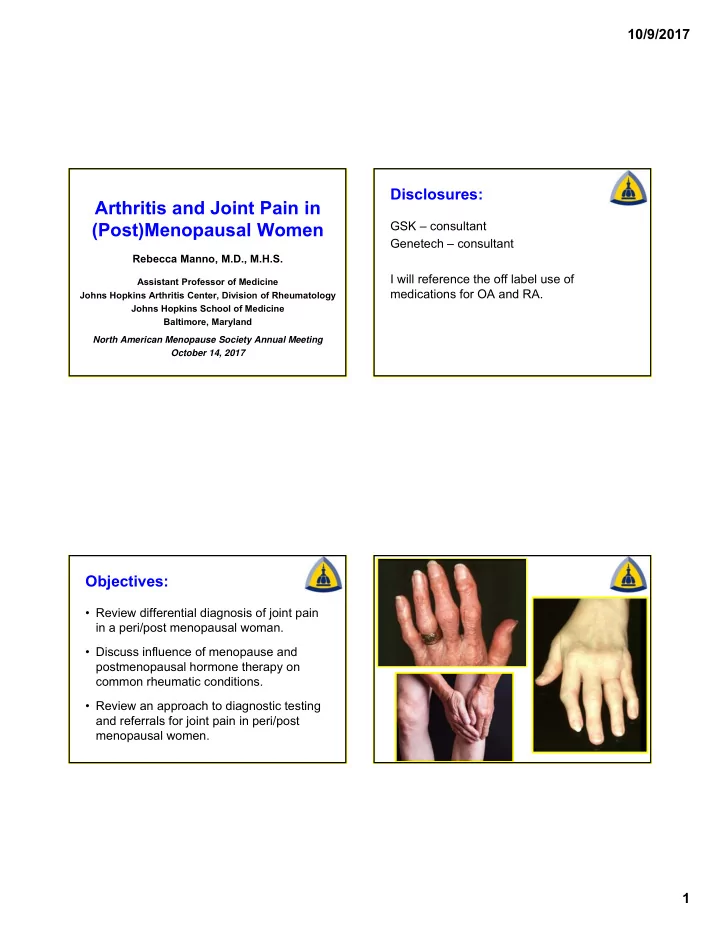
Objectives:

  • Review differential diagnosis of joint pain

in a peri/post menopausal woman.

  • Discuss influence of menopause and

postmenopausal hormone therapy on common rheumatic conditions.

  • Review an approach to diagnostic testing

and referrals for joint pain in peri/post menopausal women.

slide-2
SLIDE 2

10/9/2017 2

On any given day in a rheumatology clinic...

56yo ♀ from Baltimore…

  • ~ 12 months ago new onset joint symptoms
  • Different from ‘usual’ aches and pains
  • Started in her feet, difficult to walk to bathroom in am
  • Worsening stiffness in hands
  • Also pain in knees, elbows, and back
  • She feels achy and stiff.

Meds: HCTZ, Naprosyn 220mg daily prn PMHX: Hyperlipidemia, HTN Last menstrual period age 51. FamHX: Granddaughter SLE SocHX: Lives with husband, 2 kids, 2 dogs. Quit smoking at age 30, occasional whiskey in the evening (and Bailey’s in her coffee). Works as a paralegal in law firm.

56yo ♀ from Baltimore… Differential Diagnosis:

  • Osteoarthritis (OA)
  • Crystalline arthritis (gout)
  • Systemic autoimmune disease

56yo ♀ from Baltimore…

slide-3
SLIDE 3

10/9/2017 3

Osteoarthritis and Estrogen Osteoarthritis

Wright NC, et al. J AM Geriatr Soc 2008;56(9):1736 Talsania M, et al. Rheum Dis Clin N Am 2017;43:287

  • ≥ 20 million in the USA
  • Present in at least 44%

postmenopausal ♀ (WHI)

  • 3x more common among ♀

age 45-64 compared to ♂

  • Second leading cause of

disability in USA

  • 400,000 TKR and 600,000

THR per year

Srikanth VK, et al. Osteoarthritis Cartilage 2005;13:769 Lawrence R, et al. Arthritis Rheum 1998;41:778

20 40 60 80 20 40 60 80

Men

Age (years) Prevalence of OA (%) 20 40 60 80 20 40 60 80

Women

Age (years) Prevalence of OA (%)

Age-Related Prevalence of OA: Changes on X-Ray

DIP Knee Hip DIP Knee Hip

ESTROGEN

Martin‐Millan, M et al. Joint Bone Spine 2013;80:368

slide-4
SLIDE 4

10/9/2017 4

Martin‐Millan, M et al. Joint Bone Spine 2013;80:368

Osteoarthritis & Estrogen: Human Data

  • Genetic variations in ER genes associated

with knee OA in ♀1

  • WHI: 27% decrease THR; 13% decrease

TKR in estrogen-treated group2

  • Nurses’ Health Study: High BMI and age

associated with THR; no association with current/past estrogen supplementation3

1Riancho JA, et al. Osteoarthritis Cartilage 2010;18:927 2Cirillo DJ, et al. Arthritis Rheum 2006;54:3194 3Karlson EW, et al. Am J Med 2003;114:93

Talsania M et al. Rheum Dis Clin N Am 2017;287

56yo ♀ from Baltimore…

slide-5
SLIDE 5

10/9/2017 5

  • OA Pain is generally

related to use

  • Pain gets worse during

the day

  • Minimal morning

stiffness (<20 min) and after inactivity (gelling)

  • Range of motion

decreases

  • Joint instability
  • Bony enlargement
  • Restricted movement
  • Crepitus
  • Variable swelling

and/or instability

OA: Symptoms & Signs

  • Primary OA typically

involves variable number of joints in characteristic locations, as shown

  • Exceptions may occur, but

should trigger consideration

  • f secondary causes of OA

Distribution of primary OA

  • Dysplastic

–chondrodysplasias –epiphyseal dysplasias –congenital hip dislocation –developmental disorders –Legg-Perthes –Leg-length inequality

  • Posttraumatic

–acute

  • (e.g., fracture through joint)

–repetitive

  • (e.g., occupational injury)

–postoperative

  • (e.g., meniscectomy)

Causes of secondary OA

  • Post inflammatory

–infection –RA/inflammatory arthritis

  • Endocrine, Metabolic

–acromegaly –ochronosis –hemochromatosis –crystal –hyperparathyroidism

Differential Diagnosis:

  • Extra articular (bursitis/tendinitis)
  • Fracture
  • R/O Malignancy
  • Severe OA

Beware…night pain…

slide-6
SLIDE 6

10/9/2017 6

  • “Hip” pain

– Trochanteric bursitis – PMR – Iliotibial band syndrome – AVN – meralgia paresthetica – psoas/piriformis syndromes – neuropathic

  • Knee Pain

– Patellofemoral syndrome – Chondromalacia patella – referred hip – pes anserine bursitis – AVN – FM tender points

Is the pain OA? Differential Diagnosis:

  • Osteoarthritis (OA)
  • Crystalline arthritis (gout)
  • Systemic autoimmune disease

56yo ♀ from Baltimore…

Women and Gout Gout

  • Overall prevalence ~4% in USA
  • 5.9% prevalence ♂
  • 2% prevalence ♀
  • Major risk factors:

hyperuricemia, age, BMI (obesity)

Zhu Y, et al. Arthritis Rheum 2011;63(10):3136

slide-7
SLIDE 7

10/9/2017 7

Gout & Women

  • Obesity in early-mid adulthood is associated

with 2.8 fold increased risk gout among ♀1

  • Age, not menopause status, was associated

with gout2

  • Use of opposed estrogens decreased risk

incident gout (OR 0.69, 95% CI 0.56-0.86) ♀ >45yo (w/o renal failure)3

1Maynard J, et al. Am J Medicine 2012;125:717 2Krishnan E, et al. Menopause 2014;21(11):1211 3Bruderer SG, et al. Menopause 2015;22(12):1335

Differential Diagnosis:

  • Osteoarthritis (OA)
  • Crystalline arthritis (gout)
  • Systemic autoimmune disease

56yo ♀ from Baltimore…

slide-8
SLIDE 8

10/9/2017 8

↓ Estrogen & DHEA

Almost all autoimmune/rheumatic diseases are more common in women:

↑ IL1,IL6, TNFα ↓ IFN-gamma

  • SLE/Lupus (SELENA; HRT-SELENA)
  • Sjogren’s syndrome
  • Giant cell arteritis/polymyalgia

rheumatic

  • Rheumatoid arthritis

Almost all autoimmune/rheumatic diseases are more common in women:

RA: Epidemiology

  • Prevalence ~ 1% of the general population
  • Peak incidence between 35 - 60 years of age
  • Incidence 2-4x greater in women than in men

RA: Who cares?

  • If untreated, 20-30% of RA pts become permanently

unable to work within 3 years of diagnosis

  • Lifetime cost approaches that of cardiovascular

diseases

  • Associated with an increased mortality risk

(infection risk with disease activity)

  • Early diagnosis and appropriate therapy

reduces joint damage and comorbidities

slide-9
SLIDE 9

10/9/2017 9 Premature Mortality in Patients with RA Premature Mortality in Patients with RA

Control Women Control Men RA Women RA Men Control Women Control Men RA Women RA Men 1.0 1.0 0.9 0.9 0.8 0.8 0.7 0.7 0.6 0.6 0.5 0.5 0.4 0.4 0.3 0.3 0.2 0.2 0.1 0.1 0.0 0.0 5 5 10 10 15 15 20 20 25 25 Years After Entry Into Study Years After Entry Into Study Survival Probability Survival Probability N = 886 SMR = 3.08 N = 886 SMR = 3.08

SMR = standardized mortality ratio for patients with RA compared with non-RA controls. Wolfe F, et al. Arthritis Rheum. 1994;37:481-494. SMR = standardized mortality ratio for patients with RA compared with non-RA controls. Wolfe F, et al. Arthritis Rheum. 1994;37:481-494.

Major Cause of Excess Deaths is Cardiovascular Disease

Pfeifer EC, et al. J Rheum 2014;41(7):1270

Early Menopause(<46yo) No DIP, CMC, 1st MTP

The Clinical Spectrum of RA

Active with some deformity Early PIP swelling Late-stage deformities

slide-10
SLIDE 10

10/9/2017 10

RA: Clinical Features

  • SYMPTOMS:

– Joint swelling – Joint pain – Joint redness and warmth – SIGNIFICANT Morning Stiffness (>30min)

  • SIGNS

– ARTHRITIS: symmetric, polyarticular (>3 joints)

  • Symmetry may not be

present at disease onset! – MCP/PIP/Wrist/MTP Involvement – “Row” Pattern – Cervical spine – Sparing of T/L spine

Joint Involvement in Early RA RA: Catch the Warning Signs

Refer to a rheumatologist if a patient shows any of these symptoms:

  • ≥ 3 swollen joints (do not have to be symmetric!)
  • Positive “squeeze” test
  • Morning stiffness ≥ 30 minutes
  • Persistence of symptoms > 6 weeks
  • Positive Anti-CCP/ACPA

Squeeze test indicates pain across second to fifth metacarpals (MCP), metatarsals (MTP)

RA: Laboratory Characteristics

slide-11
SLIDE 11

10/9/2017 11

What is ‘Rheumatoid Factor (RF)’?

  • Autoantibodies to the Fc portion of IgG
  • Primarily IgM (IgG, IgA also possible)
  • Pathogenic role unclear

How common is RF?

  • 60-80% of patients with established RA
  • Frequently absent early in disease course
  • HIGH titer = poor prognosis (erosions, vasculitis, severe dz)

BEWARE: +RF DOES IS NOT ALWAYS +RA

  • Acute phase reactant
  • Infections (chronic, endocarditis), inflammation (Stills, Sjogrens)
  • Paraproteinemias, cryoglobulinemia

Anti-Citrullinated Peptide Antibodies (ACPA) Anti-CCP Antibodies

  • High Specificity for RA1,2
  • High Positive Predictive Value for RA3
  • May be especially useful in HCV and Sjogren’s4
  • Detectable earlier than RF (predate clinical disease)5
  • Found in up to 40% of patients who are RF negative

especially early in disease6

  • Predictive of erosive disease and joint damage7
  • 1. Schellekens GA et al. Arthritis Rheum 2000; 43: 155-63. 2. Lee DM, Schur PH. Ann Rheum Dis 2003;

62: 870-4. 3. Jansen LMA et al. J Rheumatol 2002; 29: 2074-6. 4. Sene D et al., Ann Rheum Dis 2006; 65: 394-7. 5. Nielen MMJ et al. Arthritis Rheum 2004; 50: 380-6. 6. Vallbracht I, et al. Ann Rheum Dis 2004; 63: 1079-84. 7. van Gaalen FA et al. Ann Rheum Dis. 2005; 64: 1510-2.

Anti-PAD3/4 antibodies

  • Antibodies activate enzymes that generate

citrullinated autoantigens

  • Hypothesis is this provides a feed-forward loop which

may drive the erosive outcome observed in RA patients with these autoantibodies

  • Associated with ILD
  • Highly correlated with anti-CCP, but may identify

subset of patients with HIGHLY erosive, aggressive disease

  • May be future treatment target

Darrah E, Giles J, Ols ML, Bull HG, Andrade F, Rosen R. Sci Transl Med 2013 May 22; 5(186)

Rheumatoid arthritis, Estrogen and Menopause

slide-12
SLIDE 12

10/9/2017 12

Estrogen & RA Observations

  • Incidence of new RA and RA flare are low

during pregnancy.

  • Post-partum (3-24 months) incidence of RA

and RA flare are high.

  • Peak age of RA onset is peri- post-

menopausal period (age 45-65 years).

Menopause & RA

  • Swedish population case/control study,

postmenopausal hormone use decreased risk of seropositive (CCP) but not seronegative RA1

  • WHI: 105 incident, 63 prevalent RA. Trend

toward protective effect estrogen alone. No difference in “RA severity” or SF-362

  • NHS: Highest risk (HR 2.4; 95%CI 1.5-4.0)

seronegative RA early age menopause (<44years); menopausal status did not influence seropositive RA3

1Orellana C, et al. Eur J Epidemiol 2015;30:449 2Walitt B, et al. Arthritis Rheum 2008;59(3):302 3Bengtsson C, et al. Arthritis Care Res 2017;1‐9

Johns Hopkins Arthritis Center

www.hopkinsarthritis.org

THANK YOU!