
SLIDE 1
1
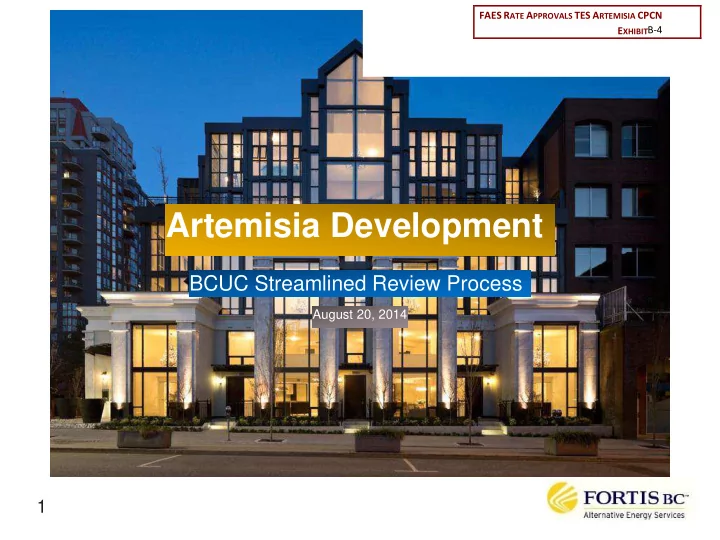
Artemisia Development
BCUC Streamlined Review Process
August 20, 2014
B-4 FAES RATE APPROVALS TES ARTEMISIA CPCN
EXHIBIT
Artemisia Development BCUC Streamlined Review Process August 20, - - PowerPoint PPT Presentation
FAES R ATE A PPROVALS TES A RTEMISIA CPCN E XHIBIT B-4 Artemisia Development BCUC Streamlined Review Process August 20, 2014 1 Artemisia Development FAES Thermal Energy Service Public Utility Service in perpetuity 1. Own assets that produce
1
August 20, 2014
B-4 FAES RATE APPROVALS TES ARTEMISIA CPCN
EXHIBIT
2
1. Own assets that produce heat and cold for the Artemisia Development 2. Meter thermal energy deliveries to Residential Strata in exchange for compensation
3
natural gas boiler for peak heating, and a natural gas make-up air unit
water)
4
Boffo FAES Residential Strata Construction & Purchase Agreement $ Energy System Title $ Service Agreement $ Metered Thermal Energy
Public Utility Service
$ Suppliers & Contractors
5
6
7
8
Jan-11 Mar-11 May-11 Jul-11 Sep-11 Nov-11 Jan-12 Mar-12 May-12 Jul-12 Sep-12 Nov-12 Jan-13 Mar-13 May-13 Jul-13 Sep-13 Nov-13 Jan-14 Mar-14 May-14 Jul-14 Sep-14 Nov-14 Jan-15 Mar-15 May-15 Jul-15 Sep-15 Nov-15 Negotiations
TES Scaled Framework
SRP Strata
Delta SD
Excavation Occupancy
Marine Gateway Kelowna DES Tsawwassen Springs TELUS Garden
Service
Artemisia Project TES Regulation
FEI Transition FAES AES Inquiry/Report SOLO Artemisia Sovereign
Ownership by FAES
9
FAES filed on June 24, 2014 and TES Regulatory Framework Guidelines (TES Guidelines) still pending Project is transitioning between two regulatory regimes Approvals sought:
1. CPCN to purchase, own and operate the energy system pursuant to ss. 45-46 of UCA 2. Rates established in the Service Agreement for the Residential Strata pursuant to ss. 59-61 of UCA 3. Exemption from long-term resource planning requirements pursuant to s. 44.1 of the UCA 4. Ongoing regulatory oversight on a complaint basis, consistent with BCUC Order G-54- 14 for SOLO
Decision Needed by September 30, 2014
(per the Thermal Energy System Construction and Purchase Agreement)
10
1. On-Site thermal energy system designed to serve:
generation or distribution facilities beyond the boundaries of the site
11
1. In Order C-3-14 (February 25), the BCUC granted the CPCN pursuant to ss. 45-46 of the UCA and noted:
“The Panel is satisfied that the evidence provided by FAES in its Application, information request responses and Streamline Review Process is adequate given the specific circumstances of the Application.”
2. The BCUC denied the rates but found the rates would be just and reasonable if FAES amended its Service Agreements to address the issues raised in Order C-3-14 and accompanying Decision. 3. On March 27, FAES filed an application for the approval of the rates established in the Amended Service Agreements to comply with BCUC Order C-3-14. In Order G-54-14 (April 15), the BCUC approved the rates as just and reasonable under ss. 59-61 of the Act
12
Agreement identical to those approved in Order G-54-14 (i.e., amendments made for SOLO were also made for Artemisia)
the completed Registration Form for Artemisia, the cover letter and the appendices supply the necessary information for the BCUC to grant the approvals sought.
13
The proposed TES System meets the description of an On-Site TES System, as defined in the TES Guidelines. The proposed TES System is associated with an approved single development / building permit. The proposed TES System capital cost is $15 M or less.
(Appendix A to June 12, 2014 TES Regulatory Framework Guidelines, page 4)
14
agreement)
implementing a rate change to explain the calculation behind the rate changes
convene a meeting to allow questions to be asked on the new rates
15
replacement capital in the forecast costs to provide the service:
per year starting in 6th year ($165,000 over 20 years)
the operation and maintenance for all FAES-owned equipment.
response respecting the operation of all thermal energy systems.
16
costs
17
1. Levelizing mechanism (20-year analysis term) 2. Initial rate in $/kWh ($0.095/kWh in 2014) 3. 2% annual escalation rate (inflation target) 4. 5-year performance terms 5. Performance ratio 6. Fuel deferral account & rate rider 7. Single variable rate for thermal energy 8. Minimum Annual Charge
“The initial rate will be $0.095/kWh (in 2014) escalated at 2% each year and adjusted every five (5) years by the Performance Ratio and will include the fuel Rate Rider which will be adjusted positively or negatively each year.”
18
intergenerational equity
19
years to the originally forecast cost of thermal energy ($/kWh) for the same period
term by this Performance Ratio
20
Deferral Account Treatment
Rate Rider
concerns
21
Annual Demand
but once actual data is available, it will be adjusted to equal the weather normalized average annual demand for the previous 3 years
Demand (in MWh), the difference would be multiplied by the applicable Energy Rate and added to the next bill.
22
Particulars 2014 2015 2016 2017 TOTAL Revenue Requirement Cost of Natural Gas 10 10 11 11 42 Cost of Electricity 3 4 4 4 14 Operation and Maintenance 14 14 14 14 56 Property Taxes
11 3 3 3 21 Amortization Expense
6 6 6 6 24
45 37 37 38 157 MWh 410 410 410 410 1,639 Forecast cost $/kWh 0.109 $ 0.090 $ 0.091 $ 0.093 $ 0.096 $ First Performance Term
23
Particulars 2014 2015 2016 2017 TOTAL NOTES Revenue Requirement Cost of Natural Gas 10 10 11 11 42 1 Cost of Electricity 3 4 4 4 14 1 Operation and Maintenance 10 15 13 12 50 2 Property Taxes
Depreciation Expense 11 3 3 3 21 2 Amortization Expense
Income Taxes
Earned Return 6 6 6 6 24
41 38 36 36 151 MWh 450 390 410 400 1,650 Actual cost $/kWh 0.090 $ 0.098 $ 0.089 $ 0.089 $ 0.092 $ First Performance Term
24
0.096 $ Performance Ratio 104.6% 0.092 $ 2014 2015 2016 2017 2018 Forecast Rates 0.095 $ 0.096 $ 0.098 $ 0.100 $ 0.102 $ Actual Rates 0.095 $ 0.096 $ 0.098 $ 0.100 $ 0.102 $ 2019 2020 2021 2022 2023 Forecast Rates 0.104 $ 0.106 $ 0.109 $ 0.111 $ 0.113 $ Actual Rates 0.100 $ 0.102 $ 0.104 $ 0.106 $ 0.108 $ Second Performance Term First Performance Term
25
customers
performing better than forecast
terms are reduced if FAES performs better
test period (except fuel costs)