Art of the Italian Renaissance Focus on the Individual Sculptors, - - PDF document

art of the italian renaissance
SMART_READER_LITE
LIVE PREVIEW

Art of the Italian Renaissance Focus on the Individual Sculptors, - - PDF document

Art of the Italian Renaissance Focus on the Individual Sculptors, artists, and architects combined classical ideas with the humanists idea of emphasis on the individual. Florentine sculptor Donatellos David Michelangelos David exemplifies


slide-1
SLIDE 1

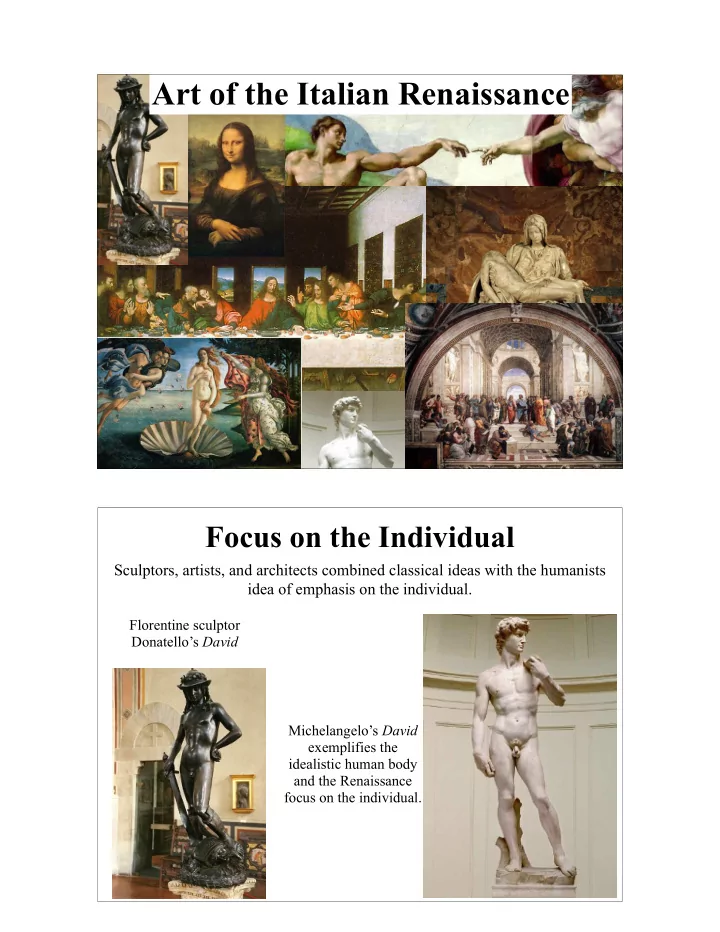
Art of the Italian Renaissance

Focus on the Individual

Sculptors, artists, and architects combined classical ideas with the humanists idea of emphasis on the individual.

Michelangelo’s David exemplifies the idealistic human body and the Renaissance focus on the individual. Florentine sculptor Donatello’s David

slide-2
SLIDE 2

Realism & Expression

Expulsion from
 the Garden

Masaccio, 1427

First nudes since
 classical times.

The first major revival of classicism occurred during the Renaissance.

Classicism

slide-3
SLIDE 3

Perspective

Renaissance painters needed to be able to translate the three-dimensional world around them onto the two-dimensional surface of a painting, called the "picture plane." The solution was "linear perspective," the idea that converging lines meet at a single vanishing point and all shapes get smaller in all directions with increasing distance from the eye. Most artists in Medieval Europe had never actually seen heaven, so the background was left to the imagination and the teachings of the church.

Perspective !

Perspective!

Perspective!

Perspective!

Perspective!

Perspective!

Perspective!

When people became more interested in the world around them and the ideas of other people rather than heaven and the teachings of the Church, landscapes and buildings began to show up in paintings.

Use of Light and Shadowing

Sfumato means “to tone down” or “to evaporate like smoke.”

!

The most prominent practitioner of sfumato was Leonard da Vinci, who described sfumato as “without lines or borders, in the manner of smoke or beyond the focus plane.” the use of strong contrasts between light and dark

Chiaroscuro Sfumato

Artemisia Gentileschi! Judith Slaying Holofernes (1614–20)! Oil on canvas! Galleria degli Uffizi, Florence.

Leonardo da Vinci! Mona Lisa
slide-4
SLIDE 4

Giotto

!

Ognissanti Madonna

!

1310

!

Tempera on panel

!

325 cm × 204 cm

!

Uffizi Gallery, Florence

Filippo Brunelleschi

!

Architect

!

Cuppolo of St. Maria
 del Fiore

!

1436

slide-5
SLIDE 5

Lorenzo Ghiberti

!

East doors, or Gates of Paradise

!

part of the Baptistry of Saint John in the Piazza del Duomo and the Piazza di San Giovanni, across from Basilica di Santa Maria del Fiore and the Campanile di Giotto, Florence

This panel depicts the story of Joseph, including his sale into slavery, the gold cup in Benjamin's sack of grain and Joseph revealing himself to his brothers.

A Contest to Decorate the Cathedral: Sacrifice of Isaac Panels

Brunelleschi Ghiberti

slide-6
SLIDE 6

Brunelleschi

!

Crucifix

!

1410-1415

!

wooden sculpture

!

Gondi Chapel of Santa Maria Novella, Florence

Masaccio, The Trinity

!

1425-28

!

Fresco, 667 x 317 cm

!

Santa Maria Novella, Florence

slide-7
SLIDE 7

Masaccio,

The Expulsion from the Garden of Eden

!

1426-28

!

Fresco, 208 x 88 cm

!

Brancacci Chapel of Santa Maria della Carmine in Florence

Fra Angelico

!

Deposition of Christ

!

1432-1434 Tempera on panel

!

176 cm × 185 cm

!

National Museum of San Marco, Florence

slide-8
SLIDE 8

Leonardo da Vinci,

Notebooks

1476-1508

Leonardo, the Engineer

Pages from his Notebook

A study of siege defenses. Studies of water-lifting devices.

slide-9
SLIDE 9

Medium oil on panel

!

203 × 314 cm

!

Uffizi Gallery, Florence

Sandro Botticelli,

!

Primavera

!

1482

Leonardo da Vinci

!

Virgin of the Rocks

!

1483-1486

!

Medium oil on panel

!

198 × 123 cm

!

Louvre Museum, Paris

slide-10
SLIDE 10

Sandro Botticelli

!

The Birth of Venus

!

1486 tempera on canvas

!

172.5 cm × 278.9 cm

!

Uffizi, Florence

Leonardo da Vinci

!

Vitruvian Man

!

1490

!

Pen and ink with wash over metalpoint on paper

!

34.4 cm × 25.5 cm

!

Accademia di Belle Arti, Venice, Italy