+ + ArrayList n Constructors ArrayList lst1 = new ArrayList(); - - PDF document

arraylist n constructors arraylist lst1 new arraylist
SMART_READER_LITE
LIVE PREVIEW

+ + ArrayList n Constructors ArrayList lst1 = new ArrayList(); - - PDF document

4/26/16 + + ArrayList n Constructors ArrayList lst1 = new ArrayList(); ArrayList lst2 = new ArrayList(int initialSize ); ArrayList<String> strList = new ArrayList(); n Parameterized type n use if you


slide-1
SLIDE 1

4/26/16 ¡ 1 ¡

+

Word Clouds cont.

+ArrayList ¡

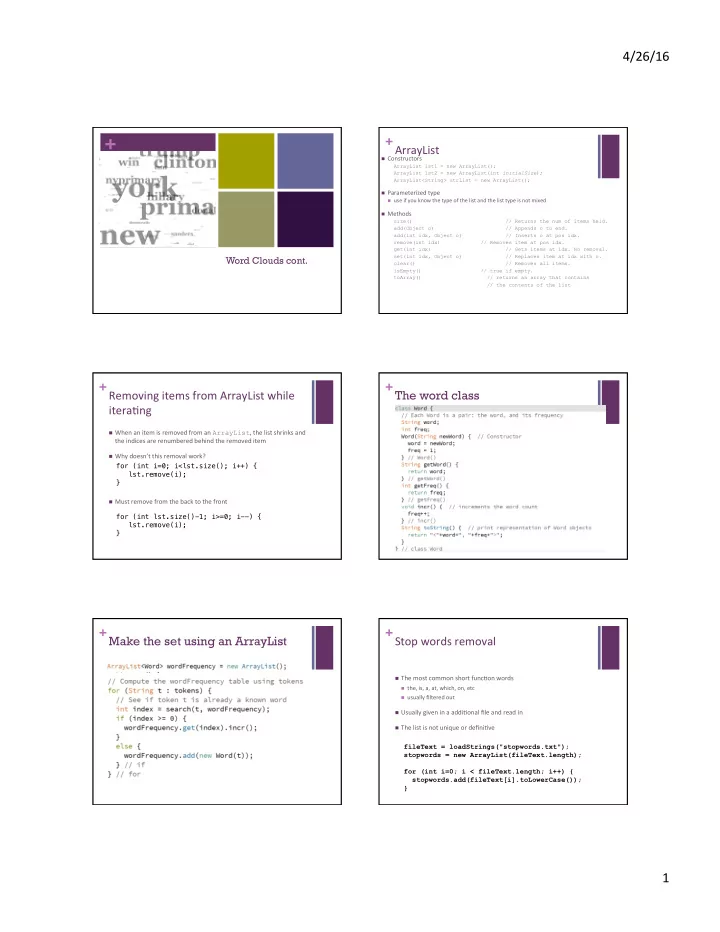
n Constructors ¡ ArrayList lst1 = new ArrayList(); ArrayList lst2 = new ArrayList(int initialSize); ArrayList<String> strList = new ArrayList(); n Parameterized ¡type ¡ n use ¡if ¡you ¡know ¡the ¡type ¡of ¡the ¡list ¡and ¡the ¡list ¡type ¡is ¡not ¡mixed ¡ n Methods ¡ size() // Returns the num of items held. add(Object o) // Appends o to end. add(int idx, Object o) // Inserts o at pos idx. remove(int idx) // Removes item at pos idx. get(int idx) // Gets items at idx. No removal. set(int idx, Object o) // Replaces item at idx with o. clear() // Removes all items. isEmpty() // true if empty. toArray() // returns an array that contains // the contents of the list

+Removing ¡items ¡from ¡ArrayList ¡while ¡ iteraDng ¡

n When ¡an ¡item ¡is ¡removed ¡from ¡an ¡ArrayList, ¡the ¡list ¡shrinks ¡and ¡

the ¡indices ¡are ¡renumbered ¡behind ¡the ¡removed ¡item ¡

n Why ¡doesn’t ¡this ¡removal ¡work? ¡ ¡ n Must ¡remove ¡from ¡the ¡back ¡to ¡the ¡front ¡

for (int i=0; i<lst.size(); i++) { lst.remove(i); } for (int lst.size()-1; i>=0; i--) { lst.remove(i); }

+The word class +Make the set using an ArrayList +Stop ¡words ¡removal ¡

n The ¡most ¡common ¡short ¡funcDon ¡words ¡ n the, ¡is, ¡a, ¡at, ¡which, ¡on, ¡etc ¡ n usually ¡filtered ¡out ¡ n Usually ¡given ¡in ¡a ¡addiDonal ¡file ¡and ¡read ¡in ¡ n The ¡list ¡is ¡not ¡unique ¡or ¡definiDve ¡

fileText = loadStrings("stopwords.txt"); stopwords = new ArrayList(fileText.length); for (int i=0; i < fileText.length; i++) { stopwords.add(fileText[i].toLowerCase()); }

slide-2
SLIDE 2

4/26/16 ¡ 2 ¡

+makeUnique ¡without ¡stop ¡words ¡

void makeUnique(String[] words) { uniqueWords = new ArrayList(); for (int i=0; i < words.length; i++) { if (!stopwords.contains(words[i])) { int idx = contains(words[i], uniqueWords); if (idx < 0) { uniqueWords.add(new Word(words[i])); } else { uniqueWords.get(idx).inc(); } } } }

+SorDng ¡

n Any ¡process ¡of ¡arranging ¡items ¡in ¡sequence ¡ n Build-­‑in ¡sort() n Works ¡on ¡arrays ¡of ¡simple ¡types, ¡i.e. ¡int, ¡float ¡and ¡String ¡ n float[] a = {3.4, 3.6, 2, 0, 7.1}; n a = sort(a); n String[] s = {"deer", "elephant", "bear",

"aardvark", "cat"};

n s = sort(s, 3); n Convenient, ¡but ¡not ¡very ¡flexible ¡ n Recall ¡that ¡we ¡have ¡an ¡ArrayList<Word> ¡

+Implement ¡your ¡own ¡sort ¡

n Many ¡sorDng ¡algorithms ¡ n Bubble ¡Sort ¡ n Looks ¡at ¡items ¡in ¡successive ¡pairs ¡ n Swap ¡if ¡in ¡the ¡wrong ¡order ¡ n SelecDon ¡Sort ¡ n Scan ¡a ¡list ¡start ¡to ¡end ¡and ¡find ¡the ¡value ¡that ¡should ¡come ¡first ¡ n Swap ¡that ¡item ¡into ¡the ¡first ¡posiDon ¡ n Repeat ¡scanning ¡and ¡swapping ¡starDng ¡at ¡the ¡second ¡posiDon ¡in ¡the ¡list ¡ n InserDon ¡Sort ¡

+Sorting (implement your own)

n Easy to code (but slow) n Selection Sort n Bubble Sort n Insertion Sort n Animations n https://www.cs.usfca.edu/~galles/visualization/

ComparisonSort.html

n http://www.sorting-algorithms.com/

+Selection sort

n Basic idea: n step forward on each item of the array starting with the first item,

if there is a smallest item in front of the item being stepped on, then swap the two items. Repeat until you've stepped on every item.

n Implementation: n nested loop n first loop marks the current item n inner loop finds the smallest item between the current item

and the last item inclusively, then swaps the items

n Time Complexity?

slide-3
SLIDE 3

4/26/16 ¡ 3 ¡

+Bubble sort

n Basic idea: n start with the first item in the array compare adjacent items if they

are not sorted, swap them, go to the next item and repeat until you get to the end.

n repeat the above process until sorted n Implementation: n nested loop n first loop checks if the array is sorted n inner compares and swaps n Time Complexity?

+Insertion Sort

n Basic idea: n start with a sorted subarray, insert the next item from your

unsorted list into the right position of the sorted list.

n When you get to the end of the unsorted list, you are done n Implementation: n nested loop n first loop gets next item to insert n inner compares, copies and makes space n inserts into space n Time Complexity?

+Arrange

n Non-overlapping arrangements are often desired n a.k.a. Tiling n Make a Word Tile Object n holds the word, frequency pair n displays itself n should have a concept of visual intersection n How do we arrange? n randomly? n grid? n spiral?

+Random Arrangement

n While there are more tiles to place n get the next tile, t, to place n while(t is not placed) n set a random location, l, for the tile n if t does not intersect any previously placed tile n place t.

+checking t against previously placed tiles

n basic idea n keep the index of the current item to place n randomly place the item at current index n loop from 0 to the current index and check if the place intersects n if not then increment current index n details n for (int j = 0; j < sortedList.size(); j++) n while goodPlace == false n randomly place sortedList.get(j) n goodPlace = true n for(int i = 0; i < j; i++) { n if sortedList.get(i).intersects(sortedList.get(j)) n goodPlace = false

+Grid arrangement (simplest way)

n Get the size of the biggest tile. n compute how many of the biggest tile would fit in the window n make a grid of width/tileWidth x height/tileHeight words

each scaled based on their frequency.

slide-4
SLIDE 4

4/26/16 ¡ 4 ¡

+Grid arrangement (slightly tougher way)

n Get the size of the biggest tile. n compute how many, M, of the biggest tile would fit in the

sketch

n if N > M, then change the maximum font size of a tile so that a

grid of the largest tile size would allow for N tiles on the sketch

n make a grid based on new tile sizes.

+Spiral Arrangement

n Sort the tiles from largest to smallest. n While there are more tiles to place n get the next tile, t, to place n while(t is not placed) n set location, l, for the tile to be at the current spiral location n if t does not intersect any previously placed tile n place t. n update the current spiral position outward by a fixed step size.

+Chris ¡Rock ¡@ ¡Oscars ¡ + Sales Data

(US $ in thousands)

Region ¡ Jan ¡ Feb ¡ Mar ¡ Apr ¡ May ¡ Jun ¡ Jul ¡ Aug ¡ Sep ¡ Oct ¡ Nov ¡ Dec ¡ Domestic ¡ 1983 ¡ 2343 ¡ 2593 ¡ 2283 ¡ 2574 ¡ 2838 ¡ 2382 ¡ 2634 ¡ 2938 ¡ 2739 ¡ 2983 ¡ 3413 ¡ International ¡ 574 ¡ 636 ¡ 573 ¡ 593 ¡ 644 ¡ 679 ¡ 593 ¡ 139 ¡ 599 ¡ 583 ¡ 602 ¡ 690 ¡

0 ¡ 500 ¡ 1000 ¡ 1500 ¡ 2000 ¡ 2500 ¡ 3000 ¡ 3500 ¡ 4000 ¡ Jan ¡ Feb ¡ Mar ¡ Apr ¡ May ¡ Jun ¡ Jul ¡ Aug ¡ Sep ¡ Oct ¡ Nov ¡ Dec ¡ US ¡$ ¡(in ¡thousands) ¡

2009 ¡Sales ¡

DomesDc ¡ InternaDonal ¡

22

4/26/16 Permeating Data Visualization in CS Courses

+ Top Medals in Olympics by Country

(1992-2012)

Country ¡ 2012 ¡ 2008 ¡ 2004 ¡ 2000 ¡ 1996 ¡ 1992 ¡ United States of America ¡ 104 ¡ 110 ¡ 103 ¡ 92 ¡ 101 ¡ 108 ¡ People's Republic

  • f China ¡

88 ¡ 100 ¡ 63 ¡ 59 ¡ 50 ¡ 54 ¡ Russian Federation ¡ 82 ¡ 72 ¡ 92 ¡ 88 ¡ 63 ¡ 112 ¡ Great Britain ¡ 65 ¡ 47 ¡ 30 ¡ 28 ¡ 15 ¡ 20 ¡ Australia ¡ 35 ¡ 46 ¡ 49 ¡ 58 ¡ 41 ¡ 27 ¡ Germany ¡ 44 ¡ 41 ¡ 49 ¡ 56 ¡ 65 ¡ 82 ¡ France ¡ 34 ¡ 40 ¡ 33 ¡ 38 ¡ 37 ¡ 29 ¡ Republic of Korea ¡ 28 ¡ 31 ¡ 30 ¡ 28 ¡ 27 ¡ 29 ¡ Japan ¡ 38 ¡ 25 ¡ 37 ¡ 18 ¡ 14 ¡ 22 ¡ Italy ¡ 28 ¡ 27 ¡ 32 ¡ 34 ¡ 35 ¡ 19 ¡

+ Top Medals in Olympics (1992-2012)

0 ¡ 20 ¡ 40 ¡ 60 ¡ 80 ¡ 100 ¡ 120 ¡ 2012 ¡ 2008 ¡ 2004 ¡ 2000 ¡ 1996 ¡ 1992 ¡

Olympic ¡Medals ¡Tally ¡

United ¡States ¡of ¡America ¡ People's ¡Republic ¡of ¡China ¡ Russian ¡FederaDon ¡ Great ¡Britain ¡ Australia ¡ Germany ¡ France ¡ Republic ¡of ¡Korea ¡ Japan ¡ Italy ¡

slide-5
SLIDE 5

4/26/16 ¡ 5 ¡

+ Top Medals in Olympics (1992-2012)

Focus on

  • Germany
  • China
  • Great Britain

0 ¡ 20 ¡ 40 ¡ 60 ¡ 80 ¡ 100 ¡ 120 ¡ 2012 ¡ 2008 ¡ 2004 ¡ 2000 ¡ 1996 ¡ 1992 ¡

Olympic ¡Medals ¡Tally ¡

United ¡States ¡of ¡America ¡ People's ¡Republic ¡of ¡China ¡ Russian ¡FederaDon ¡ Great ¡Britain ¡ Australia ¡ Germany ¡ France ¡ Republic ¡of ¡Korea ¡ Japan ¡ Italy ¡

+Example: ¡Visualizing ¡Time ¡Series ¡

Raw Data

1,4,2010,213.43,214.50,214.01,17633200 1,5,2010,214.60,215.59,214.38,21496600 1,6,2010,214.38,215.23,210.97,19720000 1,7,2010,211.75,212.00,210.58,17040400 1,8,2010,210.30,212.00,211.98,15986100 … 12,27,2010,322.85,325.44,324.68,8922000 12,28,2010,325.91,326.66,325.47,6283000 12,29,2010,326.22,326.45,325.29,5826400 12,30,2010,325.48,325.51,323.66,5624800 12,31,2010,322.95,323.48,322.56,6911000

+Visualizing ¡Time ¡Series ¡ +Visualizing ¡Time ¡Series ¡ +Data ¡VisualizaBon ¡-­‑ ¡Horizons ¡ +