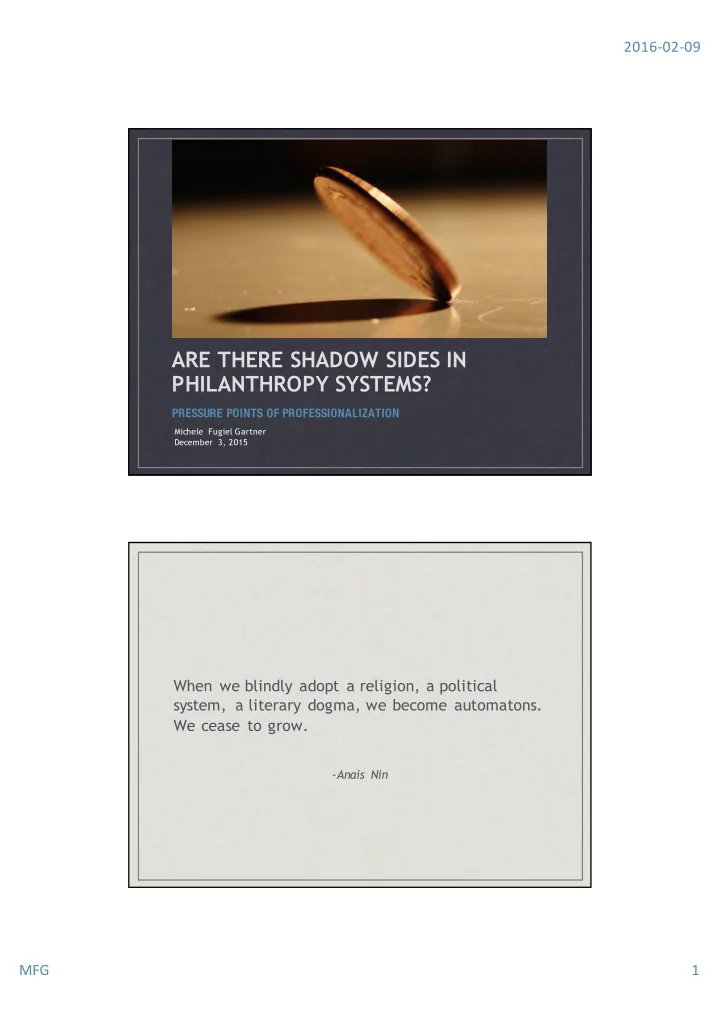
ARE THERE SHADOW SIDES IN PHILANTHROPY SYSTEMS? PRESSURE POINTS OF - - PDF document

are there shadow sides in philanthropy systems
SMART_READER_LITE
LIVE PREVIEW

ARE THERE SHADOW SIDES IN PHILANTHROPY SYSTEMS? PRESSURE POINTS OF - - PDF document

2016-02-09 ARE THERE SHADOW SIDES IN PHILANTHROPY SYSTEMS? PRESSURE POINTS OF PROFESSIONALIZATION Michele Fugiel Gartner December 3, 2015 When we blindly adopt a religion, a political system, a literary dogma, we become automatons. We cease


slide-1
SLIDE 1

2016-02-09 MFG 1

ARE THERE SHADOW SIDES IN PHILANTHROPY SYSTEMS?

PRESSURE POINTS OF PROFESSIONALIZATION

Michele Fugiel Gartner December 3, 2015

When we blindly adopt a religion, a political system, a literary dogma, we become automatons. We cease to grow.

  • Anais Nin
slide-2
SLIDE 2

2016-02-09 MFG 2

What constitutes professionalization?

Wilensky (1964) identifies five steps: the beginning of full-time work; the establishment of a training school; the formation of a professional association; the protection of jurisdiction through state-sanctioned licensing; and the development of a formal code of ethics. “This sequence is an ideal type, but some, if not all, of these events occur to varying degrees during the course of professionalization, especially for nonprofits, which often begin with volunteers and “amateur” staff.” (Hwang and Powell, 2009)

Non- Profit Advisor PHILANTHROPIC OPERATIONS

slide-3
SLIDE 3

2016-02-09 MFG 3

FINANCIAL PLANNERS,ACCOUNTANTS, AND LAWYERS

73% of Baby Boomers say they have a philanthropic responsibility. 71 of advisors raise the philanthropic discussion from a technical perspective— focusing on tax considerations or wealth structuring — compared to those who do so beginning with their clients’ philanthropic goals or passions (35%) Pressure point: Philanthropy Advisory services does not yet have a cash flow itself, rather advisors focus on the financial products. ?: Will technical tools suffice for donor engagement?

Advisor

Non- Profit Advisor PHILANTHROPIC ACTORS

slide-4
SLIDE 4

2016-02-09 MFG 4

PHILANTHROPIC MANAGERS AND CONSULTANTS

Private foundations make up 16% of private giving (Foundation Center, 2013) and are 13% of make up of revenue source for public charities(Urban Institute, 2012). Is it focused or is it flooding the zone? Tend to focus on the philanthropist, rather than the organization, and it’s decision-making and learning, as a whole. Pressure Point: Legitimacy (Frumkin, 2006) ?: Does our quest for accountability reinforce foundations need for legitimacy thereby creating a system that obscures the work?

Non- Profit Advisor PHILANTHROPIC ACTORS

slide-5
SLIDE 5

2016-02-09 MFG 5

BOARD OF DIRECTORS, FUNDRAISERS, AND EXECUTIVE DIRECTORS

Annual gifts vs. Major and Planned Board’s role in fundraising Burnout Pressure Point: short-termism ?: Short term concerns may be a cash flow reality, do we fully understand the long lasting effects on donors and staff.

Non- Profit

Non- Profit Advisor THE PHILANTHROPIC SYSTEM

community

community

Philanthropic Actors

slide-6
SLIDE 6

2016-02-09 MFG 6

ACTIVISTS, ACADEMICS, AND ALL OF US

McKnight (2009) Are we too reliant on the “servicers”? Future research needs to look at “circuits of power at the molecular level” (Kohl, 2006) Pressure Point: External to the system actors ?: Can we reflect back what is possible?

The community

“History poses many challenges for those doing applied social science. It inescapably forces us into hard thought about alternative perspectives. It denies the possibility of neutral objectivity. It insists that we recognize that every story involves the assertion of authority and power. ”

–David Hammack, 2015