Architectural Structures Arch 241 - Nov 17 November 2008 - - PDF document

architectural structures arch 241 nov 17 november 2008
SMART_READER_LITE
LIVE PREVIEW

Architectural Structures Arch 241 - Nov 17 November 2008 - - PDF document

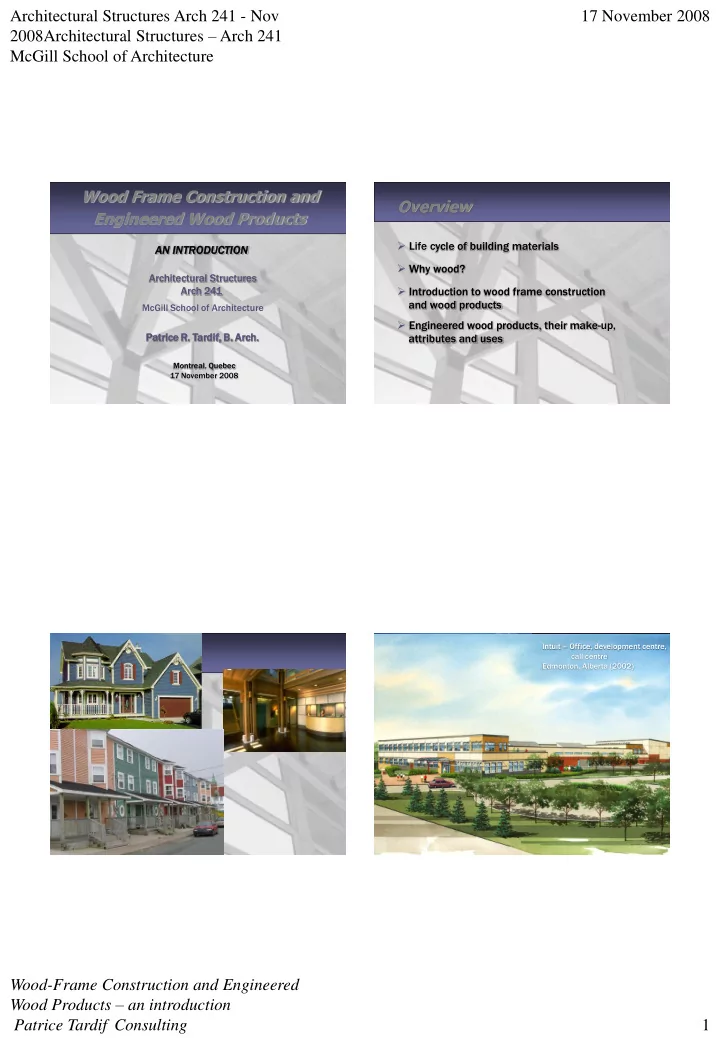
Architectural Structures Arch 241 - Nov 17 November 2008 2008Architectural Structures Arch 241 McGill School of Architecture Wood Frame Construction and Overview Engineered Wood Products Life cycle of building materials AN INTRODUCTI


slide-1
SLIDE 1

Architectural Structures Arch 241 - Nov 2008Architectural Structures – Arch 241 McGill School of Architecture 17 November 2008 Wood-Frame Construction and Engineered Wood Products – an introduction Patrice Tardif Consulting 1

Architectural Structures Arch 241

McGill School of Architecture

Montreal, Quebec 17 November 2008

AN INTRODUCTI TION ON

Wood Frame Construction and Engineered Wood Products

Patrice ice R. Tardif, f, B. Arch.

  • Life cycle of building materials
  • Why wood?
  • Introduction to wood frame construction

and wood products

  • Engineered wood products, their make-up,

attributes and uses

Overview

Intuit – Office, development centre, call centre Edmonton, Alberta (2002)

slide-2
SLIDE 2

Architectural Structures Arch 241 - Nov 2008Architectural Structures – Arch 241 McGill School of Architecture 17 November 2008 Wood-Frame Construction and Engineered Wood Products – an introduction Patrice Tardif Consulting 2

Blue Mountain Ski Resort Colllingwood, Ontario Dollarama – Le Huard Quincaillerie Home Hardware Chibougamau, Québec (2003) Jackson Triggs Winery Niagara-on-the-Lake, Ontario (2001)

 xxx

Poste de pompiers Alberta (2001)

slide-3
SLIDE 3

Architectural Structures Arch 241 - Nov 2008Architectural Structures – Arch 241 McGill School of Architecture 17 November 2008 Wood-Frame Construction and Engineered Wood Products – an introduction Patrice Tardif Consulting 3

Bibliothèque de Val Cartier Val Cartier (2002) Gene H. Kruger Pavilion, Laval University Sainte-Foy (2005)

slide-4
SLIDE 4

Architectural Structures Arch 241 - Nov 2008Architectural Structures – Arch 241 McGill School of Architecture 17 November 2008 Wood-Frame Construction and Engineered Wood Products – an introduction Patrice Tardif Consulting 4

Limoges Concert Hall Limoges, France (2006) Albert Mianscum Memorial Sports Complex Oujé-Bougoumou (2002) Complexe multi-sports de Laval Laval (2005)

 xxx

Mountain Equipment Co-op Montréal, Québec (2003) Magasin d’articles de sport Gerrick’s Cranbrook, Colombie-Brittanique (2005)

slide-5
SLIDE 5

Architectural Structures Arch 241 - Nov 2008Architectural Structures – Arch 241 McGill School of Architecture 17 November 2008 Wood-Frame Construction and Engineered Wood Products – an introduction Patrice Tardif Consulting 5

Club de golf Saint-Prime-sur-le-lac Saint-Prime, Québec (2003) Parc des Hautes, Sépaq Charlevoix, Québec

slide-6
SLIDE 6

Architectural Structures Arch 241 - Nov 2008Architectural Structures – Arch 241 McGill School of Architecture 17 November 2008 Wood-Frame Construction and Engineered Wood Products – an introduction Patrice Tardif Consulting 6

Gare Intermodale de Saint-Jérôme Saint-Jérôme (2004) Brentwood Skytrain Station Burnaby, B.C. (2001) Credit Valley Hospital Mississauga, Ontario (2004) Thunder Bay Hospital Thunder Bay, Ontario (2002)

slide-7
SLIDE 7

Architectural Structures Arch 241 - Nov 2008Architectural Structures – Arch 241 McGill School of Architecture 17 November 2008 Wood-Frame Construction and Engineered Wood Products – an introduction Patrice Tardif Consulting 7

Cathedral of Christ the Light Oakland, California (2008)

 An introduction to life cycle analysis (LCA)

building materials from “cradle to grave”

 LCA evaluation of building materials

resource extraction manufacturing requirements on-site construction occupancy / maintenance demolition recycling / reuse / disposal

 Certification programs

examples LEED

  • Life Cycle of Building Materials

LIFE CYCLE ANALYSIS (LCA)

LCA is a tool that can be used to assess the burdens placed on the environment by a product through all stages of its life.

 An introduction to Life Cycle Analysis

“Cradle to Grave”

Two main aspects to LCA:

 Data acquisition  Data analysis

 An introduction to Life Cycle Analysis cont’

slide-8
SLIDE 8

Architectural Structures Arch 241 - Nov 2008Architectural Structures – Arch 241 McGill School of Architecture 17 November 2008 Wood-Frame Construction and Engineered Wood Products – an introduction Patrice Tardif Consulting 8

 LCA evaluation of building materials

Sawmill Recycling CO2 CO2 Panel Manufacturing Biomass Facility Extraction

“Cradle to Grave”

 resource extraction  manufacturing requirements  on-site construction  occupancy / maintenance  demolition  recycling / reuse / disposal

 resource extraction

 LCA evaluation of building materials

 resource extraction cont’

 LCA evaluation of building materials cont’

 manufacturing requirements

 LCA evaluation of building materials cont’

slide-9
SLIDE 9

Architectural Structures Arch 241 - Nov 2008Architectural Structures – Arch 241 McGill School of Architecture 17 November 2008 Wood-Frame Construction and Engineered Wood Products – an introduction Patrice Tardif Consulting 9

  • n-site construction

 LCA evaluation of building materials cont’

  • n-site construction cont’

 LCA evaluation of building materials cont’

  • ccupancy / maintenance

 LCA evaluation of building materials cont’

 demolition

 LCA evaluation of building materials cont’

slide-10
SLIDE 10

Architectural Structures Arch 241 - Nov 2008Architectural Structures – Arch 241 McGill School of Architecture 17 November 2008 Wood-Frame Construction and Engineered Wood Products – an introduction Patrice Tardif Consulting 10

 recycling / reuse / disposal

 LCA evaluation of building materials cont’

Life cycle assessments look at environmental impacts, such as:

  • acid rain
  • air pollution
  • health
  • smog
  • indoor air quality
  • water intake
  • global warming
  • habitat alteration
  • ecological toxicity
  • ozone depletion
  • fossil fuel depletion

According to LCA, wood products are the most environmentally responsible construction materials when taking into consideration all of these factors.

 LCA evaluation of building materials cont’  LCA evaluation of building materials cont’

Two main aspects to LCA:

 Data acquisition  Data analysis  Interpretation  Value judgements

 product standards (ANSI, CGSB, ISO)  certified forest management practices

 CSA  FSC  SFI

 environmentally preferable products

 Green Seal  Green Cross  EPP

 performance measurement tools

 BREEAM (Green Leaf)  Green Globes  LEED  GB Tool

 Certification programs

slide-11
SLIDE 11

Architectural Structures Arch 241 - Nov 2008Architectural Structures – Arch 241 McGill School of Architecture 17 November 2008 Wood-Frame Construction and Engineered Wood Products – an introduction Patrice Tardif Consulting 11

  • Why wood?

 Renewable and sustainable  Durable  Environmentally responsible (manufacturing)  Reduces global greenhouse gas emissions  Thermally efficient  Subjective properties  renewable and sustainable

Over 600 million seedlings are planted in Canada each year

  • Why wood?

6% 16% 21% 26% 29% 40% 60% 63% 64% 66% 68% 82% 86% 90% 91% 0% 20% 40% 60% 80% 100% United Kingdom China New Zealand United States Indonesia Russian Federation Sweden CANADA Source : FAO State of the World`s Forests 2005

 Renewable and sustainable

The rate of growth in Canada’s commercial forests is equivalent to:

  • 50,354 houses a day
  • 2,098 houses an hour
  • 35 houses a minute

 Renewable and sustainable cont’

slide-12
SLIDE 12

Architectural Structures Arch 241 - Nov 2008Architectural Structures – Arch 241 McGill School of Architecture 17 November 2008 Wood-Frame Construction and Engineered Wood Products – an introduction Patrice Tardif Consulting 12

20 40 60 80 100 120 140 1999 2000 2001 2002 2003 2004 2005 2006 2007 End of year

CSA SFI FSC   

78.0 – CSA 36.1 – SFI 24.4 – FSC Source: Canadian Sustainable Forestry Certification Coalition – December 2007

Sustainable Forest Management certification (SFM) in Canada, 1999 – 2007 (millions of ha)

 Renewable and sustainable cont’

138.5 42.2 22.5 17.9 17.5 9.2 7.7 5.8 4 3.7 0.7 1.9 10 20 30 40 50 60 70 80 90 100 110 120 130 140 150 CANADA États-Unis Finlande Suède Fédération Russe Australie Allemange Brésil Malaysie France Chile Mexique

 Renewable and sustainable cont’

Source: Canadian Sustainable Forestry Certification Coalition – December 2007

SFM certification in Canada and internationally, December 2007 (millions of ha)

Norway : “Borgund” – stave church 12th century Japan : “Todaiji iji” built in 752 – the largest wood building in the world – most recent section built in 1692

 Durable

Banc de pêche de Pasbébiac – “Entrepot

  • t le Boutillier” –

built in ~ 1840

slide-13
SLIDE 13

Architectural Structures Arch 241 - Nov 2008Architectural Structures – Arch 241 McGill School of Architecture 17 November 2008 Wood-Frame Construction and Engineered Wood Products – an introduction Patrice Tardif Consulting 13

7 Wood Steel Concrete Energy Use (GJ x 108) 4 5.5

  • Why wood? cont’

 renewable and sustainable  durable  environmentally responsible (manufacturing)

 Uses less energy to manufacture

Equivalent CO2 (Tonnes) Wood Steel Concrete 1050 1300 750

AIR

 renewable and sustainable  durable  environmentally responsible (manufacturing)

 Uses less energy to manufacture  Contributes less to air pollution

 Environmentally responsible

Wood Steel Concrete Index Value x 108 165 1 5

WATER

 renewable and sustainable  durable  environmentally responsible (manufacturing)

 Uses less energy to manufacture  Contributes less to water pollution

 Environmentally responsible cont’

Wood Steel Concrete Index Value x 105 60 35 30

 renewable and sustainable  durable  environmentally responsible (manufacturing)

 Uses less energy to manufacture  Contributes less to air and water pollution  Resource extraction requirements less onerous

 Environmentally responsible cont’

slide-14
SLIDE 14

Architectural Structures Arch 241 - Nov 2008Architectural Structures – Arch 241 McGill School of Architecture 17 November 2008 Wood-Frame Construction and Engineered Wood Products – an introduction Patrice Tardif Consulting 14

 renewable and sustainable  durable  environmentally responsible (manufacturing)

52 %  dimension lumber & other wood products ; 30 %  chips for pulp and paper ; 10 %  bark for energy & mulch ; 8 %  shavings for particleboard,

MDF, energy and mulch.  Uses less energy to manufacture  Contributes less to air and water pollution  Resource extraction requirements less onerous  Efficient use of raw resource

 Environmentally responsible cont’

  • Why wood? cont’

 renewable and sustainable  durable  environmentally responsible (manufacturing)  reduces global greenhouse gas emissions

A typical 216 sq. m. (2,400

  • sq. ft) wood-frame house

holds 28.5 tonnes of carbon dioxide, an amount equal to the emissions of a small car

  • ver seven years.

 R value for wood = 1.5/in.  R value for steel = .0024/in.  R value for concrete = .08/ in.

  • Why wood? cont’

 renewable and sustainable  durable  environmentally responsible (manufacturing)  reduces global greenhouse gas emissions  thermally efficient  renewable and sustainable  durable  environmentally responsible (manufacturing)  reduces global greenhouse gas emissions  thermally efficient cont’

1 2 3 4 5 Assembly R Values Wood 2x4 Steel 2x4 Concrete Block 6"

 Thermally efficient

slide-15
SLIDE 15

Architectural Structures Arch 241 - Nov 2008Architectural Structures – Arch 241 McGill School of Architecture 17 November 2008 Wood-Frame Construction and Engineered Wood Products – an introduction Patrice Tardif Consulting 15

  • Why wood? cont’

 renewable and sustainable  durable  environmentally responsible (manufacturing)  subjective properties

 warmth  aesthetics

 reduces global greenhouse gas emissions  thermally efficient

LCA examines the entire life cycle of a product, a process or an activity . . .

  • Why wood? cont’

Embodied and Operating Energy

Steel Concrete Energy Use 12% 20% Greenhouse 15% 29% Air Pollution 10% 12% Water Pollution 300% 225% Resource Use 7% 50% Solid Waste 6% 16%

  • Why wood? cont’

For a typical building with a life expectancy of 20 years.

  • Wood – frame Construction
slide-16
SLIDE 16

Architectural Structures Arch 241 - Nov 2008Architectural Structures – Arch 241 McGill School of Architecture 17 November 2008 Wood-Frame Construction and Engineered Wood Products – an introduction Patrice Tardif Consulting 16

Vertical load path: Lateral load path:

  • Wood – frame Construction

 live  dead  snow  wind  seismic  Post and Beam construction  Prefabricated or Manufactured construction  Light-frame construction

Wood-Frame Construction Techniques:

  • Wood – frame Construction cont’

Main Structural Elements: Secondary Structural Elements:

  • Wood – frame construction cont’

 Columns  Beams  Joists  Sheathing  Decking Closely spaced members, combined with sheathing or decking, form the structural elements of the building – elements used are dimension lumber sized (2 x 4’s, 2 x 6’s, etc.)

2 basic framing methods

 Light-frame Construction

 Balloon framing  Platform framing

slide-17
SLIDE 17

Architectural Structures Arch 241 - Nov 2008Architectural Structures – Arch 241 McGill School of Architecture 17 November 2008 Wood-Frame Construction and Engineered Wood Products – an introduction Patrice Tardif Consulting 17

Sheathing Exterior finish Gypsum wallboard Flooring Insulation

  • Wood – frame construction cont’

 The wall studs are continuous for the building’s height

 Balloon framing

 The wall studs are continuous for the building’s height

 Balloon framing cont’

 Floor supports are let into the wall framing members

 Platform framing

 Floor assembly built separately from walls and extends to outer edge of walls

slide-18
SLIDE 18

Architectural Structures Arch 241 - Nov 2008Architectural Structures – Arch 241 McGill School of Architecture 17 November 2008 Wood-Frame Construction and Engineered Wood Products – an introduction Patrice Tardif Consulting 18

 Platform framing cont’

 Floor assembly built separately from walls and extends to outer edge of walls  Provides working surface for subsequent levels

Widely-spaced sawn timbers provide structural support – diagonal bracing or

  • ther support is required to

resist lateral loads.

 Post and Beam Construction

Widely-spaced sawn timbers provide structural support – diagonal bracing or other support is required to resist lateral loads

 diagonal bracing or other support is required to resist lateral loads

 Post and Beam Construction cont’

 large members connected using high capacity type connections, etc.

Elements or systems are constructed off-site in controlled environments.

 Prefabricated or Manufactured Construction

slide-19
SLIDE 19

Architectural Structures Arch 241 - Nov 2008Architectural Structures – Arch 241 McGill School of Architecture 17 November 2008 Wood-Frame Construction and Engineered Wood Products – an introduction Patrice Tardif Consulting 19

Elements can be used in conjunction with more conventional construction techniques, or entire houses can be “manufactured” off-site, then transported and assembled on-site.

 Prefabricated or Manufactured Construction cont’

Advantages:

 integrated design approach  quality of the building envelope  controlled environment, easier to assure quality of materials and construction techniques  speed of assembly

 Prefabricated or Manufactured Construction cont’

Main Structural Elements:

  • Wood – frame construction cont’

 Columns  Beams  Joists

 Engineered wood products  Timber  Specialty lumber  Dimension lumber

 Products used for Main Stuctural Elements

slide-20
SLIDE 20

Architectural Structures Arch 241 - Nov 2008Architectural Structures – Arch 241 McGill School of Architecture 17 November 2008 Wood-Frame Construction and Engineered Wood Products – an introduction Patrice Tardif Consulting 20

 Dimension lumber

  •  4” thick (100 mm) (nominal)
  • visually graded and stamped as meeting

standardized grading rules (NGRDL and NLGA)

  • Approved by the

Canadian lumber standards accreditation board

 Main Stuctural Elements cont’  Main Stuctural Elements cont’

 Dimension lumber  Specialty lumber

  • Machine stress-rated (MSR) – visually graded and

mechanically tested

 Main Stuctural Elements cont’

 Dimension lumber  Specialty lumber

  • Machine stress-rated (MSR) – visually graded and

mechanically tested

  • Finger-joined lumber –

machined profiles end-glued

  • minimum thickness of 6”

(152 mm)

  • visually graded and stamped as

meeting NGRDL and NLGA standardized grading rules

  • Canadian grades and species

meet CNBC requirements and CSA O86

 Main Stuctural Elements cont’

 Dimension lumber  Specialty lumber  Timber

slide-21
SLIDE 21

Architectural Structures Arch 241 - Nov 2008Architectural Structures – Arch 241 McGill School of Architecture 17 November 2008 Wood-Frame Construction and Engineered Wood Products – an introduction Patrice Tardif Consulting 21

  • Structural composite lumber (SCL)
  • Wood I-joists
  • Light-frame trusses
  • Glulams

 Main Stuctural Elements cont’

 Dimension lumber  Specialty lumber  Timber  Engineered wood products Secondary Structural Elements:

  • Wood – frame construction cont’

 Sheathing  Decking

 Products used for Secondary Stuctural Elements

 Decking  Sheathing

  • Plywood
  • Oriented strand board (OSB)

 Secondary Stuctural Elements cont’

 Sheathing

slide-22
SLIDE 22

Architectural Structures Arch 241 - Nov 2008Architectural Structures – Arch 241 McGill School of Architecture 17 November 2008 Wood-Frame Construction and Engineered Wood Products – an introduction Patrice Tardif Consulting 22

  • Dimension lumber with tongue and grooved profile
  • 3 thicknesses ranging from 1.5” ( 38 mm) to 3.5” (89 mm)

 Sheathing  Decking or planking

 Secondary Stuctural Elements cont’

An Engineered Wood Product (EWP) is a product that has gone through a process to provide better or more predictable properties.

 more design flexibility  longer spans  greater load carrying capacity  can use the entire tree, no matter what the species, the shape or the size  a good use of raw resource with less construction waste

  • Engineered Wood Products

Typical engineered wood products in wood-frame construction:

 SCL  trusses  glulams  plywood  wood I-joists  OSB

  • Engineered Wood Products cont’

Structural panel made from thin softwood veneers (plies) in alternating cross-oriented layers that are glued together under heat and pressure using waterproof adhesives.

 must be certified to product standards and stamped as such to be accepted by building codes  odd # of plies that are symmetrical about the centreline  sanded or unsanded  tongue & grooved or square-edged

 Plywood

slide-23
SLIDE 23

Architectural Structures Arch 241 - Nov 2008Architectural Structures – Arch 241 McGill School of Architecture 17 November 2008 Wood-Frame Construction and Engineered Wood Products – an introduction Patrice Tardif Consulting 23

Plywood – Attributes

 can be treated for added properties (resistance to fire, insects, decay)  certified for exterior applications

Plywood – Uses

 floor, roof, and wall sheathing,  floor underlayment,  concrete formwork,  box beams  stressed-skin panels  preserved wood foundations

 Plywood cont’

Structural panel made from successive layers of strands that are bonded together under heat and pressure with either waterproof adhesives or equivalent binders and wax.

 strands oriented in long direction of the panel in outer layers and typically cross-oriented in the core  must be certified to product standards and stamped to be accepted by building codes  tongue& grooved or square-edged

 Oriented Strand Board (OSB)

OSB – Attributes

 added strength and stiffness in the length of the panel  high shear value  available in many different sizes and lengths  not recommended for exposed exterior applications

OSB – Uses

 floor, roof and wall sheathing  structural insulated panels  wood I-joist webs  concrete formwork  siding

 Oriented Strand Board (OSB) cont’

Proprietary engineered wood products, each with its own design values:

 Structural Composite Lumber (SCL)

 Parallel Strand Lumber (PSL)  Laminated Veneer Lumber (LVL)  Laminated Strand Lumber (LSL)

slide-24
SLIDE 24

Architectural Structures Arch 241 - Nov 2008Architectural Structures – Arch 241 McGill School of Architecture 17 November 2008 Wood-Frame Construction and Engineered Wood Products – an introduction Patrice Tardif Consulting 24

 glued products using exterior, waterproof resins  similar structural capabilities  need individual certification to be accepted in building codes  manufacturers supply load tables and installation recommendations, as well as assist with layout drawings and sizing of members  need engineer’s approval or stamp

 Structural Composite Lumber (SCL) cont’

PSL is an SCL that consists of strands of veneers glued together under pressure with the strands

  • riented along the length of the piece.

 beams typically available in 1-3/4” ( 44.5 mm) to 7” (178 mm) thicknesses and can be sawn to any dimension  manufacturers supply load tables and installation recommendations, as well as assist with layout drawings and sizing of members – ultimately need engineer’s stamp

 Parallel Strand Lumber (PSL)

PSL – Attributes  consistent properties  resistant to seasonal stresses  high load-carrying capacities  suited to uses where appearance is important PSL – Uses  beams, columns (post & beam)  beams, headers lintels (light-frame)  heavy timber construction  in trusses

 Parallel Strand Lumber (PSL) cont’

LVL is an SCL that is manufactured by curing an assembly of glued veneers together in a heated press to form billets that are subsequently cut to the depths required.

 grain of veneers oriented parallel to the length of the piece  wider members may be built-up  available up to 80’ (24 m) in length

 Laminated Veneer Lumber (LVL)

slide-25
SLIDE 25

Architectural Structures Arch 241 - Nov 2008Architectural Structures – Arch 241 McGill School of Architecture 17 November 2008 Wood-Frame Construction and Engineered Wood Products – an introduction Patrice Tardif Consulting 25

LVL – Attributes

 strong when edge loaded  strong when face loaded  dimensional stability  high strength & reliability, low variability

LVL – Uses

 flanges for wood I-joists  scaffold planking  stock headers and beams  columns, wall studs, in trusses

 Laminated Veneer Lumber (LVL) cont’

LSL is an SCL that is manufactured from long strands

  • f wood, oriented parallel to each other and glued.

Strands are of uniform dimension and LSL is manufactured to a consistent moisture content.

 Laminated Strand Lumber (LSL)

LSL – Attributes LSL – Uses

 uniform and consistent properties  transfer lateral and vertical bearing forces (rimboards)  dimensionally stable  rimboard – an integral component of engineered wood systems that support wall loads and tie floor joists together  studs (22’ – 6.7 m)

 Laminated Strand Lumber (LSL) cont’

Glulams are manufactured by gluing together dimension lumber laminations with waterproof

  • adhesives. The lumber is first visually and

mechanically graded, then sorted for strength and stiffness into lamstock grades.

 lamstock is end-joined or butted then arranged in horizontal layers and glued under pressure  available in stress and appearance grades  available balanced & unbalanced  MC range for lamstock before assembly: 7-15%

 Glued-Laminated Timber (Glulams)

slide-26
SLIDE 26

Architectural Structures Arch 241 - Nov 2008Architectural Structures – Arch 241 McGill School of Architecture 17 November 2008 Wood-Frame Construction and Engineered Wood Products – an introduction Patrice Tardif Consulting 26

Stress grade defines strength of the material. Higher quality lamstock is located in high stress areas. Appearance grade defines the amount of patching and finished work done to the exposed surfaces after laminating (industrial, commercial, quality). Balanced beam: used for continuous spanning or cantilever applications. Unbalanced beam: used for simple spans.

 Glued-Laminated Timber (Glulams) cont’

Glulams – Attributes Glulams – Uses

 large members, many shapes and sizes – can be curved, tapered and cambered  suitable for interior or exterior use  lower MC of lamstock leads to less shrinkage and checking in service  columns, beams, headers, girders  used when structure left exposed  heavy trusses

 Glued-Laminated Timber (Glulams) cont’

Prefabricated wood I-joists are made by using exterior- rated waterproof adhesives to glue pre-dried solid sawn lumber, MSR or LVL flanges to a plywood or OSB panel web.

 each manufacture produces product with unique strength and stiffness characteristics using different combinations of flange and web materials with different connection details  manufacturers’ supply allowable load and span tables  need individual certification to be accepted in building codes  suppliers stock standard joist hangers and other connection hardware

 Wood I-joists

Wood I-joist – Attributes

 dimensionally stable, lightweight with uniform stiffness and strength and known engineering properties  high strength to weight ration – can be manually installed  can be cut and worked using common wood working tools  wide flanges allow for good fastening surface for sheathing  factory pre-punched knock-out holes in web facilitate installation of electrical services

 Wood I-joists cont’

slide-27
SLIDE 27

Architectural Structures Arch 241 - Nov 2008Architectural Structures – Arch 241 McGill School of Architecture 17 November 2008 Wood-Frame Construction and Engineered Wood Products – an introduction Patrice Tardif Consulting 27

Wood I-joist – Uses

 well suited for longer span floor and roof joist applications  economical alternative to open-web steel joists

 Wood I-joists cont’

Trusses use a triangular arrangement of webs and chords to transfer loads to reaction points.  light-frame trusses

typically prefabricated by connecting 2” (50 mm) (nominal) dimension lumber together with metal truss plates

2 Truss categories

 heavy-timber trusses

heavy timber or EWP (glulams, PSL) connected with specialty metal connectors

 Trusses

 made from dimension lumber of various sizes  chords and webs connected using toothed galvanized steel connector plates hydraulically pressed into precut lumber at joints – plates must conform to specific standard requirements  truss plate manufacturer typically engineers trusses on behalf

  • f truss fabricator

 each proprietary product requires individual certification

 Light-frame Trusses

Light-frame trusses - Attributes

 unlimited size and shape options – may be manufactured to suit any roof style

 Light-frame Trusses cont’

slide-28
SLIDE 28

Architectural Structures Arch 241 - Nov 2008Architectural Structures – Arch 241 McGill School of Architecture 17 November 2008 Wood-Frame Construction and Engineered Wood Products – an introduction Patrice Tardif Consulting 28

Light-frame trusses – Attributes cont’

 all trusses are custom designed  economical (ease of fabrication, simplified erection procedures)  flexibility in layout  long spanning capabilities

 Light-frame Trusses cont’

Light-frame trusses – Uses

 residential and commercial applications

 Light-frame Trusses cont’

Open-web joists are either metal plate connected, glued or metal-webbed trusses – parallel chord trusses.

 generally custom designed  proprietary properties and installation requirements  specific loadings and other structural requirements to be clearly identified for proper design of each system

 Open-web Joists

Open-web joists – Attributes

 often more economical than open-web steel joists  electrical, plumbing, heating and air conditioning services may be placed between the truss chords (must be specified)  can be supported on the top or bottom chord  can have built-in camber  permits large bay sizes with no intermediate support

Open-web joists – Uses

 floor or roof joists

 Open-web Joists cont’

slide-29
SLIDE 29

Architectural Structures Arch 241 - Nov 2008Architectural Structures – Arch 241 McGill School of Architecture 17 November 2008 Wood-Frame Construction and Engineered Wood Products – an introduction Patrice Tardif Consulting 29

EWP’s play an important role in wood-frame construction, both on-site and in prefabricated

  • r manufactured systems.

 great design flexibility  easy to handle, lead to fewer cut-offs on site  more efficient use of our forest reserves  lack of defects and controlled MC of individual elements afford dimensional stability and high strength  high weight to strength ratio  economical, durable, lightweight alternative to solid sawn lumber

  • Engineered Wood Products cont’

The basics …

 choose materials that are suitable for the intended application  structural elements and systems used must meet the loading requirements  interior or exterior use?  determine spans and optimum member profiles  consider material costs, including transportation to the site  form and intended function of a building may dictate certain building materials

 Designing with Wood

Material is selected …

 specify certified products that adhere to 3rd party certification program  verify local building code requirements  insure product availability and support from manufacturer  use appropriate connection detailing  use appropriate building envelope detailing  insure adequate site supervision

 Designing with Wood cont’

slide-30
SLIDE 30

Architectural Structures Arch 241 - Nov 2008Architectural Structures – Arch 241 McGill School of Architecture 17 November 2008 Wood-Frame Construction and Engineered Wood Products – an introduction Patrice Tardif Consulting 30

(also) www.forest.ca www.wood-works.org www.woodworks-software.com www.woodmags.com www.durable-wood.com

  • Appropriateness of wood as a construction material
  • Life cycle analysis of building materials
  • Wood-frame construction

 primary and secondary elements  different framing options

  • Introduction to EWPs, their uses and attributes
  • General design considerations when designing

with wood

Summary

Canadian Wood Council APA – the Engineered Wood Association Faherty and Williamson ATHENA Institute Wood WORKS! Sustainable Forestry Initiative www

Acknowledgements