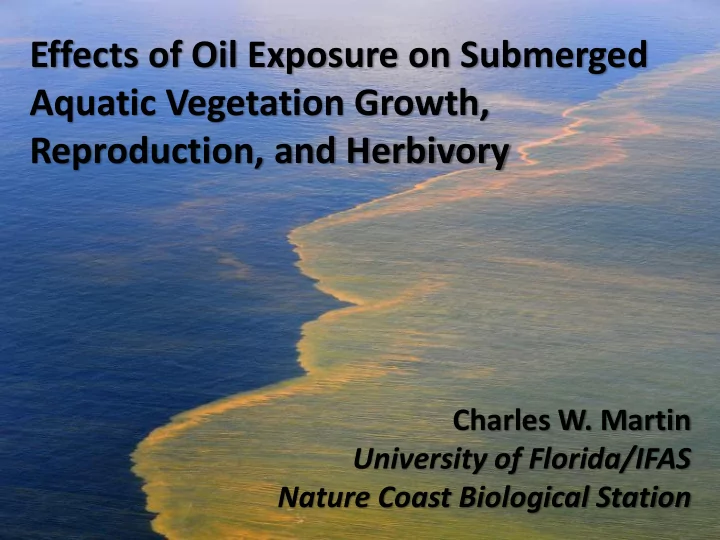
Aquatic Vegetation Growth, Reproduction, and Herbivory Charles W. - - PowerPoint PPT Presentation
Effects of Oil Exposure on Submerged Aquatic Vegetation Growth, Reproduction, and Herbivory Charles W. Martin University of Florida/IFAS Nature Coast Biological Station Estuaries in the Gulf of Mexico provide much of the nations supply
- Estuaries in the Gulf of
Mexico provide much of the nation’s supply of fisheries, wetlands, & numerous desirable natural resources
From Lellis-Dibble et al. 2008
Deepwater Horizon Oil Spill
http://gomex.erma.noaa.gov/
Photo: Coxworth Photo: Beinecke
- Effects of Oil on Submerged
Aquatic Vegetation
- Growth
- Reproduction
- Root Morphology
- Food Web Effects of Plant
Oiling
- Herbivory of oil-affected
plant tissue
- Future food web work
- Coastal vegetation
provides numerous ecosystem services
- Refuge for nekton
- Forage base for
- rganisms
- Buffer from storms
- Water filtration
Cocodrie, LA Lacombe, LA
Widgeon grass, Ruppia maritima
Port Sulphur, LA
From Pezeshki et al. 2000 Studies have focused on oil effects to emergent vegetation, while much less is known about submerged vegetation
- 1. What are the effects of oil on Ruppia
maritima?
- 2. Are there food web implications from this
- il exposure?
- Ruppia grown in 19L tanks at
10 psu for 31-33 days
- 4 randomized treatments:
(0mL) (5mL) (10mL) (20mL)
- Tanks contained 2L of
sediment and n=12/treatment
- In tanks containing oil, a layer
was buried ~3cm deep before planting
Growth Root Characteristics
Fruiting Bodies
Flowers
Reproduction
- 1. Growth (proportional
change in weight, number of shoots)
Number of Shoots
Change/day (+1SE)
0.00 0.05 0.10 0.15 0.20 0.25 0.30
None Low Medium High
p=0.737
Wet Weight
0.00 0.02 0.04 0.06 0.08 0.10
None Low Medium High Change/day (+1SE)
p=0.494
- 1. Growth
- 2. Reproduction
(proportional change in number of flowers, fruits)
Fruiting Bodies
Flowers
Fruiting Bodies
Flowers
Fruit
0.0 0.2 0.4 0.6 0.8 1.0 1.2 1.4 1.6
None Low Medium High Change/day (+1SE)
p=0.015
A A,B B B
- 2. Reproduction
Flowers
0.0 0.1 0.2 0.3 0.4 0.5
None Low Medium High Change/day (+1SE)
p=0.008
A,B A A,B B
- 3. Root Characteristics
(mass, length, diameter, area, uprooting strength)
Root Length
Length (mm+1SE)
20 40 60 80 100 120
None Low Med High
p=0.05
A A,B A,B B
Root Mass
Mass (mg+1SE)
2 4 6 8
None Low Medium High
p=0.686
Root Area
Area (mm2+1SE)
0.00 0.05 0.10 0.15 0.20
None Low Medium High
p=0.015
A A,B A,B B
Root Diameter
Diameter (mm+1SE)
0.0 0.1 0.2 0.3 0.4 0.5
None Low Medium High
p=0.021
A A,B A,B B
NO OIL HIGH OIL
Uprooting Strength
Grams of Force (+1SE)
50 100 150 200 250
None Low Medium High
A A B B
p<0.001
Silliman et al. 2012 Turner et al. 2016
C:N Ratio
Treatment C:N Ratio (+1SE)
20 22 24 26 28 30
None Low Medium High
A A,B A,B B p= 0.006
Citation Plant Herbivore Kraft & Denno 1982 Shrub Insects Coley 1983 Terrestrial trees Insects Schroeder 1983 Terrestrial tree Insects Onuf et al. 1977 Mangroves Insects Lilly 1975 Various marine plants Urchins Bjorndal 1980 Seagrass Green turtle Zieman et al. 1984 Seagrass Green turtle Williams 1988 Seagrass Green turtle McGlathery 1995 Seagrass Fishes Preen 1995 Seagrass Dugong Valentine & Heck 2001 Seagrass Urchins Goecker et al. 2005 Seagrass Fishes
Oil Exposure = Lower C:N! The link between C:N and Herbivory
Herbivores prefer plants with high nitrogen content
- Laboratory herbivory
assays
- Leaf tissue imbedded
in agar matrix (Hay et al.
1984, Valentine & Heck 2001, Goecker et al. 2005, Prado & Heck 2011)
- Herbivores:
- Grass shrimp (x5)
(Paleomonetes pugio)
- Amphipods (x10)
(Gammarus mucronatus)
Experiment 1 Paired Choice Experiment Experiment 2 Foraging Rate Experiment
None vs Low None vs Medium None vs High Low vs Medium Low vs High Medium vs High None Low Medium High
0.0 0.1 0.2 0.3 0.4 0.5
None Low
0.0 0.1 0.2 0.3 0.4 0.5
None Medium
- 0.1
0.0 0.1 0.2 0.3 0.4 0.5
None High
- 0.1
0.0 0.1 0.2 0.3 0.4 0.5
Low Medium
0.0 0.1 0.2 0.3 0.4 0.5
Low High
0.0 0.1 0.2 0.3 0.4 0.5
Medium High
Proportion Loss
* * * *
p=0.19 p=0.49 p=0.04 p<0.01 p<0.01 p<0.01
Treatment Proportion Loss
0.00 0.05 0.10 0.15 0.20
A A B B
None Low Medium High p<0.01
All Comparisons n=12
Treatment
0.00 0.02 0.04 0.06 0.08 0.10
A A A A
None Low Medium High
Experiment 1 Paired Choice Experiment Experiment 2 Foraging Rate Experiment
- 0.02
0.00 0.02 0.04 0.06 0.08 0.10 0.12
None Low
- 0.02
0.00 0.02 0.04 0.06 0.08 0.10 0.12
None Medium
- 0.02
0.00 0.02 0.04 0.06 0.08 0.10 0.12
None High
- 0.02
0.00 0.02 0.04 0.06 0.08 0.10 0.12
Low Medium
- 0.02
0.00 0.02 0.04 0.06 0.08 0.10 0.12
Low High
- 0.02
0.00 0.02 0.04 0.06 0.08 0.10 0.12
Medium High
Proportion Loss
p=0.074 p=0.79 p=0.017 p=0.03 p=0.012 p=0.071
p=0.07
24 Hours
Treatment
0.00 0.02 0.04 0.06 0.08 0.10 0.12
A B B B
None Low Medium High
p=0.01
48 Hours
* * *
All Comparisons n=12
+
- no effect
Variable effects of DWH on populations
Small fish Large fish Insects
McCall & Pennings 2012 Able et al. 2015 Fodrie & Heck 2011
Food Web Resilience to Oil
McCann et al. 2017. Frontiers in Ecology and the Environment. 15(3): 142-149.
Food Web Resilience to Oil
Literature Synthesis
McCann et al. 2017. Frontiers in Ecology and the Environment. 15(3): 142-149.
Extirpation of most sensitive nodes
- il
Unoiled Oiled 51 # Nodes 39 343 # Links 210 6.72 Link density 5.38 0.13 Connectance 0.14
- il
Extirpation of most sensitive nodes
- 1. What are the effects of oil on Ruppia maritima?
- 2. Are there food web implications from this oil
exposure?
Reduced flowering, changes to root morphology, decreased uprooting force
Martin, C.W., L.C. Hollis, R.E. Turner. 2015. Effects of oil-contaminated sediments on submerged vegetation: an experimental assessment of Ruppia maritima. PLoS ONE 10(10): e0138797. Martin, C.W., E.M Swenson. 2018. Herbivory of submerged aquatic vegetation Ruppia maritima. PLoS ONE 13(12): e0208463.
Because of changes to plant chemical composition, foraging trends were altered
- Funding:
– This research was made possible in part by a grant from The Gulf of
Mexico Research Initiative. Data are publicly available through the Gulf of Mexico Research Initiative Information & Data Cooperative (GRIIDC) at https://data.gulfresearchinitiative.org. – Northern Gulf Institute. The funders had no role in the design, execution, or analyses of this project.
- Louisiana: G. Turner, K. Able, J. Fodrie, O. Jensen, P.
Lopez-Duarte, M. McCann, K. Oken, J. Olin, M. Polito, B. Roberts, N. Rabalais, E. Swenson, J. Lee, C. Milan, G. Peterson, R. Shaw
- Alabama: J. Valentine, K. Heck, S. Powers, S. Alford, K.
Blankenhorn, T. Kauffman, L. Steele, R. Puntila, S. Sklenar, S. Madsen, M. Dueker, L. Lee
Acknowledgements
Questions?
Email: charles.martin@ufl.edu
Fish predators Marsh fish Marsh Plants Planktivores Zooplankton Phytoplankton Inverts
Alter food web structure & resilience
Food web importance Oil sensitivity
- 2017. Frontiers in Ecology and the Environment. 15(3): 142-149.
Food web importance
Critically sensitive species Critical for resilience Few indirect effects
Oil sensitivity
- 2017. Frontiers in Ecology and the Environment. 15(3): 142-149.
Oil sensitivity Food web importance
Literature Synthesis
Critically sensitive species Critical for resilience Few indirect effects
- 2017. Frontiers in Ecology and the Environment. 15(3): 142-149.
Ecological Network Analysis
Oil sensitivity Food web importance
1 1 1 1 1 1 1 1 1 1 1 1 1 1
Diet Matrix
Literature Synthesis
Critically sensitive species Few indirect effects Critical for resilience
- 2017. Frontiers in Ecology and the Environment. 15(3): 142-149.
Ecological Network Analysis
Oil sensitivity Food web importance
1 1 1 1 1 1 1 1 1 1 1 1 1 1
Taxa Oil Sensitivity
Diet Matrix Oil Sensitivity Data
Literature Synthesis
Critically sensitive species Few indirect effects Critical for resilience
- 2017. Frontiers in Ecology and the Environment. 15(3): 142-149.
52 nodes 376 links
Phytoplankton
Spartina alterniflora
Omnivorous snails
Littoraria irrorata
Piscivorous fish
No data (13) 0: none (16) 1: weak (10) 2: strong (12)
Oil Sensitivity
Food web importance
Critically sensitive species Critical for resilience Few indirect effects
Oil sensitivity
- 2017. Frontiers in Ecology and the Environment. 15(3): 142-149.
- Biomarker approach to food web effects
- Bulk Stable Isotopes
- Fatty Acids
- Compound specific isotopes
Food Web Resilience to Oil
- Biomarker approach to food web effects
- Bulk Stable Isotopes
- Fatty Acids
- Compound specific isotopes
Food Web Resilience to Oil
Fish Stomach Contents
- Biomarker approach to food web effects
- Bulk Stable Isotopes
- Fatty Acids
- Compound specific isotopes
Food Web Resilience to Oil
Terrestrial plants are the primary carbon source for most terrestrial arthropods Estuarine inverts mostly derive carbon from algae