Approx 30% of adults have periodontitis 8-13% have severe - - PDF document

approx 30 of adults have periodontitis
SMART_READER_LITE
LIVE PREVIEW

Approx 30% of adults have periodontitis 8-13% have severe - - PDF document

1/26/2011 Periodontal Disease and Cardiovascular Health: What we know and how it applies to your patients Ken Kornman DDS, PhD Interleukin Genetics Waltham, MA K. S. Kornman is a fulltime employee and shareholder of Interleukin Genetics, Inc.


slide-1
SLIDE 1

1/26/2011 1

Periodontal Disease and Cardiovascular Health:

What we know and how it applies to your patients

Ken Kornman DDS, PhD Interleukin Genetics Waltham, MA

  • K. S. Kornman is a fulltime employee and shareholder of Interleukin

Genetics, Inc. Interleukin Genetics has patents issued and pending

Sixth Annual Women’s Cardiac Health Conference Massachusetts Medical Society February 4, 2011

  • n the use of the genetic variations for various diseases.

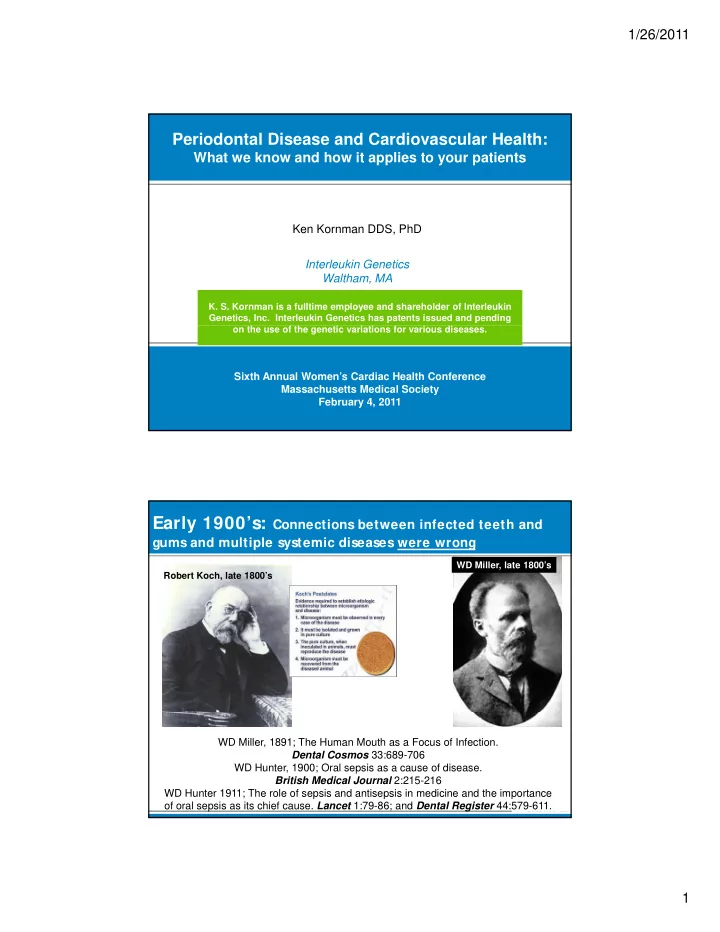
Early 1900’s: Connections between infected teeth and

gums and multiple systemic diseases were wrong

Robert Koch, late 1800’s WD Miller, late 1800’s

WD Miller, 1891; The Human Mouth as a Focus of Infection. Dental Cosmos 33:689-706 WD Hunter, 1900; Oral sepsis as a cause of disease. British Medical Journal 2:215-216 WD Hunter 1911; The role of sepsis and antisepsis in medicine and the importance

  • f oral sepsis as its chief cause. Lancet 1:79-86; and Dental Register 44:579-611.
slide-2
SLIDE 2

1/26/2011 2

Periodontitis: Bacterially- induced chronic inflammatory disease,

that destroys connective tissue and bone that support the teeth

Approx 30%

  • f adults

have periodontitis

  • 8-13%

have severe generalized disease Bacterial accumulations on the teeth initiate periodontal inflammation

Photos courtesy of Michael McGuire

Disease modifiers--- e.g....diet, smoking, diabetes, genetics

slide-3
SLIDE 3

1/26/2011 3

Number of

  • 480 male Sri Lankan tea plantation workers
  • 15 yr longitudinal monitoring q 3yrs
  • No treatment

Patients with periodontitis are on different paths

15 20 25 30 35

Number of Missing Teeth

8%

Loe et al. 1986

Age in Years

5 10 15 20 25 30 35 40 45

81% 11%

Periodontitis progression and severity is primarily a function of host modifying factors

Genetic risk factors

Microbial Challenge

Host immuno- inflammatory Connective tissue and bone Environmental and acquired risk factors

  • --i.e. smoking, diabetes, diet

Page and Kornman 1997

Challenge

y response metabolism

slide-4
SLIDE 4

1/26/2011 4

Periodontitis, Inflammation, and the health of your patients

The chronic diseases of aging are connected through common inflammatory mechanisms through common inflammatory mechanisms Inflammation levels differ among individuals and are mostly controllable Treatment of periodontitis reduces systemic Treatment of periodontitis reduces systemic inflammation---and may improve diseases influenced by inflammation.

Inflammation, your health, and the health of your patients

The chronic diseases of aging are connected through common inflammatory mechanisms through common inflammatory mechanisms

slide-5
SLIDE 5

1/26/2011 5

Moderate to Severe periodontitis is associated with Rheumatoid arthritis

Dissick et al. 2010 J Periodontology

% with mod-severe periodontitis N= 69 RA; 35 OA 51 26 30 40 50 60 periodontitis 10 20 Rheumatoid arthritis Osteoarthritis p=0.03

Patients with recent acute myocardial infarction had worse dental problems than control subjects with no MI history

Mattila et al 1989

  • 100 patients with acute MI
  • 104 community controls; no history of MI
  • S

ignificant association between MI and severity of dental disease history

DeS tefano et al 1993 DeS tefano et al. 1993 Offenbacher et al. 1996

slide-6
SLIDE 6

1/26/2011 6

Key Findings from Selected Observational Studies on Relationship of Periodontitis and Cardiovascular Disease

Study N Country Age Outcom e Odds ratio

95% Confidence i t l

ratio

interval Holmlund et

  • al. 2006

4,254 Sweden 20-70 CHD 2.69 1.12, 6.46

Dietrich et

  • al. 2008

1,203 USA 21-59 CHD 2.12 1.26, 3.60

Senba et al. 2008

23,088 Japan <66 CHD 1.68 1.08, 2.61

You et al. 2009

22,862 USA >44 Stroke 1.27 1.09, 1.49

Choe et al. 2009

867,256 Korea >29 Stroke 1.3 1.2. 1.4

  • Periodontitis effect is greater in young vs >60 yo;
  • Effect on stroke is greater than effect on CHD.
  • Effect also seen in multiple Asian studies and in never-smokers.

Periodontitis is independently associated with atherosclerotic cardiovascular disease

Periodontal disease is a risk factor for CHD that is independent of traditional i k f Increased prevalence and incidence of CAD in patients with periodontitis, an independent risk factor for CHD risk factor

  • Humphrey et al 2008; meta-

analysis

  • Risk 1.24 to 1.35
  • Humphrey et al 2008; meta-

analysis

  • Risk 1.24 to 1.35

independent risk factor for CAD

  • Bahekar et al. 2007; meta-

analysis

  • 5 prospective studies (86,092

patients) Periodontitis: 1.14 risk for CHD; p<0.001

  • Case –control studies (1,423
  • Bahekar et al. 2007; meta-

analysis

  • 5 prospective studies (86,092

patients) Periodontitis: 1.14 risk for CHD; p<0.001

  • Case –control studies (1,423

( ,4 3 patients) Periodontitis: 2.22 risk for CHD; p<0.001 ( ,4 3 patients) Periodontitis: 2.22 risk for CHD; p<0.001

slide-7
SLIDE 7

1/26/2011 7

Potential explanations for periodontitis association with CHD

  • Periodontal bacteria:
  • Periodontitis raises

bl d CRP

  • Diabetes, smoking,

ma complicate

  • can be found in the

blood

  • can be found in

atheromas

  • Various

microorganisms associated with CVD risk

  • Antibiotic studies

h b fit blood CRP

  • Higher CRP associated

with MI risk

  • Periodontitis treatment

reduces CRP levels may complicate statistical analysis

  • Some studies

adequately sized to properly adjust

  • Common genetics

show no benefit

Chronic bacteremia

Periodontitis raises systemic inflammatory burden

Major risk factors are common to both diseases

Inflammation, your health, and the health of your patients The chronic diseases of aging are connected through common inflammatory mechanisms through common inflammatory mechanisms

Inflammation levels differ among individuals and are mostly controllable

slide-8
SLIDE 8

1/26/2011 8

CRP mg/L

Kelley-Hedgepath 2008

Inflammation levels differ among individuals

  • NHANES 1999-2002; 8,335 adults
  • CRP mg/L
  • Male:

3.38 + 0.12

  • Female

4.88 + 0.17

  • p<0.01

Ethnicity Gender

  • NHANES 1999-2002; 8,335 adults

Inflammation levels differ among individuals

  • NHANES 1999-2002; 8,335 adults

4.47 + 0.15 Yes <0.01 3.90 + 0.14 No p-value CRP mg/L

Smoking

2.59 + 0.13 20- 24.9 2.31 + 0.30 <20 <0.01 3 80 + 0 15 25- 29 9 p-value CRP mg/L BMI

Smoking

6.29 + 0.24 >30 3.80 + 0.15 25 29.9

Body Fat

slide-9
SLIDE 9

1/26/2011 9

Moderate to severe periodontitis increases systemic inflammation

Periodontitis patients have higher CRP Generalized periodontitis raises systemic inflammation Meta-analysis of periodontitis and blood CRP

  • N=40 adult

periodontitis (AP); N=35 controls

  • CRP
  • higher in AP

(p<0.001)

  • Associated with

number of active y

  • N=53 localized

periodontitis; N=54 generalized; N=43 controls

  • Median CRP p=0.030
  • 1.45 mg/ L

generalized

  • 1.30 mg/ L localized
  • 0.90 mg/ L controls
  • 18 suitable papers
  • CRP higher in

periodontitis than healthy

  • Often >2.1 mg/ L in

periodontitis cases

  • Weighted mean

difference (WMD) between d d sites over 6 mos

  • Ebersole et al. 1997

9 g/

  • Leukocytes elevated

in generalized vs. localized and controls (p=0.002)

  • Loos et al. 2000

periodontitis and controls = 1.56 mg/ L; p=0.00001

  • Paraskevas et al.

2008

Severe periodontitis is associated with increase in “high” CRP levels

Severe periodontitis is associated with CRP> 3mg/ L Generalized Severe periodontitis is associated with CRP> 3mg/ L

  • N=59 moderate

periodontitis

  • N=50 severe periodontitis
  • N=65 healthy
  • Subjects with CRP > 3mg/ L

Severe: 38%

  • Thai population
  • N=62 localized chronic

periodontitis

  • N= 21 generalized severe

periodontitis

  • N=38 healthy
  • Lower CRP than

Caucasians

  • Severe: 38%
  • Moderate: 23.7%
  • Healthy: 16.9%
  • Noack, Genco, et al. 2001

Caucasians

  • Subjects with CRP > 3mg/ L

Generalized: 28.6% Localized: 17.7% Healthy: 2.6%

  • Pitiphat et al. 2008
slide-10
SLIDE 10

1/26/2011 10

Inflammation, your health, and the health of your patients

The chronic diseases of aging are connected through common inflammatory mechanisms through common inflammatory mechanisms Inflammation levels differ among individuals and are mostly controllable Treatment of periodontitis reduces systemic Treatment of periodontitis reduces systemic inflammation---and may improve diseases influenced by inflammation. Treatment of moderate to severe periodontitis decreases systemic inflammation---with time

Meta-analysis of periodontitis treatment and blood CRP Acute periodontal treatment increases systemic inflammatory mediators

  • 6 tx studies
  • Weighted mean difference

= 0.5 mg/ L; p=0.02

  • Paraskevas et al. 2008
  • Aggressive non-surgical

treatment increases systemic inflammatory mediators for up to 1 month; then lower mediators after 6 mos

  • D’Aiuto et al. 2004; 2007
  • Graziani et al. 2010
  • 14 severe chronic

periodontitis cases

  • Scaling & root planing
  • 24 hrs post-treatment

increased CRP to mean > 12mg/ L

slide-11
SLIDE 11

1/26/2011 11

Periodontal treatment reduces signs and symptoms of rheumatoid arthritis Patients with periodontitis AND rheumatoid arthritis (RA) Periodontal treatment significantly reduced inflammation in periodontal tissues

  • Decreased probing depths
  • Decreased bleeding on probing
  • Decreased Gingival Index

Periodontal treatment decreased RA parameters

  • Decreased erythrocyte sedimentation rate
  • Decreased number of swollen and tender j oints
  • Decreased patient’s assessment of pain (V

AS )

Ortiz, Bissada et al. Journal of Periodontology 2009 Apr;80(4):535-40.

The American Journal of Cardiology and Journal of Periodontology Editors’ Consensus:

“Periodontitis and Atherosclerotic Cardiovascular Disease”

Friedewald VE, Kornman KS, Beck JD, Genco R, Goldfine A, Libby P, Offenbacher S, Ridker PM, Van Dyke TE, Roberts WC. Am J Cardiol. 2009 Jul 1;104(1):59-68.

Patients with moderate to severe periodontitis should be informed there may be an increased risk

  • f atherosclerotic CVD

Patients with moderate to severe Patients with moderate to severe periodontitis with known atherosclerotic CVD risk factors should consider a medical exam if none in past 12 months

slide-12
SLIDE 12

1/26/2011 12

The American Journal of Cardiology and Journal of Periodontology Editors’ Consensus:

“Periodontitis and Atherosclerotic Cardiovascular Disease” Patients with periodontitis and atherosclerotic CVD atherosclerotic CVD should be informed periodontitis may raise inflammatory biomarkers associated with increased risk for CVD events Patients with periodontitis Patients with periodontitis should assess their risk for future CVD events and coronary artery disease Reynold’s Risk Score or National Cholesterol Education Program Risk Calculator Periodontal evaluation should be considered in patients with atherosclerotic CVD who have:

The American Journal of Cardiology and Journal of Periodontology Editors’ Consensus:

“Periodontitis and Atherosclerotic Cardiovascular Disease” atherosclerotic CVD who have: Sign/symptoms of gingival disease; significant tooth loss, unexplained elevation of hs-CRP Periodontal treatment to reduce CVD risk should be focused on reducing and controlling the bacterial accumulations and eliminating inflammation.

slide-13
SLIDE 13

1/26/2011 13

Where periodontitis appears to fit into risk for other diseases

Periodontal Tissue d i i

1

destruction is caused by inflammation

Moderate-severe periodontitis i t i Systemic inflammation may modify the course of chronic

3

1. Inflammation modifiers....smoking, diabetes, genetics, 2. Local sources of inflammatory mediators…….. visceral fat, chronic infections

increases systemic inflammation 2 diseases of aging

Periodontal Disease and Cardiovascular Health:

What we know and how it applies to your patients

Ken Kornman DDS, PhD Interleukin Genetics Waltham, MA

Sunset’s Inflammation of the Rocks Sixth Annual Women’s Cardiac Health Conference Massachusetts Medical Society February 4, 2011

2005 Chen Feng