Applications Involving the Sine Law MCR3U: Functions Example Two - - PDF document

applications involving the sine law
SMART_READER_LITE
LIVE PREVIEW

Applications Involving the Sine Law MCR3U: Functions Example Two - - PDF document

t r i g o n o m e t r y t r i g o n o m e t r y Applications Involving the Sine Law MCR3U: Functions Example Two surveyors, Alice and Bob, need to determine the height of a steep cliff. They stand 50 m apart where they each have a clear view


slide-1
SLIDE 1

t r i g o n o m e t r y

MCR3U: Functions

Applications of Trigonometry

Part 2: 3D Scenarios

  • J. Garvin

Slide 1/15

t r i g o n o m e t r y

Applications Involving the Sine Law

Example

Two surveyors, Alice and Bob, need to determine the height

  • f a steep cliff. They stand 50 m apart where they each have

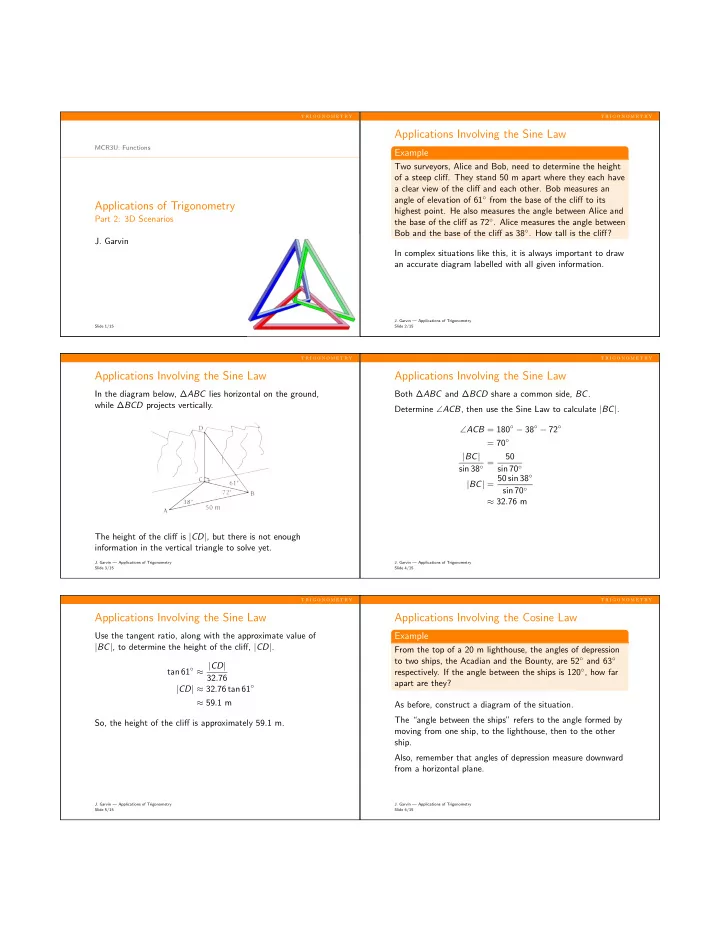
a clear view of the cliff and each other. Bob measures an angle of elevation of 61◦ from the base of the cliff to its highest point. He also measures the angle between Alice and the base of the cliff as 72◦. Alice measures the angle between Bob and the base of the cliff as 38◦. How tall is the cliff? In complex situations like this, it is always important to draw an accurate diagram labelled with all given information.

  • J. Garvin — Applications of Trigonometry

Slide 2/15

t r i g o n o m e t r y

Applications Involving the Sine Law

In the diagram below, ∆ABC lies horizontal on the ground, while ∆BCD projects vertically. The height of the cliff is |CD|, but there is not enough information in the vertical triangle to solve yet.

  • J. Garvin — Applications of Trigonometry

Slide 3/15

t r i g o n o m e t r y

Applications Involving the Sine Law

Both ∆ABC and ∆BCD share a common side, BC. Determine ∠ACB, then use the Sine Law to calculate |BC|. ∠ACB = 180◦ − 38◦ − 72◦ = 70◦ |BC| sin 38◦ = 50 sin 70◦ |BC| = 50 sin 38◦ sin 70◦ ≈ 32.76 m

  • J. Garvin — Applications of Trigonometry

Slide 4/15

t r i g o n o m e t r y

Applications Involving the Sine Law

Use the tangent ratio, along with the approximate value of |BC|, to determine the height of the cliff, |CD|. tan 61◦ ≈ |CD| 32.76 |CD| ≈ 32.76 tan 61◦ ≈ 59.1 m So, the height of the cliff is approximately 59.1 m.

  • J. Garvin — Applications of Trigonometry

Slide 5/15

t r i g o n o m e t r y

Applications Involving the Cosine Law

Example

From the top of a 20 m lighthouse, the angles of depression to two ships, the Acadian and the Bounty, are 52◦ and 63◦

  • respectively. If the angle between the ships is 120◦, how far

apart are they? As before, construct a diagram of the situation. The “angle between the ships” refers to the angle formed by moving from one ship, to the lighthouse, then to the other ship. Also, remember that angles of depression measure downward from a horizontal plane.

  • J. Garvin — Applications of Trigonometry

Slide 6/15

slide-2
SLIDE 2

t r i g o n o m e t r y

Applications Involving the Cosine Law

We wish to determine |AB| in the diagram. Note that the angles of depression from the lighthouse are equal to the angles of elevation from the ships.

  • J. Garvin — Applications of Trigonometry

Slide 7/15

t r i g o n o m e t r y

Applications Involving the Cosine Law

In ∆ACD, use the tangent ratio to determine |AC|. tan 52◦ = 20 |AC| |AC| = 20 tan 52◦ ≈ 15.6 m Use the same process in ∆BCD to determine |BC|. tan 63◦ = 20 |BC| |BC| = 20 tan 63◦ ≈ 10.2 m

  • J. Garvin — Applications of Trigonometry

Slide 8/15

t r i g o n o m e t r y

Applications Involving the Cosine Law

Now that |AC| and |BC| are known, use the Cosine Law to determine |AB|. |AB| ≈

  • 15.62 + 10.22 − 2(15.6)(10.2) cos 120◦

≈ 22.5 m Thus, the ships are approximately 22.5 m apart.

  • J. Garvin — Applications of Trigonometry

Slide 9/15

t r i g o n o m e t r y

Applications Using the Pythagorean Theorem

Example

Two students wish to determine the height of a tree. One student, facing North, measures an angle of elevation to the top of the tree of 57◦. The other student, facing West, measures an angle of elevation of 68◦. If the two students are 20 m apart, how tall is the tree? While this scenario is similar to the last one, we are looking for the height of the tree, given the distance between the two people.

  • J. Garvin — Applications of Trigonometry

Slide 10/15

t r i g o n o m e t r y

Applications Using the Pythagorean Theorem

In each of the three triangles, there is only one piece of information given (one angle or one side), so a different approach will be needed.

  • J. Garvin — Applications of Trigonometry

Slide 11/15

t r i g o n o m e t r y

Applications Using the Pythagorean Theorem

The height of the tree is |CD|, and is common to both ∆ACD and ∆BCD. ∆ABC is linked to the other triangles via sides AC and BC. Since ∆ABC is a right triangle, the Pythagorean Theorem holds. |AC|2 + |BC|2 = |AB|2 |AC|2 + |BC|2 = 202 |AC|2 + |BC|2 = 400

  • J. Garvin — Applications of Trigonometry

Slide 12/15

slide-3
SLIDE 3

t r i g o n o m e t r y

Applications Using the Pythagorean Theorem

In ∆ACD and ∆BCD, we can use the tangent ratio to relate CD with AC and BC. tan 57◦ = |CD| |AC| tan 68◦ = |CD| |BC| |AC| = |CD| tan 57◦ |BC| = |CD| tan 68◦ Use substitution with the Pythagorean Theorem equation developed earlier. |CD| tan 57◦ 2 + |CD| tan 68◦ 2 = 400 Note that we now have an equation that involves only the

  • ne variable, |CD|.
  • J. Garvin — Applications of Trigonometry

Slide 13/15

t r i g o n o m e t r y

Applications Using the Pythagorean Theorem

Isolate |CD| by common factoring. |CD|2 tan2 57◦ + |CD|2 tan2 68◦ = 400 |CD|2

  • 1

tan2 57◦ + 1 tan2 68◦

  • = 400

|CD|2 = 400

1 tan2 57◦ + 1 tan2 68◦

|CD|2 ≈ 683.8 |CD| ≈ 26.15 m So, the tree is approximately 26.15 m tall.

  • J. Garvin — Applications of Trigonometry

Slide 14/15

t r i g o n o m e t r y

Questions?

  • J. Garvin — Applications of Trigonometry

Slide 15/15