Appendix 3: Averaged switch modeling of a CCM SEPIC SEPIC example: - - PowerPoint PPT Presentation

appendix 3 averaged switch modeling of a ccm sepic
SMART_READER_LITE
LIVE PREVIEW

Appendix 3: Averaged switch modeling of a CCM SEPIC SEPIC example: - - PowerPoint PPT Presentation

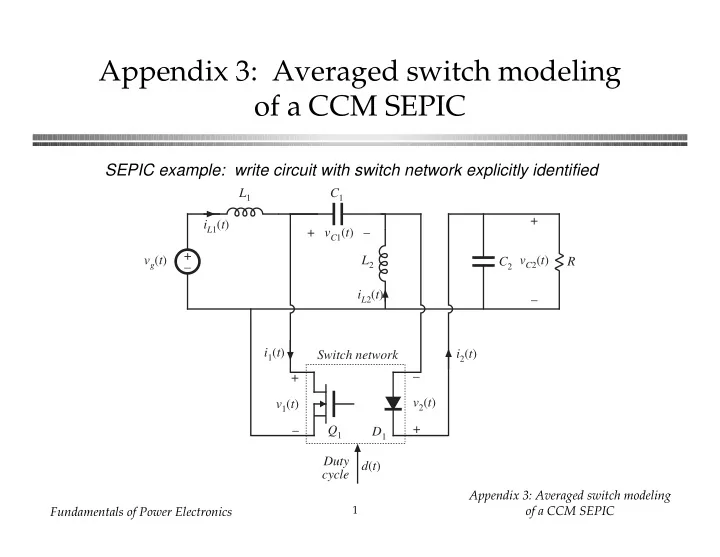
Appendix 3: Averaged switch modeling of a CCM SEPIC SEPIC example: write circuit with switch network explicitly identified L 1 C 1 + i L 1 ( t ) + v C 1 ( t ) + v g ( t ) L 2 v C 2 ( t ) C 2 R i L 2 ( t ) i 1 ( t ) i 2 ( t )


slide-1
SLIDE 1

Fundamentals of Power Electronics Appendix 3: Averaged switch modeling

  • f a CCM SEPIC

1

Appendix 3: Averaged switch modeling

  • f a CCM SEPIC

SEPIC example: write circuit with switch network explicitly identified

+ v1(t) – + – D1 L1 C2 Q1 C1 L2 R iL1(t) vg(t) Switch network iL2(t) + vC1(t) – + vC2(t) – – v2(t) + i1(t) i2(t) Duty cycle d(t)

slide-2
SLIDE 2

Fundamentals of Power Electronics Appendix 3: Averaged switch modeling

  • f a CCM SEPIC

2

A few points regarding averaged switch modeling

  • The switch network can be defined arbitrarily, as long as

its terminal voltages and currents are independent, and the switch network contains no reactive elements.

  • It is not necessary that some of the switch network terminal quantities

coincide with inductor currents or capacitor voltages of the converter, or be nonpulsating.

  • The object is simply to write the averaged equations of the switch network;

i.e., to express the average values of half of the switch network terminal waveforms as functions of the average values of the remaining switch network terminal waveforms, and the control input.

slide-3
SLIDE 3

Fundamentals of Power Electronics Appendix 3: Averaged switch modeling

  • f a CCM SEPIC

3

SEPIC CCM waveforms

t i1(t) dTs Ts 0 0 i1(t) T2 iL1 + iL2 t v1(t) dTs Ts 0 0 v1(t) Ts vC1 + vC2 t v2(t) dTs Ts 0 0 v2(t) T2 vC1 + vC2 t i2(t) dTs Ts 0 0 i2(t) Ts iL1 + iL2

Sketch terminal waveforms of switch network Port 1 Port 2

slide-4
SLIDE 4

Fundamentals of Power Electronics Appendix 3: Averaged switch modeling

  • f a CCM SEPIC

4

Expressions for average values of switch network terminal waveforms

Use small ripple approximation

v1(t)

Ts = d'(t)

vC1(t)

Ts + vC2(t) Ts

i1(t)

Ts = d(t)

iL1(t)

Ts + iL2(t) Ts

v2(t)

Ts = d(t)

vC1(t)

Ts + vC2(t) Ts

i2(t)

Ts = d'(t)

iL1(t)

Ts + iL2(t) Ts

Need next to eliminate the capacitor voltages and inductor currents from these expressions, to write the equations of the switch network.

slide-5
SLIDE 5

Fundamentals of Power Electronics Appendix 3: Averaged switch modeling

  • f a CCM SEPIC

5

Derivation of switch network equations (Algebra steps)

iL1(t)

Ts + iL2(t) Ts =

i1(t)

Ts

d(t) vC1(t)

Ts + vC2(t) Ts =

v2(t)

Ts

d(t)

We can write Hence

v1(t)

Ts = d'(t)

d(t) v2(t)

Ts

i2(t)

Ts = d'(t)

d(t) i1(t)

Ts

+ – – 〈v2(t)〉Ts + 〈i1(t)〉Ts Averaged switch network + 〈v1(t)〉Ts – 〈i2(t)〉Ts d'(t) d(t) v2(t) Ts d'(t) d(t) i1(t) Ts

Result Modeling the switch network via averaged dependent sources

slide-6
SLIDE 6

Fundamentals of Power Electronics Appendix 3: Averaged switch modeling

  • f a CCM SEPIC

6

Steady-state switch model: Dc transformer model

D' : D I1 I2 + V1 – – V2 +

slide-7
SLIDE 7

Fundamentals of Power Electronics Appendix 3: Averaged switch modeling

  • f a CCM SEPIC

7

Steady-state CCM SEPIC model

Replace switch network with dc transformer model

+ – L1 C2 C1 L2 R IL1 Vg IL2 + VC1 – + VC2 – D' : D I1 I2 + V1 – – V2 +

Can now let inductors become short circuits, capacitors become open circuits, and solve for dc conditions.

slide-8
SLIDE 8

Fundamentals of Power Electronics Appendix 3: Averaged switch modeling

  • f a CCM SEPIC

8

Small-signal model

Perturb and linearize the switch network averaged waveforms, as usual:

d(t) = D + d(t) v1(t)

Ts = V1 + v1(t)

i1(t)

Ts = I1 + i1(t)

v2(t)

Ts = V2 + v2(t)

i2(t)

Ts = I2 + i2(t)

Voltage equation becomes

D + d V1 + v1 = D' – d V2 + v2

Eliminate nonlinear terms and solve for v1 terms:

V1 + v1 = D' D V2 + v2 – d V1 + V2 D = D' D V2 + v2 – d V1 DD'

slide-9
SLIDE 9

Fundamentals of Power Electronics Appendix 3: Averaged switch modeling

  • f a CCM SEPIC

9

Linearization, continued

D + d I2 + i2 = D' – d I1 + i1

Current equation becomes Eliminate nonlinear terms and solve for i2 terms:

I2 + i2 = D' D I1 + i1 – d I1 + I2 D = D' D I1 + i1 – d I2 DD'

slide-10
SLIDE 10

Fundamentals of Power Electronics Appendix 3: Averaged switch modeling

  • f a CCM SEPIC

10

Switch network: Small-signal ac model

+ – D' : D I1 + i1 I2 + i2 I2 DD' d V1 + v1 V1 DD' d V2 + v2 + – – +

Reconstruct equivalent circuit in the usual manner:

slide-11
SLIDE 11

Fundamentals of Power Electronics Appendix 3: Averaged switch modeling

  • f a CCM SEPIC

11

Small-signal ac model

  • f the CCM SEPIC

+ – L1 C2 C1 L2 R + – D' : D I2 DD' d V1 DD' d Vg + vg IL1 + i L1 IL2 + i L2 VC1 + vC1 VC2 + vC2 + –

Replace switch network with small-signal ac model: Can now solve this model to determine ac transfer functions