APNA 29th Annual Conference Session 2031.1: October 29, 2015 S - - PDF document

apna 29th annual conference session 2031 1 october 29 2015
SMART_READER_LITE
LIVE PREVIEW

APNA 29th Annual Conference Session 2031.1: October 29, 2015 S - - PDF document

APNA 29th Annual Conference Session 2031.1: October 29, 2015 S uccessful Creation of a Violence Risk assessment tool Utilizing collaboration across disciplines and departments in a health care organization Presented by Angela M. Thomas MS


slide-1
SLIDE 1

APNA 29th Annual Conference Session 2031.1: October 29, 2015 Godfrey 1

S uccessful Creation of a Violence Risk assessment tool

Utilizing collaboration across disciplines and departments in a health care organization

Presented by

 Angela M. Thomas MS

N, PHN, BS N, BC

 Gayle Godfrey MS

RN-BC

The speakers have no conflicts of interest to disclose

Learning Obj ectives

1.

Participant will be able to identify an appropriate need for a violence risk assessment to be used to enhance patient and staff safety at their place of work.

2.

Participant will be able to design a method that will ensure a successful implementation of a violence risk assessment through collaboration across disciplines and departments.

3.

Participant will be able to explain the value of a violence risk assessment in ensuring a safe environment for patients and staff.

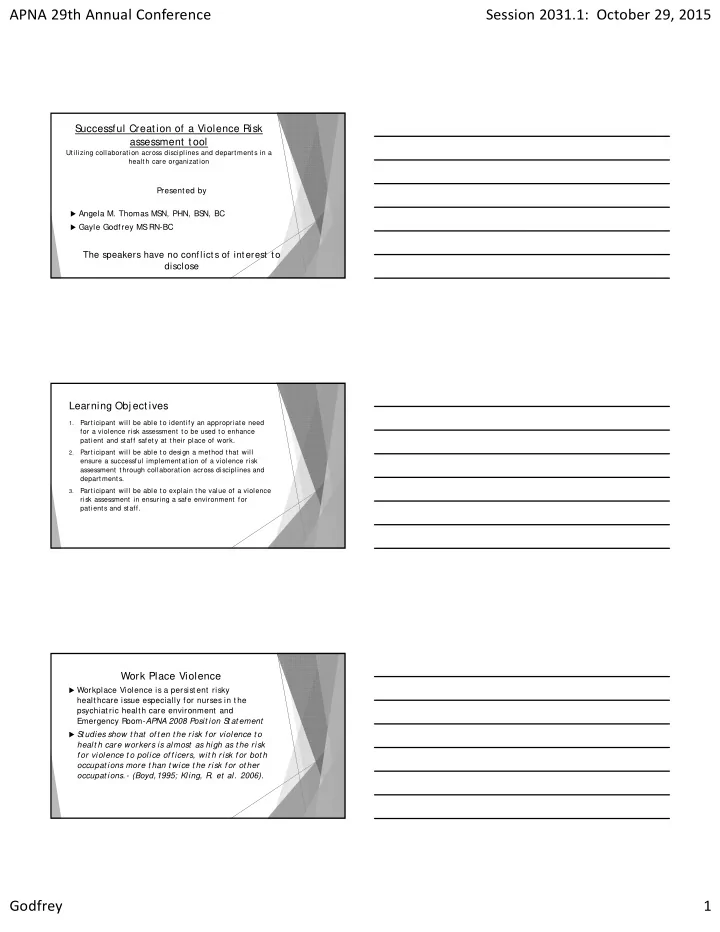
Work Place Violence

 Workplace Violence is a persistent risky

healthcare issue especially for nurses in the psychiatric health care environment and Emergency Room-APNA 2008 Posit ion S t at ement

 S

t udies show t hat oft en t he risk for violence t o healt h care workers is almost as high as t he risk for violence t o police officers, wit h risk for bot h

  • ccupat ions more t han t wice t he risk for ot her
  • ccupat ions.- (Boyd,1995; Kling, R. et al. 2006).
slide-2
SLIDE 2

APNA 29th Annual Conference Session 2031.1: October 29, 2015 Godfrey 2

Literature S earch of assessment tools currently in use

Broset S

TAMP

V-Risk-10 S

TART-20

CMAI Kennedy Axis V HCR20

Regions Hospital

Workplace Violence sub-committee

Charge Nurses, S taff Nurses, Nurse manager Mental Health Resource Nurse Psychiatrist, Doctors & Physician’s assistant s Regions security officers Pharmacist s S

  • cial Workers & Occupational Therapists

Performance Improvement Proj ect Manager Clinical Research Manager

slide-3
SLIDE 3

APNA 29th Annual Conference Session 2031.1: October 29, 2015 Godfrey 3

MIAHTAPS

 M-altered mental status  I-irritable  A-agitated  H-history of violence  T-threatening verbally  A-attacking, throwing objects  PS

– pacing and or staring

INTERVENTIONS

 Nursing- warm blanket, headphones, oral motor

interventions (gum, hard candy)

 OT- Weighted S

hrug/ blanket, pressure vest, fidgets, aromatherapy

 Providers- one time medication order to be used

when other prn orders do not exist

 Call the Psychiatric Emergency Response Team

(PERT)

 Notify S

ecurity via phone or vocera

COMMUNICATE-COMMUNICATE-COMMUNICATE

 Intranet  Daily huddle messages  Emails  Memos  Bathroom Briefs  Online learning (MyLearning)  Face to face instruction during annual education  Face to face during rounding

slide-4
SLIDE 4

APNA 29th Annual Conference Session 2031.1: October 29, 2015 Godfrey 4

S cenarios

 82 year old female, admitted from her assisted living

apartment, with a UTI. Her history shows she becomes confused when she has a UTI. S he is throwing papers on the floor and yelling for help.

 What would her score be?

What interventions would be appropriate?

 23 year old male arrives in ED. During past admissions he

has assaulted staff and security personnel. He appears irritated (answering in a loud sarcastic manner) and is staring at the MD, demanding medication.

 What would his score be?

What interventions would be appropriate? Committee Members

Wendy Waddell PhD RN- Director – Proj ect Champion

John Kuzma MD-Medical Director- Proj ect Champion

Nancy Miller-PI Proj ect Manager- Co-facilitator of Committee

Gayle Godfrey – MS RN-Co-facilitator of Committee

Angela Thomas MA BS N DNP (c)

James Peters-Proj ect Manager Consultant

Mary Russell- Director

Jason Sodren- RN Rachel Zacher- RN Supervisor

Corey Moore- RN Derek Klein BA RN

Robert LeFevere MD Allison Besler RN

Reed Larson BS N Natalie Nachtsheim RN

Tracy Keizer P A Ryan Aga MSN RN

Gloria Ramirez MD Jamie Giles DNP RN

Maddy Cohen MSW Joseph Rasimas MD

Joseph Uzpen P A Sandi Wewerka- clinical research

Angela BalzariniLeonhart- OTR Gerda Ottman- PharmD References:

American Nurses Association. (2015) Model “ S tate” Bill. The Violence Prevention in Health Care Facilities Act. Nursing World. Available online: http:/ / www.nursingworld.org/ MainMenuCategories/ Policy-Advocacy/ S tate/ Legislative- Agenda-Reports/ S tate-WorkplaceViolence/ ModelWorkplaceViolenceBill.pdf American Psychiatric Nurses Association Task Force on Workplace Violence S teering Committee (2008). Workplace Violence. APNA 2008 Position S

  • tatement. Online @

: http:/ / www.apna.org/ files/ public/ APNA_Workplace_Violence_Position_Paper.pdf. Almvik, R., (2012). Risk assessment made easy. The Broset Violence Checklist. Centre for Research and Education in Forensic Psychiatry. S

  • t. Olavs Hospital. Norway.

Amore, M., Menchetti, M., Tonti, C., S carlatti, F ., Lundgren, E., Esposito, W., & Berardi, D. (2008). Predictors of Violent Behavior Among Acute Psychiatric Patients: Clinical S

  • tudy. Psychiat ry and Clinical Neurosciences 2008; 62: 247-255.

Bernstein, K., & S aladino, J., (2007). Clinical Assessment and Management of Psychiatric Patients’ Violent and Aggressive Behaviors in General Hospital. MEDS URG Nursing, October 2007; vol 16/ No. 5.

slide-5
SLIDE 5

APNA 29th Annual Conference Session 2031.1: October 29, 2015 Godfrey 5

References cont inued:

Centers for Disease Control. (n.d.) Violence. Occupation Hazards in Hospitals. Department of Health and Human S

  • ervices. Available online:

http:/ / www.cdc.gov/ niosh/ docs/ 2002-101/ pdfs/ 2002-101.pdf Chu,C., Thomas,S ., Ogloff, T ., & Daffern, M. (2013). The S hort-to-Medium-Term Predictive Accuracy of S tatic and Dynamic Risk Assessment Measures in a S ecure Forensic

  • Hospital. S

age publications. Available online: http:/ / asm.sagepub.com/ content/ 20/ 2/ 230 Clarke, D., Brown, A., & Griffith, P . (2010). The Broset Violence Checklist: Clinical Utility in a S ecure Psychiatric Intensive Care S

  • etting. Journal of Psychiat ric and Ment al Healt h
  • Nursing. 2010, 17, 614-620.

Cornaggia, C., Beghi, M., Pavone, F ., & Barale, F . (2011). Aggression in Psychiatry Wards: A S ystematic Review. Psychiat ry Research 189 (2011), 10-20. Desmarais, S ., Nicholls, T ., Wilson, C., & Brink, J. (2012). Using Dynamic Risk and Protective Factors to Predict Inpatient Aggression: Reliability and Validity of S TART Assessment. Psychol Assess, 2012 S ep; 24(3): 685-700.

References cont inued:

Ferns, T . (2007). Factors that Influence Aggressive Behavior in Acute Care S

  • ettings. Nursing

S t andard; Apr 25-May 1, (2) 2007; 21, 33. Hartvig, P ., Roaldset, J., Moger, T ., Ostberg, B., & Bj orkly, S . (2011). The First S tep in the Validation of a New S creen for Violence Risk in Acute Psychiatry: The Inpatient

  • Context. European Psychiat ry, 2011- 03-01, Volume 26, Issue 2, 92-99.

Jaber, F . & Mahmoud, K. (2013. Risk Tools for the Prediction of Violence: VRAG, HCR-20, PCL-R. Journal of Psychiat ric and Ment al Healt h Nursing, June 2013. Kling, R., Corbiere, M., Milord, R., Morrison, J., Craib, K., Y assi, A., S idebottom, C., Kidd, C., Long, V ., & S aunders, S . (2006). Use of a Violence Risk Assessment Tool in an Acute Care Hospit al. AAOHN Journal. November 2006, vol. 54, No. 11. Luck.L, Jackson, D., & Usher, K. (2009). Conveying Caring: Nurse Attributes to Avert Violence in the ED. Int ernat ional Journal of Nursing Pract ice 2009; 15: 205-212.

References cont inued:

Luck.L, Jackson, D., & Usher, K. (2007). S TAMP: Components of Observable Behaviour that Indicate Potential for Patient Violence in Emergency Departments. Journal of Advanced Nursing 59 (1), 11-19. Needham, I., Abderhalden, C., Meer, R., Dassen, T ., Haug H., Halfens, R., & Fischer, J. (2004). The Effectiveness of two Interventions in the Management of Patient Violence in Acute Mental Inpatient S ettings: Report on a Pilot S

  • tudy. Journal of Psychiat ric and Ment al

Healt h Nursing, 2004, 11, 595-601. Roaldset, J., Hartvig, P ., Linaker, O., & Bj orkly, S . (2012). A Multifaceted Model for Risk Assessment of Violent Behaviour in Acutely Admitted Psychiatric patients. Psychiat ry Research, 2012-12-30, Vol 200, Issue 2-3, pgs. 773-778. S ande, R., Nij man, H., Noorthoorn, E., Wierdsma, A., Hellendoorn, E., Van Der S takk, C., & Mulder, C. (2011). Aggression and S eclusion on Acute Psychiatric Wards: Effect of S hort-Term Risk Assessment. BJPsych 2011, 199; 473-478.
slide-6
SLIDE 6

APNA 29th Annual Conference Session 2031.1: October 29, 2015 Godfrey 6

References cont inued:

S ands, N., Elsom, S ., Gerdtz, M., & Khaw, D. (2012). Mental Health-Related Risk Factors for Violence: Using the Evidence to Guide Mental Health Triage Decision Making. Journal

  • f Psychiat ric and Ment al Healt h Nursing, 2012, 19, 690-701.

S avage, T ., Crawford, I., & Nashed, Y . (2004). Decreasing Assault Occurrence on a Psychogeriatric Ward. Journal of Geront ological Nursing. May 2004. Pgs. 30-37. U.S . Department of Labor (2011). OS HA Instruction. Occupational S afety and Health Administration. Available online: https:/ / www.osha.gov/ OshDoc/ Directive_pdf/ CPL_02-01-052.pdf Wilkes, L. et al. (2010). Development of a Violence Tool in the Emergency Hospital S

  • etting. NurseResearcher 2010, 17, 4. Pgs. 70-82.

Wilson, C., Desmarais, S ., Nicholls, T ., & Hart, S . (2013). Predictive Validity of Dynamic Factors: Assessing Violence Risk in Forensic Psychiatric Inpatients. Law and Human

  • Behavior. 2013, vol. 37, No. 6, 377-388.