Ap ery numbers and their experimental siblings Challenges in 21st - - PowerPoint PPT Presentation

ap ery numbers and their experimental siblings
SMART_READER_LITE
LIVE PREVIEW

Ap ery numbers and their experimental siblings Challenges in 21st - - PowerPoint PPT Presentation

Ap ery numbers and their experimental siblings Challenges in 21st Century Experimental Mathematical Computation ICERM, Brown University Armin Straub July 22, 2014 University of Illinois at UrbanaChampaign n 2 n + k 2 n


slide-1
SLIDE 1

Ap´ ery numbers and their experimental siblings

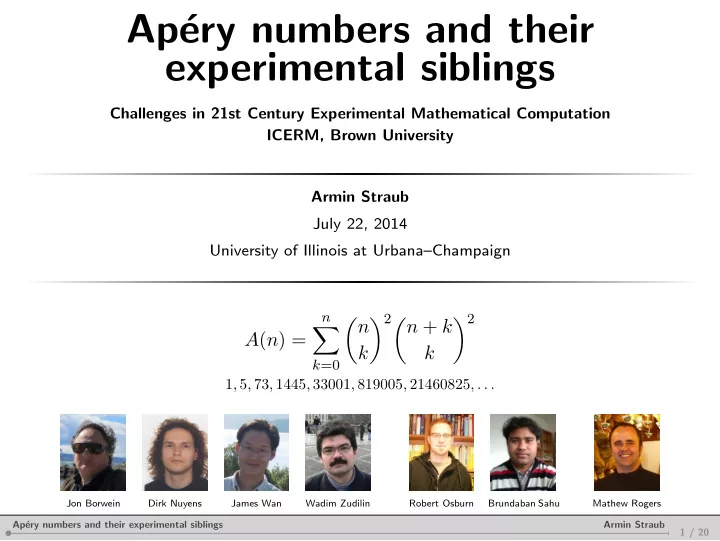
Challenges in 21st Century Experimental Mathematical Computation ICERM, Brown University Armin Straub July 22, 2014 University of Illinois at Urbana–Champaign

A(n) =

n

  • k=0

n k 2n + k k 2

1, 5, 73, 1445, 33001, 819005, 21460825, . . .

Jon Borwein Dirk Nuyens James Wan Wadim Zudilin Robert Osburn Brundaban Sahu Mathew Rogers Ap´ ery numbers and their experimental siblings Armin Straub 1 / 20

slide-2
SLIDE 2

Ap´ ery numbers and the irrationality of ζ(3)

  • The Ap´

ery numbers

1, 5, 73, 1445, . . .

A(n) =

n

  • k=0

n k 2n + k k 2 satisfy (n + 1)3un+1 = (2n + 1)(17n2 + 17n + 5)un − n3un−1.

Ap´ ery numbers and their experimental siblings Armin Straub 2 / 20

slide-3
SLIDE 3

Ap´ ery numbers and the irrationality of ζ(3)

  • The Ap´

ery numbers

1, 5, 73, 1445, . . .

A(n) =

n

  • k=0

n k 2n + k k 2 satisfy (n + 1)3un+1 = (2n + 1)(17n2 + 17n + 5)un − n3un−1. ζ(3) = ∞

n=1 1 n3 is irrational.

THM

Ap´ ery ’78

The same recurrence is satisfied by the “near”-integers B(n) =

n

  • k=0

n k 2n + k k 2  

n

  • j=1

1 j3 +

k

  • m=1

(−1)m−1 2m3n

m

n+m

m

 . Then, B(n)

A(n) → ζ(3). But too fast for ζ(3) to be rational.

proof

Ap´ ery numbers and their experimental siblings Armin Straub 2 / 20

slide-4
SLIDE 4

Zagier’s search and Ap´ ery-like numbers

  • Recurrence for Ap´

ery numbers is the case (a, b, c) = (17, 5, 1) of (n + 1)3un+1 = (2n + 1)(an2 + an + b)un − cn3un−1. Are there other tuples (a, b, c) for which the solution defined by u−1 = 0, u0 = 1 is integral?

Q

Beukers, Zagier

Ap´ ery numbers and their experimental siblings Armin Straub 3 / 20

slide-5
SLIDE 5

Zagier’s search and Ap´ ery-like numbers

  • Recurrence for Ap´

ery numbers is the case (a, b, c) = (17, 5, 1) of (n + 1)3un+1 = (2n + 1)(an2 + an + b)un − cn3un−1. Are there other tuples (a, b, c) for which the solution defined by u−1 = 0, u0 = 1 is integral?

Q

Beukers, Zagier

  • Essentially, only 14 tuples (a, b, c) found.

(Almkvist–Zudilin)

  • 4 hypergeometric and 4 Legendrian solutions
  • 6 sporadic solutions
  • Similar (and intertwined) story for:
  • (n + 1)2un+1 = (an2 + an + b)un − cn2un−1

(Beukers, Zagier)

  • (n + 1)3un+1 = (2n + 1)(an2 + an + b)un − n(cn2 + d)un−1

(Cooper)

Ap´ ery numbers and their experimental siblings Armin Straub 3 / 20

slide-6
SLIDE 6

Ap´ ery-like numbers

  • Hypergeometric and Legendrian solutions have generating functions

3F2

1

2, α, 1 − α

1, 1

  • 4Cαz
  • ,

1 1 − Cαz 2F1 α, 1 − α 1

  • −Cαz

1 − Cαz 2 ,

with α = 1

2, 1 3, 1 4, 1 6 and Cα = 24, 33, 26, 24 · 33.

  • The six sporadic solutions are:

(a, b, c) A(n) (7, 3, 81)

  • k(−1)k3n−3k n

3k

n+k

n

(3k)!

k!3

(11, 5, 125)

  • k(−1)kn

k

3 4n−5k−1

3n

  • +

4n−5k

3n

  • (10, 4, 64)
  • k

n

k

22k

k

2(n−k)

n−k

  • (12, 4, 16)
  • k

n

k

22k

n

2 (9, 3, −27)

  • k,l

n

k

2n

l

k

l

k+l

n

  • (17, 5, 1)
  • k

n

k

2n+k

n

2

Ap´ ery numbers and their experimental siblings Armin Straub 4 / 20

slide-7
SLIDE 7

Modularity of Ap´ ery-like numbers

  • The Ap´

ery numbers

1, 5, 73, 1145, . . .

A(n) =

n

  • k=0

n k 2n + k k 2 satisfy η7(2τ)η7(3τ) η5(τ)η5(6τ)

modular form

=

  • n0

A(n) η(τ)η(6τ) η(2τ)η(3τ) 12n

modular function

.

Ap´ ery numbers and their experimental siblings Armin Straub 5 / 20

slide-8
SLIDE 8

Modularity of Ap´ ery-like numbers

  • The Ap´

ery numbers

1, 5, 73, 1145, . . .

A(n) =

n

  • k=0

n k 2n + k k 2 satisfy η7(2τ)η7(3τ) η5(τ)η5(6τ)

modular form

=

  • n0

A(n) η(τ)η(6τ) η(2τ)η(3τ) 12n

modular function

. Not at all evidently, such a modular parametrization exists for all known Ap´ ery-like numbers!

FACT

  • Context:

f(τ) modular form of weight k x(τ) modular function y(x) such that y(x(τ)) = f(τ) Then y(x) satisfies a linear differential equation of order k + 1.

Ap´ ery numbers and their experimental siblings Armin Straub 5 / 20

slide-9
SLIDE 9

Supercongruences for Ap´ ery numbers

  • Chowla, Cowles and Cowles (1980) conjectured that, for p 5,

A(p) ≡ 5 mod p3.

Ap´ ery numbers and their experimental siblings Armin Straub 6 / 20

slide-10
SLIDE 10

Supercongruences for Ap´ ery numbers

  • Chowla, Cowles and Cowles (1980) conjectured that, for p 5,

A(p) ≡ 5 mod p3.

  • Gessel (1982) proved that A(mp) ≡ A(m)

mod p3.

Ap´ ery numbers and their experimental siblings Armin Straub 6 / 20

slide-11
SLIDE 11

Supercongruences for Ap´ ery numbers

  • Chowla, Cowles and Cowles (1980) conjectured that, for p 5,

A(p) ≡ 5 mod p3.

  • Gessel (1982) proved that A(mp) ≡ A(m)

mod p3. The Ap´ ery numbers satisfy the supercongruence

(p 5)

A(mpr) ≡ A(mpr−1) mod p3r.

THM

Beukers, Coster ’85, ’88

Ap´ ery numbers and their experimental siblings Armin Straub 6 / 20

slide-12
SLIDE 12

Supercongruences for Ap´ ery numbers

  • Chowla, Cowles and Cowles (1980) conjectured that, for p 5,

A(p) ≡ 5 mod p3.

  • Gessel (1982) proved that A(mp) ≡ A(m)

mod p3. The Ap´ ery numbers satisfy the supercongruence

(p 5)

A(mpr) ≡ A(mpr−1) mod p3r.

THM

Beukers, Coster ’85, ’88

Mathematica 7 miscomputes A(n) =

n

  • k=0

n k 2n + k k 2

for n > 5500.

A(5 · 113) = 12488301. . .about 2000 digits. . .about 8000 digits. . .795652125

Weirdly, with this wrong value, one still has

A(5 · 113) ≡ A(5 · 112) mod 116.

EG

Ap´ ery numbers and their experimental siblings Armin Straub 6 / 20

slide-13
SLIDE 13

Supercongruences for Ap´ ery numbers

  • Chowla, Cowles and Cowles (1980) conjectured that, for p 5,

A(p) ≡ 5 mod p3.

  • Gessel (1982) proved that A(mp) ≡ A(m)

mod p3. The Ap´ ery numbers satisfy the supercongruence

(p 5)

A(mpr) ≡ A(mpr−1) mod p3r.

THM

Beukers, Coster ’85, ’88

Simple combinatorics proves the congruence 2p p

  • =
  • k

p k

  • p

p − k

  • ≡ 1 + 1

mod p2. For p 5, Wolstenholme’s congruence shows that, in fact, 2p p

  • ≡ 2

mod p3.

EG

Ap´ ery numbers and their experimental siblings Armin Straub 6 / 20

slide-14
SLIDE 14

Supercongruences for Ap´ ery-like numbers

  • Conjecturally, supercongruences like

A(mpr) ≡ A(mpr−1) mod p3r hold for all Ap´ ery-like numbers.

Osburn–Sahu ’09

  • Current state of affairs for the six sporadic sequences from earlier:

(a, b, c) A(n) (7, 3, 81)

  • k(−1)k3n−3k n

3k

n+k

n

(3k)!

k!3

  • pen!!

modulo p2 Amdeberhan ’14

(11, 5, 125)

  • k(−1)kn

k

3 4n−5k−1

3n

  • +

4n−5k

3n

  • Osburn–Sahu–S ’14

(10, 4, 64)

  • k

n

k

22k

k

2(n−k)

n−k

  • Osburn–Sahu ’11

(12, 4, 16)

  • k

n

k

22k

n

2

Osburn–Sahu–S ’14

(9, 3, −27)

  • k,l

n

k

2n

l

k

l

k+l

n

  • pen

(17, 5, 1)

  • k

n

k

2n+k

n

2

Beukers, Coster ’87-’88

Robert Osburn Brundaban Sahu

(University of Dublin) (NISER, India) Ap´ ery numbers and their experimental siblings Armin Straub 7 / 20

slide-15
SLIDE 15

A generalization: multivariate supercongruences

Define A(n) = A(n1, n2, n3, n4) by 1 (1 − x1 − x2)(1 − x3 − x4) − x1x2x3x4 =

  • n∈Z4

A(n)xn.

  • The Ap´

ery numbers are the diagonal coefficients.

  • For p 5, we have the multivariate supercongruences

A(npr) ≡ A(npr−1) mod p3r.

THM

S 2013

Ap´ ery numbers and their experimental siblings Armin Straub 8 / 20

slide-16
SLIDE 16

A generalization: multivariate supercongruences

Define A(n) = A(n1, n2, n3, n4) by 1 (1 − x1 − x2)(1 − x3 − x4) − x1x2x3x4 =

  • n∈Z4

A(n)xn.

  • The Ap´

ery numbers are the diagonal coefficients.

  • For p 5, we have the multivariate supercongruences

A(npr) ≡ A(npr−1) mod p3r.

THM

S 2013

  • Both A(npr) and A(npr−1) have rational generating function.

The proof, however, relies on an explicit binomial sum for the coefficients.

Ap´ ery numbers and their experimental siblings Armin Straub 8 / 20

slide-17
SLIDE 17

Short random walks

joint work with:

Jon Borwein Dirk Nuyens James Wan Wadim Zudilin

  • U. Newcastle, AU

K.U.Leuven, BE SUTD, SG

  • U. Newcastle, AU

Ap´ ery numbers and their experimental siblings Armin Straub 9 / 20

slide-18
SLIDE 18

Random walks in the plane

n steps in the plane

(length 1, random direction)

Ap´ ery numbers and their experimental siblings Armin Straub 10 / 20

slide-19
SLIDE 19

Random walks in the plane

n steps in the plane

(length 1, random direction)

Ap´ ery numbers and their experimental siblings Armin Straub 10 / 20

slide-20
SLIDE 20

Random walks in the plane

n steps in the plane

(length 1, random direction)

Ap´ ery numbers and their experimental siblings Armin Straub 10 / 20

slide-21
SLIDE 21

Random walks in the plane

n steps in the plane

(length 1, random direction)

Ap´ ery numbers and their experimental siblings Armin Straub 10 / 20

slide-22
SLIDE 22

Random walks in the plane

n steps in the plane

(length 1, random direction)

Ap´ ery numbers and their experimental siblings Armin Straub 10 / 20

slide-23
SLIDE 23

Random walks in the plane

n steps in the plane

(length 1, random direction)

Ap´ ery numbers and their experimental siblings Armin Straub 10 / 20

slide-24
SLIDE 24

Random walks in the plane

d

n steps in the plane

(length 1, random direction)

Ap´ ery numbers and their experimental siblings Armin Straub 10 / 20

slide-25
SLIDE 25

Random walks in the plane

d

n steps in the plane

(length 1, random direction)

  • pn(x) — probability density of distance traveled

0.5 1.0 1.5 2.0 2.5 3.0 0.1 0.2 0.3 0.4 0.5 0.6 0.7

p3(x)

1 2 3 4 0.1 0.2 0.3 0.4 0.5

p4(x)

1 2 3 4 5 0.05 0.10 0.15 0.20 0.25 0.30 0.35

p5(x)

1 2 3 4 5 6 0.05 0.10 0.15 0.20 0.25 0.30 0.35

p6(x)

Ap´ ery numbers and their experimental siblings Armin Straub 10 / 20

slide-26
SLIDE 26

Random walks in the plane

d

n steps in the plane

(length 1, random direction)

  • pn(x) — probability density of distance traveled

0.5 1.0 1.5 2.0 2.5 3.0 0.1 0.2 0.3 0.4 0.5 0.6 0.7

p3(x)

1 2 3 4 0.1 0.2 0.3 0.4 0.5

p4(x)

1 2 3 4 5 0.05 0.10 0.15 0.20 0.25 0.30 0.35

p5(x)

1 2 3 4 5 6 0.05 0.10 0.15 0.20 0.25 0.30 0.35

p6(x)

  • Wn(s) =

0 xspn(x) dx — probability moments W2(1) = 4 π, W3(1) = 3 16 21/3 π4 Γ6 1 3

  • + 27

4 22/3 π4 Γ6 2 3

  • classical

Borwein–Nuyens–S–Wan, 2010

Ap´ ery numbers and their experimental siblings Armin Straub 10 / 20

slide-27
SLIDE 27

Moments of random walks

  • The probability moments

Wn(s) = ∞ xspn(x) dx include the Ap´ ery-like numbers W3(2k) =

k

  • j=0

k j 22j j

  • ,

W4(2k) =

k

  • j=0

k j 22j j 2(k − j) k − j

  • .

Ap´ ery numbers and their experimental siblings Armin Straub 11 / 20

slide-28
SLIDE 28

Moments of random walks

  • The probability moments

Wn(s) = ∞ xspn(x) dx include the Ap´ ery-like numbers W3(2k) =

k

  • j=0

k j 22j j

  • ,

W4(2k) =

k

  • j=0

k j 22j j 2(k − j) k − j

  • .

Wn(2k) =

  • a1+···+an=k
  • k

a1, . . . , an 2

THM

Borwein- Nuyens- S-Wan 2010

Ap´ ery numbers and their experimental siblings Armin Straub 11 / 20

slide-29
SLIDE 29

Densities of random walks

0.5 1.0 1.5 2.0 0.2 0.4 0.6 0.8

p2(x)

0.5 1.0 1.5 2.0 2.5 3.0 0.1 0.2 0.3 0.4 0.5 0.6 0.7

p3(x)

1 2 3 4 0.1 0.2 0.3 0.4 0.5

p4(x)

1 2 3 4 5 0.05 0.10 0.15 0.20 0.25 0.30 0.35

p5(x) p2(x) = 2 π √ 4 − x2 easy p3(x) = 2 √ 3 π x (3 + x2) 2F1

  • 1

3, 2 3

1

  • x2

9 − x22 (3 + x2)3

  • classical

with a spin

p4(x) = 2 π2 √ 16 − x2 x Re 3F2 1

2, 1 2, 1 2 5 6, 7 6

  • 16 − x23

108x4

  • new

BSWZ 2011

p′

5(0) =

√ 5 40π4 Γ( 1

15)Γ( 2 15)Γ( 4 15)Γ( 8 15) ≈ 0.32993

Ap´ ery numbers and their experimental siblings Armin Straub 12 / 20

slide-30
SLIDE 30

Ramanujan-type series for 1/π

4 π = 1 + 7 4 1 2 3 + 13 42 1.3 2.4 3 + 19 43 1.3.5 2.4.6 3 + . . .

Based on joint work with:

Mathew Rogers

(University of Montreal)

Ap´ ery numbers and their experimental siblings Armin Straub 13 / 20

slide-31
SLIDE 31

Ramanujan’s series for 1/π

4 π = 1 + 7 4 1 2 3 + 13 42 1.3 2.4 3 + 19 43 1.3.5 2.4.6 3 + . . . =

  • n=0

(1/2)3

n

n!3 (6n + 1) 1 4n 8 π =

  • n=0

(1/2)3

n

n!3 (42n + 5) 1 26n

  • Starred in High School Musical,

a 2006 Disney production

Srinivasa Ramanujan

Modular equations and approximations to π

  • Quart. J. Math., Vol. 45, p. 350–372, 1914

Ap´ ery numbers and their experimental siblings Armin Straub 14 / 20

slide-32
SLIDE 32

Ramanujan’s series for 1/π

4 π = 1 + 7 4 1 2 3 + 13 42 1.3 2.4 3 + 19 43 1.3.5 2.4.6 3 + . . . =

  • n=0

(1/2)3

n

n!3 (6n + 1) 1 4n 16 π =

  • n=0

(1/2)3

n

n!3 (42n + 5) 1 26n

  • Starred in High School Musical,

a 2006 Disney production

Srinivasa Ramanujan

Modular equations and approximations to π

  • Quart. J. Math., Vol. 45, p. 350–372, 1914

Ap´ ery numbers and their experimental siblings Armin Straub 14 / 20

slide-33
SLIDE 33

Another one of Ramanujan’s series

1 π = 2 √ 2 9801

  • n=0

(4n)! n!4 1103 + 26390n 3964n

  • Used by R. W. Gosper in 1985 to compute

17, 526, 100 digits of π

Correctness of first 3 million digits showed that the series sums to 1/π in the first place.

Ap´ ery numbers and their experimental siblings Armin Straub 15 / 20

slide-34
SLIDE 34

Another one of Ramanujan’s series

1 π = 2 √ 2 9801

  • n=0

(4n)! n!4 1103 + 26390n 3964n

  • Used by R. W. Gosper in 1985 to compute

17, 526, 100 digits of π

Correctness of first 3 million digits showed that the series sums to 1/π in the first place.

  • First proof of all of Ramanujan’s 17 series for 1/π

by Borwein brothers

Jonathan M. Borwein and Peter B. Borwein

Pi and the AGM: A Study in Analytic Number Theory and Computational Complexity Wiley, 1987

Ap´ ery numbers and their experimental siblings Armin Straub 15 / 20

slide-35
SLIDE 35

Ap´ ery-like numbers and series for 1/π

  • Sato observed that series for 1

π can be built from Ap´

ery-like numbers: For the Domb numbers D(n) =

k

  • j=0

k j 22j j 2(k − j) k − j

  • ,

8 √ 3π =

  • n=0

D(n)5n + 1 26n .

EG

Chan- Chan-Liu 2003

Ap´ ery numbers and their experimental siblings Armin Straub 16 / 20

slide-36
SLIDE 36

Ap´ ery-like numbers and series for 1/π

  • Sato observed that series for 1

π can be built from Ap´

ery-like numbers: For the Domb numbers D(n) =

k

  • j=0

k j 22j j 2(k − j) k − j

  • ,

8 √ 3π =

  • n=0

D(n)5n + 1 26n .

EG

Chan- Chan-Liu 2003

  • Sun offered a $520 bounty for a proof the following series:

520 π =

  • n=0

1054n + 233 480n 2n n

  • n
  • k=0

n k 22k n

  • (−1)k82k−n

THM

Rogers-S 2012

Ap´ ery numbers and their experimental siblings Armin Straub 16 / 20

slide-37
SLIDE 37

Positivity of rational functions

1 1 − (x + y + z) + 4xyz

Based on joint work with:

Wadim Zudilin

(University of Newcastle)

Ap´ ery numbers and their experimental siblings Armin Straub 17 / 20

slide-38
SLIDE 38

Positivity of rational functions

1 1 − (x + y + z + w) + 2(yzw + xzw + xyw + xyz) + 4xyzw has positive Taylor coefficients.

CONJ

Kauers– Zeilberger

Ap´ ery numbers and their experimental siblings Armin Straub 18 / 20

slide-39
SLIDE 39

Positivity of rational functions

1 1 − (x + y + z + w) + 2(yzw + xzw + xyw + xyz) + 4xyzw has positive Taylor coefficients.

CONJ

Kauers– Zeilberger

The Kauers–Zeilberger function has diagonal coefficients dn =

n

  • k=0

n k 22k n 2 .

PROP

S-Zudilin 2013

Ap´ ery numbers and their experimental siblings Armin Straub 18 / 20

slide-40
SLIDE 40

Positivity of rational functions

1 1 − (x + y + z + w) + 2(yzw + xzw + xyw + xyz) + 4xyzw has positive Taylor coefficients.

CONJ

Kauers– Zeilberger

The Kauers–Zeilberger function has diagonal coefficients dn =

n

  • k=0

n k 22k n 2 .

PROP

S-Zudilin 2013

  • For such rational functions, should positivity be (essentially) implied

by positivity of diagonal?

assuming positivity after setting one variable to zero

Ap´ ery numbers and their experimental siblings Armin Straub 18 / 20

slide-41
SLIDE 41

Summary and some open problems

  • Ap´

ery-like numbers are integer solutions to certain three-term recurrences

  • is the experimental list complete?
  • higher-order analogs, Calabi–Yau DEs
  • Ap´

ery-like numbers have interesting properties

  • modular parametrization; uniform explanation?
  • supercongruences; still open in several cases
  • Ap´

ery-like numbers occur in interesting places

  • moments of planar random walks
  • series for 1/π
  • positivity of rational functions
  • counting points on algebraic varieties
  • . . .

Ap´ ery numbers and their experimental siblings Armin Straub 19 / 20

slide-42
SLIDE 42

THANK YOU!

Slides for this talk will be available from my website: http://arminstraub.com/talks

  • A. Straub

Multivariate Ap´ ery numbers and supercongruences of rational functions Preprint, 2014

  • R. Osburn, B. Sahu, A. Straub

Supercongruences for sporadic sequences to appear in Proceedings of the Edinburgh Mathematical Society, 2014

  • A. Straub, W. Zudilin

Positivity of rational functions and their diagonals to appear in Journal of Approximation Theory (special issue dedicated to Richard Askey), 2014

  • M. Rogers, A. Straub

A solution of Sun’s $520 challenge concerning 520/π International Journal of Number Theory, Vol. 9, Nr. 5, 2013, p. 1273-1288

  • J. Borwein, A. Straub, J. Wan, W. Zudilin (appendix by D. Zagier)

Densities of short uniform random walks Canadian Journal of Mathematics, Vol. 64, Nr. 5, 2012, p. 961-990 Ap´ ery numbers and their experimental siblings Armin Straub 20 / 20