SLIDE 1 This material is made freely available at www.njctl.org and is intended for the non-commercial use of students and teachers. These materials may not be used for any commercial purpose without the written permission of the owners. NJCTL maintains its website for the convenience of teachers who wish to make their work available to other teachers, participate in a virtual professional learning community, and/or provide access to course materials to parents, students and others.
Click to go to website: www.njctl.org New Jersey Center for Teaching and Learning Progressive Science Initiative
Slide 1 / 31
www.njctl.org
Unit 3: Presentation B Chemical Reactions and Stoichiometry
AP Chemistry Slide 2 / 31 Chemical Reactions and Stoichiometry
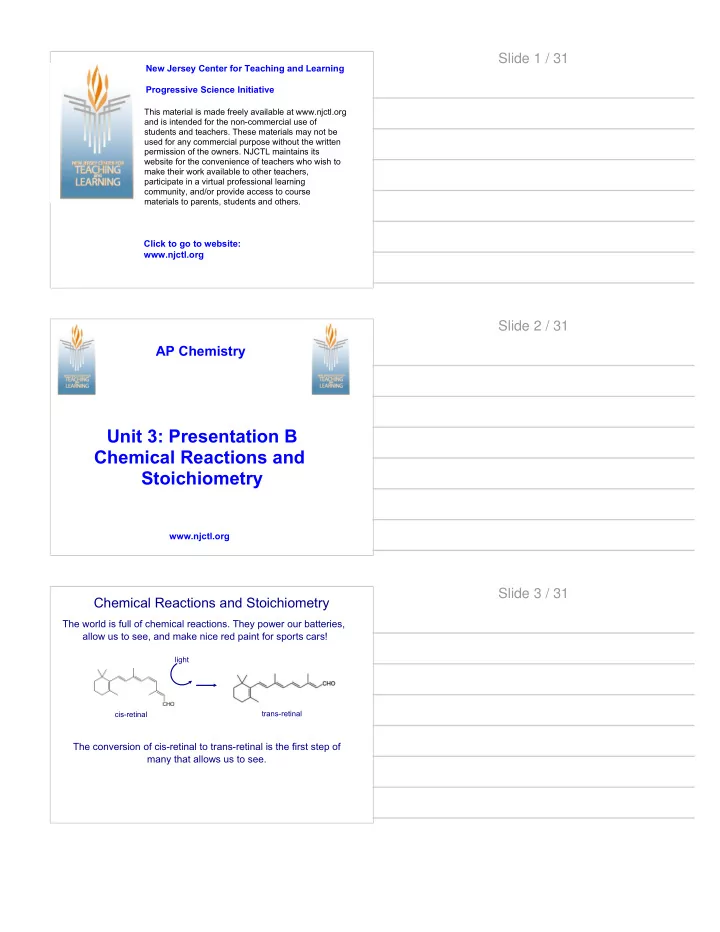
The world is full of chemical reactions. They power our batteries, allow us to see, and make nice red paint for sports cars! The conversion of cis-retinal to trans-retinal is the first step of many that allows us to see.
cis-retinal trans-retinal light
Slide 3 / 31
SLIDE 2
Chemical Reactions
To review, all chemical reactions must obey the law of conservation of mass - they must be "balanced".
3H2(g) + N2(g) --> 2NH3(g)
Reactants Products 6 H atoms 6 H atoms 2 N atoms 2 N atoms
This supports the Bohr notion that atoms are simply rearranged in a chemical reaction, not created or destroyed. Nuclear reactions do "destroy" atoms as we shall see but still obey the law of conservation of mass
Slide 4 / 31 Chemical Reactions
When balancing a reaction, only the coefficients may be changed as changing the subscripts changes the nature of the material itself. H2(g) + O2(g) --> H2O(g) One cannot balance the O atoms by making O2 suddenly O! Singular O is not reacting here, O2 gas is! Instead, one must change the number of oxygen or water molecules that react. H2(g) + 1/2O2(g) --> H2O(g)
Slide 5 / 31 Chemical Reactions
Make sure to write the correct formulas of reactants and products (NH4)2CO3 --> 2NH3 + CO2 + H2O Correct formula makes things easy!! NH4CO3 --> NH3 + CO2 + H2O Incorrect formula makes balancing impossible
Slide 6 / 31
SLIDE 3 Chemical Reactions
Fractions may be used as coefficients which can then be multiplied through by a number to get whole number coefficients. 2NaCl(s) + H2O(g) + SO2(g) + 1/2O2(g) --> 2HCl(g) + Na2SO4 To get whole number coefficients, multiply all coefficients by 2! 4NaCl(s) + 2H2O(g) + 2SO2(g) + O2(g) --> 4HCl(g) + 2Na2SO4
Slide 7 / 31 Reaction Stoichiometry
Coefficients represent the relative number of molecules, elements, or compounds involved in the reaction. 4NaCl(s) + 2H2O(g) + 2SO2(g) + O2(g) --> 4HCl(g) + 2Na2SO4 4 moles of NaCl(s) produce 2 moles of Na2SO4 0.1 moles of NaCl(s) produce ______ moles Na2SO4 4.5 x 10²³ formula units NaCl(s) produce ___________ formula units Na2SO4 *Note, the coefficients DO NOT represent the mass ratios -
- ie. 4 grams of NaCl will NOT produce 4 grams of HCl.
Slide 8 / 31 Reaction Stoichiometry
Coefficients can be used to determine the relative amounts of substances involved in a reaction.
4NaCl(s) + 2H2O(g) + 2SO2(g) + O2(g) --> 4HCl(g) + 2Na2SO4 How many grams of oxygen would be needed to produce 3 moles of HCl(g)? 3 moles of HCl x 1 mol O2 x 32 g O2 = 24 g O2 4 mol HCl molar ratio from balanced equation 1 mol O2
Slide 9 / 31
SLIDE 4
1 What is the proper coefficient in front of the oxygen molecule after the following equation is balanced? NH3(g) + O2(g) --> NO(g) + H2O(l)
Slide 10 / 31
2 The fermentation of sugar produces ethyl alcohol and carbon dioxide gas. How many moles of carbon dioxide would be produced from the fermentation of 0.4 mol of glucose? C6H12O6(s) --> C2H5OH + CO2
Slide 11 / 31
3 What is the sum total of coefficients when the equation below is balanced and all coefficients are simplified to the lowest whole number ratio? C2H5NH2 + O2 --> CO2 + N2 + H2O
Slide 12 / 31
SLIDE 5
4 Given the UNBALANCED reaction below, determine how many L of nitrogen gas would be produced when 110 grams of NaN3 decompose completely @STP? A 22.4 L B 44.8 L C 33.1 L D 57.2 L E 11.2 L
NaN3(s) ---> Na(s) + N2(g)
Slide 13 / 31
5 Phosphorus pentachloride decomposes into phosphorus trichloride gas and chlorine gas. How many total moles of gas will be produced after 50% of a 414 gram sample of phosphorus pentachloride decomposes? A 0.5 moles B 1.0 moles C 1.5 moles D 2.0 moles E 3.0 moles
Slide 14 / 31
6 If a 20 mL solution of 0.3 M Ca(NO3)2 were mixed with a solution of 3 M NaOH, how many mL of the 3 M NaOH solution would be needed to react with all of the calcium ions?
Ca2+(aq) + 2OH-(aq) --> Ca(OH)2(s)
Slide 15 / 31
SLIDE 6
Reaction Stoichiometry
The theoretical yield is the anticipated amount of product that should be made based on the amounts of reactants used and reaction conditions. CaCO3(s) --> CO2(g) + CaO(s) What is the theoretical yield of CaO (in moles) if 200 grams of calcium carbonate completely decompose? 200 g CaCO3 x 1 mol CaCO3 x 1 mol CaO = 2 mol CaO 100 g CaCO3 1 mol CaCO3
Slide 16 / 31 Reaction Stoichiometry
When two or more reactants are present, the reactant that is used up first (the limiting reactant) will determine the theoretical yield of product. N2(g) + 3H2(g) --> 2NH3(g) If 44.8 L of nitrogen gas reacts with 44.8 L of hydrogen gas @STP, what is the theoretical yield of ammonia? This type of problem can be easily solved via a series of steps.
Slide 17 / 31 Reaction Stoichiometry Steps
STEP 1: Convert known quantities to moles
N2(g) + 3H2(g) --> 2NH3(g) If 44.8 L of nitrogen gas reacts with 44.8 L of hydrogen gas @STP, what is the theoretical yield of ammonia? 44.8 L N2(g) = 2 mol N2(g) 44.8 L H2(g) = 2 mol H2(g) One might think that since both reactants are found in the same quantities, we would run out of both at the same time. Why is this not true for this reaction?
Slide 18 / 31
SLIDE 7
STEP 2: Choose a reactant and determine how much of the other would be needed and compare to how much of that reactant is available. N2(g) + 3H2(g) --> 2NH3(g) If 44.8 L of nitrogen gas reacts with 44.8 L of hydrogen gas @STP, what is the theoretical yield of ammonia? Reactant Moles available Moles of other reactant needed N2(g) 2 moles 2 mol N2 x 3/1 = 6 mol H2 H2(g) 2 moles 2 mol H2 x 1/3 = 0.66 mol N2 Since 6 mol of H2 are required and only 2 moles are available, H2 is the limiting reactant.
Reaction Stoichiometry Steps Slide 19 / 31
STEP 3: Use limiting reactant amount to determine the theoretical yield of product or amount of excess reactant that reacted.
N2(g) + 3H2(g) --> 2NH3(g) If 44.8 L of nitrogen gas reacts with 44.8 L of hydrogen gas @STP, what is the theoretical yield of ammonia? Finding Theoretical Yield 2 mol H2 x 2 mol NH3 = 1.33 mol NH3 3 mol H2 Finding Amount of Excess Reactant that Reacted 2 mol H2 x 1 mol N2 = 0.66 mol N2 reacted 3 mol H2
Reaction Stoichiometry Steps Slide 20 / 31
7 How many grams of excess reactant will remain if 4 grams of hydrogen gas react with 16 grams of oxygen gas by the reaction below?
2H2(g) + O2(g) --> 2H2O(g) Slide 21 / 31
SLIDE 8 8 If 16 grams of methane react with 32 grams of oxygen gas by the reaction below, what would be the theoretical yield of carbon dioxide ( in grams)? A 2 grams B 11 grams C 22 grams D 44 grams E 0.5 grams
CH4(g) + 2O2(g) --> CO2(g) + 2H2O(g)
Slide 22 / 31
9 How many total liters of gas can be produced @STP if 4.8 grams of magnesium metal react with 100 mL of 0.5 M HCl?
Mg(s) + 2H+(aq) --> Mg2+(aq) + H2(g) Slide 23 / 31
10 If 8 molecules of propane (C3H8) react with 10 molecules
- f oxygen gas, which would be true of the reaction
mixture after the reaction had gone to completion?
C3H8(g) + 5O2(g) --> 3CO2(g) + 4H2O(g)
C3H8 O2 CO2 H2O 3 2 2 6 6 8 2 5 3 4 A B C
Answer
Slide 24 / 31
SLIDE 9 11 If 300 mL of 0.2 M Ca(NO3)2 solution is mixed with 200 mL of 0.3 M Na3PO4 solution, what will be the concentration of phosphate ions after the reaction below has gone to completion?
3Ca2+(aq) + 2PO43-(aq) --> Ca3(PO4)2(aq)
Slide 25 / 31 Reaction Stoichiometry
The amount of product made in the laboratory is often less than what is theoretically possible. Actual Yield x 100 = % Yield Theoretical Yield
When 30 grams of CaCO3(s) decompose by the following reaction and produce 10 grams of CaO, what is the % yield? CaCO3(s) --> CO2(g) + CaO(s) 30 g CaCO3 x 1 mol x 1 mol CaO x 56 g = 16.8 g CaO 100g CaCO3 1 mol CaCO3 1 mol CaO 10 g CaO Actual Yield x 100 = 59.5% yield 16.8 g CaO Theoretical Yield
Slide 26 / 31 Reaction Stoichiometry
If the yield of a reaction is known, it can be used to modify the amounts of reactants needed to make the required amount of product.
How many grams of NaN3(s) must be decomposed to produce 62 L of N2(g) to fill an airbag at a 89% yield @STP? 2NaN3(s) --> 2Na(s) + 3N2(g) 62 L Actual Yield N2 x 100 L Theoretical Yield N
2 = 69.7 L
89 L Actual Yield N
2
We must plan to make 69.7 L instead of 62 L N
2.
69.7 L N2 x 1 mol N2 x 2 mol NaN3 x 65 g NaN3 =135 g NaN3 22.4 L N2 3 mol N2 1 mol NaN3
Slide 27 / 31
SLIDE 10 12 How many grams of potassium chlorate must decompose to produce 35 L of O2 gas @ STP if the reaction below
2KClO3(s) --> 2KCl(s) + 3O2(g) Slide 28 / 31
13 When 30 mL of 0.2 M KOH solution is mixed with 20 mL
- f 0.2 M Cu(NO3)2 solution, 0.23 grams of Cu(OH)2(s)
precipitate was formed. What is the % yield?
Slide 29 / 31
14 When 44 grams of butene (C4H8) combust in excess
- xygen gas to produce carbon dioxide and water, what
will be the actual grams of carbon dioxide produced assuming the reaction operates at a 30% yield?
Slide 30 / 31
SLIDE 11
Slide 31 / 31