Anton/Lippitt Urban Conference East Baltimore Development, Inc. - - PowerPoint PPT Presentation

anton lippitt urban conference east baltimore development
SMART_READER_LITE
LIVE PREVIEW

Anton/Lippitt Urban Conference East Baltimore Development, Inc. - - PowerPoint PPT Presentation

Anton/Lippitt Urban Conference East Baltimore Development, Inc. Presentation Overview Making the Case Timeline Creating and Implementing the Plan Accomplishments Revised Framework Plan Lessons Learned Will the east-side biotech park get


slide-1
SLIDE 1

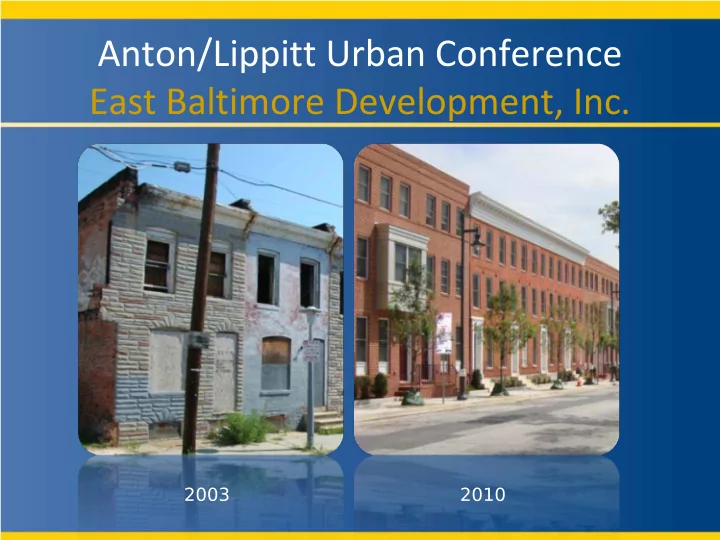
Anton/Lippitt Urban Conference East Baltimore Development, Inc.

slide-2
SLIDE 2

Making the Case Timeline Creating and Implementing the Plan Accomplishments Revised Framework Plan Lessons Learned

Presentation Overview

slide-3
SLIDE 3

Will the east-side biotech park get off the ground?

“The city has unveiled an ambitious plan to revitalize the area north of the Johns Hopkins medical complex centered on a biotech park. But before the plan gets off the drawing board, legislative approval is needed to condemn properties, and money and housing has to be found for displaced residents. How much progress is made will help determine whether the plan is a pipe dream or a bona fide blueprint for renewal and economic development in one of Baltimore's most downtrodden areas.” December 27, 2001

slide-4
SLIDE 4

The Grand Piano – Original Master Plan

slide-5
SLIDE 5
slide-6
SLIDE 6

2000 Vacancy Rate – 70 Percent

City EBDI

slide-7
SLIDE 7

2000 Unemployment Rate

City EBDI

slide-8
SLIDE 8

2000 Poverty Rate

City EBDI

slide-9
SLIDE 9

2000 Median Household Income

City EBDI

slide-10
SLIDE 10

Additional Metrics

Core East Baltimore Baltimore City % of Population Age 16- 64 Not Working and Not Looking for Work 53% 43% % of Population Without H.S./GED Degree 40% 32.8% Juvenile Arrest Record (per 10,000 age 10-17) 232.3 111.4 MSPAP: Gr. 3 reading (% scoring satisfactory) 14.1 23.7 MSPAP: Gr. 3 math (% scoring satisfactory) 12.5 18.5 Child Abuse and Neglect (per 1,000 children) 14.3 4.5

slide-11
SLIDE 11

 In 2000, Mayor O’Malley conceived a plan early in his administration to build market rate housing and biotechnology park.  In 2001, Mayor forms North of Hopkins Steering Committee with representatives from stakeholder and community. Johns Hopkins a reluctant partner initially.  In late 2001, the first East Baltimore conceptual plan released that calls for demolishing 88 acres and developing a new biotech park, mixed- income housing, supporting retail, and parking.  In 2002, EBDI is established to oversee and manage revitalization.  Annie E. Casey Foundation President named to the EBDI. Casey becomes a forceful advocate for responsible relocation, providing funding for family advocates and other services.

EBDI Timeline

slide-12
SLIDE 12

In 2003, East Side elected officials and residents negotiate relocation benefits. Johns Hopkins and Casey agree to fund relocation supplemental benefits. In 2003, City Council approves legislation allowing for the acquisition of 2,000 properties. In 2004, EBDI selects Forest City – New East Baltimore Partnership as the master developer for 25 acres. FC – NEBP proposes a 1.1 million square foot biotech park, 700 housing units (economically diverse), first floor retail in commercial buildings, and structured parking.

EBDI Timeline

slide-13
SLIDE 13

80 Acre Site Science + Tech Park and Phase I

Phase I – 35 Acres (FC-NEBP)

slide-14
SLIDE 14
slide-15
SLIDE 15

1.1 million sq. ft. of lab/biotech space (6,000 jobs) 2,000 mixed-income residential units (1/3 low; 1/3 workforce; 1/3 market) 50,000 sq. ft. of retail space Charter School Open space

slide-16
SLIDE 16

Sources and Uses of Funds

slide-17
SLIDE 17

Johns Hopkins has funded $22 million through 2010

Johns Hopkins Investment

Private Philanthropy Johns Hopkins Institutions Casey Foundation Weinberg Foundation Rouse Foundation Goldseker Foundation Abell Foundation Atlantic Philanthropies

slide-18
SLIDE 18

1,800 of 2,000 properties acquired 522 properties demolished; 200 underway – new demolition protocol 726 of 741 households relocated (to better housing in safer neighborhoods) Family advocate assigned to every family – before, during and after relocation On average, homeowners received 5-fold increase in equity wealth from $29,000 to $153,000. 59 renters became homeowners

Selected Accomplishments

slide-19
SLIDE 19

Of 229 relocated homeowners, only three experienced foreclosure (1/5 the citywide rate) Economic Inclusion – $67.2 million (37% of all contracts) to M/WBE; 57% of construction hours worked were Created workforce pipeline for employers and residents – 1,000 jobs placements Right of Return for renters and homeowners (House for a House and Home Repair Program) Three resident satisfaction surveys (80% satisfied with how they were treated)

Selected Accomplishments

slide-20
SLIDE 20

Progress Ahead

slide-21
SLIDE 21

Affordable Rental and Homeownership

slide-22
SLIDE 22

Rangos Building Retail

Atwaters Teavolve Cuban Revolution Harbor Bank

slide-23
SLIDE 23

MICA Place

slide-24
SLIDE 24

Deering Hall

slide-25
SLIDE 25

House for a House and Home Repair Program

slide-26
SLIDE 26

Graduate Student Housing

321 units 573 beds $60 million Open August 2012

slide-27
SLIDE 27

1,500 space Parking Garage

slide-28
SLIDE 28

Maryland Public Health Lab

130,000 sq. ft. $160 million 350 jobs 2011 second quarter ground breaking

slide-29
SLIDE 29

Spin-Off Development

slide-30
SLIDE 30
slide-31
SLIDE 31

SUMMARY DISCUSSION DRAFT 21 AUGUST 2011

slide-32
SLIDE 32

87% 86% 83% 79% 72% 69% 66% 65% 61% 61% 60% 50% 44% 44% 26% 88% A walkable community Green space Peaceful and relaxing Everyone is respectful of the community Safe and alive at night Athletic facility Historical Baltimore elements People interested in fitness and health Everyone helps their neighbors Central outdoor location Supports creativity Top-ranked K-8 school Diversity of demographics Variety of housing for different needs Indoor community/cultural center Housing over shops

slide-33
SLIDE 33

Demand:  Market research identified wellness most desirable theme  Marketability of Beacon Park as a cutting-edge, model wellness community Need:  Urban/Suburban health disparity  Preventative medicine can lower healthcare costs Opportunity:  Proximity to JHMI is a unique

  • pportunity to partner in

pioneering wellness research  Current political attention means opportunity for logistical and financial support  Successes could be replicated throughout Baltimore, and even nationally

slide-34
SLIDE 34

 Hotel gateway and a central park  Next phase residential  Retail connections to community and campus  Commercial development strategy  East Baltimore Community School

slide-35
SLIDE 35

Park Looking South to Gateway Block

35

slide-36
SLIDE 36

Ashland Street at Wolfe Street Looking West

36

slide-37
SLIDE 37

37

slide-38
SLIDE 38

1st Phase Eager Street Buildings Expected to Stimulate Demand TOTAL UNIT TYPE COUNT Apt / Loft Rental: 236 SF Townhouse For Sale: 28 Stacked Duplex For Sale: 34 SF Townhouse For Rent: 7 SF Rehab Townhouse For Sale: 40 Total Residential Units: 345 UNIT TYPE BREAKDOWN

  • 1 Bedroom Apt / Loft Rental:
  • Eager Street: 155
  • 2 Bedroom Apt / Loft Rental:
  • Eager Street:

81

  • SF Townhouse For Sale:
  • Eager Street:

10

  • UME / Mews:

18

  • Stacked Duplex For Sale:
  • Eager Street:

34

  • SF Townhouse Rental:
  • UME / Mews:

7

  • SF Rehab Townhouse For Sale:
  • UME / Mews:

15

  • McDonough:

25

slide-39
SLIDE 39

SUMMARY DISCUSSION DRAFT 21 AUGUST 2011

RETAIL SPACE PLAN

Completed, Under Dev., and Next Phase Dev. USE # SQUARE FEET % OF TOTAL Restaurants 4 25,724 21% Cafes 5 11,863 10% Grocery 1 12,000 10% Retail Anchor 0% Apparel/Specialty 0 0% Service Retail 28,891 24% Fitness/Wellness 1 44,000 36% Total 16 122,478 100%

39

slide-40
SLIDE 40

PHASE 2 GARAGE PHASE 3 GARAGE PH 4 PH 3 PH 4 PH 4 PH 4 PH 4 PH 2 PH 3 PH 3 PH 4 PH 3 PH 1 PH 1

COMMERCIAL

slide-41
SLIDE 41

Completed Under Development Next Phase Development Future Pipeline

41

slide-42
SLIDE 42

42

slide-43
SLIDE 43

43

slide-44
SLIDE 44
slide-45
SLIDE 45
slide-46
SLIDE 46

 First three residential projects – 100 percent low income  School is 100 percent “free and reduced lunch”  Setting unrealistic job creation expectations  Ill prepared to managed negative public relations  Botched effort to name and brand the new neighborhood  Original plan lacked connectivity to Hopkins East Baltimore Campus  Hopkins low profile efforts failed