
SLIDE 1
Research Design and Ethnographic Methods
ANTHRO 5650
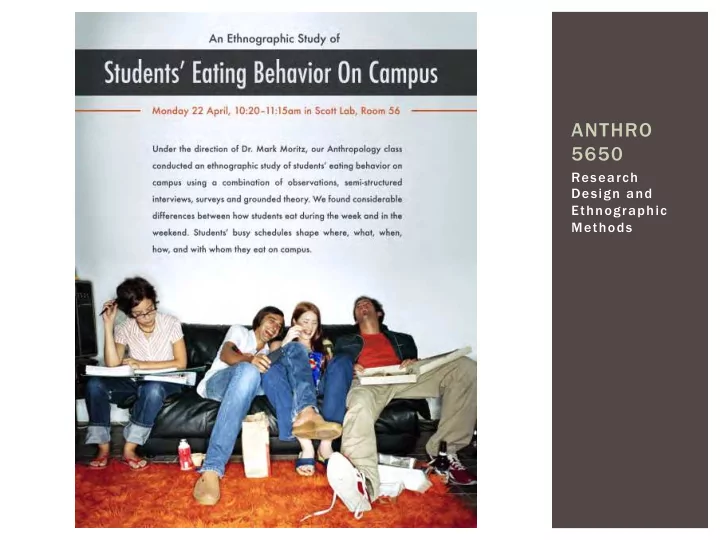
ANTHRO 5650 Research Design and Ethnographic Methods OUTLINE 1. - - PowerPoint PPT Presentation
ANTHRO 5650 Research Design and Ethnographic Methods OUTLINE 1. 1. Int Introduct oduction ion 2. 2. Et Ethnog hnographic re raphic resear arch 3. 3. Findings Findings 4. 4. Discussion Discussion 1 INTRODUCTION PROBLEM
Research Design and Ethnographic Methods
ANTHRO 5650
1. 1. Int Introduct
ion 2. 2. Et Ethnog hnographic re raphic resear arch 3. 3. Findings Findings 4. 4. Discussion Discussion
¡ The goal of this study was to come to a better understanding
students' eating habits at the Ohio State University.
¡ ANTHRO 5650: Research Design and Ethnographic Methods. ¡ OSU campus as a natural laboratory.
¡ Studies of students’ eating behavior focus on:
§ Food choice (nutrition, calories, labels) § Health indicators (weight and BMI) § Dorm versus off-campus eating habits § Gender differences § "Freshman 15”
¡ The common methods are:
§ Surveys § Food diaries § Body measurements
The Freshman Fifteen
Henrich, Joseph, Steven J. Heine, and Ara Norenzayan. 2010. Most people are not
!"#$%&'(#)* !"#$%&'(#)* +,-&).,"/()**
1&2',3-$* 45)#,6-7'&)* !',3-$* 45)#,6-7'&)* 8#3"9)(,:.(:,#%* 1&(#,6"#;)* <:#)7'&&-",#)* <:-&7(-76#* =-(-* >&-$?)")* >&-$?)")* @,':&%#%* +A#',?* 8(-7)7.-$*
1&(#,/,#(-7'&* B,"7&0*C/* !"#$%&'$('&'$
¡ IRA approach
§ Iterative § Recursive § Abductive
¡ Considering meaning and context questions
§ POV2 à POV1
¡ Increase understanding and narrow focus using grounded theory
Aga gar, Mic , Micha
Ethnogr
phy By An y By Any y Other Other Na
um: Qualita litativ tive Socia e Social R l Resea esearch. h.
We used an ecocultural approach as conceptual framework:
1. Ecocultural context (e.g., schedule of classes, institutions, living arrangements) 2. Cultural models of development (e.g., ideas that students have about food, their goals) 3. Direct focus on activity settings (e.g., everyday eating routines in social settings).
¡ Observations of everyday eating activities in places on and around campus at different times during the week (n = 47).
¡ Semi-structured interviews with descriptive questions to get students’ model of their
¡ Typical descriptive grand-tour question:
§ Can you describe your typical eating habits throughout a school day? For example, when do you eat, what do you eat, where do you eat, with whom do you eat? Starting with the morning when you get up until at night when you go to bed?
¡ Online survey using Google Drive (n = 356) to measure self-report
eating preferences.
§ Non-random sample of OSU students with 81% female respondents.
84% of students reported have a busy, very busy, or extremely busy schedule.
" I usually tend to eat alone just because it's kind of a spur of the moment, "hey I'm kind of hungry and I have 20 minutes before class.” "A lot of my lunches and dinners end up being in class, so I just eat alone." "During the week-alone. Our schedules are pretty busy you know. If it's in between classes, I usually eat by myself."
48% of surveyed students reported that they regularly or always eat alone.
"I like can't do it, and it's really strange because, like, I was an
but eating alone I cannot do it. I just can't do it." "I'd probably be on my phone [when eating alone], just to not look super awkward." "I feel like you have to get used to it, like the first few times you do it, you're like - oh my gosh this is so weird."
Freq equen uency of cy of ea eatin ting a g alon lone e Awkw wkward sca d scale le (5=mor (5=more a e awkw wkward) d) Never 3.2 Occasionally 2.7 Regularly 2.6 Always 2.2
Spearman’s R = -0.173, p = 0.005
"Yeah, if you eat with a group, people will talk and you will lose much time, especially on
doesn't matter - I think." "On weekends, I eat in groups. Never alone." "During the week alone...But
friends or roomates [to eat]."
When When I ea I eat with o t with other thers s When When I ea I eat a t alon lone e P- P-level I eat more 3.05 2.99 NS I enjoy my food more 2.67 3.11 P<0.001 I eat more slowly 2.51 3.51 P<0.001 I am more aware of manners 2.12 3.57 P<0.001 I use my phone less 1.66 4.10 P<0.001
1 = strongly agree 2 = agree 3 = neutral 4 = disagree 5 = strongly disagree Kruskal-Wallis Test (Nonparametric ANOVA)
1. To better understand students’ eating behavior we need to use a holistic approach that includes observations in natural settings and students’ cultural models. 2. It also requires a theory of human behavior that takes into account the habits, constraints, and emotions that shape how students experience and make decisions about eating.
¡ Individual work spaces with electrical outlets and internet in restaurants so that students can work and socialize using FaceTime.
¡ Seating arrangements that facilitate conversations with
and common purpose”.
Questions?
THANKS