Introduction Best suited for initial explorations of a group or - - PDF document

introduction
SMART_READER_LITE
LIVE PREVIEW

Introduction Best suited for initial explorations of a group or - - PDF document

Stephen E. Brock, Ph.D., NCSP Qualitative Research: Overview and Data Collection/Analysis Stephen E. Brock, Ph.D., NCSP California State University, Sacramento 1 Qualitative vs. Quantitative Research (Gay et al., 2006, p. 400) Quantitative (


slide-1
SLIDE 1

Stephen E. Brock, Ph.D., NCSP EDS 250: Educational Research 1

1

Qualitative Research: Overview and Data Collection/Analysis

Stephen E. Brock, Ph.D., NCSP California State University, Sacramento

2

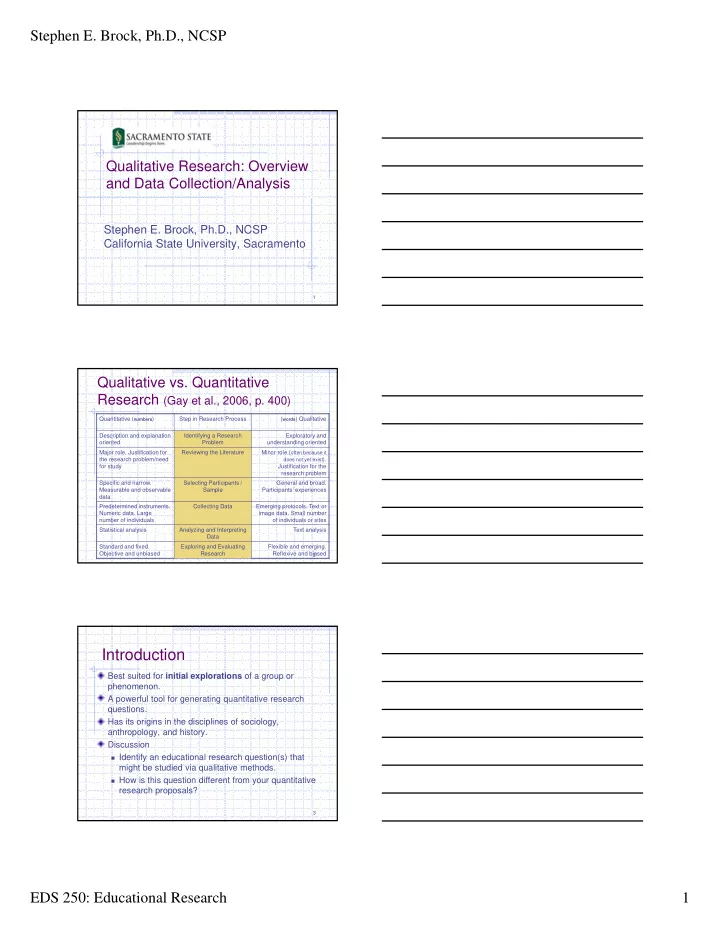
Qualitative vs. Quantitative Research (Gay et al., 2006, p. 400)

Quantitative (numbers) Step in Research Process (words) Qualitative Description and explanation

  • riented

Identifying a Research Problem Exploratory and understanding oriented Major role. Justification for the research problem/need for study Reviewing the Literature Minor role (often because it

does not yet exist).

Justification for the research problem Specific and narrow. Measurable and observable data Selecting Participants / Sample General and broad. Participants’ experiences Predetermined instruments. Numeric data. Large number of individuals Collecting Data Emerging protocols. Text or image data. Small number

  • f individuals or sites

Statistical analysis Analyzing and Interpreting Data Text analysis Standard and fixed. Objective and unbiased Exploring and Evaluating Research Flexible and emerging. Reflexive and biased

3

Introduction

Best suited for initial explorations of a group or phenomenon. A powerful tool for generating quantitative research questions. Has its origins in the disciplines of sociology, anthropology, and history. Discussion

 Identify an educational research question(s) that

might be studied via qualitative methods.

 How is this question different from your quantitative

research proposals?

slide-2
SLIDE 2

Stephen E. Brock, Ph.D., NCSP EDS 250: Educational Research 2

4

Features of Qualitative Research

1.

Relies on data gathered during intensive field (real world) study.

2.

The researcher is the primary evaluation tool or measure. Relatively little standardized instrumentation is used (at least at the outset).

3.

Results are descriptive (done with words not numbers).

4.

Aims at making holistic (systematic, encompassing, integrated) interpretations.

5.

Inductive reasoning. Looks at the whole to understand the parts

6.

Participant perspectives emphasized. Explicate the ways people in particular settings come to understand, account for, take action, and otherwise manage their day-to-day situations. Very complex phenomena/subjects (e.g., how do IEP teams function) are best suited to this type of research. Examples???

5

Characteristics of Qualitative Research

1.

A portrait (with words not numbers) of some group of people.

2.

Determines how members of a culture function and interact within a natural setting.

3.

Does not manipulate variables.

4.

Tries to identify variables that occur naturally and to explain how they are interrelated.

5.

Variable to be studied are not necessarily identified in advance (a common mini-proposal mistake is being too specific).

6.

Foreshadowed problems, the general ideas or notions the researcher brings to the study.

Qualitative vs. Quantitative Research

Small Group Discussion

 Review the qualitative mini-proposal outline found

in the syllabus.

 Compare it to the quantitative mini proposal

  • utline.

 Identify specific ways in which the proposals will

be different.

 From your mini-proposal own work…

 What are the advantages of a qualitative approach?  What are the disadvantages?

6

slide-3
SLIDE 3

Stephen E. Brock, Ph.D., NCSP EDS 250: Educational Research 3

7

Validity (trustworthiness) in Qualitative Research

  • 1. Descriptive Validity
  • 2. Interpretive Validity
  • 3. Theoretical Validity
  • 4. Evaluative Validity

8

Strategies for Ensuring Validity (Guba, 1981)

1.

Prolonged participation

2.

Persistent observation

3.

Peer debriefing

4.

Collect a variety of raw data items

5.

Check findings with participants

6.

Collect detailed descriptive data

7.

Develop detailed descriptions of the context

8.

Establish and audit trail

9.

Practice triangulation

  • 10. Practice reflexivity

9

Strategies for Ensuring Validity (Wolcott, 1994)

  • 1. Talk little, listen a lot
  • 2. Record observations accurately
  • 3. Begin writing early
  • 4. Let readers “see” for themselves
  • 5. Report fully
  • 6. Be candid
  • 7. Seek feedback
  • 8. Write accurately
slide-4
SLIDE 4

Stephen E. Brock, Ph.D., NCSP EDS 250: Educational Research 4

10

Selecting Participants

  • 1. Who

a)

Informed of topic

b)

Real life

  • 2. How

a)

Stratified purposeful

b)

Opportunistic

c)

Convenience

d)

Typical case

  • 3. How many

a)

Time, energy, resources dictate

b)

Rarely more that 20 (as few as 1)

 Thus sampling is very important

11

Data Collection

Observation Interview Record/Document Review NOTE: Did your mini-proposals use all

  • f these data sources?

12

Data Collection: Observation

Fieldwork (the time spent observing the group being studied).

 Field notes (example to follow)

 Chronological account of events.

 Memos

 Reflective note designed to help the researcher focus on the whole.

 Participant observation

 Becoming part of the group being observed.

 Privileged observers

 Observer, but not a participant.

slide-5
SLIDE 5

Stephen E. Brock, Ph.D., NCSP EDS 250: Educational Research 5

Data Collection: Observation

Discussion

1.

What are the pros and cons of being a participant observer?

2.

What are the pros and cons of being a privileged observer?

3.

How do you over come the identified “cons” and realize the identified “pros?”

13 14 15

slide-6
SLIDE 6

Stephen E. Brock, Ph.D., NCSP EDS 250: Educational Research 6

16

Data Collection: Interview

Unstructured Semi-structured (example to follow) Structured Recording and transcribing the interview.

17

University of California, Davis Collaborative Research on Preparing New Teachers Semistructured Interview Outline Prior to Beginning the Interview

  • 1. Introduction: The interviewer should introduce him or her self to the interviewee. Provide background information

necessary to facilitate an effective rapport.

  • 2. Motives and intentions: Explain to interviewee that the interviewer gained access to the teacher training program

via membership in EDU 203. The interview is part of a larger research effort designed to better understand how the UCD teacher training program works.

  • 3. Protection of respondents: E xplain to the interviewee that the identities of all participants in the study will be

protected via the use of pseudonyms.

  • 4. Review Statement of Consent form: Obtain the interviewee's signature on this form.
  • 5. Logistics: Determine the availability of the interviewee and establish how long the interview will last.

Note: Qs 2 & 3 from Mirriam (1987). Interview Questions Personal Questions

  • 1. Interviewee's name and credential program?
  • 2. What lead to your interest in becoming a teacher?
  • 3. What lead you to choose the UCD teacher training program?

Programmatic Questions

  • 4. What activities have you eng aged in as part of your preparation to become a teacher at UCD?
  • 5. How were these tasks organized overtime?
  • 6. How have your pr eparation tasks changed as the year progressed?

Rewards and Challenge Questions

  • 7. Which of these activities have been most/least helpful in providing you the skills needed to become and effective

teacher?

  • 8. What turning points -- either positive or negative -- did you expe rience in your work with the program this past

year?

  • 9. What activity(ies) contradicted/were consistent with your initial teacher training program expectations?
  • 10. What activity(ies) were the most rewarding/challenging/frustrating?
  • 11. How did these rewards/challenges/frustrations change over time

Relationship Questions

  • 12. How wou ld you characterize your relationship with other people involved in one w ay or another in the teacher

preparation program (i.e. other student teachers, university supervisors, cooperating teachers,K-12 students)?

  • 13. What has gone well or poorly for you with each of these relationships?
  • 14. What aspects of these relationships would you like to alter if you had this year to do over again?

Evaluative Questions

  • 15. In what ways did the design of the program help or hinder your p reparation to become a teacher?

18

  • 1. Knowing what you do now, how might you redesign your training program experience to better prepare you to

become an effective teacher?

  • 2. In general, what changes would you like to see in how teacher preparation programs in general are organized?
  • 3. Is there anything else about the university teacher training program that you wou ld like to share with me?

Questions About the Future

  • 4. What are your goals for the future?
  • 5. Ten years from know what do you hope to be doing?
  • 6. Personally speaking, is there anything else that the teacher training program could do for you to better assist you in
  • btaining you r goals?

After Completing the Interview

  • 1. Protection of respondents: Remind interviewees that their identities will be hidden.
  • 2. Feedback: Let interviewees know that they will be given feedback regarding what was learned from this

research project.

slide-7
SLIDE 7

Stephen E. Brock, Ph.D., NCSP EDS 250: Educational Research 7

19

Interview Transcript Interview Code Number: SB-I2 (interview with male single subject credential candidate) Person(s) Being Interviewed: Student 6 Interview Setting: Empty classroom Interviewer: Stephen E. Brock Interview Date: May 10, 1994 Time: 1:15 to 2:00 Place: University, Rooms A (1:15 to 1:40), and B (1:40 to 2:00) Recording Arrangements: Recorded with the consent of Student 6 GENERAL RESEARCH QUESTIONS: This Interview was conducted as part of EDU 203's study of the University teacher training program. The general purpose of this study was to learn more about the process of preparing students to become credentialed teachers. SPECIFIC INTERVIEW QUESTIONS: A semistructured interview outline was used to he lp guide this interview. CONTEXT: A m ale student (code number 6) in a single subject credential program at the University was i nterviewed. The interviewer had previously had contact with student 6 on two occasions. The first was when 6 attended an in-service

  • n suicide prevention that the interviewer had given 4 weeks earlier. The second contact was when the interviewer
  • bserved 6's s mall group seminar. These prior contacts were judged by the interviewer to have been neutral. The

interviewer had no t formed any specific preconceptions about 6 before the interview. The I nterview took place in University Rooms A and B, . Room A is the classroom in which the interviewer had observed the small group seminar (which student number 6 is a student in) one week earlier. It was comfortable and quiet. The interview began in Room A at 1: 15 and was move into Room B at 1:40. The change in interview locations was necessitated by the fact that at approximately 1:35 students began to arrive for the 2:00 small group seminar. Room B is a gradu ate research room, which at the time of the interview was empty. This room was also judged to have been comfortable and qu iet. The change in interview locations did not appear to have an adverse effect on the student being interviewed. The interview ended at 2:00. PRE - INTERVIEW: Before turning the tape recorder on, the general purpose of the study was described to 6. In addition, he was assured that his participation was voluntary, that his confidentiality would be protected and that his name would not be used in the reporting of any of the study's results. He was also told that the information learned from the study would be shared with him via a personal report. Finally, his signature was obtained on a "Statement of Consent". With 6's permission, the tape recorder was then turned on. What follows is a word-for-word transcription of the interview that then took place. TRANSCRIPT CONVENTIONS: [ ] are used to insert interviewer comments and observations (i.e., to r eport laughter, nonverbal gestures, sighs, changes in vo ice volume etc.). [[ ]] are used to indicate the insertion of pseudonyms to protect the identity of participants. É within a response and at the end of a sentence are used to indicate an incomplete sentence.

20

É at the end of an incomplete response, followed by a verbalization from the other interview participant, followed by . . . at the beginning of the next verbalization by the first interview participant is used to indicate instances where both subject are talking at the same time. For example, SB: Do you agree with me when... 6: Uh huh SB: . . . I said you liked student teaching. would indicate that 6 said "Uh huh" in the middle of one of the interviewers questions. / between two words indicates that the words were said simultaneously, as if they were one word. INTERVIEW TRANSCRIPT: SB: OK, why don' t we start by, um, you telling me something about what lead to your interest in becoming a teacher. 6: What lead to my interest in becoming a teacher? SB: [nodes yes] 6: I don't know. It's kinda a hard thing to say because... I, I liked teaching when I was in high school, I mean ever since I was been, I can't remember, I've been helping other students SB: um hum 6; So I, I mean I've always had this background of liking to help people. SB: Even when you were a high school student yourself. 6: Junior high. SB: Junior high. OK. 6: And so ... That was kinda an interest of mine" but when I went to college I started off as an engineer because both my dad and step dad were engineers and type of thing. So I just went to college thinking I was just become an engineer they make money stability ... SB: um huh 6: . . . easy life type thing. But then when I got to college Iza, I got some jobs, I was a resident assistant and then I was like a orientation counselor so I worked with a lot of students on a, on a counseling level and, you know, sometimes I'd help them with homework or whatever and I always just, I liked that feeling, I liked doing that. So I ended up switching out of engineering and into something I figured I, I could teach and math was not only something I always felt comfortable with, but also something that I had a lot of units towards [smiles, almost laughs as he says this]. And that ...

21

Interview Log Interview Code Number: SB-I3 (interview with female single subject credential candidate) Person(s) Being Interviewed: Student 5 Interview Setting: Research Room Interviewer: Stephen E. Brock Interview Date: May 15, 1994 Time: 1: 15 to 1:45 Place: University, Room B Recording Arrangements: Recorded with the consent of Student 5 GENERAL RESEARCH QUESTIONS: This Interview was conducted as part of study of the University teacher training program. The general purpose of this study was to learn more about the process of preparing students to become credentialed teachers. SPECIFIC INTERVIEW QUESTIONS: A semistructured interview outline was used to he lp guide this interview. CONTEXT: A female student (code number 5) in a s ingle subject credential program at the University was interviewed. The interviewer had previously bad contact with student 5 on one occasion. This contact occurred when the interviewer

  • bserved 5's small group s eminar. This prior contact was judged by the interviewer to have been neutral. The

interviewer had no t formed any specific preconceptions about 5 be fore the interview. The interview took place in University Room B on May 15, 1994. Room B is a graduate research room. This room was j udged to have been

  • comfortable. However, it wa s noisy as some of the other graduate students who sh are this office were having a

conversation in the room at the time of the interview. The interview ended at about 1:45. PRE-INTERVIEW: Before turning the tape recorder on, the general purpose of the study was described to 5. Also, she was assured that her participation was voluntary, that her confidentiality would be protected and that her name would not be used in the reporting of any of the study's results. She was also told that the information learned from the study would be shared with her via a personal report. Finally, her signature was obtained on a "Statement of Consent". With 5's permission, the tape recorder was then turned on. What follows is a wo rd-for-word transcription of what was said during the interview at one minute intervals. Interviewer comments summarize gist of the conversation between these intervals. LOG CONVENTIONS: [ ] are used to insert interviewer comments and observations (i.e., to r eport laughter, nonverbal gestures, sighs, changes in vo ice volume etc.). " " When quotation marks (" ") appear within brackets a direct quote is being reported. Typically, this is done to back up the interviewer comments and observations, which appear within brackets ([]). [[ ]] are used to indicate the insertion of pseudonyms to protect the identity of participants. É within a response and at the end of a sentence are used to indicate an incomplete sentence. É at the end of an incomplete response, followed by a verbalization from the other interview participant, followed by É at the beginning of the next verbalization by the first interview participant is used to indicate instances where both subject are talking at the same time. For example, SB: Do you agree with me whenÉ
slide-8
SLIDE 8

Stephen E. Brock, Ph.D., NCSP EDS 250: Educational Research 8

22

5: Uh hum SB: É I said you liked student teaching. would indicate that 5 said "Uh huh" in the middle of one of the interviewers questions. / between two words indicates that the words were said simultaneously, as if they were one word. INTERVIEWLOG Minutes Speaker Quotes and Interviewer Comments 00.00 SB OK, why don't we just get started by you telling me something about what 1W to your interest in becoming a teacher. The beginning in other words. but it sounds like you always knew you would like 01.00 SB but it sounds like you always knew you would like 5 ...Yea... SB ...teaching ... 5 Um hum. [5's interest in becoming a teacher cannot be traced back to any one event. She started out at University as a chemical engineering student. It sounds like she just sort of fell into becoming a teacher. Regarding her choice of University, it would appear that she chose it because of its familiarity "I was here already". She also knew and liked Supervisor B. She indicates that she really didn't want to move. "In fact this was the only place I applied"] 02.00 SB ... telling me about some of the activities you have engaged in during the course of the program. [5 describes her course of study as involving a placement in a school where she student teaches in two separate classes and aids in a third. She also indicates that journal writing, and small and large group seminars have been pa rt of her

  • preparation. ]

03.00 5 ... LEP, LEP and a [p ause] this quarter is, wait/interviewing and, its kinda like four sections, ones been interviews, ones been [pause] resumes, ones been, urn, sexual harassment, um, and today, a, is gangs.

23

Data Collection

Record/Document Review

 Archival Documents  Journals  Maps  Video and audio tapes  Artifacts

24

An Example

Topic: The education of children with ADHD Initial formulation

 Researcher bias

How would you collect qualitative data about this topic?

slide-9
SLIDE 9

Stephen E. Brock, Ph.D., NCSP EDS 250: Educational Research 9

25

An Example

Data collection

 Interviews with all stakeholders (parents, teachers, students,

support staff).

 Semi structured Interview Questions:

 How are ADHD children best served?  What modifications should be made?  When are special education programs needed?  What is the role of general education?

 Fieldwork

 Privileged observer.

 Documents

 Cumulative files

 Standardized testing  Teacher comments

 Teacher training materials

26

Threats to Validity

Observer Bias

 How do pre-existing beliefs about the topic

affect the data?

Observer Effect

 How does the researcher’s physical

presence affect the data?

27

Leaving the Field

Data driven Resource driven Ideally determined by data redundancy

 You feel that you understand the

phenomena

 You feel that you can predict the results of

any future data collection

 You know what people will say  You know what you will observer

slide-10
SLIDE 10

Stephen E. Brock, Ph.D., NCSP EDS 250: Educational Research 10

28

Data Management

No universally agreed upon procedures. Use common sense. Be as organized as possible

 Label, code, categorize

29

Data Analysis

During data collection After data collection

records

  • bservations

interviews Triangulation

30

Steps in Data Analysis

  • 1. Reading/Memos (whole)

Write/read memos about field notes, transcripts

  • bservations to the an initial sense of the whole
  • 2. Describing

Through/comprehensive descriptions of participants, setting, phenomenon in all its rich complexity

  • 3. Classifying (part)

Break down data into smaller parts

slide-11
SLIDE 11

Stephen E. Brock, Ph.D., NCSP EDS 250: Educational Research 11

31

Data Analysis Strategies

  • 1. Identifying themes
  • 2. Coding qualitative data
  • 3. Asking key questions
  • 4. Doing an organizational review
  • 5. Concept mapping
  • 6. Analyzing antecedents and consequences
  • 7. Displaying findings
  • 8. Stating what’s missing

32

Example of a Concept Map

33

Example of a Concept Map

IEP Team decisions Develop a concept map for how you think (from your own participant observations) IEP teams work. This is actually an “initial formulation,” but will give you the idea of this kind of data analysis.

slide-12
SLIDE 12

Stephen E. Brock, Ph.D., NCSP EDS 250: Educational Research 12

34

Data Interpretation

What is important in the data? Why is it important? What can be learned from it? So what?

 An orientation similar to when we

determine the effect size in quantitative research

35

Ensuring Credibility

Are the data based on one’s own observations? Is there corroboration from others of your

  • bservations?

In what circumstances was an observation made or reported? How reliable are those providing data? What motivations might have influenced a participant’s report? What biases might have influenced how an

  • bservation was made or reported?

36

Mixed Methods

QUAL-quan Method

 Qualitative study followed by quantitative

investigations

QUAN-qual Method

 Quantitative study followed by qualitative

investigations

QUAN-QUAL Method

 Both methods undertaken at the same time