
SLIDE 1
Metro Provides Excellence in Service and Support. Los Angeles County Metropolitan Transportation Authority
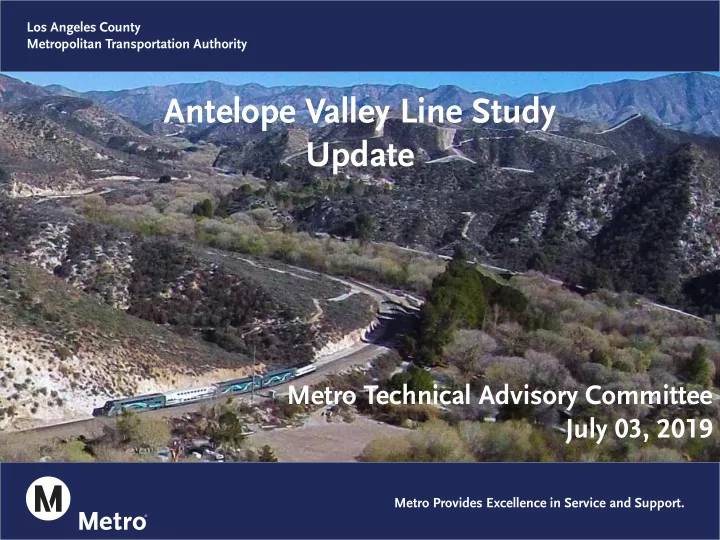
Antelope Valley Line Study Update Metro Technical Advisory - - PowerPoint PPT Presentation
Los Angeles County Metropolitan Transportation Authority Antelope Valley Line Study Update Metro Technical Advisory Committee July 03, 2019 Metro Provides Excellence in Service and Support. AVL Study Context 1. Strong Ridership and Mode
Metro Provides Excellence in Service and Support. Los Angeles County Metropolitan Transportation Authority
2
a) Daily AVL trips could increase from 6,500 in FY19 to 15,000 by FY30 b) Projected 9% growth per annum through 2042
Station FY15 FY19 2042 Growth Trends
GLENDALE 609 718 1,568 BURBANK 832 925 1,689 BURBANK AIRPORT-NORTH — 79 727 SUN VALLEY 76 102 899 SYLMAR / SAN FERNANDO 462 642 4,598 NEWHALL 295 394 1,942 SANTA CLARITA 263 401 1,566 VIA PRINCESSA / VISTA CANYON 421 546 944 ACTON / VINCENT GRADE 95 130 425 PALMDALE 342 499 8,241 LANCASTER 349 475 4,295 TOTAL 3,744 4,911 39,025
3
4
a) Planning years provided are build out conditions due to multiple service options and capital project scheduling. b) New/Available round trips can be filled by current operators (Metrolink or Union Pacific Railroad) or future potential operators (Amtrak –Pacific Surfliner, California High Speed Rail Authority or Virgin Trains USA)
5
6
3
1 4 11 7 Scenarios 1, 2 and 3 require 4 of 14 capital projects highlighted above.
Santa
13 8 6 12 10 5 9 2 14
7
4
First Phase to support Service Scenario 2
Boulevard to Sierra Highway; Capital Cost = $41.8M Second Phase to support Service Scenario 3
3
First phase capital investment allows for hourly mid-day service and existing peak service Second phase capital investment allows for 30 minute bi-directional service to Santa Clarita and hourly service from Santa Clarita to Lancaster.
2 1
Track Comparison
8
a) Phase I, First Ten Years: $41.8 M, Team to work with State and Local Partners to identify funding. b) Phase II, Second Ten Years: $133.4M, Team to work with Local, State and Federal Partners to identify funding.
9
1. The State is considering an extension of intercity passenger rail service to Santa Clarita to connect with the Pacific Surfliner service in Los Angeles. This could present an opportunity for through service between Santa Clarita and San Diego with Amtrak bus service to shorten the commute to Bakersfield from the current 3 hours to about 90 minutes(LAUS to Bakersfield).
Amtrak Bus Service Intercity Rail Vista Canyon Station
New investment opportunity would require coordination between LOSSAN and Metrolink *This exhibit modified the 2018 State Rail Plan
10 10
a) Original HSR Plan for dedicated alignment extremely costly; funding unlikely b) Blended service on the AVL route offers potential benefits for CHSRA, Virgin Trains USA, Amtrak and Metrolink rail services
Source: 2018 State Rail Plan- 2040 So Cal Vision
11 11
a) Diesel Multiple Unit (DMU) – One Power Car required for four cab cars b) Electric Multiple Unit (EMU, similar to HSR) – 1:3 ratio for powering c) Metrolink is developing a Fleet Modernization Plan (Fall 2020) to plan for a zero emissions future.
a) 100 mph maximum capability for both (79 mph CA max speed) b) Tilting train capability for both DMU and EMU
Continue to evaluate the extent to which the EMU service supports future development of HSR in the corridor
Source: Redlands Passenger Rail Project (SBCTA)
12 12