Annual Survey of Hours and Earnings (ASHE) Key Findings Median - - PDF document

annual survey of hours and earnings ashe
SMART_READER_LITE
LIVE PREVIEW

Annual Survey of Hours and Earnings (ASHE) Key Findings Median - - PDF document

Annual Survey of Hours and Earnings (ASHE) Key Findings Median Weekly Median weekly earnings in Scotland increased by 2.4 Full-time Earnings per cent from 563.1 in 2018 to 576.7 in 2019. Gender Pay Gap for full-time employees in Scotland


slide-1
SLIDE 1
  • 6%
  • 4%
  • 2%

0% 2% 4% 2006 2007 2008 2009 2010 2011 2012 2013 2014 2015 2016 2017 2018 2019

Percentage Change (%)

Scotland UK

Source: Scottish Government Analysis of Annual Survey of Hours and Earnings (ASHE), ONS

Annual Survey of Hours and Earnings (ASHE)

Key Findings

Median Weekly Full-time Earnings Gender Pay Gap Living Wage

Earnings

100 200 300 400 500 600 700 2005 2006 2007 2008 2009 2010 2011 2012 2013 2014 2015 2016 2017 2018 2019

Median Full-Time Weekly Pay (£)

Nominal Pay - Scotland Nominal Pay - UK Real Pay - Scotland Real Pay - UK

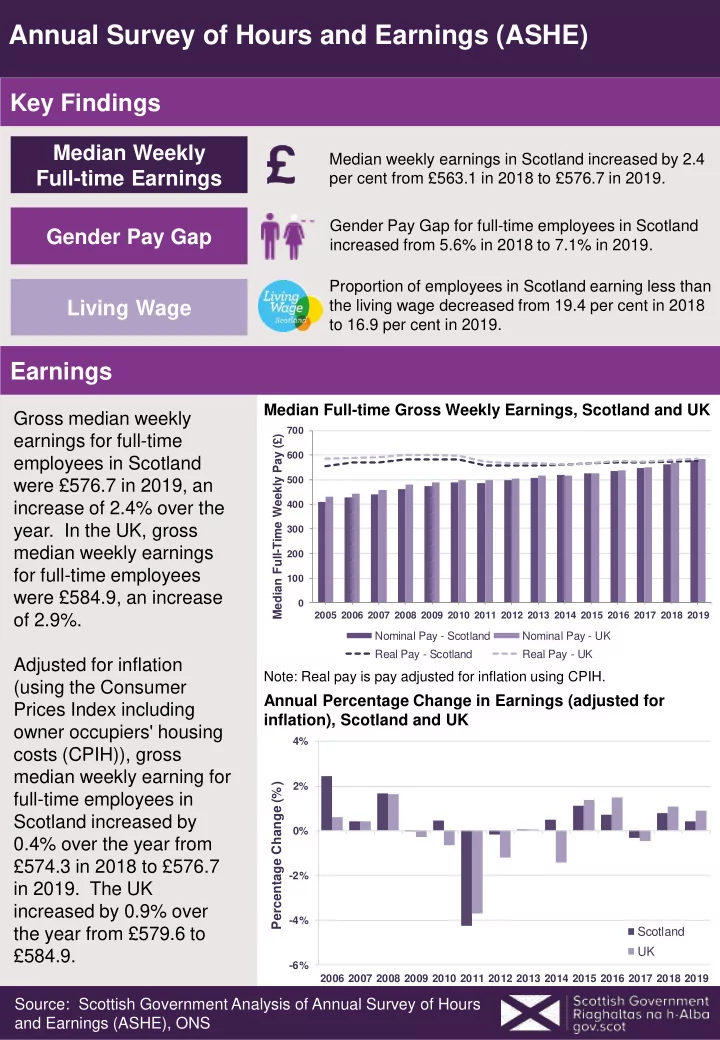
Median Full-time Gross Weekly Earnings, Scotland and UK Annual Percentage Change in Earnings (adjusted for inflation), Scotland and UK Median weekly earnings in Scotland increased by 2.4 per cent from £563.1 in 2018 to £576.7 in 2019. Gender Pay Gap for full-time employees in Scotland increased from 5.6% in 2018 to 7.1% in 2019. Proportion of employees in Scotland earning less than the living wage decreased from 19.4 per cent in 2018 to 16.9 per cent in 2019.

Gross median weekly earnings for full-time employees in Scotland were £576.7 in 2019, an increase of 2.4% over the

  • year. In the UK, gross

median weekly earnings for full-time employees were £584.9, an increase

  • f 2.9%.

Adjusted for inflation (using the Consumer Prices Index including

  • wner occupiers' housing

costs (CPIH)), gross median weekly earning for full-time employees in Scotland increased by 0.4% over the year from £574.3 in 2018 to £576.7 in 2019. The UK increased by 0.9% over the year from £579.6 to £584.9.

Note: Real pay is pay adjusted for inflation using CPIH.

slide-2
SLIDE 2

5 10 15 20 25 1997 1999 2001 2003 2005 2007 2009 2011 2013 2015 2017 2019

Gender Pay Gap (%)

UK Scotland 470.0 576.7 204.5 566.8 619.9 176.5 394.4 527.0 210.4 3.6 2.4 4.9 3.8 3.6 2.3 4.2 2.1 4.6

All Full-time Part-time

All Men Women

£ per week Change

  • n Year

(%)

Source: Scottish Government Analysis of Annual Survey of Hours and Earnings (ASHE), ONS

Annual Survey of Hours and Earnings (ASHE)

Key Findings Earnings

7.1

  • 8.6

14.3 8.9

  • 3.1

17.3

  • 10

10 20

Full-time Part-time All Gender Pay Gap (%) Scotland UK

Gender Pay Gap for Median Full-Time Hourly Earnings (excluding overtime), Scotland and UK Gender Pay Gap by Work Pattern, Scotland and UK, 2019

Gender Pay Gap

Median Gross Weekly Earnings by Gender and Work Pattern, Scotland, 2019

In the last year, women’s

  • verall earnings increased

at a faster rate than for men. For full-time Median gross weekly earnings for women increased by 2.1 per cent to £527.0 compared with an increase of 3.6 per cent to £619.9 for men. The Gender Pay Gap for all employees in Scotland has decreased from 15.0 per cent in 2018 to 14.3 per cent in 2019, the lowest since the series began in 1997. Over the last year, the Gender Pay Gap for full- time employees in Scotland has increased from 5.6 per cent to 7.1 per cent while it has increased from 8.6 per cent to 8.9 per cent for the UK. The Gender Pay Gap for full-time employees in Scotland has been lower than in the UK since 2003.

slide-3
SLIDE 3

About the Annual Survey of Hours and Earnings The Annual Survey of Hours and Earnings (ASHE) is the official source of UK earnings and hours worked

  • estimates. ASHE data is published annually by the Office for national Statistics (ONS) and is based on a 1

per cent sample of the Pay As You Earn (PAYE) system. Further details: https://www.ons.gov.uk/employmentandlabourmarket/peopleinwork/earningsandworkinghours/methodologie s/annualsurveyofhoursandearningslowpayandannualsurveyofhoursandearningspensionresultsqmi Glossary CPIH: The Consumer Prices Index including owner occupiers’ housing costs (CPIH) is the most comprehensive measure of inflation. Further details can be found at the following link: https://www.ons.gov.uk/economy/inflationandpriceindices/datasets/consumerpriceinflation Work Patterns: Full-time is defined as employees working more than 30 paid hours per week (or 25 or more hours for teaching professions). Part-time is defined as employees working less than or equal to 30 paid hours per week (or less than 25 hours for the teaching professions). Gender Pay Gap is calculated as the difference between the average hourly earnings (excluding overtime) for men and women as a proportion of the average hourly earnings (excluding overtime) for men. Real Living Wage: The real living wage rates have been independently calculated by the Resolution Foundation according to the cost of living based on household goods and services. Current and historical living wage rates can be found at the following link: https://livingwage.org.uk/calculation

Source: Scottish Government Analysis of Annual Survey of Hours and Earnings (ASHE), ONS

Annual Survey of Hours and Earnings (ASHE)

Key Findings Living Wage

Contact Labour Market Statistics team Tel: 0131 244 6783 Email: lmstats@gov.scot Published: 29th October 2019

18.8 18.6 19.3 19.6 20.1 18.4 19.4 16.9

2012 2013 2014 2015 2016 2017 2018 2019

Proportion earning less than the Living Wage (%)

Proportion of Employees (18+) earning less than the real Living Wage, Scotland

Background

400,000 employees (16.9 per cent of people in employment) in Scotland earned less than the Living Wage (£9.00) in 2019, decreasing from 473,000 in 2018. The proportion of employees earning less than the Living Wage remained relatively constant between 2012 and 2016, decreasing to 16.9 per cent in 2019.