Annual Survey of Hours and Earnings (ASHE) 2019 Key Findings This - - PDF document

annual survey of hours and earnings ashe 2019
SMART_READER_LITE
LIVE PREVIEW

Annual Survey of Hours and Earnings (ASHE) 2019 Key Findings This - - PDF document

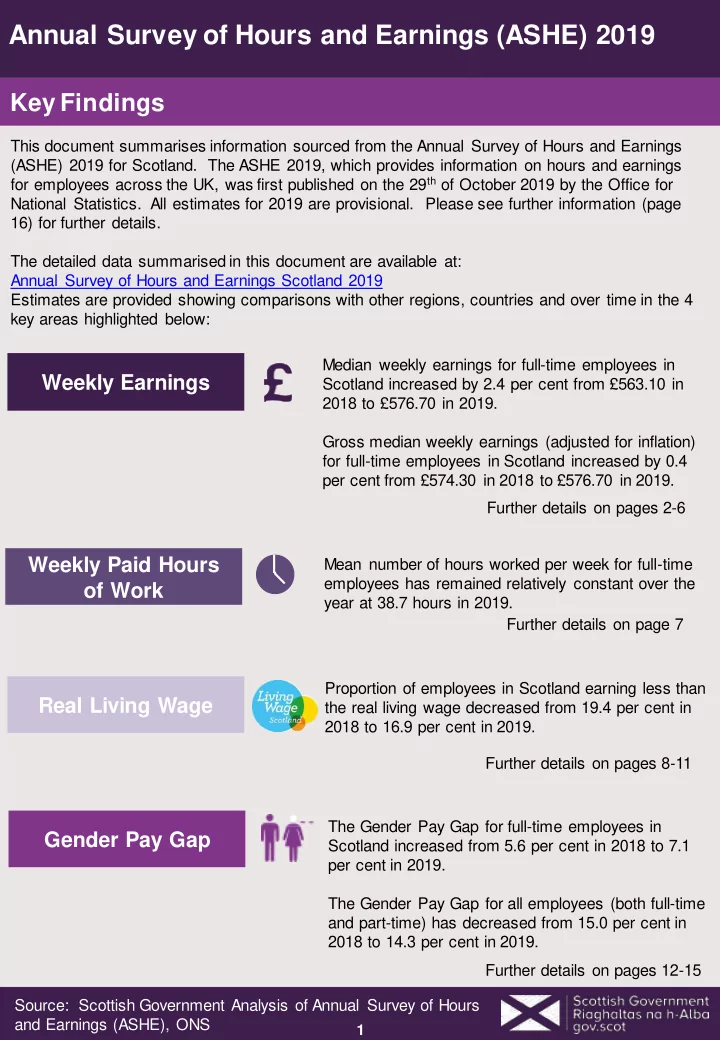
Annual Survey of Hours and Earnings (ASHE) 2019 Key Findings This document summarises information sourced from the Annual Survey of Hours and Earnings (ASHE) 2019 for Scotland. The ASHE 2019, which provides information on hours and earnings for


slide-1
SLIDE 1

Source: Scottish Government Analysis of Annual Survey of Hours and Earnings (ASHE), ONS

Annual Survey of Hours and Earnings (ASHE) 2019

Key Findings

1

Weekly Earnings

Median weekly earnings for full-time employees in Scotland increased by 2.4 per cent from £563.10 in 2018 to £576.70 in 2019. Gross median weekly earnings (adjusted for inflation) for full-time employees in Scotland increased by 0.4 per cent from £574.30 in 2018 to £576.70 in 2019. Further details on pages 2-6

Weekly Paid Hours

  • f Work

Mean number of hours worked per week for full-time employees has remained relatively constant over the year at 38.7 hours in 2019. Further details on page 7

Gender Pay Gap

The Gender Pay Gap for full-time employees in Scotland increased from 5.6 per cent in 2018 to 7.1 per cent in 2019. The Gender Pay Gap for all employees (both full-time and part-time) has decreased from 15.0 per cent in 2018 to 14.3 per cent in 2019. Further details on pages 12-15

Real Living Wage

Proportion of employees in Scotland earning less than the real living wage decreased from 19.4 per cent in 2018 to 16.9 per cent in 2019. Further details on pages 8-11 This document summarises information sourced from the Annual Survey of Hours and Earnings (ASHE) 2019 for Scotland. The ASHE 2019, which provides information on hours and earnings for employees across the UK, was first published on the 29th of October 2019 by the Office for National Statistics. All estimates for 2019 are provisional. Please see further information (page 16) for further details. The detailed data summarised in this document are available at: Annual Survey of Hours and Earnings Scotland 2019 Estimates are provided showing comparisons with other regions, countries and over time in the 4 key areas highlighted below:

slide-2
SLIDE 2
  • 6%
  • 4%
  • 2%

0% 2% 4% 2006 2007 2008 2009 2010 2011 2012 2013 2014 2015 2016 2017 2018 2019

Percentage Change (%)

Scotland UK

Source: Scottish Government Analysis of Annual Survey of Hours and Earnings (ASHE), ONS

Annual Survey of Hours and Earnings (ASHE)

Weekly Earnings

100 200 300 400 500 600 700 2005 2006 2007 2008 2009 2010 2011 2012 2013 2014 2015 2016 2017 2018 2019

Median Full-Time Weekly Pay (£)

Nominal Pay - Scotland Nominal Pay - UK Real Pay (2019 prices) - Scotland Real Pay (2019 prices) - UK

Median Full-time Gross Weekly Earnings, Scotland and UK, 2005-2019 1,2,3,4,5 Annual Percentage Change in Earnings (adjusted for inflation), Scotland and UK, 2006-2019 1,2,3,4,5

Gross median weekly earnings for full-time employees in Scotland were £576.70 in 2019, an increase of 2.4 per cent

  • ver the year.

Gross median weekly earnings (adjusted for inflation) for full-time employees in Scotland increased by 0.4 per cent

  • ver the year from £574.30

in 2018 to £576.70 in 2019. In the UK, gross median weekly earnings for full- time employees were £584.90, an increase of 2.9 per cent over the year. The UK gross median weekly earnings (adjusted for inflation) for full-time employees increased by 0.9 per cent over the year from £579.60 to £584.90. Median weekly earnings for full-time employees (real and nominal) are higher in the UK than Scotland for all years except 2014.

Note: Real pay (2019 prices) is pay adjusted for inflation using CPIH

2

slide-3
SLIDE 3

£533.00 £534.60 £535.00 £535.10 £538.10 £549.80 £551.40 £552.50 £576.70 £581.00 £613.50 £736.50 £584.90 +5.1% +3.3% +5.1% +3.8% +3.4% +3.7% +3.8% +3.0% +2.4% +4.2% +4.1% +3.3% +2.9%

North East Northern Ireland Wales East Midlands Yorkshire and The Humber North West South West West Midlands Scotland East South East London United Kingdom

£ per week

345.5 347.8 316.8 329.0 310.5 584.9 591.4 535.0 576.7 534.6 United Kingdom England Wales Scotland Northern Ireland

£ per week 1999 2019

Source: Scottish Government Analysis of Annual Survey of Hours and Earnings (ASHE), ONS

Annual Survey of Hours and Earnings (ASHE)

Weekly Earnings by Country and Region

Median Gross Weekly Full-Time Earnings by UK Country , 1999 and 2019 1,2,3,5

Scotland had the largest growth in median gross weekly earnings for full-time employees between 1999 and 2019 of the countries of the UK. However, between 2018 and 2019, Scotland had the lowest increase in median gross weekly earnings for full-time employees of the 12 countries and regions of the UK. In 2019, median gross weekly earnings for full-time employees were highest in London (£736.50) and lowest in the North East (£533.00). Scotland had the fourth highest median gross weekly earnings for full-time employees of the 12 countries and regions of the UK at £576.70, behind London (£736.50), the South East of England (£613.50) and the East of England (£581.00).

3

Median Gross Weekly Full-Time Earnings and Annual Percentage Change by UK Country and Region, 2019 1,2,3

slide-4
SLIDE 4

Source: Scottish Government Analysis of Annual Survey of Hours and Earnings (ASHE), ONS

Annual Survey of Hours and Earnings (ASHE)

Weekly Earnings by Public and Private Sector

Private sector earnings are consistently below public sector earnings. Gross median weekly earnings for full-time employees in the public sector in Scotland were £644.00 in 2019, an increase of 2.4 per cent over the year. Gross median weekly earnings (adjusted for inflation) for full-time employees in the public sector in Scotland increased by 0.4 per cent over the year from £641.20 in 2018 to £644.00 in 2019. Gross median weekly earnings for full-time employees in the private sector in Scotland were £544.10 in 2019, an increase of 3.0 per cent over the year. Gross median weekly earnings (adjusted for inflation) for full-time employees in the private sector in Scotland increased by 1.0 per cent over the year from £538.50 in 2018 to £544.10 in 2019. Compared to the UK In 2019, the UK median weekly earnings for full-time employees in the public sector were £632.10, less than the Scottish figure of £644.00. In 2019, the UK median weekly earnings for full-time employees in the private sector were £570.00, higher than the Scottish figure of £544.10.

4 100 200 300 400 500 600 700 2005 2006 2007 2008 2009 2010 2011 2012 2013 2014 2015 2016 2017 2018 2019

Median Full-Time Weekly Pay (£)

Nominal Pay - Public Nominal Pay - Private Real Pay (2019 prices) - Public Real Pay (2019 prices) - Private

£664.00 £544.10

Note: Real pay (2019 prices) is pay adjusted for inflation using CPIH.

Median Gross Weekly Full-Time Earnings by Public and Private Sector, Scotland, 2005-2019 1,2,3,4,5

slide-5
SLIDE 5

£388.90 £436.90 £442.50 £462.40 £489.60** £536.60 £553.10* £567.90 £579.10 £589.30 £594.30 £638.70* £645.40 £659.10 £670.80 £671.20 £689.70* £768.40 £826.20** £576.70

+6.8% +10.8% +3.7% +3.2% +11.3% +1.0% +3.9% +2.1% +1.1% +3.5% +5.2% +5.5% +3.4% +0.6% +2.8%

  • 0.6%

+4.8% +4.5% +0.7% +2.4%

ACCOMMODATION AND FOOD SERVICE ACTIVITIES ARTS, ENTERTAINMENT AND RECREATION WSALE & RETAIL TRADE; REPAIR OF MOTOR… ADMINISTRATIVE AND SUPPORT SERVICE ACTIVITIES OTHER SERVICE ACTIVITIES AGRICULTURE, FORESTRY AND FISHING REAL ESTATE ACTIVITIES HUMAN HEALTH AND SOCIAL WORK ACTIVITIES MANUFACTURING CONSTRUCTION TRANSPORTATION AND STORAGE WATER SUPPLY; SEWERAGE, WASTE MANAGEMENT… EDUCATION INFORMATION AND COMMUNICATION PROFESSIONAL, SCIENTIFIC AND TECHNICAL… PUBLIC ADMIN AND DEFENCE; COMPULSORY… FINANCIAL AND INSURANCE ACTIVITIES ELECTRICITY, GAS, STEAM, AIR CONDITIONING… MINING AND QUARRYING SCOTLAND

£ per week

£389.90 £392.40 £406.10 £445.60 £490.70 £546.00 £613.30 £733.30 £814.60 £576.70 +2.4% +2.6% +1.9% +3.1%

  • 0.6%

+3.7%

  • 0.3%

+3.1% +5.5% +2.4%

ELEMENTARY OCCUPATIONS SALES AND CUSTOMER SERVICE OCCUPATIONS CARING, LEISURE AND OTHER SERVICE OCCUPATIONS ADMINISTRATIVE AND SECRETARIAL OCCUPATIONS PROCESS, PLANT AND MACHINE OPERATIVES SKILLED TRADES OCCUPATIONS ASSOCIATE PROFESSIONAL AND TECHNICAL OCCUPATIONS PROFESSIONAL OCCUPATIONS MANAGERS, DIRECTORS AND SENIOR OFFICIALS SCOTLAND

£ per week

Source: Scottish Government Analysis of Annual Survey of Hours and Earnings (ASHE), ONS

Annual Survey of Hours and Earnings (ASHE)

Weekly Earnings by Occupation and Industry

In 2019, the occupation with the highest median weekly earnings for full-time employees was Managers, directors and senior officials at £814.60. Elementary and Sales and customer service occupations were the lowest paid at £389.90 and £392.40 per week, respectively. The largest annual percentage increase in full-time median weekly earnings between 2018 and 2019 was seen for Managers, directors and senior officials.

5

Median Gross Weekly Full-Time Earnings and Percentage Change by Occupation, Scotland, 2019 1,2,3,7 Median Gross Weekly Full-Time Earnings and Percentage Change by Industry Sector, Scotland, 2019 1,2,3,8 In 2019, the industry sector with the highest median weekly earnings for full-time employees was Mining and Quarrying at £826.20. Accommodation and food service activities and Arts, entertainment and recreation sectors were the lowest paid at £388.90 and £436.90 per week, respectively.

Statistical robustness All estimates considered precise unless indicated: * Estimates are considered reasonable quality ** Estimates are considered lower quality and should be used with caution
slide-6
SLIDE 6

409.1 577.1* 691.7 662.8 388.1 500.2 597.8 525.2

16-24 25-34 35-49 50-64 Median Full-Time Weekly Earnings (£)

Men Women 470.0 576.7 204.5 566.8 619.9 176.5 394.4 527.0 210.4 3.6 2.4 4.9 3.8 3.6 2.3 4.2 2.1 4.6

All Full-time Part-time

All Men Women

£ per week Change

  • n Year

(%) Source: Scottish Government Analysis of Annual Survey of Hours and Earnings (ASHE), ONS

Annual Survey of Hours and Earnings (ASHE)

Weekly Earnings by Gender, Age and Work Pattern

Median Gross Weekly Earnings by Gender and Work Pattern, Scotland, 2019 1,2,3

In the last year, women’s

  • verall earnings increased

at a faster rate than for men. Median gross weekly earnings for full-time women increased by 2.1 per cent to £527.00 compared with an increase

  • f 3.6 per cent for men

(£619.90). Median gross weekly earnings for part-time women increased by 4.6 per cent to £210.40 compared with an increase

  • f 2.3 per cent for men

(£176.50). For men and women in Scotland, median gross weekly earnings for full-time employees reached a peak at age range 35-49 (£691.70 for men and £597.80 for women). Median gross weekly earnings for full-time women are less than full- time men’s for all age groups, with the gap between men and women’s earnings increasing with age from 16-24 to 50-64 year olds.

6

Median Full-time Gross Weekly Earnings by Age and Gender, Scotland, 2019 1,3,9

Statistical robustness All estimates considered precise unless indicated: * Estimates are considered reasonable quality ** Estimates are considered lower quality and should be used with caution

slide-7
SLIDE 7

0.0 0.4 0.8 1.2 1.6 2.0 2.4 2.8 37.3 37.4 37.5 37.6 37.7 37.8 37.9 38.0 1997 1999 2001 2003 2005 2007 2009 2011 2013 2015 2017 2019

Mean overtime hours worked Mean basic hours worked Basic hours worked Overtime hours worked

17.5 18.0 18.5 19.0 19.5 20.0 20.5 38.0 38.4 38.8 39.2 39.6 40.0 40.4 1997 1999 2001 2003 2005 2007 2009 2011 2013 2015 2017 2019

Mean total paid part-time hours Mean total paid full-time hours Total Paid Full-Time Hours Total Paid Part-Time Hours

Source: Scottish Government Analysis of Annual Survey of Hours and Earnings (ASHE), ONS

Annual Survey of Hours and Earnings (ASHE)

Weekly Paid Hours of Work

Mean Weekly Paid Total Hours (16+) by Work Pattern, Scotland, 1997-2019 1,2,3,5,6,10

7

Total Hours by Work Pattern Over the year, the average total paid hours per week for full-time employees remained relatively constant at 38.7 hours, while average total paid hours for part-time employees was also relatively constant at 18.7 hours.

Mean Full-time Weekly Paid Basic and Overtime Hours (16+), Scotland, 1997-2019 1,2,3,5,6,10

Basic and Overtime Hours Average overtime hours per week for full-time employees have decreased from 2.3 hours per week in 1997 to 1.0 hours per week in 2019 while average basic hours have remained relatively constant at 37.7 hours per week.

Note: Total paid hours includes basic hours worked and overtime hours worked in reference week

slide-8
SLIDE 8

Source: Scottish Government Analysis of Annual Survey of Hours and Earnings (ASHE), ONS

Annual Survey of Hours and Earnings (ASHE)

Real Living Wage

The Real Living Wage has been independently calculated by the Resolution Foundation according to the cost of living based on household goods and

  • services. See Glossary (page 16) for further details.

In April 2019, the real living wage was £10.55 for employees in London and £9.00 for employees elsewhere in the UK. 400,000 employees (16.9 per cent of people in employment) in Scotland earned less than the real Living Wage (£9.00) in 2019, decreasing from 473,000 (19.4 per cent of people in employment) in 2018. The proportion of employees earning less than the real Living Wage remained relatively constant between 2012 and 2016, decreasing to 16.9 per cent in 2019.

8

18.8 18.6 19.3 19.6 20.1 18.4 19.4 16.9

2012 2013 2014 2015 2016 2017 2018 2019 Proportion earning less than the Living Wage (%)

Earning less than the living wage 95% CI

National Performance Framework Indicator

Proportion of Employees (18+) earning less than the real Living Wage, Scotland, 2012-2019 1,2,11

slide-9
SLIDE 9

15.9 16.9 18.8 19.8 20.4 21.1 21.7 22.1 22.6 22.6 22.8 25.1 20.1 South East Scotland East London South West North West West Midlands Yorkshire and The Humber Wales North East East Midlands Northern Ireland United Kingdom 16.9

20.1 22.6 25.1 20.1 Scotland England Wales Northern Ireland United Kingdom Source: Scottish Government Analysis of Annual Survey of Hours and Earnings (ASHE), ONS

Annual Survey of Hours and Earnings (ASHE)

Living Wage by Country and Region

Proportion of Employees (18+) earning less than the real Living Wage by Country of the UK, 2019 1,2,11

9

Proportion of Employees (18+) earning less than the real Living Wage by Country and Region of the UK, 2019 1,2,11

In 2019, Scotland had the lowest proportion of employees earning less than the real Living Wage (16.9 per cent) across the countries of the UK. In 2019, Scotland had the second lowest proportion of employees earning less than the real Living Wage across the countries and regions of the UK, behind the South East (15.9 per cent).

slide-10
SLIDE 10

16.9 3.2* 24.8 83.1 96.8 75.2 Scotland Public Private

Earning less than the living wage Earning the living wage or more

Source: Scottish Government Analysis of Annual Survey of Hours and Earnings (ASHE), ONS

Annual Survey of Hours and Earnings (ASHE)

Proportion of Employees (18+) earning less than the real Living Wage by Public and Private Sector, Scotland, 20191,2,11

Living Wage by Sector

10

Proportion of Employees (18+) earning less than the real Living Wage by Industry Sector, Scotland, 2019 1,2,8,11

16.9 6.2* 6.9** 8.6** 8.9** 11.3* 14.8* 23.8* 25.6** 29.5** 31.2* 42.5 60.2 Scotland Education Professional, scientific and technical activities Transportation and storage Construction Human health and social work activities Manufacturing Arts, entertainment and recreation Agriculture, Forestry and Fishing Other service activities Administrative and support service activities Wholesale and retail trade; Repair of motor vehicles and motorcycles Accommodation and food service activities

In 2019, it is estimated that 24.8 per cent of employees in the private sector in Scotland earn less than the real Living Wage, down from 27.7 per cent in 2018. This compares with 3.2 per cent in the public sector, down from 5.6 per cent in 2018.

In 2019, the proportion of employees earning less than the real living wage is highest in Accommodation and food service activities (60.2 per cent are paid less than the real living wage) and Wholesale and retail trade and repair of motor vehicles and motorcycles (42.5 per cent). The proportion of employees earning less than the real living wage is lowest in Education (6.2 per cent) and Professional, scientific and technical activities (6.9 per cent).

Notes:

  • 1. It is not possible to display the following sectors due to small sample sizes - Mining and Quarrying; Electricity, gas,

steam and air conditioning supply; Water supply, sewerage, waste management and remediation activities; Information and Communication; Financial and insurance activities; Real estate activities; Public administration and defence and Compulsory social security; Activities of households as employers, undifferentiated goods and services producing activities of households for own use.

Statistical robustness All estimates considered precise unless indicated: * Estimates are considered reasonable quality ** Estimates are considered lower quality and should be used with caution

slide-11
SLIDE 11

9.2 9.8 46.8 39.5 13.5 11.8 35.2 29.9

2012 2013 2014 2015 2016 2017 2018 2019 Men Full-time Men Part-time Women Full-time Women Part-time

44.9 16.2 11.5 14.6 55.1 83.8 88.5 85.4 18-24 25-34 35-49 50+

Earning less than the living wage Earning the living wage or more 14.0 19.5 16.9 86.0 80.5 83.1 Men Women Scotland Earning less than the living wage Earning the living wage or more

Source: Scottish Government Analysis of Annual Survey of Hours and Earnings (ASHE), ONS

Annual Survey of Hours and Earnings (ASHE)

Proportion of Employees (18+) earning less than the real Living Wage by Gender, Scotland, 2019 1,2,11

Living Wage by Gender, Work Pattern and Age

11

The proportion of women in Scotland earning less than the real Living Wage (£9.00) in 2019 was 19.5 per cent, compared with 14.0 per cent of men. The age group with the highest proportion of employees earning less than the real Living Wage was those aged 18-24 at 44.9 per cent. The proportion of part-time employees earning less than the real Living Wage is higher for part-time than for full-time employees. Although this has decreased in the last year.

Proportion of Employees (18+) earning less than the real Living Wage by Age, Scotland, 2019 1,2,11 Proportion of Employees (18+) earning less than the real Living Wage by Gender and Work Pattern, Scotland, 2019 1,2,3,11

slide-12
SLIDE 12

7.1

  • 8.6

14.3 8.9

  • 3.1

17.4

Full-time Part-time All Gender Pay Gap (%) Scotland UK

  • 15
  • 10
  • 5

5 10 15 20 25 30 1997 1999 2001 2003 2005 2007 2009 2011 2013 2015 2017 2019

Gender Pay Gap (%)

Dashed lines represent discontinuities in 2004, 2006 and 2011 ASHE estimates. All Scotland Full-time Scotland Part-time Scotland

5 10 15 20 25 1997 1999 2001 2003 2005 2007 2009 2011 2013 2015 2017 2019

Gender Pay Gap (%)

Dashed lines represent discontinuities in 2004, 2006 and 2011 ASHE estimates.

UK Scotland

Source: Scottish Government Analysis of Annual Survey of Hours and Earnings (ASHE), ONS

Annual Survey of Hours and Earnings (ASHE)

Gender Pay Gap for Median Full-Time Hourly Earnings (excluding overtime), Scotland and UK, April 1997 to April 2019 1,2,3,5,12

Gender Pay Gap

Over the last year, the Gender Pay Gap for full-time employees in Scotland has increased from 5.6 per cent to 7.1 per cent while it has increased from 8.6 per cent to 8.9 per cent for the UK. The Gender Pay Gap for full- time employees in Scotland has been lower than in the UK since 2003. There are a range of measures used to monitor the gender pay gap – full-time employees, part- time employees and all employees. The Gender Pay Gap for all employees in Scotland has decreased from 15.0 per cent in 2018 to 14.3 per cent in 2019, the lowest since the series began in 1997.

12

National Performance Framework Indicator

The Gender Pay Gap is calculated as the difference between the median hourly earnings (excluding

  • vertime) for men and women as a proportion of the

median hourly earnings (excluding overtime) for men.

7.1 8.9

Gender Pay Gap by Work Pattern, Scotland and UK, 2019 1,2,3,5,12

14.3 7.1

  • 8.6
slide-13
SLIDE 13
  • 2.8%

6.4% 7.1% 7.9% 8.6% 10.3% 10.7% 10.8% 11.2% 11.6% 13.6% 13.8% 8.9%

Northern Ireland Wales Scotland North East North West West Midlands Yorkshire and The Humber South West East East Midlands South East London United Kingdom Gender Pay Gap (%) 16.4 16.1 17.2 16.7 13.4 12.2 12.7 12.6 8.5 3.7 8.9 10.0 6.4 7.1

  • 2.8

United Kingdom England Wales Scotland Northern Ireland

Gender Pay Gap (%)

1999 2009 2019

Source: Scottish Government Analysis of Annual Survey of Hours and Earnings (ASHE), ONS

Annual Survey of Hours and Earnings (ASHE)

Full-time Median Gender Pay Gap by UK Country , 1999-2019 1,2,3,5,12

Gender Pay Gap by Country and Region

13

Full-time Median Gender Pay Gap by UK country and Region, 2019 1,2,3,12

In 2019, London had the highest gender pay gap for median full-time hourly earnings (excluding

  • vertime) at 13.8 per cent

while Northern Ireland had the lowest at -2.8 per cent, with women earning more than men on average. Scotland had the third lowest gender pay gap for median full-time hourly earnings (excluding

  • vertime) of the 12

countries and regions of the UK at 7.1 per cent, behind Wales (6.4 per cent) and Northern Ireland (-2.8 per cent). The median gender pay gap for full-time hourly earnings (excluding overtime) has reduced over time for all of the countries of the UK.

slide-14
SLIDE 14

6.3 6.4 8.1 8.6 8.9 10.6 17.3* 22.7* 24.7* 7.1

+0.1

  • 1.0
  • 2.0

+0.1 +3.1

  • 0.5

+1.3 +1.7

  • 2.2

+1.5 CARING, LEISURE AND OTHER SERVICE OCCUPATIONS ADMINISTRATIVE AND SECRETARIAL OCCUPATIONS ELEMENTARY OCCUPATIONS PROFESSIONAL OCCUPATIONS SALES AND CUSTOMER SERVICE OCCUPATIONS ASSOCIATE PROFESSIONAL AND TECHNICAL OCCUPATIONS PROCESS, PLANT AND MACHINE OPERATIVES MANAGERS, DIRECTORS AND SENIOR OFFICIALS SKILLED TRADES OCCUPATIONS SCOTLAND Gender Pay Gap (%)

  • 5

5 10 15 20 25 30

1997 1999 2001 2003 2005 2007 2009 2011 2013 2015 2017 2019

Gender Pay Gap (%)

Public Sector Private Sector

Source: Scottish Government Analysis of Annual Survey of Hours and Earnings (ASHE), ONS

Annual Survey of Hours and Earnings (ASHE)

Gender Pay Gap for Median Full-time Hourly Earnings (excluding overtime) by Public and Private Sector, Scotland, 1997-2019 1,2,3,5,12

Gender Pay Gap by Sector and Occupation

14

The median gender pay gap for full-time hourly earnings (excluding overtime) for public sector employees has been consistently below the gender pay gap for the private sector. The gender pay gap for the public sector has been increasing since 2016 while the gender pay gap for the private sector has been continuing to decrease.

Full-time Median Gender Pay Gap and Percentage Point Change by Occupation, Scotland, 2019 1,2,3,7,12

16.7% 6.3%

In 2019, the median gender pay gap for full-time hourly earnings (excluding

  • vertime) was highest

for Skilled trades

  • ccupations at 24.7

per cent and lowest for Caring, leisure and other service

  • ccupations at 6.3

per cent.

Statistical robustness All estimates considered preciseunless indicated: * Estimates are considered reasonable quality ** Estimates are considered lower quality and should be used with caution

slide-15
SLIDE 15
  • 5

5 10 15 20 25 1997 1999 2001 2003 2005 2007 2009 2011 2013 2015 2017 2019

Gender Pay Gap (%) 16-34 35-49 50-64

0.0 7.4* 6.3 11.7 7.1 0.6 13.3* 14.2 21.2 14.3

16-24 25-34 35-49 50-64 16+ Gender Pay Gap (%) Full-Time All

Source: Scottish Government Analysis of Annual Survey of Hours and Earnings (ASHE), ONS

Annual Survey of Hours and Earnings (ASHE)

Median Gender Pay Gap by Age and Work Pattern, Scotland, 2019 1,2,3,12

Gender Pay Gap by Age

15

The median gender pay gap for hourly earnings (excluding overtime) tends to increase with age, with those aged 50-64 having the highest gender pay gap for all and full-time employees.

Median Gender Pay Gap for Full-time Hourly Earnings by Age, Scotland, 1997-2019 1,2,3,5,12

The median gender pay gap for full-time hourly earnings (excluding overtime) has decreased slightly for those aged 35-49 and 50-64 since 2011. For those aged 16- 34, the gender pay gap for full-time hourly earnings (excluding overtime) is consistently lower than the gender pay gap for other age groups and has increased since 2011.

Statistical robustness All estimates considered preciseunless indicated: * Estimates are considered reasonable quality ** Estimates are considered lower quality and should be used with caution * Estimates are considered reasonable quality for 16-34 year olds in 2001, 2002, 2003, 2010, 2011, 2013, 2016, 2017, 2018 and 2019. ** Estimates are considered lower quality for 16-34 year olds in 2012.

slide-16
SLIDE 16

Source: Scottish Government Analysis of Annual Survey of Hours and Earnings (ASHE), ONS

Annual Survey of Hours and Earnings (ASHE)

Glossary

Statistical robustness As these estimates are obtained from a sample survey, the quality of each estimate is assessed by ONS using the coefficient of variation (CV). The CV is the ratio of the standard error of an estimate to the estimate itself and is expressed as a percentage. Estimates which have a CV of less than or equal to 5% are considered ‘precise’. Estimates where the CV is greater than 5% and less than or equal to 10% are considered reasonable quality while estimates with a CV of greater than 10% and less than or equal to 20% are considered lower quality and should be used with caution. Where the CV of an estimate is greater than 20% then the estimate is considered unreliable and is not shown. Within this document ‘*’ has been used to denote estimates which are considered to be of reasonable quality and ‘**’ for estimates that are considered to be of lower quality. Gross Weekly Pay (Pages 2-6) Gross pay for the reference period = basic pay + incentive pay + shift and premium payments + other pay + overtime pay Real Earnings Earnings adjusted for inflation are calculated by adjusting nominal (unadjusted) earnings using the Consumer Prices Index including owner occupiers’ housing costs (CPIH). The CPIH figures are based on the All Items Consumer Prices Index (including owner occupiers' housing costs) of inflation for April. The CPIH is the most comprehensive measure of inflation. Further details can be found at the following link: https://www.ons.gov.uk/economy/inflationandpriceindices/datasets/consumerpriceinflation Work Pattern Full-time is defined as employees working more than 30 paid hours per week (or 25 or more hours for teaching professions). Part-time is defined as employees working less than or equal to 30 paid hours per week (or less than 25 hours for the teaching professions). Gender Pay Gap The Gender Pay Gap is calculated as the difference between the average hourly earnings (excluding

  • vertime) for men and women as a proportion of the average hourly earnings (excluding overtime) for
  • men. The median has been used as the average measure.

It should be noted that the figures do not show differences in rates of pay for comparable jobs, as these are affected by factors such as the proportion of men and women working part time or in different

  • ccupations. For example, a higher proportion of women work in occupations such as administration and

caring, which tend to offer lower salaries. Real Living Wage The real living wage rates have been independently calculated by the Resolution Foundation according to the cost of living based on household goods and services. Current and historical living wage rates can be found at the following link: https://livingwage.org.uk/calculation Living Wage analysis from the Annual Survey of Hours and Earnings covers those aged 18 and over on the PAYE system and whose pay was not affected by absence. National Minimum Wage and National Living Wage The National Minimum Wage (NMW) is the minimum amount per hour that most workers in the UK are entitled to be paid. The rates are different depending on a worker’s age and whether they are an

  • apprentice. The NMW applies to employees aged 16-24 years old. The National Living Wage (NLW)

which was introduced on 1 April 2016 applies to employees aged 25 years and over. Current and historical living wage rates can be found at the following link: https://www.gov.uk/national-minimum-wage- rates 16

slide-17
SLIDE 17

Source: Scottish Government Analysis of Annual Survey of Hours and Earnings (ASHE), ONS

Annual Survey of Hours and Earnings (ASHE)

For the charts in this summary, the following notes apply:

  • 1. Estimates for 2019 data are provisional.
  • 2. Employees are on adult rates, pay is unaffected by absence.
  • 3. Full-time is defined as employees working more than 30 paid hours per week (or 25 or more for the

teaching professions).

  • 4. The data have been adjusted for inflation using the Consumer Prices Index including owner occupiers'

housing costs (CPIH). The CPIH figures are based on the All Items Consumer Prices Index (including

  • wner occupiers' housing costs) of inflation for April.
  • 5. Discontinuities exist in 2004, 2006 and 2011 ASHE estimates.
  • 6. Estimates of the mean include zero responses, whereas estimates of the median exclude zero

responses.

  • 7. Occupations are defined by the Standard Occupational Classification (SOC) 2010 codes.
  • 8. Industry sectors are defined using the Standard Industrial Classification (SIC) 2007 codes.
  • 9. Includes all employees aged 16 to 17 years and employees aged 18 years and over on adult rates, pay

unaffected by absence.

  • 10. The y-axis does not start at zero for mean total paid full-time hours, mean total paid part-time hours

and mean basic hours worked.

  • 11. The Living Wage Foundation proposed living wage rates of £10.55 for employees in London and

£9.00 for employees elsewhere in the UK in April 2019.

  • 12. The Gender Pay Gap is calculated as the difference between the median hourly earnings (excluding
  • vertime) for men and women as a proportion of the median hourly earnings (excluding overtime) for men .

17 Industry sectors: Defined using the Standard Industrial Classification (SIC) codes 2007 (https://www.ons.gov.uk/methodology/classificationsandstandards/ukstandardindustrialclassificationofeco nomicactivities) Occupations: Defined using the Standard Occupational Classification (SOC) codes 2010 (https://www.ons.gov.uk/methodology/classificationsandstandards/standardoccupationalclassificationsoc)

Footnotes for charts Glossary (continued)

slide-18
SLIDE 18

Source: Scottish Government Analysis of Annual Survey of Hours and Earnings (ASHE), ONS

Annual Survey of Hours and Earnings (ASHE)

Further Information

About the Annual Survey of Hours and Earnings

The Annual Survey of Hours and Earnings (ASHE) is the official source of UK earnings and hours worked

  • estimates. ASHE data is published annually by the Office for National Statistics (ONS) and is based on a

1 per cent sample of employee jobs from HM Revenue and Customs Pay As You Earn (PAYE) system. All estimates for 2019 are provisional and relate to the reference date 11 April 2019. Further details: https://www.ons.gov.uk/employmentandlabourmarket/peopleinwork/earningsandworkinghours/methodolog ies/annualsurveyofhoursandearningslowpayandannualsurveyofhoursandearningspensionresultsqmi Scottish Government: Tables providing Scottish estimates for a number of different breakdowns are available on the Scottish Government website at: https://www2.gov.scot/Topics/Statistics/Browse/Labour-Market/Earnings National Performance Framework: https://nationalperformance.gov.scot/

ONS:

Labour Market Statistics Theme page: http://www.ons.gov.uk/ons/taxonomy/index.html?nscl=Labour+Market Employee earnings in the UK: https://www.ons.gov.uk/employmentandlabourmarket/peopleinwork/earningsandworkinghours/bulletins/an nualsurveyofhoursandearnings/2019 Low and high pay in the UK: https://www.ons.gov.uk/employmentandlabourmarket/peopleinwork/earningsandworkinghours/bulletins/lo wandhighpayuk/2019 Gender Pay Gap in the UK: https://www.ons.gov.uk/employmentandlabourmarket/peopleinwork/earningsandworkinghours/bulletins/ge nderpaygapintheuk/2019

NOMIS:

Online database for official labour market statistics: https://www.nomisweb.co.uk/default.asp Contact Labour Market Statistics team Tel: 0131 244 6773 Email: lmstats@gov.scot Published: 26 November 2019 This ASHE summary was produced by the OCEAES: Economic Statistics: Labour Market Statistics team. If you have any comments on the style and content of this briefing pack, please contact us at the above email address. 18