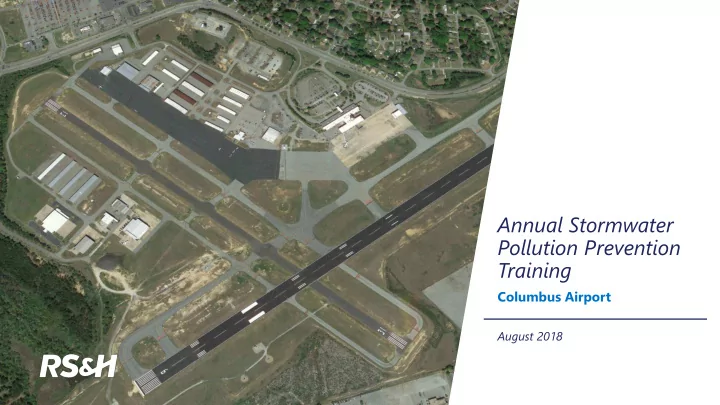
SLIDE 1 Annual Stormwater Pollution Prevention Training
August 2018
Columbus Airport
SLIDE 2
Agenda
1. Regulatory Background 2. Regulated Activities 3. Roles and Responsibilities 4. Best Management Practices 5. Spill Response 6. Inspections and Monitoring 7. Reporting 8. Quiz
SLIDE 3 Regulatory Background
» Clean Water Act (CWA) of 1972 » Gave EPA authority to implement pollution control programs, such as the National Pollutant Discharge Elimination System or NPDES program
JUNE 22, 1969: UMM, THE CUYAHOGA RIVER'S ON FIRE ... AGAIN
Source: TIME Magazine
SLIDE 4
Regulatory Background
» EPA delegated authority to the individual states Georgia Department of Natural Resources (GADNR) Environmental Protection Division (EPD) » NPDES Permit GAR050000 Storm Water Discharges Associated with Industrial Activity, Sector S – Air Transportation » Coverage through submittal of Notice of Intent (NOI)
SLIDE 5 Stormwater Pollution Prevention Plan
Protects water resources
SLIDE 6
Where are your operations?
SLIDE 7
Drainage Areas and Discharge Outfalls
SLIDE 8
Covered Industrial Activities
» Vehicle and aircraft maintenance
– rehabilitation – mechanical repairs – painting – fueling and lubrication
» Equipment cleaning operations » Runway rubber removal » Waste management » Airport deicing operations
SLIDE 9
Operators w/ Industrial Activities
» Must submit a separate NOI requesting coverage under GAR050000 » Must submit through Georgia EPD – GEOS website https://epd.georgia.gov/geos/ » Must comply with the signatory requirements of the SWPPP » Operators form the CSG Pollution Prevention Team (PPT)
SLIDE 10 PPT Team Leader Eric Trivett Baron Aviation Services Flightways FBO JW Culpepper, LLC B&C Aviation T-Hanger Tenants performing applicable activities Aflac Columbus Aero Service Aircraft Rescue and Fire Fighting
CSG Pollution Prevention Team
SLIDE 11
CSG Pollution Prevention Team
SLIDE 12
Responsibilities –PPT Leader
» Submit initial NOI and renewals every 5 years and ensure that all members of the PPT also submit NOI and renewals » Coordinate overall PPT to maintain SWPPP requirements » Provide annual training to PPT members » Schedule and conduct PPT meetings » Ensure that each member of the PPT carries out applicable duties » Conduct and/or ensure that quarterly visual observations at all industrial stormwater discharge outfalls are conducted as specified in the Permit » Conduct and/or ensure that all required routine inspections are conducted » Perform the annual updating and certifications as required by the SWPPP » Ensure that annual benchmark monitoring is completed » Complete and submit the annual report on GEOS
SLIDE 13
Responsibilities – PPT Members
» Submit initial NOI and renewal every 5yrs » Sign and understand SWPPP » Attend PPT meetings » Implement BMPs » Perform routine inspections for all applicable areas and provide inspection documentation to PPT leader » Perform record keeping and documentation as required by the SWPPP » Evaluate the adequacy of the SWPPP and notify the PPT leader of the need for modifications
SLIDE 14 What To Do And When To Do It
Task to be Performed Documentation Frequency Responsible Party SWP3 Certification SWPPP Certification Upon approval and after each SWP3 modification Representatives of all PPT Members meeting the signatory requirements. SWPPP Training Records SWPPP Appendix J Annually or as needed PPT Leader Corrective Action and Maintenance SWPPP Appendix B As required PPT Member Routine Inspections SWPPP Appendix C1 Minimum of Quarterly PPT Leader/ PPT Members Quarterly Inspection SWPPP Appendix C2 Quarterly PPT Leader Annual Inspection SWPPP Appendix C3 Annually Authorized Representative Annual Report SWPPP Appendix E Annually PPT Leader SWP3 Modifications Revise SWPPP Section(s) update signatory pages As required PPT Leader Benchmark Monitoring Collect and maintain applicable data Annually PPT Leader
SLIDE 15
- 1. What does NPDES stand for?
- 2. What sector do airports fall under in GAR050000?
3. True or False, only the PPT leader has to complete the signatory requirements of the SWPPP Answer: National Pollution Discharge Ellimination System Answer: Sector S Answer: False
SLIDE 16
B M P s
SLIDE 17
Best Management Practice (BMP) Categories
» Good Housekeeping » Minimize Exposure » Erosion and Sediment Control » Activity Specific » Spill Management
SLIDE 18
Minimize Exposure
» Store Materials Under Cover
– Inside if possible – Cover if stored outside – Close dumpsters
» Secondary Containment » Perform Maintenance Inside
SLIDE 19
Erosion and Sediment Controls
» Pavement Sweeping
– Terminal ramps, taxiways, and runways – Parking lots
» Vegetative Cover
– Channel, swale, and ditch side slopes
» Construction Activities
– Inlet Protection – Site Stabilization – Silt fencing
SLIDE 20
Erosion and Sediment Controls (cont)
» Management of Runoff
– Open Channel, Ditch, and/or Swale – Wet or Dry Retention/Detention Pond
SLIDE 21 Activity Specific BMPs
Elimination of Non-stormwater Discharges to Storm Drains (SC1)
SLIDE 22 Activity Specific BMPs
Aircraft, Vehicle, and Equipment Maintenance (SC2)
SLIDE 23 Activity Specific BMPs
Aircraft, Vehicle, and Equipment Fueling (SC3)
SLIDE 24 Activity Specific BMPs
Aircraft, Vehicle, and Equipment Washing (SC4)
SLIDE 25 Activity Specific BMPs
Aircraft Deicing (SC5)
SLIDE 26 Activity Specific BMPs
Outdoor Material Storage/Handling, Above Ground Storage Tanks, (SC7 & SC8)
SLIDE 27 Activity Specific BMPs
Waste handling and disposal (SC9)
SLIDE 28 Activity Specific BMPs
Aircraft Sump Fuel Management (SC11)
SLIDE 29 Activity Specific BMPs
Fire Fighting Foam Discharge (SC15)
SLIDE 30 Activity Specific BMPs
Oil/Water Separators (TC1)
SLIDE 31 Activity Specific BMPs
Building and Grounds Maintenance (SC10)
SLIDE 32
Additional Activity Specific BMPs
» Stormwater Pollution Prevention Education (SC12) » Emergency Spill Cleanup Plans (SC16) » Runway Rubber Removal (SC17) » TMDL Bacterial Loading (SC18) » Painting operations (SC19)
SLIDE 33
Spill Response
» Source of spill should be stopped, if possible. » Spills should be contained immediately and prevention measures implemented to prevent a discharge into a waterway. » Emergency personnel should be notified for any spills that cannot be contained or has reached a waterway. » Complete corrective action form documenting the spill and provide copy to PPT Leader. » Properly manage all contaminated response materials. » Coordinate spill reporting obligations with PPT Leader.
SLIDE 34
Spill Kits
» Located at Fuel and Maintenance Facilities » Inspected Regularly » Replace Immediately After Use
SLIDE 35
Spill Reporting
SLIDE 36
- 1. A spill is discovered, what is the first thing you do?
- 2. If the spill may have reached a waterway, who should
the discoverer coordinate with about reporting?
- 3. What does BMP stand for?
Answer: Attempt to stop the source of the spill Answer: PPT Leader Answer: Best Management Practice
SLIDE 37
Routine Inspection
» Must be conducted at least quarterly » Conducted by each member of the PPT for their applicable area where industrial material or activities are exposed to stormwater. » One inspection per year must be performed when stormwater discharge is occurring. » Must be signed and dated. » Reports should be maintained by each PPT member with a copy provided to the PPT Leader. » Airport is responsible for applicable airport operational areas. » Record of routine inspections kept in SWPPP Appendix C1.
SLIDE 38
What to Look For
SLIDE 39
Quarterly Visual Observation
» Must be conducted quarterly, can be conducted in conjunction to routine inspections. » Visual observations of outfalls (only one substantially identical) » Collect water in a clear glass or plastic container » Record observations and sign form
SLIDE 40
What to look for?
» Color » Clarity » Floating Solids » Suspended Solids » Odor
SLIDE 41
What to look for?
Clarity (1 is clear and 5 is very opaque or cloudy) Floating Solids (1 is no solids and 5 is the surface is covered with floating solids, trash, and debris)
1 3 5 1 3 5
SLIDE 42
What to look for?
Suspended Solids (1 is no solids and 5 is extremely muddy or clouded with other particles)
1 5 3
SLIDE 43
Benchmark Monitoring
» Sampling to determine a baseline and to evaluate the stormwater system annually thereafter. » Sample discharges from drainage basins 1,4, and 5 » TSS and oil & grease. » Monitoring records maintained in Appendix D
SLIDE 44 Annual Inspection
» Annual inspection must be conducted by qualified personnel and a member of the PPT » Annual inspection must examine all permitted
- utfalls, areas identified as potential pollutant
sources, and stormwater BMPs » Record of annual inspection kept in SWPPP Appendix C3
SLIDE 45
Annual Report
» Annual Report must be submitted using the Georgia EPD Online System (GEOS) https://epd.georgia. gov/geos/
SLIDE 46
- 1. How often must outfalls be visually observed by PPT leader?
- 2. True or False, Benchmark monitoring should be conducted
annually. Answer: Quarterly Answer: True
SLIDE 47