Annual Report 2013 Presentation to informal session of the UN Women - - PowerPoint PPT Presentation

annual report 2013
SMART_READER_LITE
LIVE PREVIEW

Annual Report 2013 Presentation to informal session of the UN Women - - PowerPoint PPT Presentation

Annual Report 2013 Presentation to informal session of the UN Women Executive Board STRUCTURE Starting with normative, coordination and cross-cutting areas. Then moving to specific thematic areas. Better captures link between


slide-1
SLIDE 1

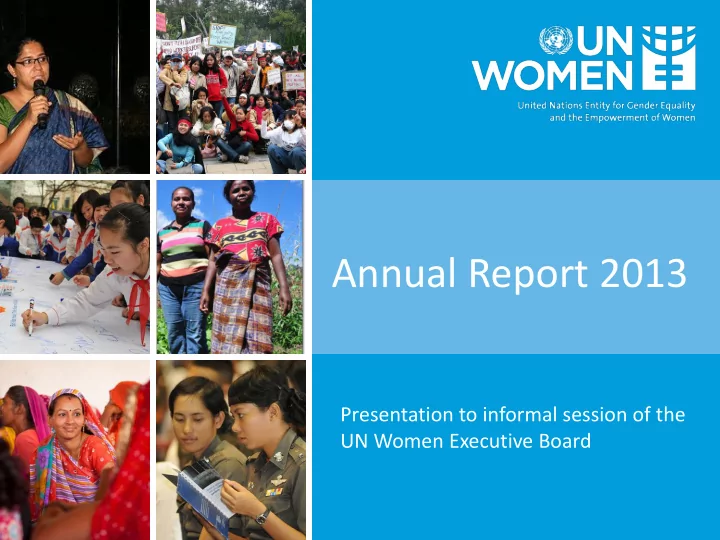
Annual Report 2013

Presentation to informal session of the UN Women Executive Board
slide-2
SLIDE 2

STRUCTURE

  • Starting with normative, coordination and cross-cutting areas.
  • Then moving to specific thematic areas.
  • Better captures link between different aspects of the mandate.
  • We have retained trajectory charts from last year + added

traffic light tables to summarize progress against MRF targets.

  • QCPR integrated through the report
slide-3
SLIDE 3
  • Context
  • UN Women’s normative role and how we work with the UN

system, our partnerships and advocacy, RBM and evaluation.

  • UN-Women’s results: SP priority areas 1-5
  • Organisational effectiveness and institution building: structural

reform + improvements in operations and business processes.

  • Income and expenditure

OUTLINE

slide-4
SLIDE 4
  • Reporting on the QCPR is integrated through the report.
  • The QCPR is central to the Entity’s approach to coordination and to

strengthening system-wide delivery on gender equality and women’s empowerment.

  • In 2013 UN-Women prioritized alignment between its new strategic plan,

2014-17 and the QCPR.

  • Throughout 2013, UN-Women contributed to timely follow-up to the

resolution through the UNDG and its various mechanisms. This included contributing to an action plan on QCPR implementation and contributing to the M&E framework.

  • From next year the Entity will report on the new Strategic Plan 2014-17

which is a fuller reflection of the integration of QCPR priorities into UN Women’s work.

QCPR

slide-5
SLIDE 5

COUNTRY COVERAGE

slide-6
SLIDE 6

Countries where UN-Women provided support: 2011-2013

slide-7
SLIDE 7

DEVELOPMENT RESULTS BY PRIORTY AREA

slide-8
SLIDE 8

Political Participation and Leadership

slide-9
SLIDE 9

Economic Empowerment

slide-10
SLIDE 10

Ending Violence against Women

slide-11
SLIDE 11

Women, Peace and Security

slide-12
SLIDE 12

National Planning and Budgeting

slide-13
SLIDE 13
  • Security Council resolution 2122 – strengthening language from

SCR 1325

  • 4 GA Resolutions on gender equality
  • ECOSOC ministerial declaration – Science, technology and

innovation for MDGs

  • 5th Tokyo International Conference on African Development –

gender equality

  • Open Working Group of the General Assembly on Sustainable

Development Goals

  • Declaration by the Peacebuilding Commission and Arms Trade

Treaty

Normative Frameworks

slide-14
SLIDE 14
  • UN System Wide Action Plan on Gender Equality and Women’s

Empowerment (SWAP)

  • Support to QCPR
  • Coordinated UN System support on gender to Rio+20, CSW, and

post-2015

  • Active participation in Delivering as One
  • Leadership/Participation in 91 UNCT Gender Theme Groups
  • Inter-Agency and Expert Group on Gender Statistics

UN Coordination

slide-15
SLIDE 15

SWAP

slide-16
SLIDE 16

MANAGEMENT RESULTS

slide-17
SLIDE 17
  • Strengthening the field: 6 MCOs, 6 Ros and 48 COs.
  • Recruitment of 14 new Representatives.
  • Full Delegation of authority issued to 38 offices.
  • IPSAS implementation
  • Improved guidance and oversight tools and processes

Organizational Effectiveness

slide-18
SLIDE 18
  • Key Challenge in 2013 and ahead
  • Funding targets missed
  • 11% increase in the number of donors compared to 2012
  • 18 governments increased their contributions
  • 1 new national committee (France)

Resource Mobilization

slide-19
SLIDE 19

Revenue and Expenses

slide-20
SLIDE 20

Expenses by geographic region

These figures are unaudited and subject to change.

slide-21
SLIDE 21

 Resources  Expectation are high, pressure for immediate

impact

 Ensuring there is no push-back on the

normative agenda

 Ensuring GEWE is robustly addressed in post-

2015 development agenda

Challenges

slide-22
SLIDE 22

 Our mandate and role make us uniquely

positioned to deliver for women

 Achieved a great deal in 2013  Will continue to build capacity and ability to

leverage normative and operation roles.

 Beijing+20 is an important opportunity to look

at achievements and challenges.

Conclusion