Announcements Thursday Extras: CS Commons on Thursdays @ 4:00 pm - - PowerPoint PPT Presentation

announcements thursday extras cs commons on thursdays 4
SMART_READER_LITE
LIVE PREVIEW

Announcements Thursday Extras: CS Commons on Thursdays @ 4:00 pm - - PowerPoint PPT Presentation

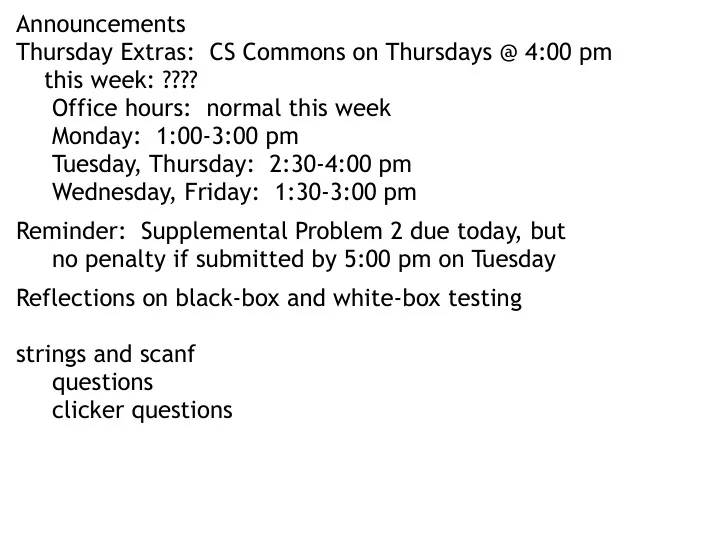
Announcements Thursday Extras: CS Commons on Thursdays @ 4:00 pm this week: ???? Office hours: normal this week Monday: 1:00-3:00 pm Tuesday, Thursday: 2:30-4:00 pm Wednesday, Friday: 1:30-3:00 pm Reminder: Supplemental Problem 2 due


slide-1
SLIDE 1

Announcements Thursday Extras: CS Commons on Thursdays @ 4:00 pm this week: ???? Office hours: normal this week Monday: 1:00-3:00 pm Tuesday, Thursday: 2:30-4:00 pm Wednesday, Friday: 1:30-3:00 pm Reminder: Supplemental Problem 2 due today, but no penalty if submitted by 5:00 pm on Tuesday Reflections on black-box and white-box testing strings and scanf questions clicker questions

slide-2
SLIDE 2

Clarifications about White-box and Black-box Testing Consider these statements:

  • 1. Black-box Testing only involves looking at the output given

for specific inputs.

  • 2. White-box Testing only involves looking at the output given

for specific inputs. Which, if any, of these statements is true?

  • A. Both 1 and 2
  • B. 1, not 2
  • C. 2, not 1
  • D. neither 1 nor 2
slide-3
SLIDE 3

Clarifications about White-box and Black-box Testing Consider the following program outline: Enter values If (condition 1) A else B if (condition 2) C else D if (condition 3) E else F Assume conditions 1, 2 and 3 are independent of each other Vote 1: What is the minimum number of test cases required for White-box testing?

  • A. 0-3
  • B. 4-6
  • C. 7-9
  • D. >= 10
  • E. cannot tell

Vote 2: What is the minimum for Black-box testing?

  • A. < 8
  • B. = 8
  • C. > 8
  • D. no way to know
slide-4
SLIDE 4

Consider the following program that reads 3 characters: #include <stdio.h> int main () { char a, b, c; scanf ("%c%c%c", &a, &b, &c); printf ("#%c#%c#%c#\n", a, b, c); return 0; } A user enters x y z (that is, the letters x, y, z, each separated by a space character; there is no space before the x or after z What is printed?

  • A. compile error
  • B. runtime error
  • C. #x#y#z#
  • D. #x# #z#
  • E. something else
slide-5
SLIDE 5

Consider the following program that reads 3 characters: #include <stdio.h> int main () { char a, b, c; scanf ("%c %c %c", &a, &b, &c); // spaces added before %c printf ("#%c#%c#%c#\n", a, b, c); return 0; } A user enters x y z (that is, the letters x, y, z, each separated by a space character; there is no space before the x or after z What is printed?

  • A. compile error
  • B. runtime error
  • C. #x#y#z#
  • D. #x# #z#
  • E. something else
slide-6
SLIDE 6

A code segment is to be written that will read a word (up to 10 characters) and print the result. The basic code progression is Declaration of str variable scanf ("%11s", str); printf ("the string is %s\n", str); Five declarations are proposed:

  • 1. char str[15];
  • 2. char * str;
  • 3. char word[15];

char * str = word

  • 4. char word[15];

char str [ ] = word;

  • 5. char str [15] = "my string"
  • 6. char * str = "my string"

The user wants to type the word Hello. When the code is compiled and run, either an error

  • ccurs or it runs fine:

6 Votes with these options:

  • A. compilation error
  • B. run-time error
  • C. runs fine

6 Votes: Vote 1: declaration 1 Vote 2: declaration 2 Vote 3: 2 lines from code 3 Vote 4: 2 lines from code 4 Vote 5: declaration 5 Vote 6: declaration 6

slide-7
SLIDE 7

A user is to type words on each of 2 lines. The program is to read the first word of each line, and ignore the rest of the input. Assume each word is no longer than 9 characters, and assume the following declarations: char str1 [10], str2 [10], bigstr[100], ch; Two approaches are proposed:

  • 1. scanf ("%9s", str1);

fgets (bigstr, 100, stdin); scanf ("%9s", str2);

  • 2. scanf ("%9s", str1);

while ((ch=getchar()) != '\n') ; scanf ("%9s", str2); Which, if any, of these approaches works?

  • A. Both 1 and 2
  • B. 1, not 2
  • C. 2, not 1
  • D. neither 1 nor 2
slide-8
SLIDE 8

As in the previous slide, a user is to type a word on each of 2

  • lines. Two more approaches are proposed:
  • 3. int i = 0;

do { str1[i] = getchar(); i++; } while (!isspace(str1[i])) str1[i] = 0; while ((ch=getchar()) != '\n') ; int i = 0; do { str2[i] = getchar(); i++; } while (!isspace)str2[i])) str2[i] = 0;

  • 4. int i = 0;

do { str1[i] = getchar(); i++; } while (!isspace(str1[i-1])) while ((ch=getchar()) != '\n') ; int i = 0; do { str2[i] = getchar(); i++; } while (!isspace)str2[i-1]))

  • A. Both 3 and 4
  • B. 3, not 4
  • C. 4, not 3
  • D. neither 3 nor 4
slide-9
SLIDE 9

Suppose input will contain a name in the first 40 characters of a line, followed by a number.

char line [101]; //leaving room for null character char name [41]; int number; Two approaches are proposed reading a line

  • 1. scanf ("%41s %d", name, &number);
  • 2. fgets (line, 101, stdin);

strncpy (name, line, 40); name[40] = 0; number = atoi (line+40); Which of these approaches works reliably?

  • A. Approaches 1 and 2
  • B. Approach 1, not 2
  • C. Approach 2, not 1
  • D. Neither 1 nor 2
slide-10
SLIDE 10

Suppose you want to read an integer at the start of one line, skip anything else on that line, and then read a double at the start of the next line. int one; double two; #define max 100 char line [max+1]; Two approaches are proposed:

  • 1. scanf ("%d", &one);

while (getchar () != '\n') ; scanf ("%lf", &two);

  • 2. fgets (line, max+1, stdin);
  • ne = atoi (line);

while (line[strlen(line)-1] != '\n') fgets (line, max+1, stdin); fgets (line, max+1, stdin); two = atof (line);

Which of these approaches works reliably?

  • A. Approaches 1 and 2
  • B. Approach 1, not 2
  • C. Approach 2, not 1
  • D. Neither 1 nor 2