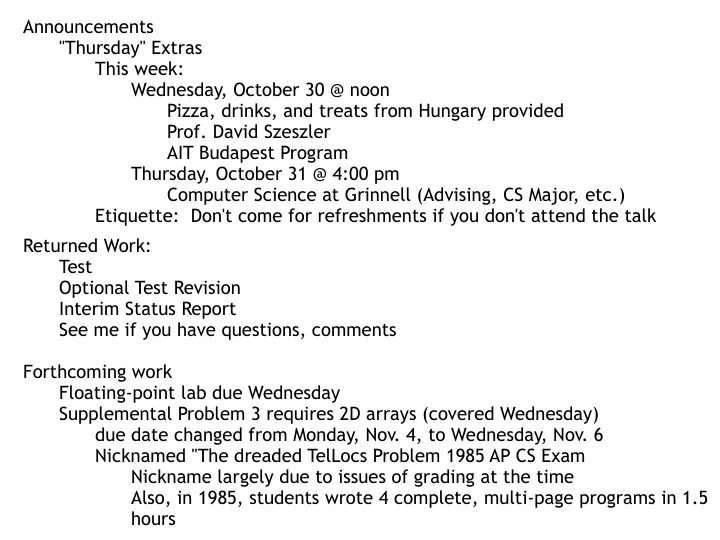
SLIDE 1 Announcements "Thursday" Extras This week: Wednesday, October 30 @ noon Pizza, drinks, and treats from Hungary provided
AIT Budapest Program Thursday, October 31 @ 4:00 pm Computer Science at Grinnell (Advising, CS Major, etc.) Etiquette: Don't come for refreshments if you don't attend the talk Returned Work: Test Optional Test Revision Interim Status Report See me if you have questions, comments Forthcoming work Floating-point lab due Wednesday Supplemental Problem 3 requires 2D arrays (covered Wednesday) due date changed from Monday, Nov. 4, to Wednesday, Nov. 6 Nicknamed "The dreaded TelLocs Problem 1985 AP CS Exam Nickname largely due to issues of grading at the time Also, in 1985, students wrote 4 complete, multi-page programs in 1.5 hours
SLIDE 2
Follow-up on strings questions clicker questions Structs: new topic can look quite different from what you have seen in the past some adjustment likely, "new" not "hard" new syntax introduced the next several classes be sure to work through each lab tendency for students to be overwhelmed for awhile, so take time to work through each step! will take time to develop comfort level questions clicker questions
SLIDE 3 Given two declared strings: char str1 [10] = "Hello"; char str2 [10] = "Hello"; char str3 [15] = "Hello"; What is printed by if (str1 == str2) printf "yes12\n"; else printf "no12\n"; if (str1 == str3) printf "yes13\n"; else printf "no13\n"; if (str2 == str3) printf "yes23\n"; else printf "no23\n";
yes13 yes23
no13 no23
yes13 no23
no13 no23
SLIDE 4 Given three declared strings: char str1 [10] = "Hello"; char str2 [10] = {'H','e','l','l','o','\0','f','o','u','r'}; char str3 [15] = "Hello"; What is printed by if (strcmp(str1, str2) == 0) printf "yes12\n"; else printf "no12\n"; if (strcmp (str1, str3) == 0) printf "yes13\n"; else printf "no13\n"; if (strcmp (str2, str3) == 0) printf "yes23\n"; else printf "no23\n";
yes13 yes23
no13 no23
yes13 no23
no13 no23
SLIDE 5
#include <stdio.h> //line 1 typedef struct { //line 2 int x; //line 3 int y; //line 4 } point; //line 5 void set(point p) { //line 7 p.x = 5; //line 8 p.y = 6; //line 9 } int main() { //line 12 point a = {1,2}; //line 13 set(a); //line 14 printf("a:(%d,%d)\n", a.x, a.y); //line 15 return 0; } What happens when trying to compile and run? 1. (1,2) printed 2. (5,6) printed 3. Compiler error, lines 7-9 4. Compiler error, lines 12-15 5. none of the above
SLIDE 6
#include <stdio.h> typedef struct { int x; //line 3 int y; //line 4 } point; //line 5 void set(point * p) { //line 7 (*p).x = 5; //line 8 (*p).y = 6; //line 9 } int main() { point a = {1,2}; //line 13 set(&a); //line 14 printf("a:(%d,%d)\n", a.x, a.y); //line 15 return 0; } What happens when trying to compile and run? 1. (1,2) printed 2. (5,6) printed 3. Compiler error, lines 7-9 4. Compiler error, lines 12-15 5. none of the above
SLIDE 7 #include <stdio.h> 1 typedef struct { 2 int x; 3 int y; 4 } point; 5 6 int main() { 7 point p1 = {3,4}; 8 point p2 = {3,4}; 9 10 if (p1==p2) 11 printf("Overlap"); 12 else 13 printf("Distinct"); 14 return 0; 15 }
What is printed by this program?
- A. Overlap
- B. Distinct
- C. Compiler error, line 1
- D. Compiler error, lines
7&8
- E. Compiler error, line 10