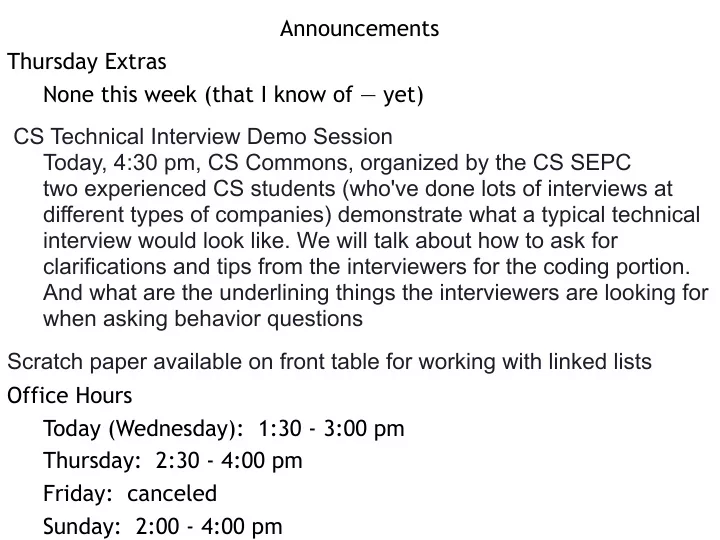
Announcements Thursday Extras None this week (that I know of yet) - - PowerPoint PPT Presentation

announcements thursday extras none this week that i know
SMART_READER_LITE
LIVE PREVIEW

Announcements Thursday Extras None this week (that I know of yet) - - PowerPoint PPT Presentation

Announcements Thursday Extras None this week (that I know of yet) CS Technical Interview Demo Session Today, 4:30 pm, CS Commons, organized by the CS SEPC two experienced CS students (who've done lots of interviews at different types of


slide-1
SLIDE 1

Announcements Thursday Extras None this week (that I know of — yet) CS Technical Interview Demo Session Today, 4:30 pm, CS Commons, organized by the CS SEPC two experienced CS students (who've done lots of interviews at different types of companies) demonstrate what a typical technical interview would look like. We will talk about how to ask for clarifications and tips from the interviewers for the coding portion. And what are the underlining things the interviewers are looking for when asking behavior questions Scratch paper available on front table for working with linked lists Office Hours Today (Wednesday): 1:30 - 3:00 pm Thursday: 2:30 - 4:00 pm Friday: canceled Sunday: 2:00 - 4:00 pm

slide-2
SLIDE 2

More practice with Linked Lists

  • Today: don't change list structure
  • Friday: insert and/or delete nodes
  • Questions
  • Utilize lab code as templates/patterns for lab

exercises

  • Clicker questions

Lab partner change today

  • 2 to 1 margin in vote results!
slide-3
SLIDE 3

What is printed by the following code, assuming D designates the null list: struct node * ptr = D; printf ("( "); while (ptr != NULL) { printf (" %d", ptr->data); ptr = (*ptr).next; } printf (" )\n");

  • A. ( )
  • B. (

)

  • C. compile

error

  • D. possible run-time error
  • E. something else
slide-4
SLIDE 4

B 2 7 1 8 2 8 Assume B in main points to the first node in the following list: int proc (struct node * ptr) { int value = 0; while (ptr != NULL) { value += (*ptr).data); ptr = ptr->next); } return value; } What happens when main calls proc (B)

  • A. 20 returned
  • B. 26 returned
  • C. 28 returned
  • D. 28 printed
  • E. something else
slide-5
SLIDE 5

B 2 7 1 8 2 8 Assume B in main points to the first node in the following list: int proc (struct node * ptr) { int value = 0; while ((*ptr).next != NULL) { value += (*ptr).data); ptr = ptr->next; } return value; } What happens when main calls proc (B)

  • A. 20 returned
  • B. 28 returned
  • C. 20 printed
  • D. 28 printed
  • E. something else
slide-6
SLIDE 6

B 2 7 1 8 2 8 Assume B in main points to the first node in the following list: int proc (struct node * ptr) { int value = 0; if ((*ptr).next != NULL) { value += (*ptr).data); proc (ptr->next); } return value; } What happens when main calls proc (B)

  • A. 20 returned
  • B. 26 returned
  • C. 28 returned
  • D. 28 printed
  • E. something else
slide-7
SLIDE 7

B 2 7 1 8 2 8 Assume B in main points to the first node in the following list: void proc (struct node * ptr) if (ptr != NULL) { proc (ptr->next); printf (" %d", ptr->data); } } What happens when main calls proc (B)

  • A. 2 printed
  • B. 2 7 1 8 2 8 printed
  • C. 8 2 8 1 7 2 printed
  • D. 8 printed
  • E. something else
slide-8
SLIDE 8

B 2 7 1 8 2 8 Assume B in main points to the first node in the following list: void proc (struct node * ptr) if (ptr != NULL) { printf (" %d", ptr->data); proc (ptr->next); } } What happens when main calls proc (B)

  • A. 2 printed
  • B. 2 7 1 8 2 8 printed
  • C. 8 2 8 1 7 2 printed
  • D. 8 printed
  • E. something else