Announcements Reminder: A1 due this Friday Texture Tues, Sept 15 - - PDF document

announcements
SMART_READER_LITE
LIVE PREVIEW

Announcements Reminder: A1 due this Friday Texture Tues, Sept 15 - - PDF document

9/14/2015 Announcements Reminder: A1 due this Friday Texture Tues, Sept 15 Kristen Grauman UT Austin Review Today: Texture Edge detection: Filter for gradient Threshold gradient magnitude, thin Chamfer matching to compare


slide-1
SLIDE 1

9/14/2015 1

Texture

Tues, Sept 15 Kristen Grauman UT Austin

Announcements

  • Reminder: A1 due this Friday

Review

  • Edge detection:

– Filter for gradient – Threshold gradient magnitude, thin

  • Chamfer matching to compare shapes (in terms
  • f edge points)
  • Binary image analysis

– Thresholding – Morphological operators to “clean up” – Connected components to find regions

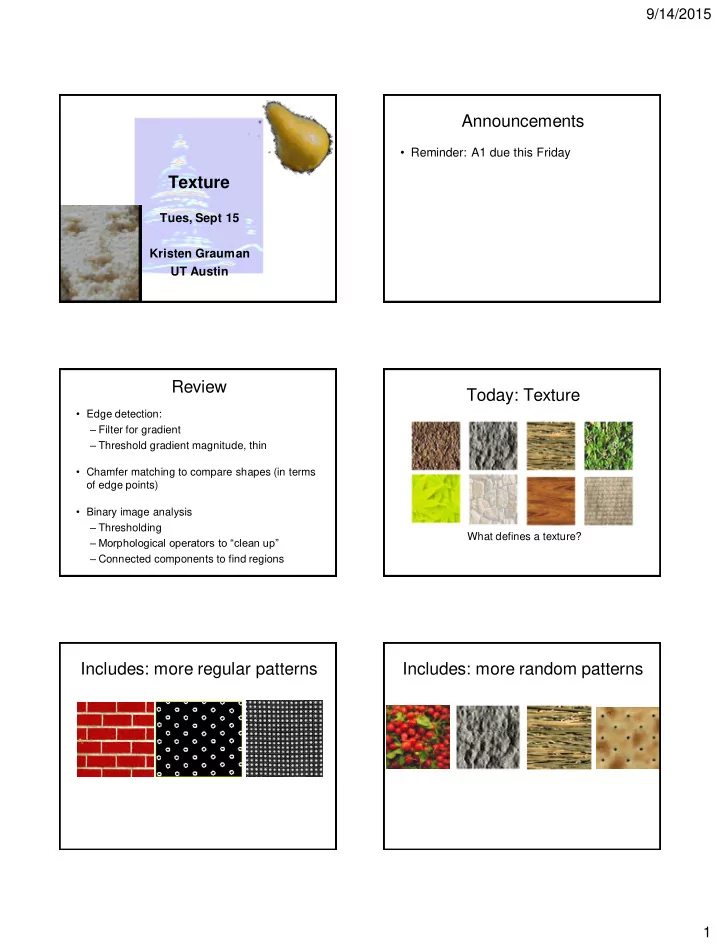
Today: Texture

What defines a texture?

Includes: more regular patterns Includes: more random patterns

slide-2
SLIDE 2

9/14/2015 2

Scale and texture Texture-related tasks

  • Shape from texture

– Estimate surface orientation or shape from image texture

Shape from texture

  • Use deformation of texture from point to point to

estimate surface shape

Pics from A. Loh: http://www.csse.uwa.edu.au/~angie/phdpics1.html

Texture-related tasks

  • Shape from texture

– Estimate surface orientation or shape from image texture

  • Segmentation/classification from texture cues

– Analyze, represent texture – Group image regions with consistent texture

  • Synthesis

– Generate new texture patches/images given some examples

Analysis vs. Synthesis

Images:Bill Freeman, A. Efros

Why analyze texture?

slide-3
SLIDE 3

9/14/2015 3

http://animals.nationalgeographic.com/

What kind of response will we get with an edge detector for these images?

Images from Malik and Perona, 1990

…and for this image?

Image credit: D. Forsyth

Why analyze texture?

Importance to perception:

  • Often indicative of a material’s properties
  • Can be important appearance cue, especially if

shape is similar across objects

  • Aim to distinguish between shape, boundaries,

and texture Technically:

  • Representation-wise, we want a feature one

step above “building blocks” of filters, edges.

Psychophysics of texture

  • Some textures distinguishable with preattentive

perception– without scrutiny, eye movements [Julesz 1975] Same or different?

slide-4
SLIDE 4

9/14/2015 4 Capturing the local patterns with image measurements

[Bergen & Adelson, Nature 1988] Scale of patterns influences discriminability Size-tuned linear filters

Texture representation

  • Textures are made up of repeated local

patterns, so:

– Find the patterns

  • Use filters that look like patterns (spots, bars, raw

patches…)

  • Consider magnitude of response

– Describe their statistics within each local window, e.g.,

  • Mean, standard deviation
  • Histogram
  • Histogram of “prototypical” feature occurrences

Texture representation: example

  • riginal image

derivative filter responses, squared statistics to summarize patterns in small windows mean d/dx value mean d/dy value

  • Win. #1

4 10

slide-5
SLIDE 5

9/14/2015 5

Texture representation: example

  • riginal image

derivative filter responses, squared statistics to summarize patterns in small windows mean d/dx value mean d/dy value

  • Win. #1

4 10 Win.#2 18 7

Texture representation: example

  • riginal image

derivative filter responses, squared statistics to summarize patterns in small windows mean d/dx value mean d/dy value

  • Win. #1

4 10 Win.#2 18 7

Texture representation: example

  • riginal image

derivative filter responses, squared statistics to summarize patterns in small windows mean d/dx value mean d/dy value

  • Win. #1

4 10 Win.#2 18 7 Win.#9 20 20

Texture representation: example

statistics to summarize patterns in small windows mean d/dx value mean d/dy value

  • Win. #1

4 10 Win.#2 18 7 Win.#9 20 20

… Dimension 1 (mean d/dx value) Dimension 2 (mean d/dy value)

Texture representation: example

statistics to summarize patterns in small windows mean d/dx value mean d/dy value

  • Win. #1

4 10 Win.#2 18 7 Win.#9 20 20

… Dimension 1 (mean d/dx value) Dimension 2 (mean d/dy value) Windows with small gradient in both directions Windows with primarily vertical edges Windows with primarily horizontal edges Both

Texture representation: example

  • riginal image

derivative filter responses, squared visualization of the assignment to texture “types”
slide-6
SLIDE 6

9/14/2015 6

Texture representation: example

statistics to summarize patterns in small windows mean d/dx value mean d/dy value

  • Win. #1

4 10 Win.#2 18 7 Win.#9 20 20

… Dimension 1 (mean d/dx value) Dimension 2 (mean d/dy value) Far: dissimilar textures Close: similar textures

Texture representation: example

Dimension 1 Dimension 2

a b 

     

2 1 2 2 2 2 2 1 1

) ( ) , ( ) ( ) ( ) , (

i i i

b a b a D b a b a b a D

Texture representation: example

Dimension 1 Dimension 2

a b a b

Distance reveals how dissimilar texture from window a is from texture in window b.

b Texture representation: window scale

  • We’re assuming we know the relevant window

size for which we collect these statistics. Possible to perform scale selection by looking for window scale where texture description not changing.

Filter banks

  • Our previous example used two filters, and

resulted in a 2-dimensional feature vector to describe texture in a window.

– x and y derivatives revealed something about local structure.

  • We can generalize to apply a collection of

multiple (d) filters: a “filter bank”

  • Then our feature vectors will be d-dimensional.

– still can think of nearness, farness in feature space

Filter banks

  • What filters to put in the bank?

– Typically we want a combination of scales and orientations, different types of patterns.

Matlab code available for these examples: http://www.robots.ox.ac.uk/~vgg/research/texclass/filters.html

scales

  • rientations

“Edges” “Bars” “Spots”

slide-7
SLIDE 7

9/14/2015 7

Multivariate Gaussian

        9 9         9 16         5 5 5 10

Filter bank

Image from http://w w w.texasexplorer.com/austincap2.jpg

Showing magnitude of responses

slide-8
SLIDE 8

9/14/2015 8

slide-9
SLIDE 9

9/14/2015 9

slide-10
SLIDE 10

9/14/2015 10

You try: Can you match the texture to the response?

Mean abs responses Filters A B C 1 2 3 Derek Hoiem

Representing texture by mean abs response

Mean abs responses Filters Derek Hoiem

slide-11
SLIDE 11

9/14/2015 11

[r1, r2, …, r38] We can form a feature vector from the list of responses at each pixel.

d-dimensional features

. . .

2d 3d

 

d i i i

b a b a D

1 2

) ( ) , (

Euclidean distance (L2)

Example uses of texture in vision: analysis Classifying materials, “stuff”

Figure by Varma & Zisserman

Texture features for image retrieval

Y . Rubner, C. Tomasi, and L. J. Guibas. The earth mover's distance as a metric for image retrieval. International Journal of Computer Vision, 40(2):99-121, November 2000,

Characterizing scene categories by texture

  • L. W. Renninger and
  • J. Malik. When is

scene identification just texture recognition? Vision Research 44 (2004) 2301–2311

slide-12
SLIDE 12

9/14/2015 12

http://www.airventure.org/2004/gallery/images/073104_satellite.jpg

Segmenting aerial imagery by textures

Texture-related tasks

  • Shape from texture

– Estimate surface orientation or shape from image texture

  • Segmentation/classification from texture cues

– Analyze, represent texture – Group image regions with consistent texture

  • Synthesis

– Generate new texture patches/images given some examples

Texture synthesis

  • Goal: create new samples of a given texture
  • Many applications: virtual environments, hole-

filling, texturing surfaces

The Challenge

  • Need to model the whole

spectrum: from repeated to stochastic texture

repeated stochastic Both?

Alexei A. Efros and Thomas K. Leung, “T exture Synthesis by Non-parametric Sampling,” Proc. International Conference on Computer Vision (ICCV), 1999.

Markov Chains

Markov Chain

  • a sequence of random variables
  • is the state of the model at time t
  • Markov assumption: each state is dependent only on the

previous one

– dependency given by a conditional probability:

  • The above is actually a first-order Markov chain
  • An N’th-order Markov chain:

Source S. Seitz

Markov Chain Example: Text

“A dog is a man’s best friend. It’s a dog eat dog world out there.”

2/3 1/3 1/3 1/3 1/3 1 1 1 1 1 1 1 1 1 1 a dog is man’s best friend it’s eat world

  • ut

there dog is man’s best friend it’s eat world

  • ut

there a . .

Source: S. Seitz

slide-13
SLIDE 13

9/14/2015 13

Text synthesis

Create plausible looking poetry, love letters, term papers, etc.

Most basic algorithm

  • 1. Build probability histogram

– find all blocks of N consecutive words/letters in training documents – compute probability of occurrence

  • 2. Given words

– compute by sampling from

Source: S. Seitz

WE NEED TO EAT CAKE

Text synthesis

  • Results:

– “As I've commented before, really relating to someone involves standing next to impossible.” – "One morning I shot an elephant in my arms and kissed him.” – "I spent an interesting evening recently with a grain of salt"

Dewdney, “A potpourri of programmed prose and prosody” Scientific American, 1989.

Slide from Alyosha Efros, ICCV 1999

Synthesizing Computer Vision text

  • What do we get if we

extract the probabilities from a chapter on Linear Filters, and then synthesize new statements?

Check out Yisong Yue’s website implementing text generation: build your own text Markov Chain for a given text corpus. http://www.yisongyue.com/shaney/

Synthesized text

  • This means we cannot obtain a separate copy of the

best studied regions in the sum.

  • All this activity will result in the primate visual system.
  • The response is also Gaussian, and hence isn’t

bandlimited.

  • Instead, we need to know only its response to any data

vector, we need to apply a low pass filter that strongly reduces the content of the Fourier transform of a very large standard deviation.

  • It is clear how this integral exist (it is sufficient for all

pixels within a 2k +1 × 2k +1 × 2k +1 × 2k + 1 — required for the images separately.

Synthesized UTCS code of conduct

  • You should be on the day your assignment is

due.

  • Remember that the work available to the

bookstore, buy books, read them, and write some code without ever signing up for a class.

  • In this document, a group of the grade will go

down rather than up.

  • To make this process work, you have made prior

arrangements with the instructor.

  • But remember that the instructor responded to

such issues.

Synthesized UTCS code of conduct

  • For example, don’t write to your instructor.
  • For example, don’t write to your instructor.
  • But, whenever you do in the field.
  • Classes that use different exams each semester

may have very different score distributions from

  • ne semester to the day your assignment is due.
  • (It’s on the class to file a complaint about the

grading of your work, you have the right to expect your instructor has read a lot of problems, and then chosen, from all of that material, 14 weeks of the one week from the time of preregistration.

slide-14
SLIDE 14

9/14/2015 14

Markov Random Field

A Markov random field (MRF)

  • generalization of Markov chains to two or more dimensions.

First-order MRF:

  • probability that pixel X takes a certain value given the values
  • f neighbors A, B, C, and D:

D C X A B

Source: S. Seitz

Texture Synthesis [Efros & Leung, ICCV 99]

Can apply 2D version of text synthesis

Texture corpus (sample) Output

Texture synthesis: intuition

Before, we inserted the next word based on existing nearby words… Now we want to insert pixel intensities based

  • n existing nearby pixel values.

Sample of the texture (“corpus”) Place we want to insert next

Distribution of a value of a pixel is conditioned

  • n its neighbors alone.

Synthesizing One Pixel

  • What is ?
  • Find all the windows in the image that match the neighborhood
  • To synthesize x

– pick one matching window at random – assign x to be the center pixel of that window

  • An exact neighbourhood match might not be present, so find the

best matches using SSD error and randomly choose between them, preferring better matches with higher probability

p

input image synthesized image

Slide from Alyosha Efros, ICCV 1999

Neighborhood Window

input

Slide from Alyosha Efros, ICCV 1999

Varying Window Size

Increasing window size

Slide from Alyosha Efros, ICCV 1999

slide-15
SLIDE 15

9/14/2015 15

Growing Texture

  • Starting from the initial image, “grow” the texture one pixel at a time

Slide from Alyosha Efros, ICCV 1999

Synthesis results

french canvas rafia weave

Slide from Alyosha Efros, ICCV 1999

white bread brick wall

Synthesis results

Slide from Alyosha Efros, ICCV 1999

Synthesis results

Slide from Alyosha Efros, ICCV 1999

Failure Cases

Growing garbage Verbatim copying

Slide from Alyosha Efros, ICCV 1999

Hole Filling

Slide from Alyosha Efros, ICCV 1999

slide-16
SLIDE 16

9/14/2015 16

Extrapolation

Slide from Alyosha Efros, ICCV 1999

  • The Efros & Leung algorithm

– Simple – Surprisingly good results – Synthesis is easier than analysis! – …but very slow p

Image Quilting [Efros & Freeman 2001]

  • Observation: neighbor pixels are highly correlated

Input image non-parametric sampling

B Idea: unit of synthesis = block

  • Exactly the same but now we want P(B|N(B))
  • Much faster: synthesize all pixels in a block at once

Synthesizing a block

Slide from Alyosha Efros, ICCV 1999

Input texture

B1 B2

Random placement

  • f blocks

block

B1 B2

Neighboring blocks constrained by overlap

B1 B2

Minimal error boundary cut

  • min. error boundary

Minimal error boundary

  • verlapping blocks

vertical boundary

_

=

2

  • verlap error

Slide from Alyosha Efros

slide-17
SLIDE 17

9/14/2015 17

Failures

(Chernobyl Harvest)

slide-18
SLIDE 18

9/14/2015 18

Texture Transfer

  • Take the texture from one
  • bject and “paint” it onto

another object

– This requires separating texture and shape – That’s HARD, but we can cheat – Assume we can capture shape by boundary and rough shading

  • Then, just add another constraint when sampling:

similarity to underlying image at that spot

+ = + =

parmesan rice

+ = = +

(Manual) texture synthesis in the media (Manual) texture synthesis in the media

slide-19
SLIDE 19

9/14/2015 19

http://www.dailykos.com/story/2004/10/27/22442/878

  • A. Zalesny et al., Realistic Textures for Virtual Anastylosis

Synthesizing textures when constructing 3d models

  • f archaeological sites

Summary

  • Texture is a useful property that is often

indicative of materials, appearance cues

  • Texture representations attempt to summarize

repeating patterns of local structure

  • Filter banks useful to measure redundant

variety of structures in local neighborhood

– Feature spaces can be multi-dimensional

  • Neighborhood statistics can be exploited to

“sample” or synthesize new texture regions

– Example-based technique

So far: features and filters

Transforming and describing images; textures, colors, edges