Aneutronic Fusion The most efficient and ecologically safest energy - - PowerPoint PPT Presentation

aneutronic fusion
SMART_READER_LITE
LIVE PREVIEW

Aneutronic Fusion The most efficient and ecologically safest energy - - PowerPoint PPT Presentation

Aneutronic Fusion The most efficient and ecologically safest energy source 1p + 11B 3*4He + 8.7 MeV Michael Esuabana Agenda Why Aneutronic Theory LPP TriAlpha Polywell Space propulsion Why Aneutronic Fission reactor


slide-1
SLIDE 1

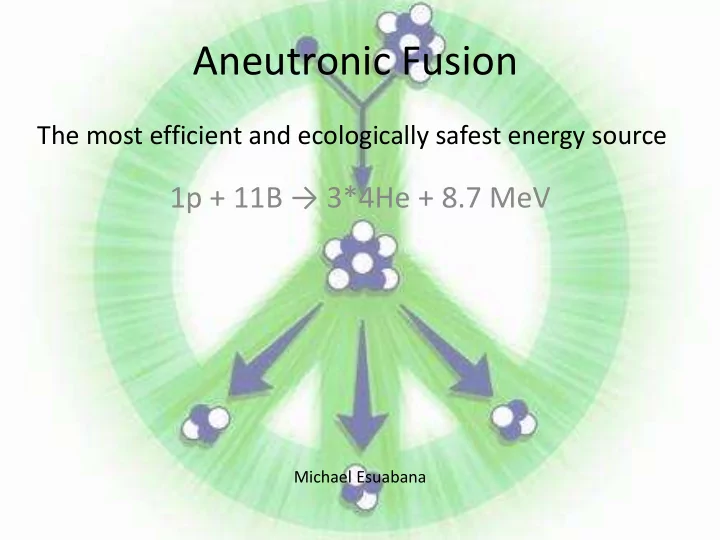
Aneutronic Fusion

1p + 11B → 3*4He + 8.7 MeV

The most efficient and ecologically safest energy source

Michael Esuabana
slide-2
SLIDE 2

Agenda

  • Why Aneutronic
  • Theory
  • LPP
  • TriAlpha
  • Polywell
  • Space propulsion
slide-3
SLIDE 3

Why Aneutronic

Fission reactor 1M x more efficient than coal but!

  • Expensive (Mining, Turbine, Cleanup/Storing)
  • Large amount of Highly Radioactive byproducts
  • Proliferation (Thorium doesn’t help either U232)

D-T Fusion reactors Tokamak /(Laser not shown)

  • 3-4 times more efficient than a Fission reactor
  • Produces high number of Neutrons
  • Still requires expensive Turbine system.
  • Storing problem, irradiated from Neutrons.

ITER Pros

  • Lower temperature to ignite 400MK
  • Higher Cross section
slide-4
SLIDE 4

Proton + 11Boron Fusion Pros

  • Has no Neutron emission < 1%,

just Helium Ions.

  • Energy can be directly converted

without Turbine

  • No Storage worry
  • Still 10:1 input output ratio as D-T

fusion reaction.

  • Cheaper

Cons

  • Higher Temperature required to

fuse 1.6BK

  • Lower cross section than D-T

He3 is scarce on earth, must mine in space(moon) Li7 has no advantages to B11, and has lower cross section!

slide-5
SLIDE 5

Theory

  • Emittied n is < 1% of total

energy emitted from fusion.

  • Q value is 3.07 MeV amount
  • f energy released from

decay C12

  • P colliding Boron11 A=11 Z=5

produces radioactive ion C12 A=12 Z=6.

  • C12’s half life 20 minutes,

decays into stable He4 ions.

  • With boron at rest, proton

needs large velocity to fuse. Resonance at 675 keV has large cross section 0.9 barn.

  • Low energy and High cross

section ideal for Fusion.

  • Direct conversion to

electricity can be obtained from 8.7 MeV of 3 α part

  • No γ rays, no neutrons. Ideal for

everday use around populace.

  • Z=6 is large state of electric charge,

easy to convert directly into

  • electricity. By cyclotron or reverse

linear accelerator.

  • Can recover energy 13 times larger

for every 675 keV used 8.7 MeV is produced.

slide-6
SLIDE 6

B11 as stationary source is impractical

  • With 10^18 events, on average the proton must

travel 8cm.

  • Proton loses all of its energy traveling 10 microns in

the target

  • Loss from ionization and excitation of atoms in the

target.

  • Too many electrons on the way before proton can

hit nucleus of Boron Method colliding beams is promising

  • Don’t have to overcome electric force in order

fuse them

  • Two beams with same velocity Tp=56 keV, Tb =

619 keV

  • Tp+Tb=657keV < W
  • W = 8.7 MeV, the reaction from fusing the proton

with B11 ion. C12 is in the realm of fusion, not much higher from He4. Fe56 is like an ash for fusion, (equal energy to fuse or to split) Above Fe only fission releases energy.

slide-7
SLIDE 7

LPP

Natrual Instabilities of fusion to capture energy Cost effective $.08 - $.2/W to generate. Can sell for $.3/W vs $.6/W of today conventional energy cost. Successfully raise ion temperature to 1.8 BK Confinement 20 ns so far Density required is not achieved, any where near Must increase by the order of 10,000 for it to be feasible. Middlesex NJ LPPFusion Company

slide-8
SLIDE 8

LPP

DPF = Dense Plasma focus

  • Charged bank of electric capacitors switch to

anode

  • Rising electric current flows across the

insulator axisymmetrically

  • The plasma rise from surface of insulator

axisymmetrically because of interaction of current with its own magnetic field accelerating axially.

  • Releases ions and Xray

The beam (B11 ions) from the opposite smashes into the plasma to induce fusion.

slide-9
SLIDE 9

TriAlpha

Tri Alpha Energy, Inc Private company(stealth company for 17 years with no website) Foothill ranch, Lake Forest, California

slide-10
SLIDE 10

TriAlpha

Divertors shoot plasmoids toward each other where they collide inside the confinement. Uses magnetic topology of plasma rather than containing it. More stable than tokamak reactors. Colliding beams create FRC a field reversed configuration where a toroidal cylindrical current is induced inside a cylendrical plasma Not shown, beams at angle then further stabilize the plasma. Uses inverse cyclotron converter ICC for direct fusion to electric power. 100MW potential (Truck sized)

slide-11
SLIDE 11

PolyWell

  • Uses for four magrids to contain the plasma inside.
  • 2 Tesla is produced by each donut
  • Red is ions and turquoise beam is an electron, they

converge to produce most stable arrangement

  • Without electrons you get leakage through magrids’

gaps

  • The power out put of polywell is proportional to R^7

where R is the radius of the magrid.

  • Optimum radius to achieve self sufficiency is 1.5

meters. At 60% efficiency a 3 meter radius polywell, will supply 7.68GW Meaning around a little more than 840 of these reactors to power all of the earth electricity usage 12.9TW

slide-12
SLIDE 12

PolyWell

  • The negative cloud creates a well, hence the name PolyWell.
  • Electron cloud Attracts protons and B11 ions, accelerating them in the process

helping the fusion process

  • The well has 50000 volt potential of incoming ions p and B. The outgoing α have

2.46MeV

  • Spherical metal shell +1.22 million volt will slow the α, this will push electrons

through cable connected to the shell.

slide-13
SLIDE 13

Space Propulsion

P-B11 fusion engine makes movie instastellar spaceships possible. Or Star Wars X-Wing or 2001 Space oddessey Pan-Am space plane.

slide-14
SLIDE 14

Space Propulsion

  • Fusion of 2 tsp of Boron makes enough

energy to send an F-16 to the moon

  • Can achieve speed up to 116 320.687 miles

per hour

  • Which will take 49.7545068 days to go to

Mars with 5332 s of Maximum specific impulse.

  • Higher specific impulse means lower amount
  • f propellant used to achieve certain

momentum.

  • Less exposure to the dangers of space
  • Outposts and space stations can be powered

similarly

slide-15
SLIDE 15

Milka

Successfully fused proton with Boron11 using laser Fusion techniques. (short lived plasma) Still not viable for commercial productions Success means that it is no longer a theory but a reality That is coming to us in the near future.

slide-16
SLIDE 16

References

  • Polywell Nuclear fusion
  • http://www.polywellnuclearfusion.com/NuclearFusion/PolywellReactor2.html
  • Nuclear Fusion with Borons
  • http://www.osti.gov/scitech/servlets/purl/6911764
  • Focus fusion
  • http://fire.pppl.gov/FPA13_Lerner_plasma_focus.pdf
  • Why does iron kill stars
  • http://www.askamathematician.com/2013/11/q-why-does-iron-kill-stars/
  • Aneutronic fusion
  • https://en.wikipedia.org/wiki/Aneutronic_fusion
  • Tri Alpha Energy inc
  • https://en.wikipedia.org/wiki/Tri_Alpha_Energy,_Inc.
  • Plasma physics: the fusion upstarts
  • http://www.nature.com/news/plasma-physics-the-fusion-upstarts-1.15592
  • Nuclear fission and Fusion
  • http://www.diffen.com/difference/Nuclear_Fission_vs_Nuclear_Fusion
  • Nuclear efficacy Oil and Gas
  • http://www.greenworldinvestor.com/2011/07/07/nuclear-energy-efficiency-vs-fossil-fuels-oilgas-in-power-load-

factorsenergy-density-and-waste/

  • Tri Alpha energy
  • http://phys.org/news/2015-08-tri-alpha-energy-reportedly-important.html
  • Aneutronic spacecraft architecture
  • http://www.nasa.gov/pdf/716081main_Tarditi_2011_PhI_Aneutronic_Fusion.pdf
  • George H Miley Presentation on Nuclear Fusion Rockets and Spaceplanes
  • http://nextbigfuture.com/2010/03/george-h-miley-presentation-on-nuclear.html
  • Record proton boron fusion achieved
  • http://www.fusenet.eu/node/575