and the VSC During Patient Encounters B. J. Harman, M.S., D.C., - - PowerPoint PPT Presentation

and the vsc during patient encounters
SMART_READER_LITE
LIVE PREVIEW

and the VSC During Patient Encounters B. J. Harman, M.S., D.C., - - PowerPoint PPT Presentation

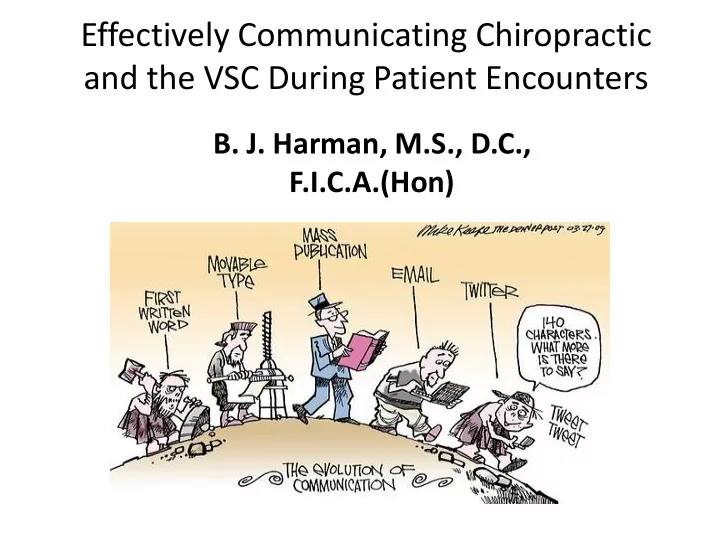
Effectively Communicating Chiropractic and the VSC During Patient Encounters B. J. Harman, M.S., D.C., F.I.C.A.(Hon) Your Lifes Work Find something that you love to do and you will never have to work a day in your life.


slide-1
SLIDE 1

Effectively Communicating Chiropractic and the VSC During Patient Encounters

  • B. J. Harman, M.S., D.C.,

F.I.C.A.(Hon)

slide-2
SLIDE 2

Your Life’s Work

  • “Find something that you love

to do and you will never have to work a day in your life.”

slide-3
SLIDE 3

Background

  • B.S., Lehman College, History, NY, 1974
  • D.C., Life Chiropractic College, 1980
  • M.S., Georgia State University, 1998

– Human Resource Development/Educational Psychology

  • Associate Director, Pasterski Clinic, 1980-1991
  • Assistant Professor, Life University, 1991-2000

– Administrator

  • Director of Post-Graduate Education
  • Department Head, Chiropractic Technique

– Taught

  • Spinal Anatomy
  • Toggle Technique
  • Pediatric technique
  • Philosophy
  • Muscle Testing
  • Clinic Faculty
  • Co-Founder and C.F.O., Now You Know Inc., August 1998-December 2013
  • Assistant Professor, Life University teaching 7 different classes, 2013-present.
  • CHPM 1501, 1502, 1503, 2606
  • ANAT 1507 labs, ANAT 1607
  • CLIN 3601
slide-4
SLIDE 4

My Motivation

slide-5
SLIDE 5

My Mission

  • Educate
  • Enlighten
  • Entertain
  • Enhance
  • Engage
  • Enrich.
slide-6
SLIDE 6

Joseph Priestley (1733-1804) Scholar and teacher, credited with the discovery of

  • xygen in its gaseous state.

“The more elaborate our means of communication, the less we communicate”.

slide-7
SLIDE 7

Changes in the Way We Communicate

  • Messengers in the Old Greek and Roman Times. Ex of

Pheidippides

  • Carrier Pigeons
  • Pony Express
  • Telegraph
  • Railroads
  • Long Distance via Telephone
  • Air Travel
  • Cables and Telexes
  • Fax machines
  • The Internet technology explosion of PC’s, IM’s, Cell Phones,

Ipads, Emails, Websites, Social Media, Good or Bad?

  • What’s Next???????????
slide-8
SLIDE 8

Update for the New Millennium

That’s not what Daddy told me!

  • Daddy, how was I born?

A little boy goes to his father and asks 'Daddy, how was I born?' The father answers, 'Well, son, I guess one day you will need to find out anyway! Your Mom and I first got together in a chat room on Yahoo. Then I set up a date via e-mail with your Mom and we met at a cyber-cafe. We sneaked into a secluded room, and googled each other. There your mother agreed to a download from my hard drive. As soon as I was ready to upload, we discovered that neither one of us had used a firewall, and since it was too late to hit the delete button, nine months later a little Pop-Up appeared that said:

  • You’ve got male!!!!!
slide-9
SLIDE 9

Try Talking to One Another!

slide-10
SLIDE 10

Why is Communication Important in Chiropractic?

  • Educate, naturally!
  • Get the message out
  • Define the conversation, otherwise someone

else will

  • Set a tone for the doctor-patient relationship.
slide-11
SLIDE 11

Definitions of Effective Communication

  • The exchange of thoughts, messages, or the

like as by speech, signals, or writing

  • To express oneself in such a way that one is

readily and clearly understood

  • The sharing of information between two or

more individuals or groups to reach a common understanding.

slide-12
SLIDE 12

Goals of Communication

  • Understanding of what we do as Chiropractors
  • What is the PRIMARY focus of a Chiropractor?
  • Definition of Chiropractic
  • What is not Chiropractic
  • The uniqueness of Chiropractic as the square peg

in the round hole

  • We want to anchor existing members of our club

to what we do

  • Build relationships.
slide-13
SLIDE 13

Do you have patients like this?

slide-14
SLIDE 14

Goals of Communication

  • Inspiring others to join us.
  • http://www.ted.com/talks/lang/en/derek_sivers_how_to_start_a_

movement.html

  • AHA Moment!

– Watkins Video

  • Education of patients is a continual and ongoing process from the

moment they walk into the office until the moment they leave

  • Difference between a job and a profession
  • Job=what you do
  • Profession= who you are
  • Chiropractic is not just a business but for many an entire paradigm

for living your life

  • Is it your intention to make money or change lives?
slide-15
SLIDE 15

Chiropractic History

  • DD was way ahead of his time!
  • DD Palmer, actually thought he had a cure for

deafness!

  • Concept of tone, the body was like an
  • rchestra, but with one instrument out of key

it disrupts the whole orchestra and its sound

  • “Chiropractic is a thing of beauty, for it

demonstrates the strength of a simple principle.” D.D. Palmer, 1910.

slide-16
SLIDE 16

Components of Communication

  • Three Types
  • Verbal
  • Paraverbal
  • Nonverbal
  • The three types of communication are used to:
  • Send clear, concise messages
  • Receive and Correctly Understand Messages Sent

To Us.

slide-17
SLIDE 17

Verbal Communication

  • Verbal component of communication refers to the content of our

message, the choice and arrangement of our words

  • KISS Principle often more effective
  • Approximately 10-20% of communication is considered to be verbal

depending on your source.

  • Importance of terminology, often more important to us than the

patient

  • Adjustment- a rearrangement of physical parts made in response to

changing conditions; manipulation of the spine, said to restore normal nerve function and cure disease!(From Dorlands MEDICAL dictionary)

  • Manipulation- the forceful passive movement of a joint beyond its

active limit of motion!

  • Question: How many definitions of Chiropractic are there?
slide-18
SLIDE 18

Definitions of Subluxation

  • That condition of a vertebrae that has lost its normal juxtaposition

with the one above or the one below to an extent less than a luxation that impinges nerves and interferes with the transmission

  • f mental impulses.(Classic)
  • “A subluxation is a complex of functional and/or structural and/or

pathological articular changes that compromise neural integrity, and may influence organ system function and general health.”(ACA and ACC)

  • The chiropractic adjustment shall be defined as a specific

directional thrust that sets a vertebra into motion with the intent to improve or correct vertebral malposition or to improve it juxtaposition segmentally in relationship to its articular mates thus reducing or correcting the neuroforaminal/neural canal encroachment factors inherent in the chiropractic vertebral subluxation complex.(ICA).

slide-19
SLIDE 19

Tips from a Communication Pro

  • Roger Jabaly, communication strategist suggests:

– Listen: sway people with your ability to listen actively, you can show knowledge often by saying nothing – Research: Don’t count on what you know and past experiences. Constantly look to increase and enhance your knowledge base – Share: Keeping things to yourself will get you nowhere, the rising tide raises all boats

  • Famous BJ Palmer quote, “The candle loses nothing when lighting another
  • candle. It is always better to light one candle than to curse the darkness.”

– Learn: Keep yourself engaged in a learning environment, you can never know too much – Simplify: Gear your talks as if you are addressing 6th graders, if they get “it”, everyone will – Engage your audience by reaching out to them and let them see who you are(he actually said get exposed but…☺) – Enjoy: Have fun as no one likes a boring communicator.

slide-20
SLIDE 20

Verbal Professionalism or not?

  • Overuse of the word, “Like” from Sunday GMA
  • http://www.youtube.com/watch?v=f72HSptSMYE
  • Overuse of. “UMM” and “You Know”
  • Caroline Kennedy, count the UMMS and YK’s
  • http://www.youtube.com/watch?v=W85XJADEHxU
  • Columbia law grad, 7 books, daughter of a president
  • How many did you count?
  • 17 UMMs and 29 YK’s
  • How does it sound to you now that you have listened

and are aware?

slide-21
SLIDE 21

Support Groups

slide-22
SLIDE 22

Paraverbal Communication

  • How we choose to say what we say
  • Approximately 30% of communication is

considered to be Paraverbal

  • Volume
  • Tone
  • Tenor
  • Regional or foreign accent
  • Demeanor
  • Pacing and speed: FEDEX Commercial
  • http://www.youtube.com/watch?v=NeK5ZjtpO-M.
slide-23
SLIDE 23

Paraverbal Messaging

  • What you say can convey an entirely different

meaning depending on the words as well as the tone of your voice. Example:

– I didn’t SAY you were stupid – I didn’t say YOU were stupid – I didn’t say you were STUPID – https://www.youtube.com/watch?v=3r6udb4LNc w

slide-24
SLIDE 24

Paraverbal Tips

  • Meet the patient on their level
  • Be sympathetic, empathetic, understanding,

and compassionate

  • Kneel down to children and remove anything

physically intimidating to them

  • Be reassuring, concept of vocal anesthesia
  • Be confident in all your communicating but

not to the point of arrogance.

slide-25
SLIDE 25

Paraverbal Hints and Tips to Remember

  • When you are angry or excited, your speech will become more

rapid and higher pitched

  • When you are bored or feeling down, your speech will slow

down and become more monotone

  • When you are defensive your speech may become more abrupt
  • Strive for consistent messaging and communicating to be

effective

  • Inconsistency can create a lack of trust and damage the

relationship building process

  • A successful Chiropractic practice is about building relationships
  • Your patients will then become your greatest advocates and

promoters and source of referrals.

slide-26
SLIDE 26

Speaking Properly

  • Julian Treasure: How to speak so that people

want to listen:

  • http://www.ted.com/talks/julian_treasure_ho

w_to_speak_so_that_people_want_to_listen? utm_source=newsletter_daily&utm_campaign =daily&utm_medium=email&utm_content=bu tton__2014-12-23#t-36655

slide-27
SLIDE 27

Non-Verbal Communication

  • Accounts for 50-55% of what is perceived and

understood by others

slide-28
SLIDE 28

Non-Verbal Communication Defined

  • The transfer of meaning

without using verbal symbols.

slide-29
SLIDE 29

Generalizations about Non Verbal Messages

  • Nonverbal signals rarely have one set, specific

meaning.

  • Nonverbal signals vary from culture to culture

and region to region in their meaning

  • Nonverbal behavior is highly believable
  • When nonverbal signals contradict verbal
  • nes, nonverbals are usually the ones to trust.
slide-30
SLIDE 30

Why is Non-Verbal Communication Important?

  • Used to repeat or reinforce the verbal message (e.g. point in a

direction while stating directions)

  • Often used to accent a verbal message. (e.g. verbal tone indicates

the actual meaning of the specific words)

  • Often complement the verbal message but also may contradict.

E.g.: a nod reinforces a positive message (among Americans); a “wink” may contradict a stated positive message

  • Regulate interactions (non-verbal cues convey when the other

person should speak or not speak)

  • May substitute for the verbal message (especially if it is blocked by

noise, interruption, etc) — i.e. gestures (finger to lips to indicate need for quiet), facial expressions (i.e. a nod instead of a yes).

  • Other uses of finger or fingers in a non-verbal setting
  • One index finger vs. one middle finger
  • Index and middle fingers in a “V”, multiple meanings.
slide-31
SLIDE 31

Non-Verbal Examples

  • Chiropractic Commercial,

http://youtu.be/AG9_xGCfxeU

  • Example of 2000 Presidential Debate

http://www.youtube.com/watch?v=oAUcyfKESts http://www.youtube.com/watch?v=4Y8SZDH3B _4 (2:10 time stamp)

  • Palin Debate Winks

http://www.youtube.com/watch?v=a9kxaNUC 3QI

slide-32
SLIDE 32

Eye Contact

  • Eye contact allows us to tell when the other party
  • r parties are paying attention
  • Talkers maintain eye contact approximately 40

percent of the time

  • Listeners maintain eye contact approximately 70

percent of the time

  • We maintain more eye contact when we are

discussing topics with which we are comfortable and less with uncomfortable topics.

slide-33
SLIDE 33

Eye Contact-Cultural Differences

  • Direction, duration, and intensity of gaze are often seen as indicators of interest,

attention or involvement between two people but eye contact varies from one society to another

  • Different cultures invest different meaning in non-verbal signals and interpret

these signals differently.

– In japan, looking directly into the eyes of a supervisor is a sign of defiance, but in the US, supervisors expect eye contact. – In western society, eye contact is associated with honesty and integrity

  • Did you notice the glare from Nixon during the video?
  • Direct eye contact is expected when communicating in the US and most Western

cultures

  • Japanese, Chinese, Indonesians and rural Mexicans lower their eyes as a sign of

deference

  • Arabs look intently for long periods to demonstrate interest
  • African Americans use more continuous eye contact than European Americans

when speaking but less when listening

  • Women hold eye contact longer than men.
slide-34
SLIDE 34

Facial Expression

  • Facial expression muscles include the brow

and forehead, eyes, eyelids and root of the nose, cheeks, mouth, and the remainder of the nose and chin

  • Facial expressions usually mirror thoughts and

feelings, but at times fail to match feelings.

slide-35
SLIDE 35

Facial Expressions-Cultural Differences

  • Most sources are in agreement as to facial expressions being

consistent with respect to smiling, crying, or showing anger, sorrow or disgust. However the intensity and interpretation can vary from culture to culture

  • Many Asian cultures suppress facial expression as much as

possible

  • Many Mediterranean (Latino / Arabic) cultures exaggerate

grief or sadness while most American men hide grief or sorrow

  • Some see “animated” expressions as a sign of a lack of control
  • Too much smiling is viewed in as a sign of shallowness.
  • Women smile more than men.
slide-36
SLIDE 36

Touch

  • Very widely discussed and perhaps least

understood aspect of human behavior

  • Numerous studies have shown that physical

contact is essential to human existence

  • Adults need touch for social and psychological

balance

  • Children need touch for security and

reassurance.

slide-37
SLIDE 37

Types of Touch

  • Spontaneous touch: Touch that is automatic

and subconscious

  • Ritualized touch: Touch that is scripted rather

than spontaneous

  • Task-related touch: Used to perform certain

functions.

slide-38
SLIDE 38

Touch-Cultural Differences-Example from Research…..

  • Illustration: An African-American male goes into a convenience

store recently taken over by new Korean immigrants. He gives a $20 bill for his purchase to Mrs. Cho who is cashier and waits for his

  • change. He is upset when his change is put down on the counter in

front of him.

  • What is going on here?
  • What is the problem?

– Traditional Korean (and many other Asian countries) don’t touch strangers, especially between members of the opposite sex. – But the African-American sees this as another example of discrimination (not touching him because he is black) – Specific and distinct example of mis-communication because of cultural differences in communication and perspective – One party sees absolutely nothing wrong with their actions while the

  • ther party may be offended, angered, and/or hurt by the interaction.
slide-39
SLIDE 39

Touch-Cultural Differences-2

  • Touch is often culturally determined
  • Different cultures have clear and defined concepts of what

parts of the body one may not touch

  • USA:

– handshake is common (even for strangers), – hugs, kisses for those of opposite gender or of family (usually) on an increasingly more intimate basis.

slide-40
SLIDE 40

Touch-Cultural Differences-3

  • Islamic and Hindu: typically don’t touch with the left hand. To do so is a

social insult. Left hand is for toilet functions. Mannerly in India to break your bread only with your right hand (sometimes difficult for non-Indians)

  • Islamic cultures generally don’t approve of any touching between genders

(even hand shakes). But consider such touching (including hand holding, hugs) between same-sex to be appropriate

  • Many Asian cultures don’t touch the head (Head houses the soul and a

touch puts it in jeopardy

  • Europeans routinely kiss both cheeks of family, friends, acquaintances,

and eve perfect strangers upon introduction

  • Basic patterns:

– Cultures (English , German, Scandinavian, Chinese, Japanese) with high emotional restraint concepts have little public touch – Cultures which encourage emotion (Latino, Middle-East, Jewish) accept frequent touches.

slide-41
SLIDE 41

What to do?

  • If you are engaging with different cultures and are

unsure what to do and how to handle, keep the physical contact to a bare minimum

  • Be respectful of the cultural differences
  • Be professional and business-like in all your

interactions until you have determined what boundaries may or may not exist

  • Cultural mis-understanding:

https://www.youtube.com/watch?v=DWynJkN5HbQ

  • Remember, it’s about relationships and relationships

have to grow and develop.

slide-42
SLIDE 42

Posture

  • Please note the following actions and be aware of

the cultural differences.(There are probably a whole bunch more!)

  • Bowing (not done, criticized, or affected in US; shows

rank in Japan)

  • Slouching (rude in most Northern European areas)
  • Hands in pocket (disrespectful in Turkey)
  • Sitting with legs crossed (offensive in Ghana, Turkey)
  • Showing soles of feet. (Offensive in Thailand, Saudi

Arabia)

  • Even in US, there is a gender difference on acceptable

posture.

slide-43
SLIDE 43

Physical Appearance

  • Includes body type, height, weight, hair, skin

color or tone, and physical appearance

  • A number of studies have shown that people

readily attribute greater intelligence, wit, charm, and sociability to those people whom they judge to be attractive.

slide-44
SLIDE 44

Dress

  • What we wear says much about who we are
  • Dress is an important part of the first impression

we form in meeting others and is often the key to credibility

  • Be neither the first or last to adopt a fashion
  • Women shouldn’t wear clothes that portray them

as staff, separate from staff

  • Dress as well as your individual situation dictates.

What works for a practitioner in Key West will not be the same as the Upper West Side of Manhattan!

slide-45
SLIDE 45

Women and Nonverbal Signals

  • Perception that women are sending the, “wrong”

signals in business situations and men often misinterpret the signals

  • Men take up more physical space and may sometime

use their size to their advantage

  • https://www.youtube.com/watch?v=hOYZ0hGe4Xs
  • Men tend to touch women twice as much as women

touch men

  • Women maintain eye contact longer than men, but

men may mis-read the eye contact and perceive it as a sign of affection.

slide-46
SLIDE 46

Non-Verbal Bad Signs

  • Hand/arm gestures are small and close to his
  • r her body
  • Facial expressions are minimal
  • Body is physically turned away from

you(indirect body orientation)and in some cases can be perceived as a sign of disrespect

  • Arms are crossed in front of body
  • Eyes maintain little contact, or are downcast.
slide-47
SLIDE 47

Non-Verbal Hints and Tips to Remember

  • You are communicating even when you think you

aren’t communicating

  • Often you will be judged by your appearance as

many DO judge books by their cover

  • How do you act on a “First Date”?
  • 1 chance to make a first impression, first visit call

to ALL patients

  • Your office décor, let your walls do the talking

when you are unable to

  • You are never off the clock!
slide-48
SLIDE 48

Nonverbal Summary

  • Nonverbal cues are often difficult to read
  • Nonverbal cues are often difficult to interpret
  • Nonverbal cues may be contradictory
  • We often read into some cues much that isn’t

there and fail to read some cues that are clearly present.

slide-49
SLIDE 49

Four Agreements-Background

  • Don Miguel Ruiz, Mexican author of Toltec and

neoshamanistic texts

  • Focuses on ancient Toltec(800-1000) teachings

to achieve happiness

  • Four Agreements published in 1997.
slide-50
SLIDE 50

Agreement #1

  • Be Impeccable With Your Word

– Speak with integrity – Avoid using the word to speak against yourself or to gossip about others – Use the power of your word in the direction of truth.

slide-51
SLIDE 51

Agreement #2

  • Don’t Take Anything Personally

– Nothing others do is because of you. – What others say and do is a projection of their

  • wn reality, their own dream

– When you are immune to the opinions and actions of others, you won’t be the victim of needless frustration and distraction.

slide-52
SLIDE 52

Agreement #3

  • Don’t Make Assumptions

– Find the courage to ask questions and to express what you really want. – Communicate with others as clearly as you can to avoid misunderstandings, sadness, and drama. – With just this one agreement, you can completely transform your life.

slide-53
SLIDE 53

Agreement #4

  • Always Do Your Best

– Your best is going to change from moment to moment; it will be different when you are healthy as opposed to sick – Under any circumstance, simply do your best.

slide-54
SLIDE 54

Generational Differences-Senior Texts

  • ATD - At The Doctors
  • BFF-Best Friend Fell
  • BTW-Bring the Wheelchair
  • BYOT-Bring Your Own Teeth
  • FWIW-Forgot Where I Was
  • GGPBL-Gotta Go Pacemaker Battery Low
  • GHA-Got Heartburn Again
  • IMHO-Is My Hearing Aid On
  • OMMR-On My Massage Recliner
  • OMSG- Oh My, Sorry Gas
  • TTYL-Talk To You Louder!
slide-55
SLIDE 55

Your Online Presence

  • What does your online presence say about you?

(Embarassing FaceBook Posts)

  • Juan Enriquez and your online presence
  • http://www.ted.com/talks/juan_enriquez_how_to_think_a

bout_digital_tattoos.html

  • Don’t post embarassing, compromising, or potential mis-

interpreted information ANYWHERE as it may come back to haunt you

  • “I don’t believe there is any such a thing as a private life

anymore,” Prince Harry said in an NBC News interview. “Every single mobile phone has got a camera on it now. You can’t move an inch without someone judging you, and I suppose that’s just the way life goes.”!

slide-56
SLIDE 56

Confidence

  • Article from the Journal of Chiropractic Education:

– Importance of Building Confidence in Patient Communication and Clinical Skills Among Chiropractic Students

  • Faith or belief that one will act in a right, proper, or

effective way

  • How confident you are “will play a critical role in the

decisions you make, how you utilize your analytical and technical skills, and communicate with patients”

  • Faith has always played an important part in

Chiropractic and has distinguished it from the medical community.

slide-57
SLIDE 57

Confidence

  • Confident people have specific body language

– Posture, sit up straight or stand tall with your shoulders back – Eye contact, solid with a “smiling” face – Speech, should be slow and clear – Tone of voice, should be moderate to low – Arm gestures, should be purposeful and deliberate but not exaggerated – https://www.youtube.com/watch?v=KiIP_KDQmX s

slide-58
SLIDE 58

When will you be communicating?

  • Initial Consultation
  • During Examination
  • Report of Findings
  • Routine Office Visits
  • Re-examinations and Re-evaluations
  • Basically ALL the time.
slide-59
SLIDE 59

Effective Verbal Communication- Continued

  • Free of jargon, colloquialisms(slang)
  • Try to avoid using the words, “like” and “you

know” repetitiously

  • Non-confrontational and non-threatening,

avoid using the negative when you can use a positive

  • Include Universal Points of Agreement.
slide-60
SLIDE 60

Importance of Effective Communication

  • M.A. Stewart, CMAJ, 1995. (quoted as a source in the

Journal of Chiropractic Education article, 2009)

– “good patient-centered communication (via the physician) has been reported as having positive outcomes on various patient health measures, such as compliance with medical treatments, symptom resolution, and pain control.” – “in a group of 235 headache patients, those who perceived that their headache was discussed fully by the physician were three to four times more likely to report resolution of their headache than patients who did not perceive this” – there were statistically and clinically significant associations between increased communication and symptoms resolution and blood pressure reduction in patients.

slide-61
SLIDE 61

Importance of Effective Communication, II

  • “The doctor-patient relationship has a

pronounced impact on patient health and recovery(Davis/Bove)with the healer needing qualities such as empathy and compassion(McDonough, et al)”

  • Excellent communication, both verbal and

nonverbal, results in higher patient satisfaction and treatment adherence(Roter) and is recognized by patients and student-clinicians as a fundamental consideration in achieving a satisfactory clinical outcome(Jamison).

slide-62
SLIDE 62
  • Dr. BJ Palmer
slide-63
SLIDE 63

Elevator Speech

  • Elevator speech: “a short summary used to quickly and simply define a person,

profession, product, service, organization or event and its value proposition”

  • The term reflects the idea that it should be possible to deliver the summary in the

time span of an elevator ride, or approximately thirty seconds to two minutes. http://www.youtube.com/watch?v=oZi0FPp_rOg

  • Tips for a successful elevator speech on Chiropractic
  • PT#1. According to ICA, Chiropractic is the second largest primary health care

profession in the US

  • PT#2. Chiropractic is a natural form of health care that relies on the innate, inborn,
  • r inherent recuperative powers of the body to maintain and restore health and

does not utilize or rely on drugs or surgery

  • Pt.#3. We find small misalignments of the bones of your spine called subluxations

and correct them either using our hands or a number of different instruments

  • Pt.#4. There are numerous studies and research that shows Chiropractic to be safe,

effective, and often less expensive than other forms of health care for a variety of conditions.

slide-64
SLIDE 64

Effective Non-Verbal Communication

  • Facial expression, smiling, frowning, raising of
  • ne eyebrow. Allow your face to sincerely reflect

your feelings

  • Maintain consistent and natural eye contact but

drop your eyes occasionally so it doesn’t appear that you are staring

  • Touch, remember, Chiropractic is, “High Touch”

– firm handshake shows self-confidence; – a touch to the shoulder can show empathy – a hug can be friendly but be cautious as some may be

  • ffended especially cultural and societal differences.
slide-65
SLIDE 65

Universal Points of Agreement

  • Catch phrases or sound bites that everyone can agree
  • n
  • Generally links an unknown to a known

– As a Chiropractor I am opposed to drugs and surgery – As a Chiropractor I am opposed to unnecessary drugs and surgery – Do you brush your teeth all the time or just when they hurt – Do you go to the gym all the time or just when you are fat – Do you change your oil on schedule or wait until the light comes on – Example of recent late NYK bill.

slide-66
SLIDE 66

Magic Phrases: What to say

  • How may we help you?
  • Let me suggest…
  • I’d like to ask you…
  • It’s my pleasure…
  • Please…
  • Thank you…
  • Your’re welcome
  • I’d be happy to…
  • Yes.
slide-67
SLIDE 67

Deadly Phrases: What not to say

  • I/we can’t do that…
  • I/we won’t do that…
  • It’s not my job
  • That’s not our policy/procedure…
  • You’ll have to….
  • Please call back later
  • I don’t know…
  • But…
  • No…
  • Let me get this straight, You claim/say…
slide-68
SLIDE 68

The Other Side of the Coin!

  • Being an effective listener
  • Who is your audience
  • Are you speaking to them or at them
  • Study of 8,000 workers found that almost all respondents believed

that they communicate equally to or more effectively than their co- workers

  • Research also shows that the average person listens at about 25%

efficiency

  • It’s Not About The Nail… http://youtu.be/-4EDhdAHrOg
  • Effective listening is a way of showing concern that fosters cohesive

bonds, commitment, and trust.

  • In short effective listening is a key component in the doctor-patient

relationship!

slide-69
SLIDE 69

Effective Listening

  • Effective listening is

– actively absorbing the information given to you – this shows that you are listening and engaged – then you process the information and provide feedback – He or she will then know that the message they sent was received – Julian Treasure, expert on sound and listening http://www.youtube.com/watch?v=cSohjlYQI2A.

slide-70
SLIDE 70

Steven Covey, 5 Levels of Listening

  • Level 1. Ignoring-not listening or hearing at all
  • Level 2. Pretending-looking like you are listening

but the mind is elsewhere

  • Level 3. Selective Listening-hearing only certain

parts of the conversation

  • Level 4. Attentive Listening-paying attention and

focusing energy on the words being spoken

  • Level 5. Empathic Listening- listening with

empathy and the intent to understand, to get inside the speakers frame of reference and see the world as they see it.

slide-71
SLIDE 71

Stephen Covey on Level 5 Listening

  • In empathic listening, you listen with your

ears, but you also, and more importantly, listen with your eyes and with your heart. You listen for feeling, for meaning. You listen for

  • behavior. You use your right brain as well as

your left brain. You sense, you intuit, you feel.”

  • “You have to open yourself up to be

influenced.”

slide-72
SLIDE 72

Mastering Being an Effective Listener

  • Level 1-hard to hide that you are not listening, remember

the non-verbals

  • Levels 2 and 3-the speaker is most likely aware of your

pretence and/or selective listening

  • Level 4-to get to this level, you need to consciously turn off

your inner dialogue, clear your mind so that you can hear and process the incoming message. Easy to say but hard to master

  • Level 5-mastery of the skill of attending to the speaker and

clearing your mind. In addition you listen beyond your ears with your heart for the unspoken words, identifying the emotions underlying the speakers message.

slide-73
SLIDE 73

Levels of Listening-Explained

  • Different responses from the speaker may be

noted as you move through the different levels of listening.

  • Switch roles and imagine yourself as the

speaker/patient.

  • How do you feel and react when someone

ignores you as you speak to them

  • How does that compare when the listener puts

their whole attention and focus on what you are saying?

slide-74
SLIDE 74

Tips for Effective Listening

  • Stop talking! You can’t listen when you are talking
  • Face the speaker
  • Lean slightly forward towards the speaker but be careful not to invade

their personal space

  • Relax, smile, provide eye contact
  • Remove distractions, CELL PHONES!!!, other people
  • Try to read between the lines and listen for what is not being said as well
  • Reflect back to reinforce that you heard them correctly
  • Be aware of the patient’s non-verbal’s such as tone, facial, posture
  • Be patient and don’t interrupt, let the patient finish their thoughts and

don’t finish their sentences

  • Treat the patient in the same manner that you would want to be treated if

the situation was reversed

  • It’s about THEM, not you.
slide-75
SLIDE 75

If you have a significant other

slide-76
SLIDE 76

Learning to Listen with Your Heart

  • Pause and take a few deep breaths, relax, and

put the focus on your out/relaxing breath

  • As much as you are able, still and calm your

mind

  • Imagine a place that is calm and peaceful for

you

  • Focus your attention around your heart.
slide-77
SLIDE 77

Benefits of Improved Listening

  • People(patients) are more open to new ideas!
  • People(patients) may gain greater recognition
  • f their problems just by having someone

listen to their concerns

  • Communication is successful more often, with

less confusion and wasted time

  • Team members(staff) are more engaged and

more willing to go the extra mile

slide-78
SLIDE 78

Mirroring

  • Behave as if you were a mirror for the other

person, sometimes known as “Reflecting”

  • Feel their pain, describe it back to them so they

know that you know what they experiencing

  • Bill Clinton, “I Feel Your Pain”. Whether he did or

not, people believed that he understood their problems and that he was on their side

  • 1992 debate, who REALLY listened to the lady

asking the question? http://www.youtube.com/watch?v=7ffbFvKlWqE

slide-79
SLIDE 79

Paraphrase

  • Paraphrase or restate what the patient has said back to

them but usually in a shorter, more concise manner. Can preface with “let me understand” or other statement

  • Don’t just parrot what they have said, be creative in

your responses

  • You may also summarize, in their own words what the

patient has said or ask a question for clarification, elaboration, or to gain more information

  • Always be sincere, and honest, do not appear to be

going through the motions(scripting).

slide-80
SLIDE 80

Summary-Key Points to Remember

  • Listening is a key leadership skill
  • The first step of listening is, “Close YOUR Mouth!
  • By and large people are not taught to listen, it is an

unconscious skill

  • Two techniques to improve your listening are active

listening and reflective listening

  • To listen empathetically you must listen with your heart
  • Many benefits both personally and professionally to

improving your listening skills

  • There can be costs and stresses associated with poor

listening, it will pay off it you work to improve them.

slide-81
SLIDE 81

Visual Learners

  • Learn Primarily through the written word
  • Some tend to try to take down every word
  • Information presented in pictures, charts, or diagrams

are also easily remembered.

  • Visual learners often pay close attention to the body

language of others(facial expressions, eyes, stance, etc)

  • Intelligent Choice Video from Bill Esteb

http://www.youtube.com/watch?v=YrS3zlnPd68

  • Will learn better with video aids, such as charts,

posters, videos, etc.

slide-82
SLIDE 82

Images for Visual learners

slide-83
SLIDE 83

Auditory Learners

  • Learn best by listening
  • Listening to verbal lectures, discussion, talking things

through, and listening to what others have to say

  • Focus their ears and attention on your words and listen

closely and intently

  • Seldom takes notes or writes things down(servers)
  • Prefers lectures to reading assignments
  • Has superior speech skills
  • Like to talk rather than write and enjoy discussing what

they have heard

  • May actually close their eyes to create a mental image.
slide-84
SLIDE 84

Teaching to auditory learners

  • Use of analogies especially in Chiropractic
  • Circuit breaker box in garage(full-spine)
  • Master breaker on outside of house(U.C)
  • Spark plug wires connecting from distributor

to spark plugs in car engine

  • Old fashioned “garden hose” theory.
slide-85
SLIDE 85

Kinesthetic Learners

  • Learn better by doing, experience, and

manipulating materials

  • Require practice to absorb what they are

learning then remember what was done not was seen or heard

  • Want to have their hands on keyboard,

hammer, test tube or some object because they think in terms of physical action.

slide-86
SLIDE 86

Teaching to Kinesthetic Learners

  • Demonstrate how something works, important when

explaining adjusting techniques, adjusting instruments and tables, complementary procedures

  • Stick finger into I.V.F. of demonstration spine
  • Adjusting of infants and small children works best by

demonstration

  • As student, use of bag of bones/ vertebral segments,

identify them blindfolded.

  • Teaching of Toggle Technique!!
  • “If you love something enough, it will give up it’s

secrets.”