
SLIDE 1
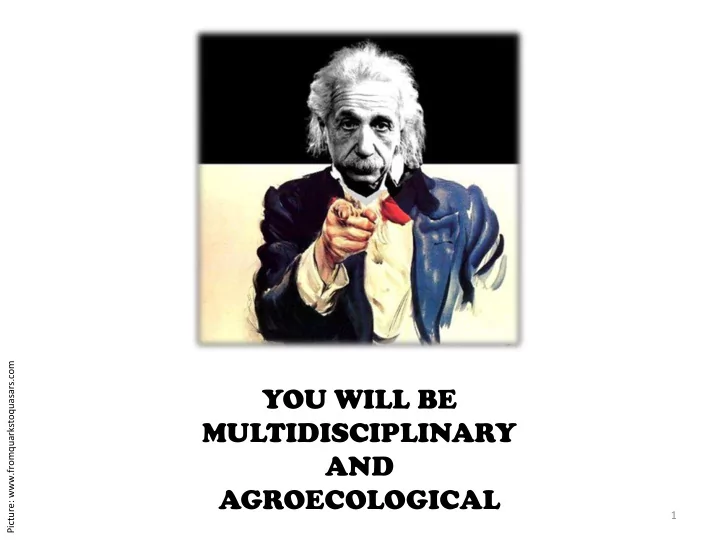
YOU WILL BE MULTIDISCIPLINARY AND AGROECOLOGICAL
Picture: www.fromquarkstoquasars.com
1
AND AGROECOLOGICAL 1 Lets write te a a But What review iew - - PowerPoint PPT Presentation
Picture: www.fromquarkstoquasars.com YOU WILL BE MULTIDISCIPLINARY AND AGROECOLOGICAL 1 Lets write te a a But What review iew paper per on on does es it it mean?? ?? Agroecolo roecology ! 2 Incorporate Agroecology within
Picture: www.fromquarkstoquasars.com
1
2
Séverin HATT, Sidonie ARTRU, Fanny BOERAEVE, David BREDART Ludivine LASSOIS, Sarah GARRE, Marc DUFRENE, Nicolas DENDONCKER, Pierre STASSART, Frédéric FRANCIS
4th BELGIAN AGROECOLOGY MEETING – BRUSSELS – 5th November 2014
3
Picture: www.trendhunter.com
► Various disciplines
(Tomich et al., 2011)
Pi cutres: S. Hatt / Google Earth / olitriathlon.fr
► Combine methods ► Cross scales
► Multiple stakeholders
(Lyon et al., 2011) (Doré et al., 2011) (Mac Millan & Benton, 2014) 4
5
Objectivism Constructivism Holism Reductionism Technocentric Ecocentric Holocentric
T1 T2 T3
(Steyeart, 2014) (Bawden, 1997)
The Earth: www.how-to-draw-funny-cartoons.com
6
2.Question our posture
methodologies?
7
Picture: PhDcomics.com
8
Translate a societal issue into a scientific problem?
T1 T2 T3
9
(Bawden, 1997)
Objectivism Contextualism Holism Reductionism Technocentric Ecocentric Holocentric
10
11
Question our posture of research?
12
Objectivism Contextualism Holism Reductionism Technocentric Ecocentric Holocentric
(Bawden, 1997)
13
14
Implications in terms of methodologies?
Pictures: S. Artru
15
Objectivism Contextualism Holism Reductionism Technocentric Ecocentric Holocentric
(Bawden, 1997)
16
Experimental design
Implications in terms of methodologies?
Pictures: S. Hatt
17
Objectivism Contextualism Holism Reductionism Technocentric Ecocentric Holocentric
( Bawden, 1997 )
18
Objectivism Contextualism Holism Reductionism Technocentric Ecocentric Holocentric
(Bawden, 1997)
19
Picture: S. Hatt
20
▪ Bawden R. (1997). The Community Challenge: The Learning Response. Presentation made at the 29th Annual International Meeting of the Community Development Society, Athens Georgia. ▪ Doré T., Makowski D., Malézieux E., Munier-Jolain N., Tchamitchian M., & Tittonell P. (2011). Facing up to the paradigm of ecological intensification in agronomy: Revisiting methods, concepts and knowledge. European Journal of Agronomy, 34 (4), p. 197–210. ▪ Lyon A., Bell M. M., Gratton C., & Jackson R. (2011). Farming without a recipe: Wisconsin graziers and new directions for agricultural science. Journal of Rural Studies, 27 (4), p. 384–393. ▪ MacMillan T., & Benton T. G. (2014). Agriculture: Engage farmers in research. Nature, 509 (7498), p. 25–27. ▪ Steyeart, P. (2014). Personal communication. ▪ Tomich T. P., Brodt S., Ferris H., Galt R., Horwath W. R., Kebreab E., Leveau J. H. J., Liptzin D., Lubell M., Merel P., Michelmore R., Rosenstock T., Scow K., Six J., Williams N., & Yang L. (2011). Agroecology: A Review from a Global-Change Perspective. Annual Review of Environment and Resources, 36 (1), p. 193–222.
21